
Chapter 1 — full chapter
Chapter 1 — full chapter
1.1 Analog vs Digital Fashion: Why Sustainability Needs a Digital Transition
Analog and digital fashion are two ways of producing knowledge about a product, not two aesthetics and not two speeds. In an analog chain a design is tested by cutting a sample, fit is tested by sewing a prototype, and demand is tested by committing a production run months before the first customer sees it, so material is spent in order to acquire information. In a digital chain each of those tests is performed on a file. Understanding what that shift does to the cost of being wrong, and therefore to the economics of producing less, is the starting point of this module.
1.1.1 The Metrics of Overproduction: What an Analog Value Chain Costs
Overproduction is an information problem before it is a moral one. In an analog value chain, the only way to learn whether a product works is to make it: a design is validated by cutting a sample, fit by sewing a prototype, a sole by cutting a mold, a color by printing a strike-off, and demand by committing a production run twelve to eighteen months before the product reaches a customer. Because knowledge about the product and its market can be acquired only by producing physical objects, the system substitutes material for information, and inventory becomes the hedge against not knowing. The aggregate cost of that substitution is documented. Roughly 100 billion garments are produced each year globally. Estimates of the sector's greenhouse gas contribution converge on a range of about 3 to 10 percent of global emissions, commonly expressed as 1.2 to 1.7 billion tonnes of CO₂e depending on system boundaries, and UNEP attributes approximately 20 percent of global industrial wastewater to textile dyeing and finishing. A synthetic garment can shed hundreds of thousands of microfibers in a single domestic wash load (Napper & Thompson, 2016). The European Environment Agency records average consumption of about 19 kg of clothing, footwear, and household textiles per person in 2022, against roughly 16 kg of textile waste generated per person per year, most of it landfilled or incinerated (European Environment Agency, 2024). Global textile waste is estimated at around 92 million tons annually, while closed-loop recycling of garments into new garments remains below 1 percent (Ellen MacArthur Foundation, 2017). Around 90 percent of production takes place in low-wage economies, where labor conditions are verified through periodic physical audits: an analog information channel with a low sampling frequency and a well-documented falsification problem.
Digitalization intervenes at each of these validation steps, and the transition is best read step by step rather than as a slogan. Virtual prototyping replaces the physical sample with a simulation parameterized by measured material behavior, removing the cost, the lead time, and the air freight of the sampling loop (Chapter 3). Digital fit assessment replaces the fit session with parametric avatars and iterative simulation (Chapter 3). Digital printing and additive manufacturing remove tooling and setup, decoupling unit economics from batch size and making a series of one economically comparable to a series of ten thousand (Chapter 4). Data-driven demand estimation moves the moment of commitment downstream, from a seasonal forecast to an actual order, which is the structural definition of on-demand production (Chapters 4 and 5). Traceability infrastructure, from GS1 Digital Link identifiers to the Digital Product Passport mandated under the ESPR, replaces declarative transparency with machine-readable and independently verifiable evidence (Chapter 6). In each case, the same operation is performed, but on a file rather than on matter, and the marginal cost of performing it again approaches zero.
Read this way, fast and slow fashion are consequences rather than causes, and both are historically analog systems. Fast fashion is the analog regime optimized for throughput: it accepts a high forecasting error rate and absorbs it through markdown, outlet channels, and the destruction of unsold stock, because at sufficient volume the cost of error is lower than the cost of accuracy. Slow fashion is the analog regime optimized for durability, and it has remained a niche of conviction precisely because short series in an analog cost structure carry the full fixed burden of sampling, tooling and minimum order quantities. Digitalization doesn't change the ethics; it changes the cost curve: it converts the fixed costs of an analog information loop into variable, near-zero marginal costs, so short series, local manufacturing, and long product lifetimes become economically defensible rather than ethically exceptional.
The regulatory and market context is accelerating. Ultra-fast-fashion platforms shipping directly from Asian factories now move over 5.8 million low-value parcels into the EU every day; in response, the EU agreed to abolish the €150 duty-free exemption and apply a €3 handling fee on small parcels from mid-2026, while France adopted the first national ultra-fast-fashion law, introducing an eco-modulation fee per item that can reach €20 by 2030 (WWD, 2026; Ecotextile News, 2025; The Conversation, 2026).
1.1.2 The Designer's Digital Journey
This module follows one idea: a garment concept travels through a sequence of digital states before, and sometimes instead of, becoming a physical object. It begins as a moodboard, then becomes AI-assisted concept images, a 3D prototype, a virtual fabric, a digital sample, a tech pack, a virtual fit on an avatar, production data, and finally use-phase data that flows back into the next design. At every state the garment exists as a file rather than as material, so iterations cost time and electricity instead of fabric, samples and shipping. The six chapters follow exactly this journey, from the first idea to the last data point, keep one garment idea in mind as you work through the module and carry it through every stage.
Chapters at a glance: Ch1, map the journey · Ch2, ideate: AI-assisted concepts and 3D prototypes · Ch3, create: virtual fabrics, digital samples and fit · Ch4, make: digital manufacturing and on-demand production · Ch5, decide: forecasts, material choice and data-driven decisions · Ch6, measure and connect: impact data, traceability and circularity.
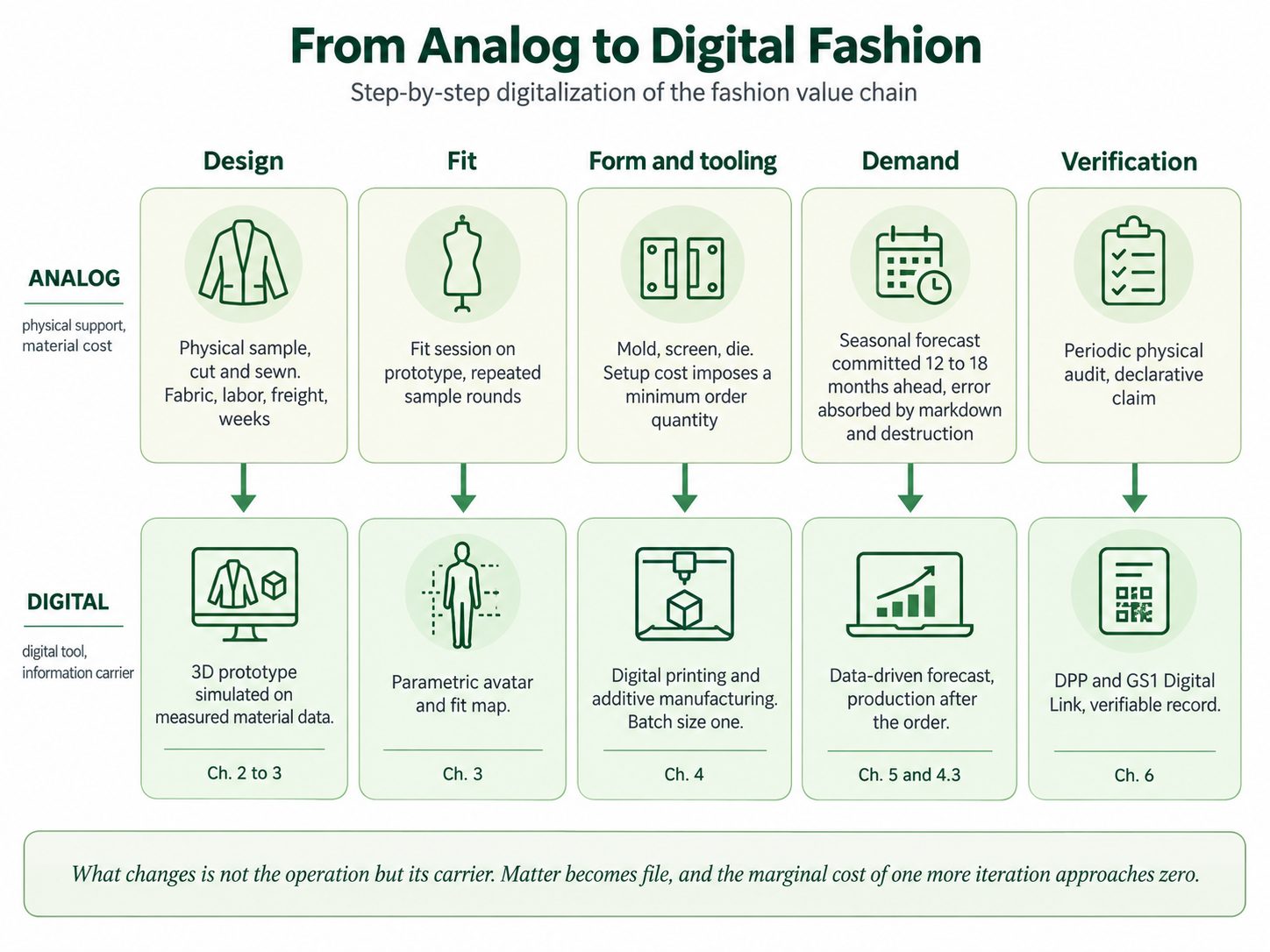
Figure 1.1, From analog to digital validation: every decision that an analog value chain tests on physical objects, sample, fit, tooling, forecast and audit, moves onto a file, and the cost of iterating it falls toward zero. (Source: course material)