Chapter 1 — full chapter
| Site: | FashionKIC Learning Platform |
| Course: | Digital Tools and AI for Sustainable Fashion |
| Book: | Chapter 1 — full chapter |
| Printed by: | Guest user |
| Date: | Sunday, 1 November 2026, 3:20 AM |
1.1 Analog vs Digital Fashion: Why Sustainability Needs a Digital Transition
Analog and digital fashion are two ways of producing knowledge about a product, not two aesthetics and not two speeds. In an analog chain a design is tested by cutting a sample, fit is tested by sewing a prototype, and demand is tested by committing a production run months before the first customer sees it, so material is spent in order to acquire information. In a digital chain each of those tests is performed on a file. Understanding what that shift does to the cost of being wrong, and therefore to the economics of producing less, is the starting point of this module.
1.1.1 The Metrics of Overproduction: What an Analog Value Chain Costs
Overproduction is an information problem before it is a moral one. In an analog value chain, the only way to learn whether a product works is to make it: a design is validated by cutting a sample, fit by sewing a prototype, a sole by cutting a mold, a color by printing a strike-off, and demand by committing a production run twelve to eighteen months before the product reaches a customer. Because knowledge about the product and its market can be acquired only by producing physical objects, the system substitutes material for information, and inventory becomes the hedge against not knowing. The aggregate cost of that substitution is documented. Roughly 100 billion garments are produced each year globally. Estimates of the sector's greenhouse gas contribution converge on a range of about 3 to 10 percent of global emissions, commonly expressed as 1.2 to 1.7 billion tonnes of CO₂e depending on system boundaries, and UNEP attributes approximately 20 percent of global industrial wastewater to textile dyeing and finishing. A synthetic garment can shed hundreds of thousands of microfibers in a single domestic wash load (Napper & Thompson, 2016). The European Environment Agency records average consumption of about 19 kg of clothing, footwear, and household textiles per person in 2022, against roughly 16 kg of textile waste generated per person per year, most of it landfilled or incinerated (European Environment Agency, 2024). Global textile waste is estimated at around 92 million tons annually, while closed-loop recycling of garments into new garments remains below 1 percent (Ellen MacArthur Foundation, 2017). Around 90 percent of production takes place in low-wage economies, where labor conditions are verified through periodic physical audits: an analog information channel with a low sampling frequency and a well-documented falsification problem.
Digitalization intervenes at each of these validation steps, and the transition is best read step by step rather than as a slogan. Virtual prototyping replaces the physical sample with a simulation parameterized by measured material behavior, removing the cost, the lead time, and the air freight of the sampling loop (Chapter 3). Digital fit assessment replaces the fit session with parametric avatars and iterative simulation (Chapter 3). Digital printing and additive manufacturing remove tooling and setup, decoupling unit economics from batch size and making a series of one economically comparable to a series of ten thousand (Chapter 4). Data-driven demand estimation moves the moment of commitment downstream, from a seasonal forecast to an actual order, which is the structural definition of on-demand production (Chapters 4 and 5). Traceability infrastructure, from GS1 Digital Link identifiers to the Digital Product Passport mandated under the ESPR, replaces declarative transparency with machine-readable and independently verifiable evidence (Chapter 6). In each case, the same operation is performed, but on a file rather than on matter, and the marginal cost of performing it again approaches zero.
Read this way, fast and slow fashion are consequences rather than causes, and both are historically analog systems. Fast fashion is the analog regime optimized for throughput: it accepts a high forecasting error rate and absorbs it through markdown, outlet channels, and the destruction of unsold stock, because at sufficient volume the cost of error is lower than the cost of accuracy. Slow fashion is the analog regime optimized for durability, and it has remained a niche of conviction precisely because short series in an analog cost structure carry the full fixed burden of sampling, tooling and minimum order quantities. Digitalization doesn't change the ethics; it changes the cost curve: it converts the fixed costs of an analog information loop into variable, near-zero marginal costs, so short series, local manufacturing, and long product lifetimes become economically defensible rather than ethically exceptional.
The regulatory and market context is accelerating. Ultra-fast-fashion platforms shipping directly from Asian factories now move over 5.8 million low-value parcels into the EU every day; in response, the EU agreed to abolish the €150 duty-free exemption and apply a €3 handling fee on small parcels from mid-2026, while France adopted the first national ultra-fast-fashion law, introducing an eco-modulation fee per item that can reach €20 by 2030 (WWD, 2026; Ecotextile News, 2025; The Conversation, 2026).
1.1.2 The Designer's Digital Journey
This module follows one idea: a garment concept travels through a sequence of digital states before, and sometimes instead of, becoming a physical object. It begins as a moodboard, then becomes AI-assisted concept images, a 3D prototype, a virtual fabric, a digital sample, a tech pack, a virtual fit on an avatar, production data, and finally use-phase data that flows back into the next design. At every state the garment exists as a file rather than as material, so iterations cost time and electricity instead of fabric, samples and shipping. The six chapters follow exactly this journey, from the first idea to the last data point, keep one garment idea in mind as you work through the module and carry it through every stage.
Chapters at a glance: Ch1, map the journey · Ch2, ideate: AI-assisted concepts and 3D prototypes · Ch3, create: virtual fabrics, digital samples and fit · Ch4, make: digital manufacturing and on-demand production · Ch5, decide: forecasts, material choice and data-driven decisions · Ch6, measure and connect: impact data, traceability and circularity.
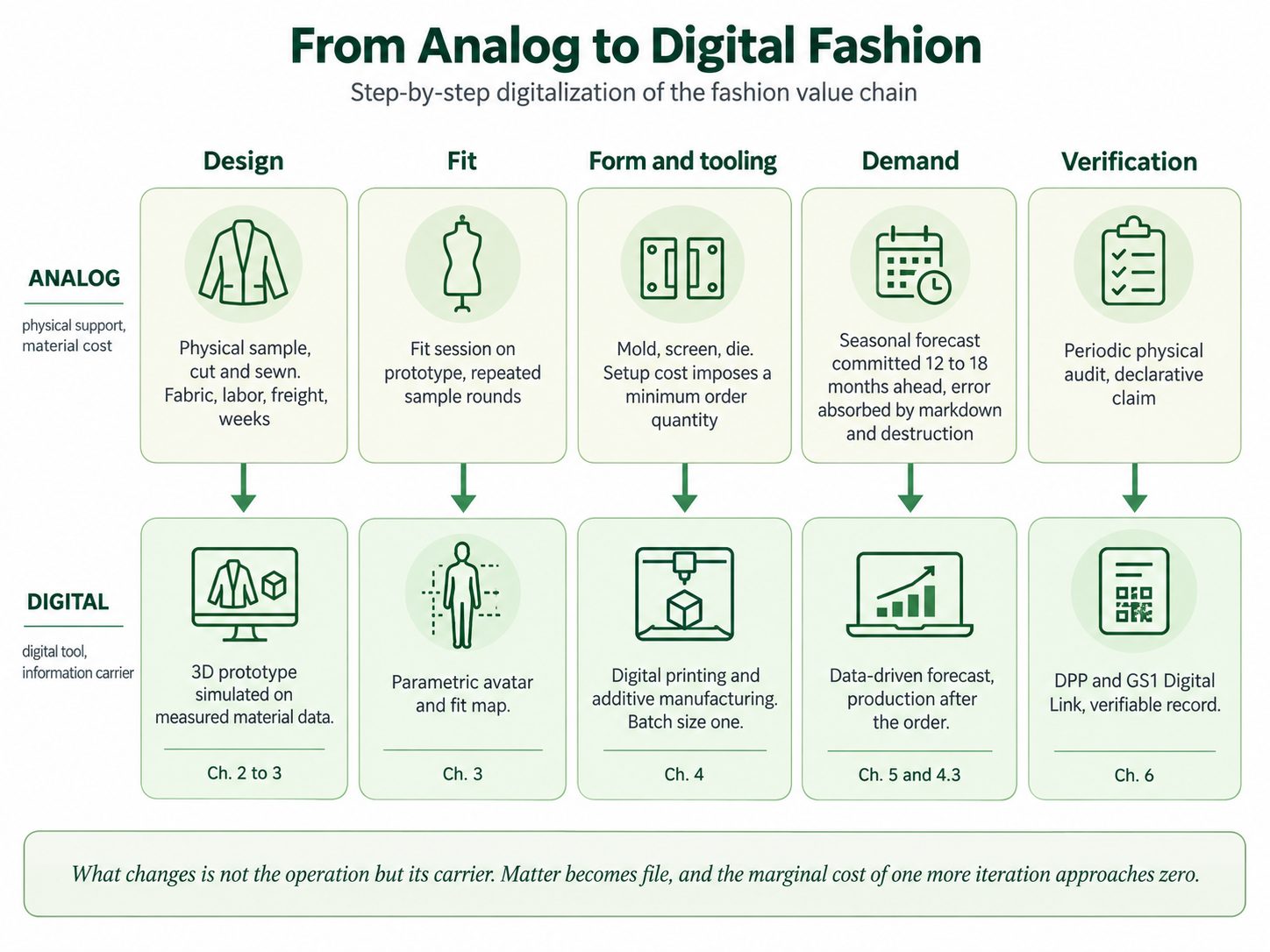
Figure 1.1, From analog to digital validation: every decision that an analog value chain tests on physical objects, sample, fit, tooling, forecast and audit, moves onto a file, and the cost of iterating it falls toward zero. (Source: course material)
1.2 Digitalization across the value chain
Reducing the impact of a fashion product requires knowing where the impact occurs in its life. This section maps the value chain stage by stage and locates the digital intervention points that the rest of the module develops.
1.2.1 Five Stages from Fiber to End-of-Life
The fashion product life cycle runs through five macro-stages, and holistic sustainability requires optimizing all of them rather than shifting burdens from one to another.
Stage 1, raw materials and design: decisions made here determine up to 80% of a product's environmental impact. Fiber choice (natural, synthetic, regenerated, each with a distinct impact profile), construction quality, mono-materiality, repairability and zero-waste pattern cutting are all locked in at the design table; the digital tools of Chapters 2 and 3 (3D design, parametric modeling, virtual sampling) operate here.
Stage 2, manufacturing and processing: the most energy- and chemical-intensive stage; dyeing alone can account for up to 20% of global industrial water pollution, and 15–20% of fabric is typically lost as cutting waste. Digital printing, automated cutting, and AI process optimization come into play here.
Stage 3, transportation and distribution: products often cross continents multiple times; logistics emissions depend on modal choices (air freight being the most carbon-intensive) and on the accuracy of demand planning.
Stage 4, use: around one-third of a garment's total impact can occur in households through washing and drying; durability and care information (communicated via the Digital Product Passport) act here.
Stage 5, end-of-life: garments are often discarded after only 7–10 uses, and roughly 85% of textile waste ends up in landfill or incineration; collection, sorting and recycling technologies close the loop. Reading the chain this way turns "sustainability" from a generic aspiration into an engineering discipline: each stage has measurable flows (materials, energy, water, emissions, data), and each flow has a digital tool that makes it visible and improvable. The chapters of this module are, in effect, a tour of this map.
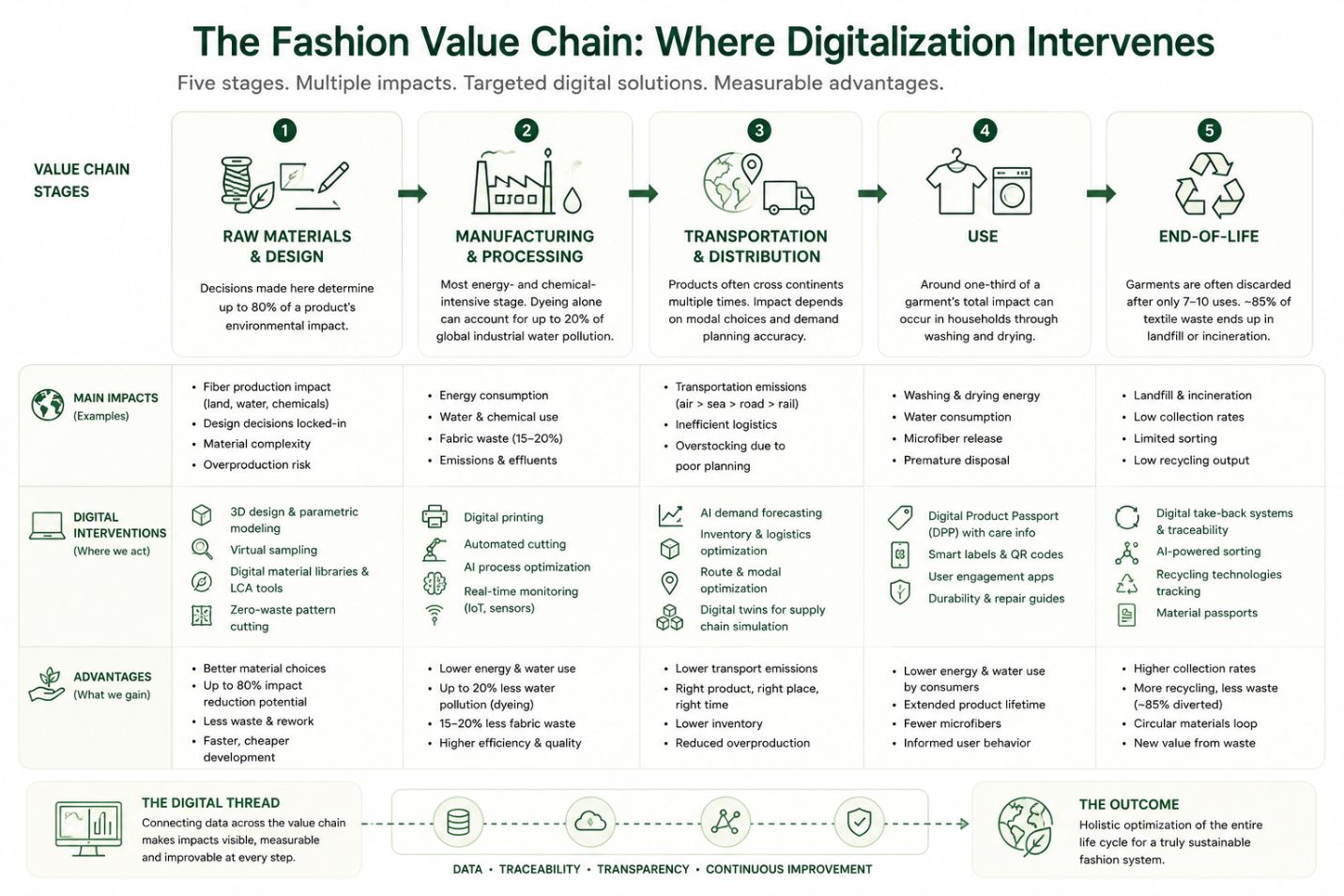
Figure 1.2, The fashion value chain and where digitalization intervenes: five stages from raw materials to end-of-life, each with its impacts, digital interventions and advantages.
1.2.2 The digitalization ladder
Digitalization is rarely adopted as a program. Companies adopt it one step at a time, and the order is not a matter of preference because each step consumes the data the previous one produces. A company that buys a traceability platform before it has a digital tech pack will populate that platform by hand, and a company that buys forecasting software before it has structured sell-through data will forecast noise. The ladder below sequences the six chapters of this module as an adoption path, ordered by prerequisite rather than by cost or ambition.
The first rung is design, where vector drawing and 3D modeling replace manual technical drawing and the ambiguity of a hand-annotated tech pack. It has no prerequisite, which is why it is the entry point, and it is developed in Chapter 2. The second rung is prototype: once a digital pattern and measured material data exist, garment simulation replaces sample rounds and the shipping that goes with them (Chapter 3). The third is produce, where digital printing, additive manufacturing and made-to-order flows replace tooling, setup costs and forecast-driven batches, which becomes possible only when a production-ready file and an approved digital sample already exist (Chapter 4). The fourth is measure, where structured sell-through and bill-of-material data allow demand forecasting and footprint calculation to replace experience-based planning and estimated impacts (Chapter 5). The fifth is trace, where item-level identifiers and the Digital Product Passport replace declarative claims verified by periodic audit, and where the supplier and composition data are assembled at the previous rung (Chapter 6). The sixth is circular, where resale, repair, rental and fiber-to-fiber recycling become operable once the product carries an identity that survives its first sale (Chapter 6).
To locate a company on this ladder, the useful question is not which software it owns, but which decisions it still makes about physical objects. A studio that still cuts four sample rounds per style stands on the first rung, whatever licenses it holds. The practical rule for an SME is to climb one rung rather than six, because the return on the first rung above the current position is almost always higher than the return on a full-stack adoption: each rung generates the data the next one needs, and a skipped rung produces an expensive system fed by manual data entry.
The digitalization ladder is not the compliance ladder of section 1.3, and the two should not be confused. The compliance ladder is ordered by regulatory deadline, so it can demand a rung the company has not yet reached: an SME may be required to publish structured product data before it has digitalized its design process. Where the two conflict, the obligation sets the date and the ladder sets the least wasteful way to meet it, which is normally to build the missing rung rather than buy a system that compensates for its absence.
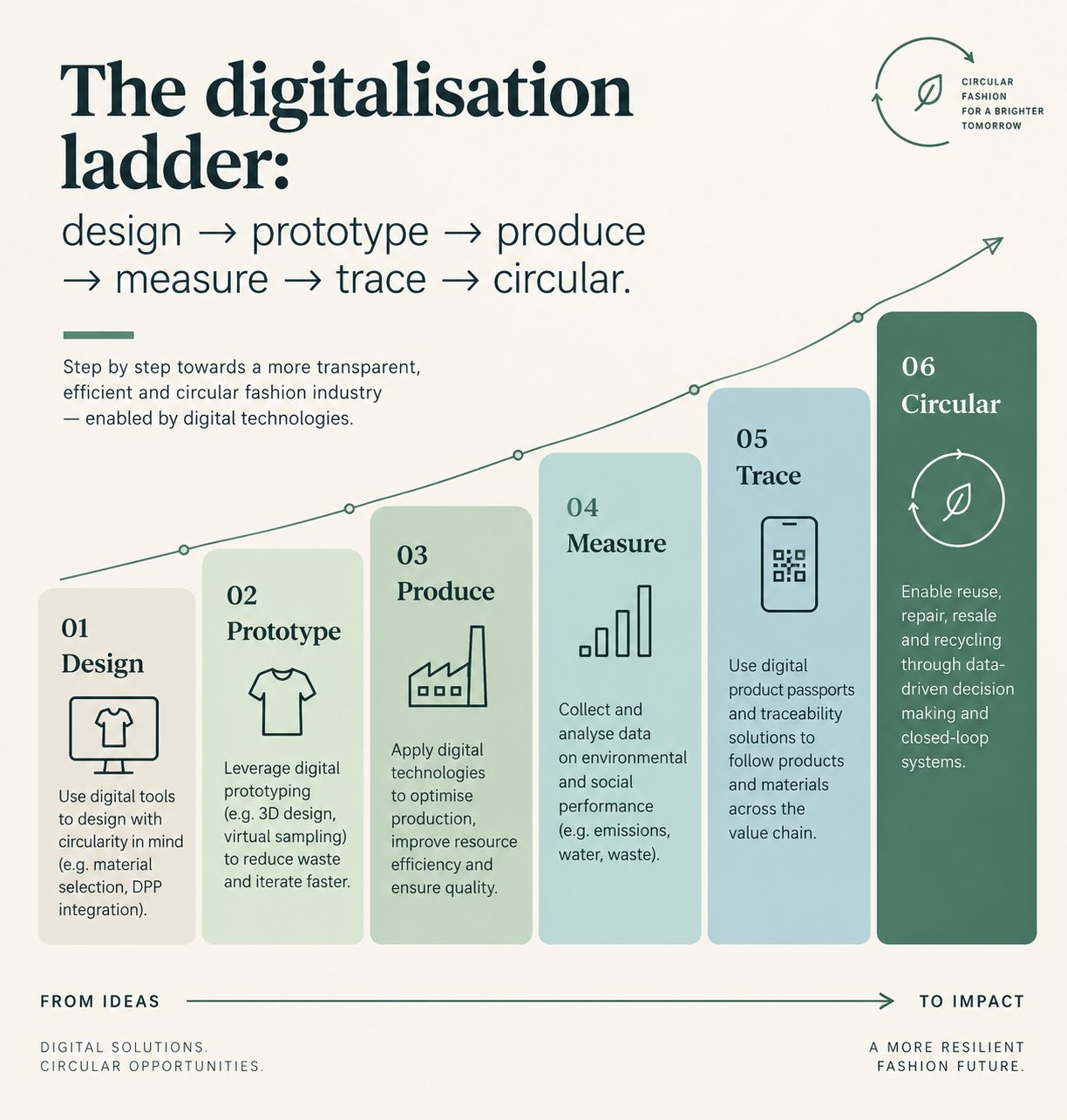
Figure 1.3, The Digitalization ladder shows the essential step to transition to digital production.
The technologies in this module belong to two overlapping industrial paradigms. Industry 4.0 supplies the digital infrastructure; Industry 5.0 redefines what it is for. This section distinguishes the two and previews the toolbox.
From the designer's chair, Industry 4.0 and 5.0 are not policy concepts but descriptions of daily work: 4.0 supplies the tools, 3D software, data pipelines, AI, and 5.0 reminds us who they serve. The human stays in the loop: the designer sets the brief, judges the AI output, makes the fit and material decisions, and takes responsibility for the result. Human-centered AI in fashion means the machine proposes and the designer disposes, prompt, critique, iterate. The rest of this module is the practical version of that idea: every chapter shows a digital tool taking over a task that used to be manual, and the designer deciding whether the result is good enough.
Industry 4.0, the fourth industrial revolution, is the integration of cyber-physical systems, the Internet of Things (IoT), cloud computing, big data analytics and AI into manufacturing and supply chains. Applied to fashion, it delivers end-to-end visibility (RFID and IoT sensors tracking materials and garments in real time), vertical and horizontal integration (data flowing from ERP through MES to shop-floor machines, and across supply chain partners), predictive analytics (demand forecasting, predictive maintenance, automated replenishment) and real-time decision support. Its limitation is its own optimization target: efficiency. Systems tuned only for speed and cost become brittle under disruption and blind to social and environmental externalities.
Industry 5.0, formally introduced by the European Commission (Breque, De Nul & Petridis, 2021), keeps the same technological stack but reorients it around three priorities: human-centricity (AI that augments rather than replaces human judgement, with workers' knowledge integrated into planning), resilience (redundancy, flexibility and stress-testing valued alongside efficiency) and sustainability (environmental and social metrics, carbon, water, waste, labour, tracked as first-class KPIs next to cost and speed, with circular flows such as take-back, repair and recycling integrated into core operations rather than treated as afterthoughts). For the TCLF sector this distinction is practical, not philosophical: the same RFID tag that optimizes inventory in an I4.0 reading becomes, in an I5.0 reading, the data carrier of a Digital Product Passport enabling reuse and recycling. The remaining chapters of this module can be read as the I5.0 toolbox in action: design tools that reduce impact before production, manufacturing technologies that produce on demand, analytics that measure and report, and traceability that closes the loop.
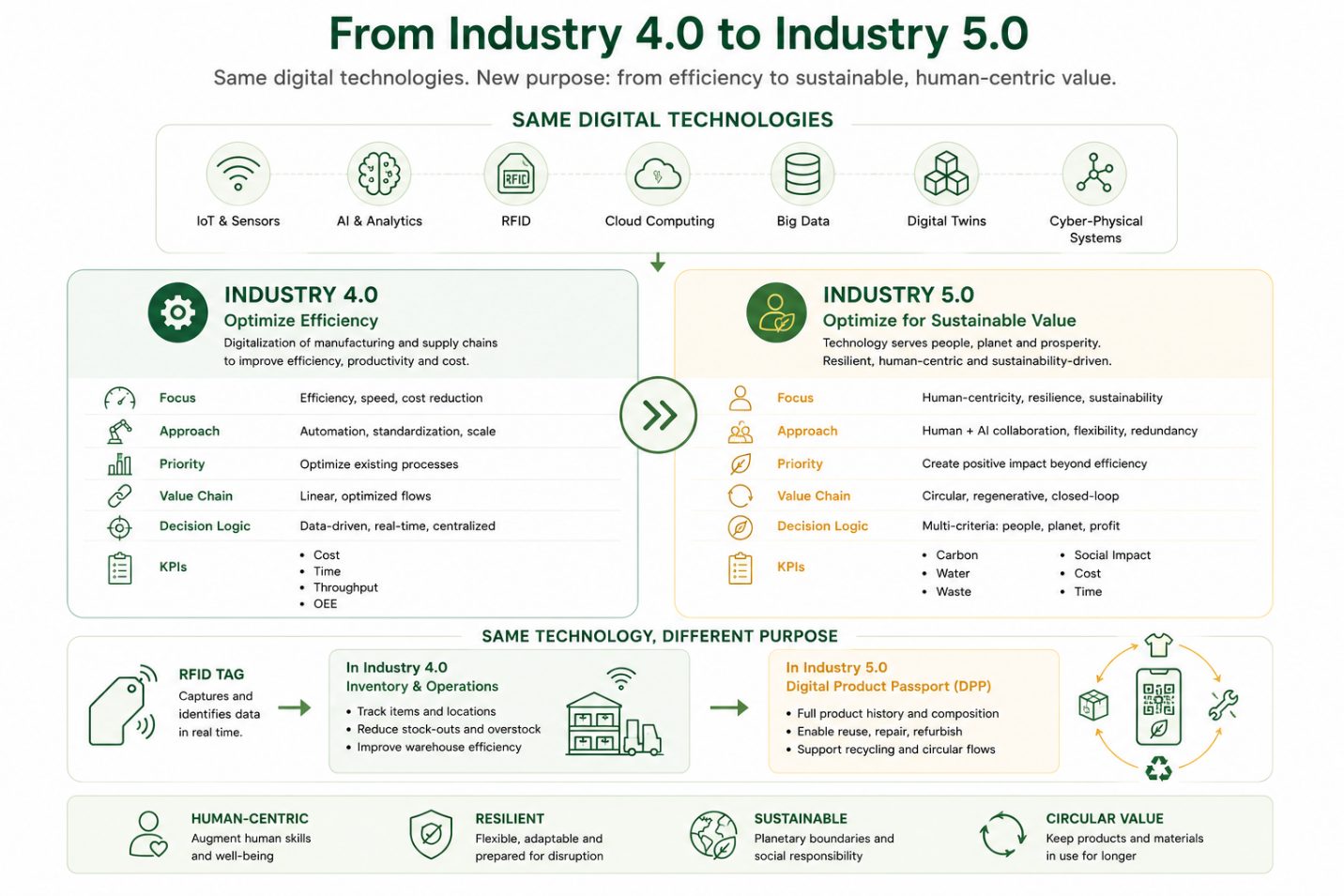
Figure 1.4, From Industry 4.0 to Industry 5.0: the same digital technologies redirected from efficiency toward sustainable, human-centric value.
1.3 The EU Policy Push: Green Deal, ESPR, Textile Strategy
Regulation is the strongest driver of digitalization in European fashion. This section summarizes the EU policy architecture and translates it into concrete product and data requirements.
POLICY CONTEXT: EU rules for textiles are tightening: the Ecodesign for Sustainable Products Regulation (ESPR) brings the Digital Product Passport, and Directive (EU) 2025/1892 extends Extended Producer Responsibility (EPR) to textiles. Large companies face the first binding dates now (unsold-goods destruction ban from July 2026); SMEs feel the pressure from 2027–2028, as customers and platforms request product data.
The detail is taught withing the other FashionKIC modules: Circular Design Strategies, the Digital Product Passports, the Sustainable Materials and Processes, and the Sustainability Communication and Marketing modules. For this module, policy is context: build the digital workflow now, the data you will need is a by-product of it.
1.3.1 Compliance Arrives on a Schedule: The Order of EU Obligations
Regulation arrives on its own schedule, not on the company's. Section 1.2.2 ordered digital adoption by prerequisite; compliance is ordered by date, and the two sequences do not coincide. For a TCLF SME the obligations nonetheless arrive in a recognizable order, and each of them consumes data produced by the one before it.
The first is already binding on large companies: from 19 July 2026 the ESPR prohibits the destruction of unsold clothing and footwear. Smaller companies are exempt for longer, but the effect reaches them through customers who can no longer treat destruction as a planning safety valve. The second is knowing the product, which means a reliable bill of materials, fiber composition per component, and a supplier list resolved to facility level. No instrument names this as an obligation in its own right, which is why it is the step most often skipped, and yet every subsequent requirement consumes it. The third is publishing a basic product record, typically a QR page carrying composition, origin, care and end-of-life information assembled from data the company already holds. It costs days rather than months, and it is the rehearsal for the passport that follows. The fourth is Extended Producer Responsibility: Directive (EU) 2025/1892 requires Member States to operate functioning textile EPR schemes by April 2028, with fees eco-modulated according to durability, recyclability and design, so that product decisions begin to carry a direct financial signal. The fifth is substantiating environmental claims by a recognized method rather than by self-declaration, for which the PEFCR for Apparel and Footwear v3.1, approved in May 2025, is the reference. The sixth is full conformity with the Digital Product Passport once the ESPR delegated act for textiles applies.
On that last point one distinction is worth holding precisely. The delegated act for textiles is indicatively targeted for adoption in 2027, while application is expected around 2029. Adoption is not application. Planning against the earlier date and budgeting against the later one is the posture that avoids both unpreparedness and premature investment in infrastructure whose requirements are not yet fixed.
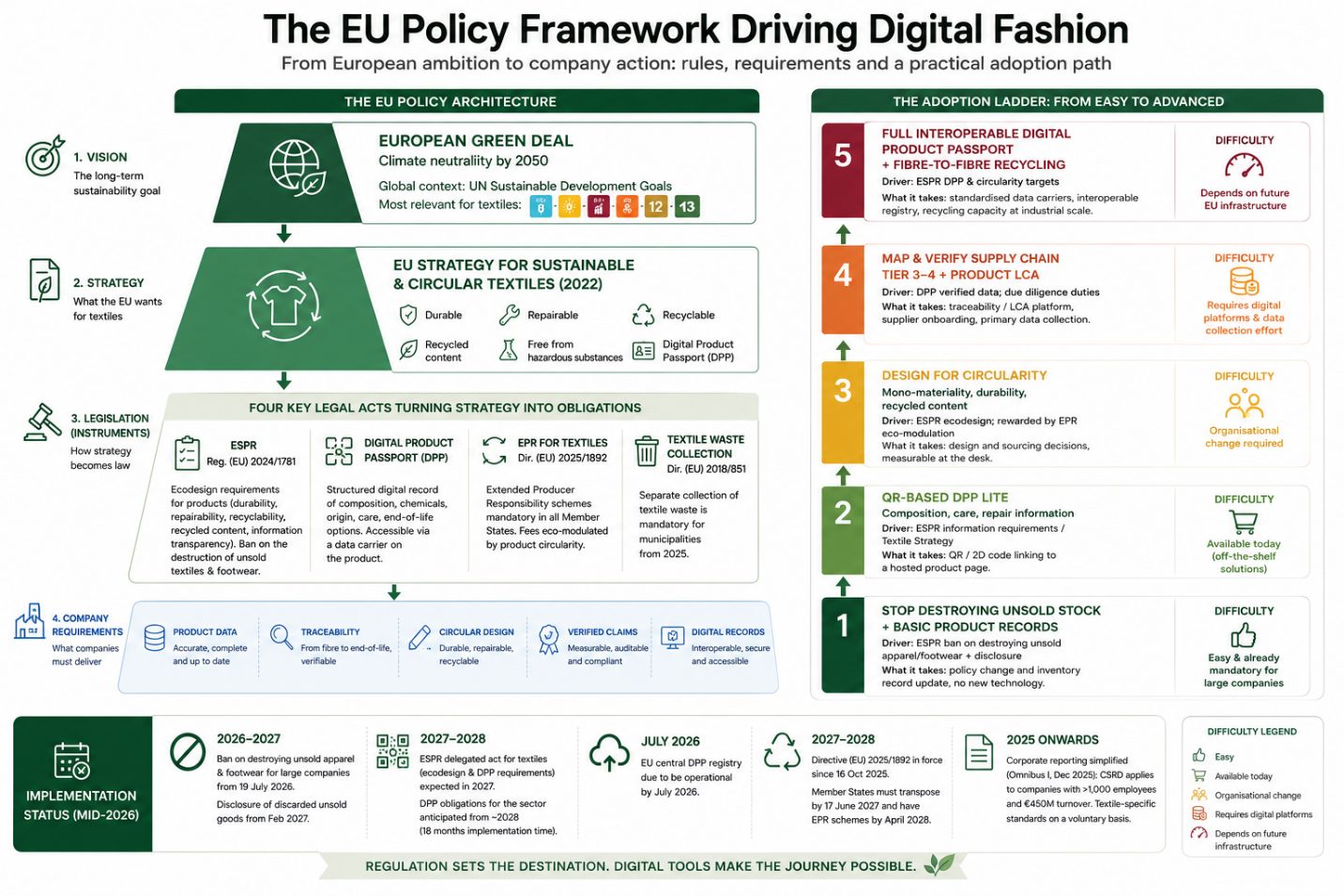
Figure 1.5, The EU policy framework driving digital fashion: from the Green Deal and the Textile Strategy to the ESPR, the Digital Product Passport and EPR, with a practical adoption ladder from easy to advanced.
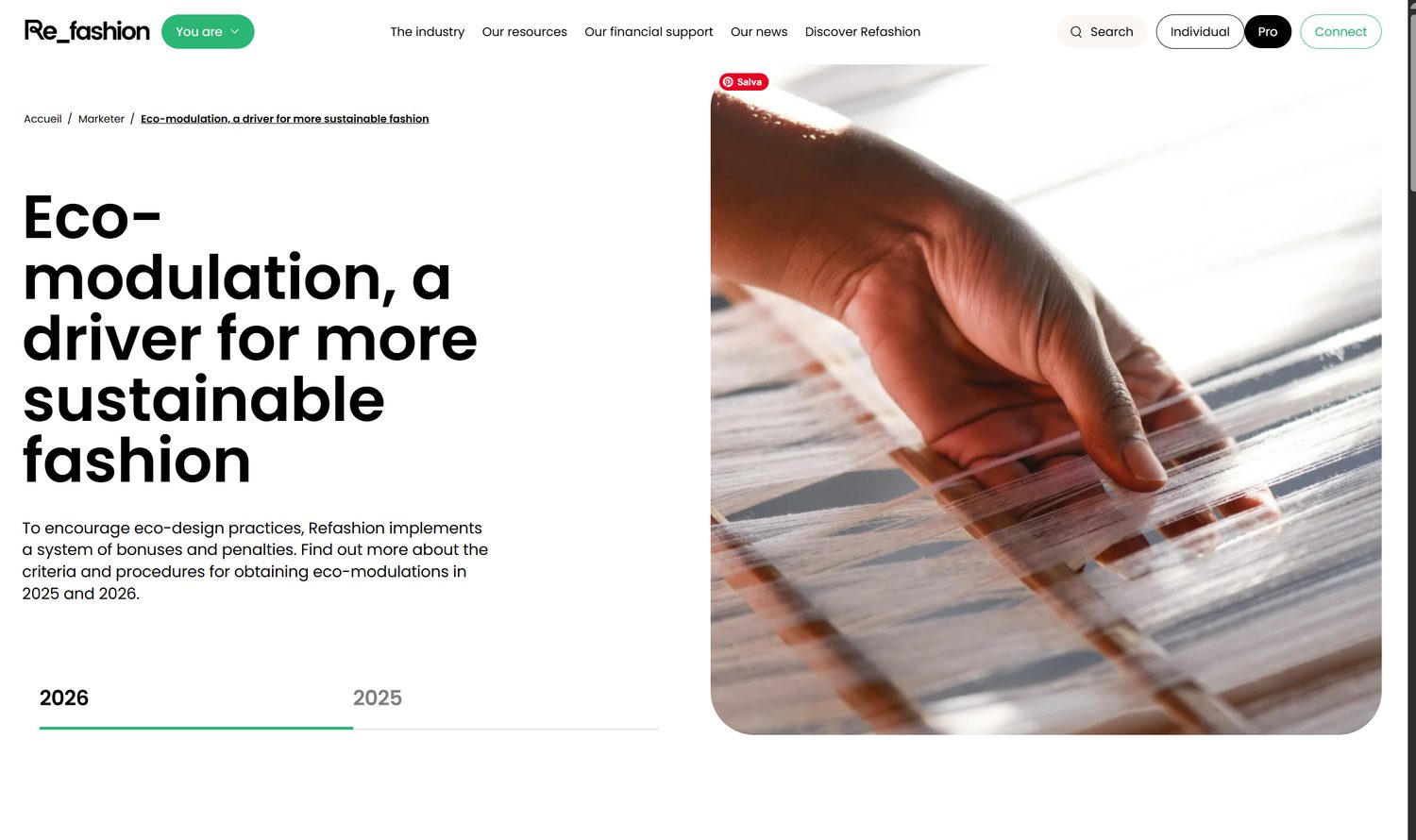
Figure 1.6, Refashion's eco-modulation: bonuses and penalties applied to the eco-fee reward durable, recyclable and eco-designed products. (Source: refashion.fr)
1.4 Case example: Fairly Made, mapping the value chain as a service
Fairly Made[21], a Paris-based traceability and impact platform, demonstrates how the value-chain map in this section serves as an operational tool rather than a diagram. Instead of a single brand publishing its own footprint, Fairly Made digitalizes the chain for many brands at once: it connects each tier, from fiber and spinning through weaving, dyeing, and confection, and structures the resulting data at the product and batch levels, the exact granularity the EU Digital Product Passport will require. On that traceability backbone, the platform runs a life-cycle assessment for every SKU, returning CO₂, water and energy metrics alongside social and recyclability scores, which brands can then surface to consumers as a per-product data statement. By 2025, the service reported more than 100 brands across some 15 countries, over 30,000 connected factories and more than 100,000 LCAs computed on the platform, figures that illustrate how "mapping the value chain from fiber to end-of-life" scales from a conceptual model to shared digital infrastructure (Fairly Made, fairlymade.com; Tech Geography, 2024). The case makes the section's core point concrete: sustainability stops being a claim and becomes a number only when the whole chain is instrumented, and that instrumentation is increasingly bought as a service rather than built in-house.
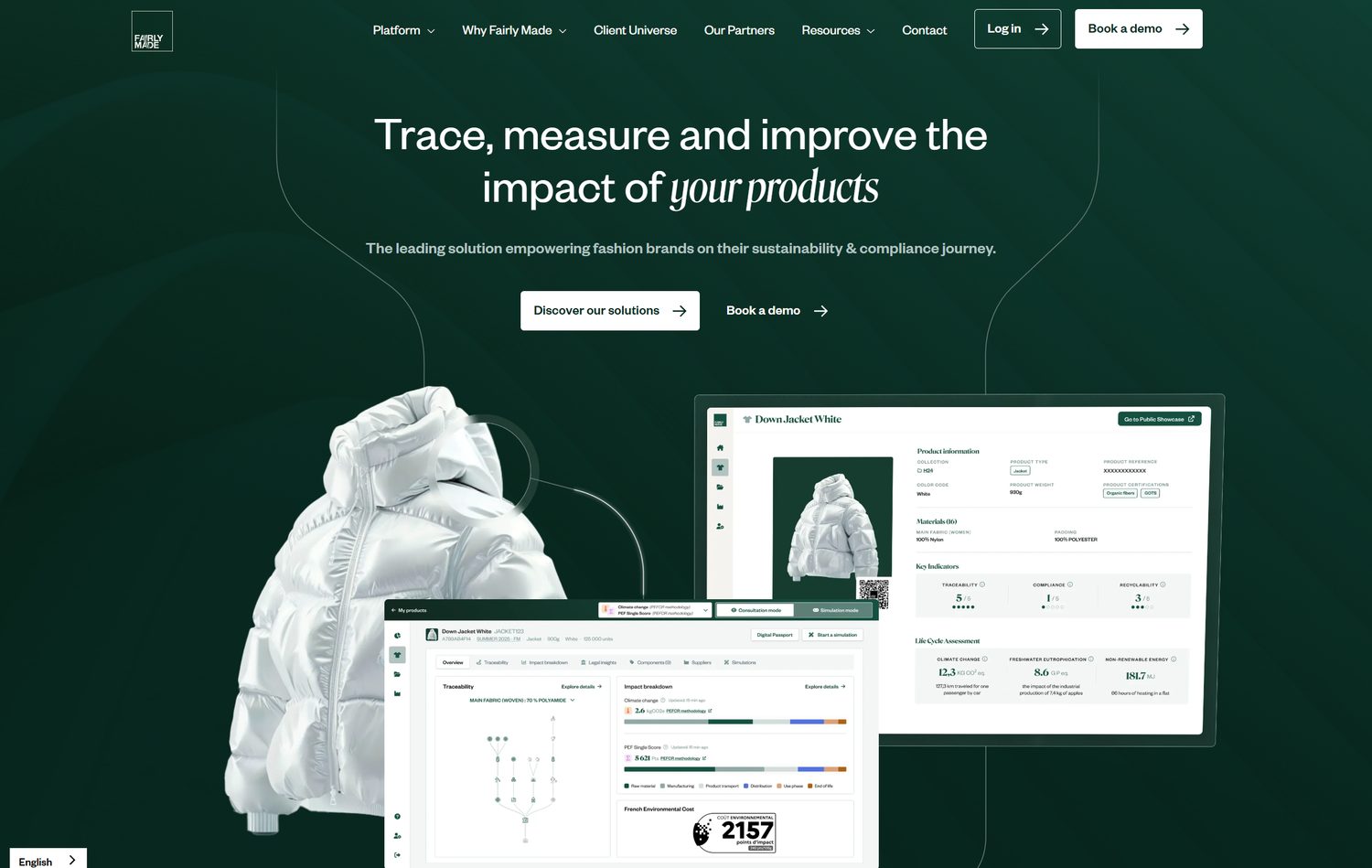
Figure 1.7, Fairly Made's platform links each supply-chain tier to product-level impact data (CO₂, water, recyclability), anticipating the data structure of the EU Digital Product Passport. (Source: fairlymade.com)
TOOLS AND FRAMEWORKS
Policy frame. EU Green Deal; UN Sustainable Development Goals (SDGs); EU Strategy for Sustainable and Circular Textiles (2022).
Product law. Regulation (EU) 2024/1781 (ESPR), which introduces the Digital Product Passport (DPP); Directive (EU) 2024/825 on empowering consumers for the green transition, which restricts generic environmental claims and unverified sustainability labels.
Waste and producer responsibility. Directive 2008/98/EC and its waste hierarchy; Directive (EU) 2018/851, which requires separate collection of textiles; Directive (EU) 2025/1892, which extends Extended Producer Responsibility to textiles; at national level, the French AGEC law and the Refashion eco-modulation shown in Figure 1.6.
Reporting and measurement. CSRD and the ESRS, in particular ESRS E5 on resource use and circular economy; the Product Environmental Footprint method and the PEFCR for Apparel and Footwear v3.1; ISO 14040 and ISO 14044 for life cycle assessment.
Design frameworks. The waste hierarchy read as a design ranking; the 5R framework: Refuse, Reduce, Reuse, Repurpose, Recycle.
Industrial paradigms and enabling technologies. Industry 4.0 and Industry 5.0 (European Commission); IoT, RFID, cloud computing and big data analytics; GS1 identifiers, GTIN and GS1 Digital Link carried by a QR code, which are what make a product record machine-readable rather than declarative.
Voluntary standards an SME can adopt before the obligations arrive. Textile Exchange standards (GRS, RCS, OCS) for recycled and organic content; OEKO-TEX and bluesign for chemical management. None of them satisfies a legal requirement on its own, but each produces the supplier and composition data that the obligations in section 1.3.1 consume.