
Chapter 2 — full chapter
Chapter 2 — full chapter
2.3 Biomimicry: Learning from Living Systems
Biomimicry studies how living organisms and ecosystems perform functions and translates those strategies into design. It can investigate how nature creates colour, regulates temperature, constructs lightweight structures, adapts to changing conditions, uses local resources or circulates materials.
This differs from simply reproducing the appearance of nature. A fabric printed with leaves is nature-inspired, but it is not necessarily biomimetic. Biomimicry focuses on understanding and emulating the function, process or system behind a biological strategy. Biomimicry Institute — Biomimicry Toolbox
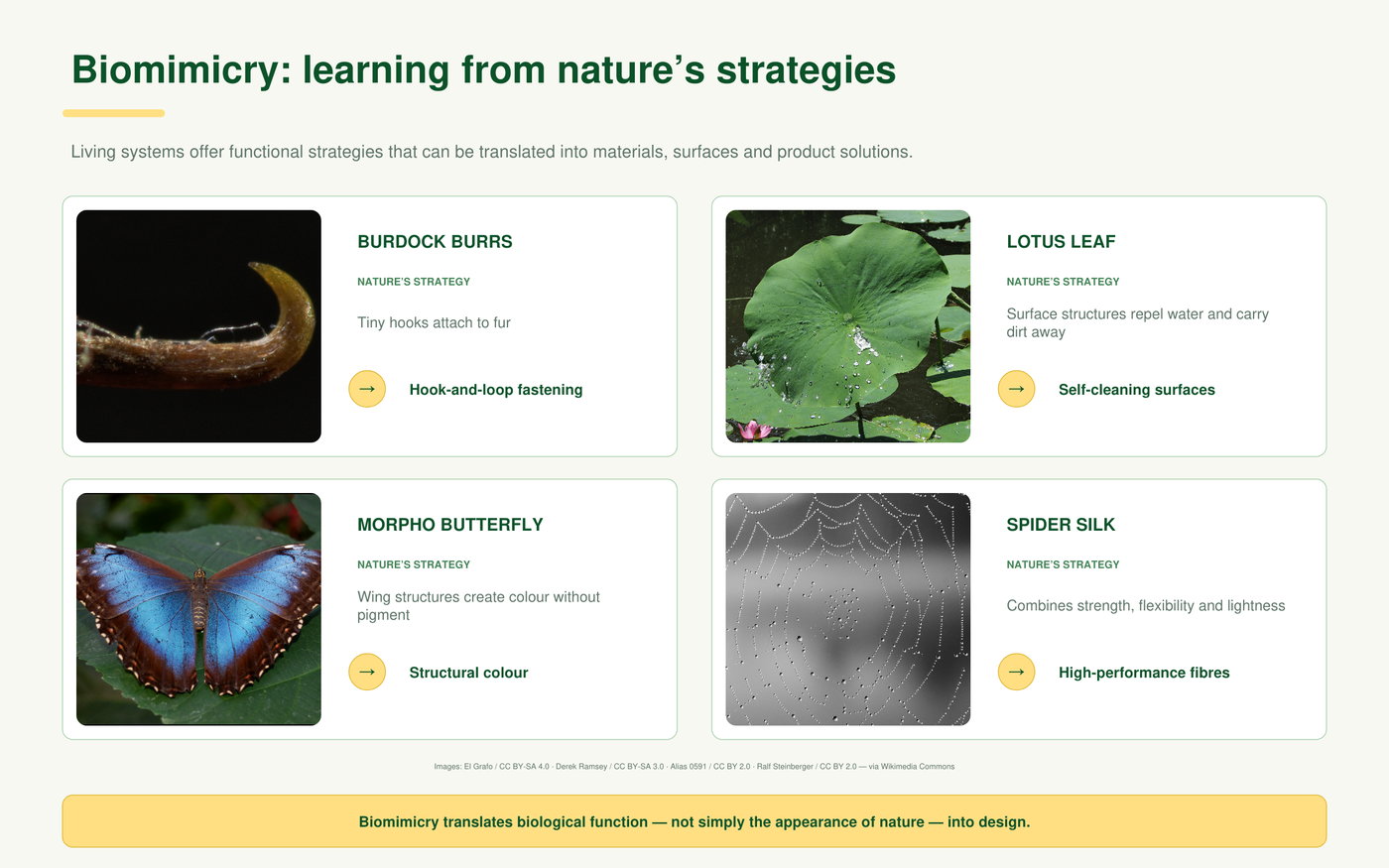
Figure 15. Biomimicry translates strategies found in living systems into design solutions. Burdock burrs inspired hook-and-loop fastening; lotus leaves inform self-cleaning surfaces; butterfly wings demonstrate structural colour; and spider silk inspires strong, lightweight and flexible fibres. Biological inspiration does not automatically make a product sustainable: its materials, production impacts and future circulation must still be evaluated.
In fashion, biomimicry can influence silhouette, surface, structure, movement, material development and manufacturing. However, biological inspiration is not evidence of circularity. The resulting product must still be assessed in relation to material safety, durability, production impacts and future recovery.