
Chapter 3 — Full chapter
Chapter 3 — Full chapter
3.2 Stakeholder information needs and evidence levels
Once a circular initiative has passed the legal, specificity and substantiation checks introduced in Chapters 1 and 2, the verified information must be organised for different stakeholders.
Stakeholders may require different levels of detail, formats, and contexts, depending on the decision they need to make or the action they are expected to take. A supplier may need technical specifications and quality requirements. A customer may need practical information about how to access a repair service. A retailer may need approved product information and supporting documentation. A policymaker may need aggregated results and information about broader policy relevance.
Adapting communication does not mean creating different versions of the truth. The verified meaning, scope, and relevant qualifications must remain consistent across audiences and channels.
The communication task is therefore to identify what each stakeholder needs to know and why they need it, while keeping the underlying evidence and meaning consistent.
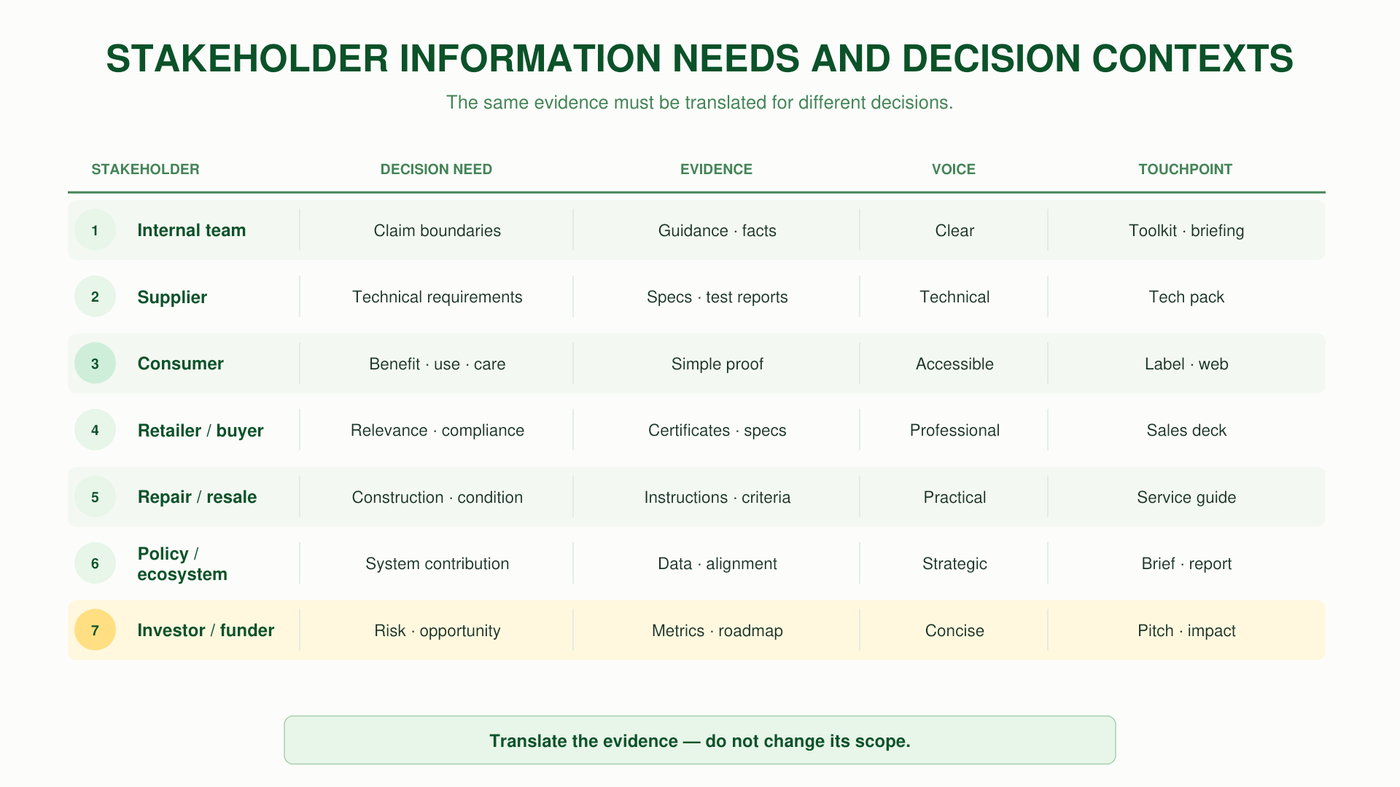
Figure 3.3. Stakeholder Information Needs and Decision Contexts. The same verified information may need to be presented with different levels of detail, supporting documentation, tone, and channels according to each stakeholder’s role and decision context, without changing its meaning, scope, or relevant qualifications.
RESOURCE INSIGHT: Circularity Gap Report 2026 — Circle Economy Foundation / Deloitte, 2026. The report’s headline evidence: the global economy remains roughly 7% circular, and the new “Value Gap” estimate puts avoidable annual economic value lost to linear models at about €25.4 trillion. For stakeholder communication, such system-level, quantified evidence raises the bar — circular progress claims should be benchmarked against aggregate reality, not isolated initiatives. Source: https://circulareconomy.europa.eu/platform/sites/default/files/2026-04/The%20Circularity%20Gap%20Report%202026%20%281%29.pdf.
GFA RESOURCE: Unpacking Pay Equity in Fashion: Türkiye — Global Fashion Agenda & PwC, 2025. The report shows how better data can meet stakeholder information needs. Monitoring and disclosure of gender pay data are not yet widespread among Turkish manufacturers: SLCP facility assessments show that 35% of facilities pay women less than men for the same or similar work, and in 13% of facilities the gap exceeds 10%, while national estimates range from 15.6% to 17.4%. Workers, unions and buyers all benefit from verified data, making disclosure a clear transparency opportunity for suppliers. Source:
Source: https://globalfashionagenda.org/resource/unpacking-pay-equity-in-fashion-turkiye/