Chapter 3 — Full chapter
| Site: | FashionKIC Learning Platform |
| Course: | Sustainability Communication and Marketing |
| Book: | Chapter 3 — Full chapter |
| Printed by: | Guest user |
| Date: | Sunday, 1 November 2026, 3:20 AM |
Table of contents
- Chapter 3 — Stakeholder Communication Strategies for Circular Fashion
- 3.1 Sustainability communication ecosystems
- 3.2 Stakeholder information needs and evidence levels
- 3.3 Defining the Communication Objective
- 3.4 The Stakeholder Information and Communication Matrix
- 3.5 Common risks in stakeholder communication
Chapter 3 — Stakeholder Communication Strategies for Circular Fashion
Chapter purpose
This chapter reframes circular communication as a multi-stakeholder practice, not only a consumer-facing marketing activity. Learners are introduced to the idea that sustainability and circularity messages must be adapted according to the audience, the decision context, the level of knowledge, the evidence required, and the communication channel.
Rather than asking only “How do we communicate sustainability?”, this chapter asks: who needs to know what, why do they need to know it, and what action or decision should the communication support?
This is especially relevant for designers, SMEs and fashion ecosystem actors, because circularity depends on coordination between many actors: internal teams, suppliers, manufacturers, retailers, customers, repair services, resale platforms, policymakers, investors, educators and local communities.
Introductory Note
Sustainability communication does not begin with a campaign, claim or content plan. It begins with the organisation’s understanding of its impacts, material priorities, stakeholders, responsibilities, and business model. These elements determine what the organisation needs to change, what evidence it must collect, and what it can communicate credibly.
Communication can translate strategy, support stakeholder participation and make progress accountable, but it cannot define material priorities or substitute for operational change. When communication is developed before the underlying strategy, responsibilities and evidence are established, it risks becoming selective, disconnected, or misleading.
This module therefore assumes that communication follows — and remains connected to — materiality assessment, stakeholder engagement, circular business-model decisions, governance and implementation.
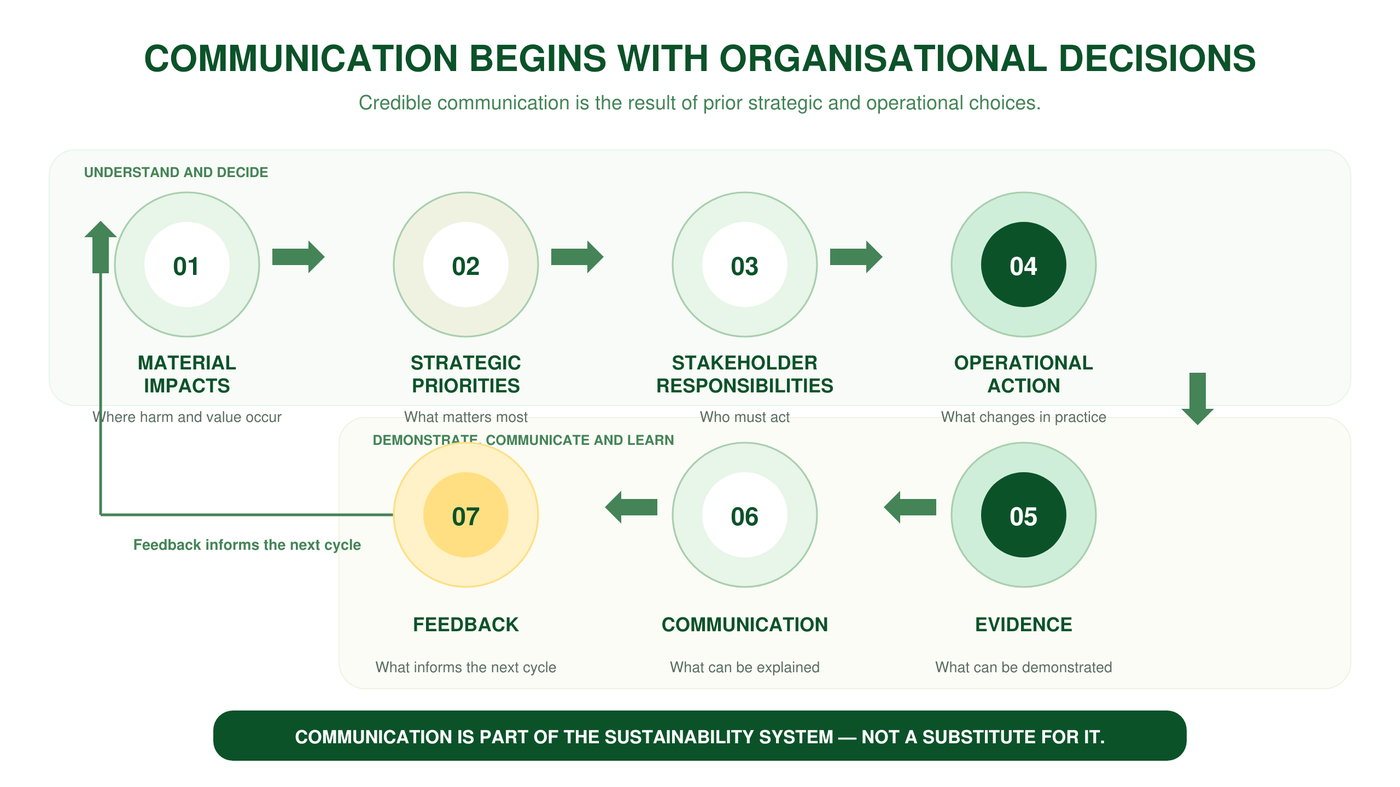
Figure 3.1. Communication Begins with Organisational Decisions. Credible sustainability communication emerges from the identification of material impacts, strategic priorities, stakeholder responsibilities, operational action, and evidence. Communication and feedback form part of this wider sustainability system; they do not replace it.
Chapter overview
Circular communication is not one message repeated across all channels. A product claim, a supplier briefing, a sales deck, a customer care script, a policy brief and a social media campaign may all refer to the same sustainability initiative, but they should not communicate it in the same way.
This chapter introduces stakeholder communication as a practical planning tool. Learners will identify the different people and organizations involved in a circular fashion initiative and define what each stakeholder needs to know, what evidence they need, which tone is appropriate, and which channel is most effective.
The chapter also shows how communication gaps can create confusion, inconsistency, greenwashing risk, and missed opportunities for collaboration.
Time: ≈ 2.5–4 h · reading & activities (2 h) · assignment (1–3 h) · quiz (10 min).
Introduction — Communication beyond the consumer
Fashion communication is often associated with consumer-facing activities: campaigns, product pages, labels, social media, newsletters, store displays, or press materials. These are important, but they are only one part of the communication ecosystem.
Circular fashion requires a broader communication approach. A designer may need clear circular design criteria. A sourcing team may need material specifications. A supplier may need technical requirements. A salesperson may need safe language for customer conversations. A retailer may need substantiated claims and compliance information. A policymaker may need evidence of social, environmental, or regional relevance. A funder or investor may need to understand risk, scalability, and impact.
This means communication should not be treated as a final layer added after the product or service is developed. It should be part of the circular strategy itself. Good communication helps align internal teams, support responsible claims, build trust with external audiences, and enable circular actions such as care, repair, reuse, take-back, rental, resale, or recycling.
For SMEs, this is especially important because teams are often small and roles overlap. The same person may be responsible for product development, marketing, customer relations, and partnerships. A simple stakeholder communication framework can reduce mistakes and make communication more coherent.
The key idea of this section is that communication is not only about what a brand says externally. It is also about how information moves inside and around the organization so that circularity can actually be implemented.
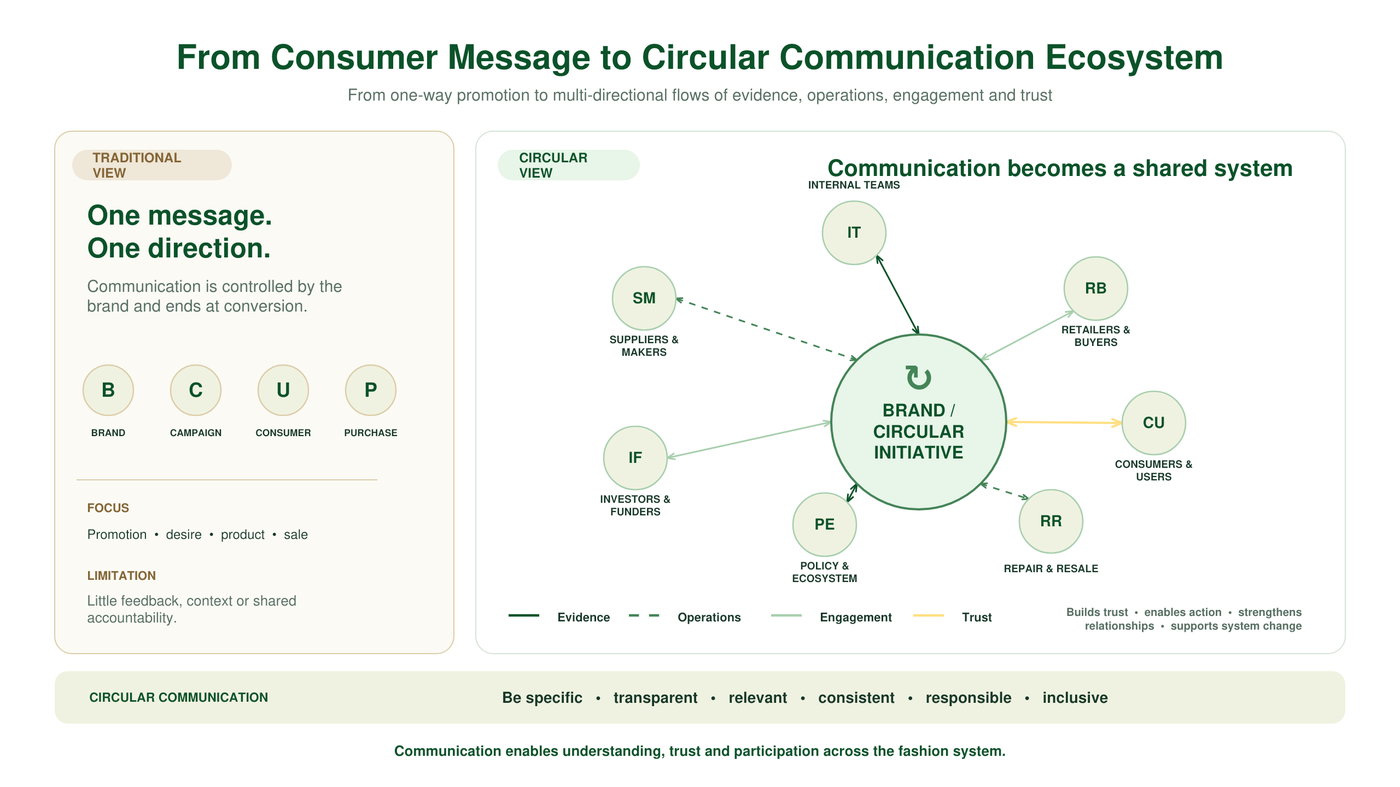
Figure 3.2. Circular fashion communication moves beyond one-way promotion. It requires a shared flow of evidence, operational information, engagement, and trust between multiple stakeholders. The goal is not only to communicate a product, but to make circular action understandable, credible and possible.
In this chapter:
- 3.1 Sustainability communication ecosystems
- 3.2 Stakeholder information needs and evidence levels
- 3.3 Defining the Communication Objective
- 3.4 The Stakeholder Information and Communication Matrix
- 3.5 Common risks in stakeholder communication
3.1 Sustainability communication ecosystems
A circular communication ecosystem includes several layers. Each layer has different needs, expectations, and risks.
Internal communication includes design, product development, sourcing, marketing, sales, retail teams, customer care, and leadership. Internal communication ensures that everyone understands what the brand can say, what it cannot say, what evidence exists, and what the current limitations are.
Supplier and production communication includes manufacturers, material suppliers, dye houses, finishers, repair partners, logistics partners and service providers. Communication here must be technical, precise, and actionable.
Consumer communication includes product pages, labels, care instructions, social media, packaging, newsletters, store communication and post-purchase touchpoints. Communication here must be clear, accessible, and trustworthy.
B2B communication includes retailers, buyers, showrooms, marketplaces, resale platforms and commercial partners. Communication here must combine brand story, product differentiation, technical information, and claim substantiation.
Institutional and policy communication includes public authorities, associations, EU projects, municipalities, educators, and ecosystem partners. Communication here should show relevance to wider priorities such as circular economy, skills, innovation, local development, regional priorities or sustainable production.
Investor, funder and strategic partner communication includes investors, grant-making bodies, accelerators and strategic partners. Communication here should connect sustainability with resilience, risk management, innovation, business model transition, and long-term value.
The important point is that these layers are connected. If the internal team does not understand the evidence behind a claim, the consumer-facing message may become vague or exaggerated. If a supplier does not receive clear requirements, the product may not deliver what the brand later wants to communicate. If a retailer receives a beautiful story without substantiation, the brand may lose commercial credibility.
RESOURCE INSIGHT: Communicating Climate Change and Sustainability — UN Global Compact. The UN Global Compact ecosystem (25,000+ business participants in 160+ countries) treats communication as part of responsible business: its Communication on Progress mechanism requires companies to publicly account for progress on the Ten Principles and the SDGs. A 2026 UNGC–Kantar benchmark found marketing leaders embedding sustainability but facing capability gaps — communication ecosystems need strategy, not just messages. Source: https://unglobalcompact.org.
3.1.1 Reflection note — Stella McCartney: one position, different communication formats
Stella McCartney provides an example of how the same sustainability position can be communicated through different formats and levels of detail.
The brand’s 2024 Sustainability Statement provides the formal accountability layer. It presents governance, material impacts, risks and opportunities, environmental and social information, metrics, and reporting scope. Inspired by the European Sustainability Reporting Standards, it gives stakeholders access to the evidence and organisational processes behind the brand’s sustainability position.
Campaign films translate this position into a more emotional and accessible language. Through imagery, creative direction, and brand voice, they connect sustainability with innovation, desirability and the identity of the fashion house.
The Falabella story brings the narrative to product level. The bag is presented through its vegan identity, material innovation, Italian craftsmanship and continued reinvention using materials such as recycled inputs and plant-based alternatives. It makes the brand’s wider position tangible through a recognisable product.
Together, these formats perform different but connected roles: the report supports accountability, the campaign creates meaning and desire, and the product story shows how the position is expressed through design. They do not need to contain the same level of detail, but their claims, scope and overall message must remain consistent.
Thought prompt: How does Stella McCartney adapt its tone, evidence and storytelling across the sustainability report, campaign film and Falabella story? What does each format contribute, and where could simplification create a communication risk?
Sources: Stella McCartney Sustainability Statement 2024, Generation Falabella
3.2 Stakeholder information needs and evidence levels
Once a circular initiative has passed the legal, specificity and substantiation checks introduced in Chapters 1 and 2, the verified information must be organised for different stakeholders.
Stakeholders may require different levels of detail, formats, and contexts, depending on the decision they need to make or the action they are expected to take. A supplier may need technical specifications and quality requirements. A customer may need practical information about how to access a repair service. A retailer may need approved product information and supporting documentation. A policymaker may need aggregated results and information about broader policy relevance.
Adapting communication does not mean creating different versions of the truth. The verified meaning, scope, and relevant qualifications must remain consistent across audiences and channels.
The communication task is therefore to identify what each stakeholder needs to know and why they need it, while keeping the underlying evidence and meaning consistent.
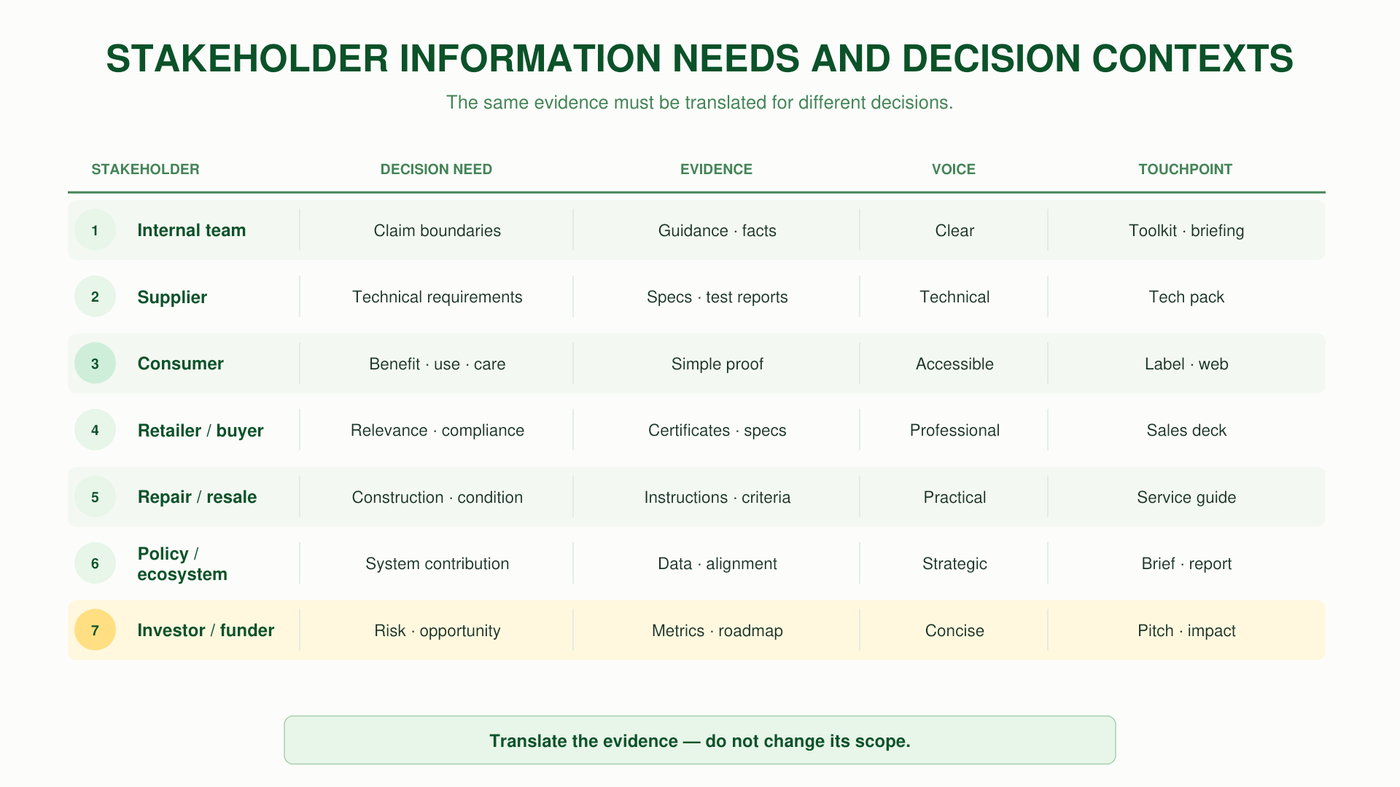
Figure 3.3. Stakeholder Information Needs and Decision Contexts. The same verified information may need to be presented with different levels of detail, supporting documentation, tone, and channels according to each stakeholder’s role and decision context, without changing its meaning, scope, or relevant qualifications.
RESOURCE INSIGHT: Circularity Gap Report 2026 — Circle Economy Foundation / Deloitte, 2026. The report’s headline evidence: the global economy remains roughly 7% circular, and the new “Value Gap” estimate puts avoidable annual economic value lost to linear models at about €25.4 trillion. For stakeholder communication, such system-level, quantified evidence raises the bar — circular progress claims should be benchmarked against aggregate reality, not isolated initiatives. Source: https://circulareconomy.europa.eu/platform/sites/default/files/2026-04/The%20Circularity%20Gap%20Report%202026%20%281%29.pdf.
GFA RESOURCE: Unpacking Pay Equity in Fashion: Türkiye — Global Fashion Agenda & PwC, 2025. The report shows how better data can meet stakeholder information needs. Monitoring and disclosure of gender pay data are not yet widespread among Turkish manufacturers: SLCP facility assessments show that 35% of facilities pay women less than men for the same or similar work, and in 13% of facilities the gap exceeds 10%, while national estimates range from 15.6% to 17.4%. Workers, unions and buyers all benefit from verified data, making disclosure a clear transparency opportunity for suppliers. Source:
Source: https://globalfashionagenda.org/resource/unpacking-pay-equity-in-fashion-turkiye/
3.2.1 Mini case note — ISTO.: Price Transparency as Sustainability Communication
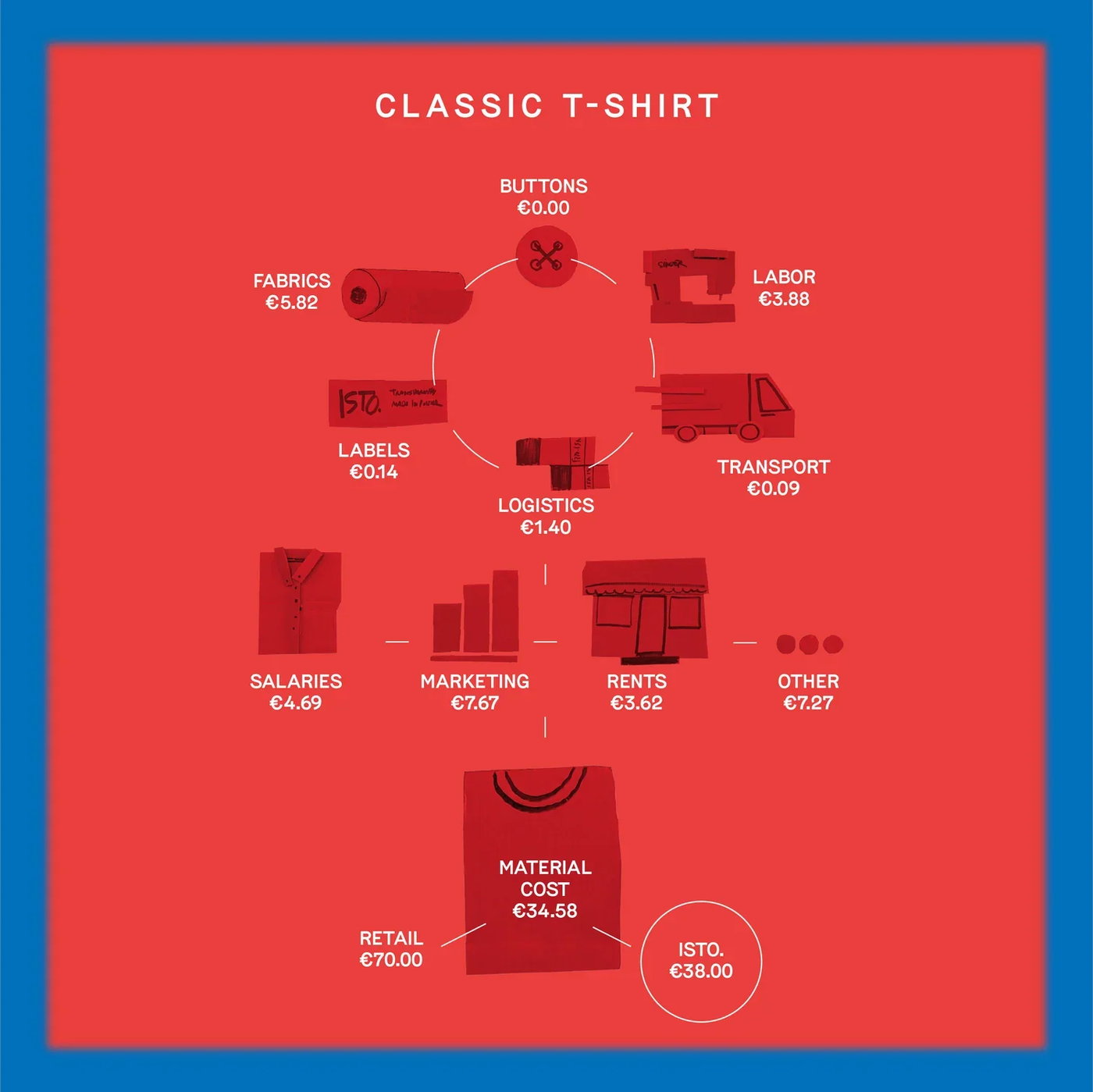
Source: https://isto.pt/pages/price-breakdown-of-the-year-2023
Portuguese brand ISTO. is a useful example of how transparency can support sustainability communication at different levels. Through its price breakdown communication, the brand shows the costs behind selected products and explains components such as materials, production, and other elements that contribute to the final retail price.
This type of disclosure does not, by itself, prove that a product is sustainable. Its value lies in making business decisions more visible and giving consumers and other stakeholders clearer context about value, pricing and responsibility.
The example shows how sustainability communication can move beyond broad claims by providing specific, understandable information that helps audiences assess how a brand operates and where value is created.
Thought prompt: What makes price transparency meaningful rather than purely promotional? Which types of information help consumers understand value, and which build wider stakeholder trust?
3.3 Defining the Communication Objective
Knowing who the stakeholder is and what information they need is not enough. Communication also needs a clear purpose: what should the stakeholder be able to understand, decide, or do as a result?
A communication objective translates a broad topic into a specific intended outcome. For example, “communicate our repair service” describes a subject; “help customers understand whether their garment is eligible for repair and how to access the service” defines what the communication needs to achieve. Similarly, an internal objective might be to ensure that sales teams use an approved recycled-fibre claim consistently, while a supplier objective might be to obtain the data required to substantiate that claim.
A useful communication objective can therefore be framed through three questions:
Who needs the information? What decision or action should it support? What should change as a result of the communication?
Once the objective is defined, the organisation can determine the information, evidence, ownership, format, and feedback mechanisms needed to support it. These elements are brought together in the Stakeholder Information and Communication Matrix in the next section.
3.4 The Stakeholder Information and Communication Matrix
The Stakeholder Information and Communication Matrix helps organisations translate verified information into a coordinated communication process. It connects each stakeholder’s needs and decision context to the source, ownership, delivery, and feedback mechanisms required.
The process begins by identifying the stakeholder and the decision or action the communication should support. The organisation can then determine what information is required and where the verified information comes from. This prevents communication from being developed independently from the product, service, or initiative it describes.
Clear information ownership is essential. Each information flow should have a designated owner responsible for ensuring that the content is accurate, approved, up to date and consistent across teams and channels. The owner may sit within sustainability, product, operations, legal, communications, or another relevant function. Ownership does not mean that one person produces all communication; it means that responsibility for the reliability and maintenance of the underlying information is clearly assigned.
The matrix also defines the appropriate format or channel, when the information should be delivered or reviewed, and how stakeholders can ask questions, report errors, or provide feedback. This feedback loop allows new information and operational issues to return to the responsible team.
By linking information needs to verified sources and clear ownership, the matrix supports consistency without requiring identical communication for every audience. The level of detail and format may change, but the verified meaning, scope, and relevant qualifications must remain consistent.
Try it now
Take one circular initiative you know (a repair service, a take-back or resale programme) and draft a mini Stakeholder Information and Communication Matrix with five roles — customer, store staff, customer service, repair or service team, management. For each role note: decision needed, information required, information owner, channel and feedback mechanism. Free: paper or a spreadsheet, 30 minutes — the matrix template is below.
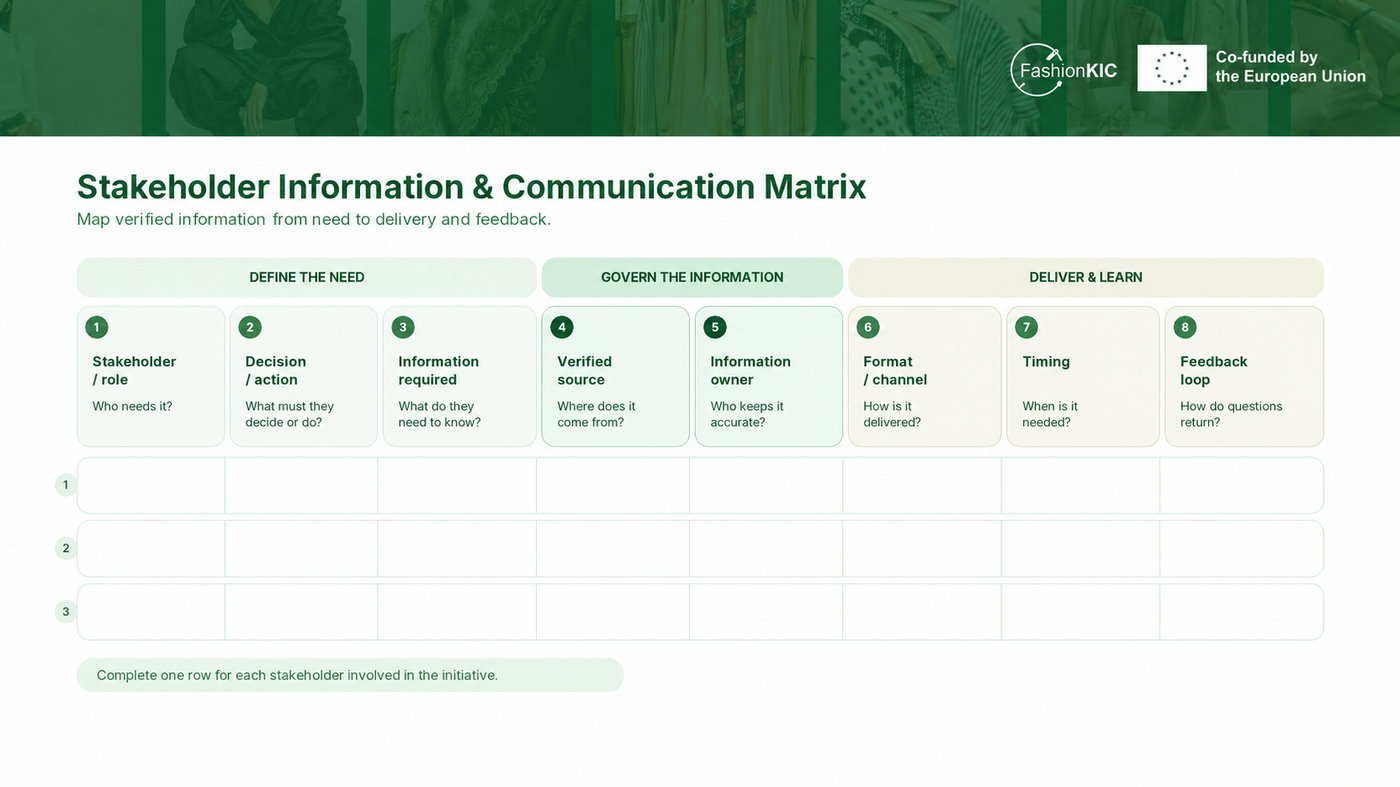
Figure 3.4. Stakeholder Information and Communication Matrix. This tool helps organisations identify what each stakeholder needs to know or do, connect that need to a verified information source and responsible owner, and define the appropriate channel, timing and feedback mechanism.
3.5 Common risks in stakeholder communication
Adapting communication to different stakeholders creates several risks. One is oversimplification: reducing technical information so much that important context, scope or qualifications are lost. The opposite can also happen. Providing excessive detail without considering the stakeholder’s role may make the information difficult to understand or use.
Another risk is inconsistency. Although audiences may require different formats and levels of detail, the underlying meaning must remain the same. Suppliers, customers, retailers, employees, and policymakers should not receive conflicting accounts of the same product, service, or initiative.
Communication may also focus on visibility rather than usefulness. A message can reach a large audience but still fail if it does not provide the information needed to make a decision or take an action. Publishing a repair initiative, for example, is not enough if customers cannot understand where the service is available, what it costs, or which products are eligible.
Channel selection can create further barriers. Important information may be placed in reports or webpages that the intended stakeholder is unlikely to consult. Language, accessibility, digital access, and technical literacy should also be considered.
Finally, one-way communication limits learning and accountability. Stakeholders need appropriate ways to ask questions, report problems, and provide feedback. Effective stakeholder communication therefore requires consistency, relevance, accessibility, and dialogue — not simply the distribution of information.
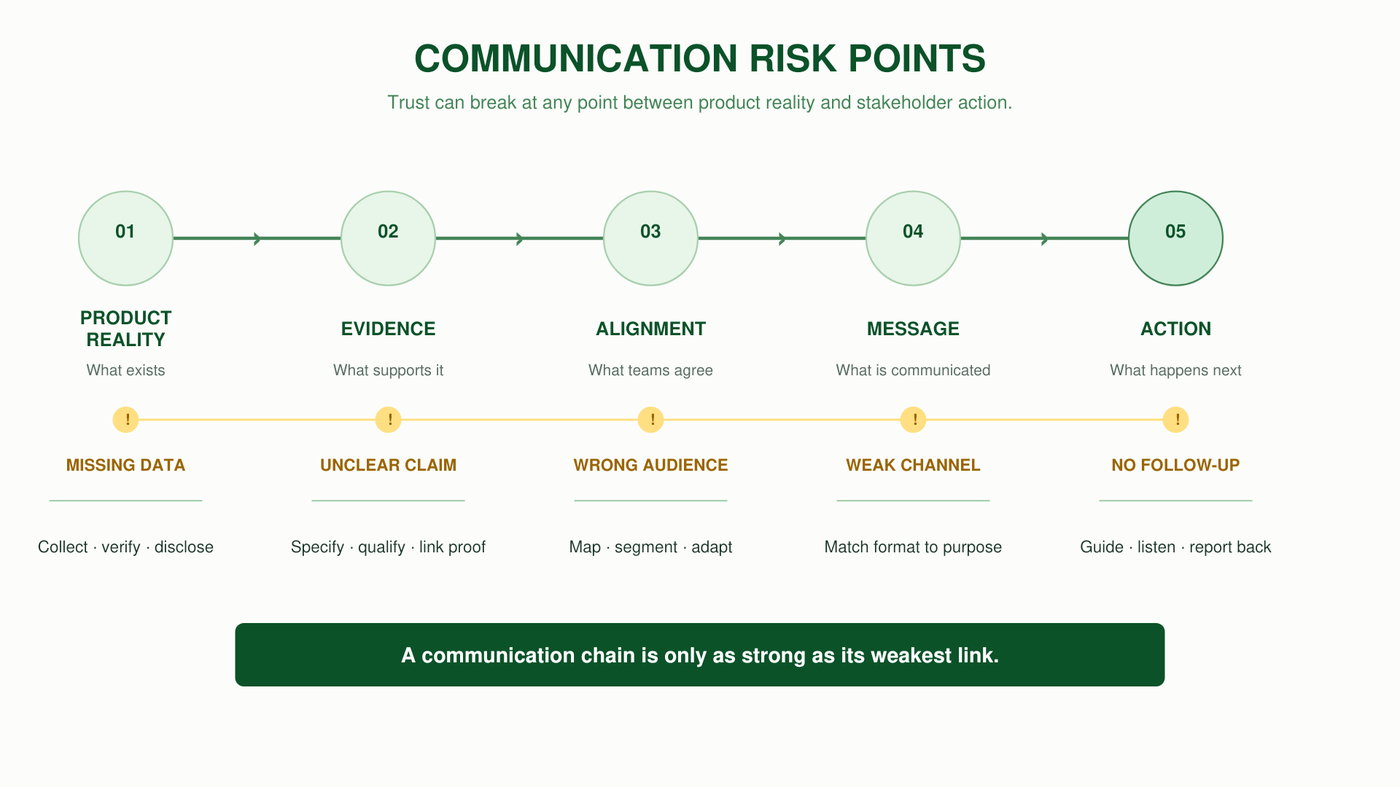
Figure 3.5. Communication Risk Points. Communication risks can emerge at every stage between product reality and stakeholder action. Missing data, unclear claims, internal misalignment, unsuitable channels, and weak follow-up can undermine accuracy, understanding, and trust.
FOR YOUR SME / BUSINESS CASE: inconsistency between channels is a legal and commercial risk, so the same claim should carry the same scope everywhere. Retailers and marketplaces increasingly ask for the evidence behind sustainability claims, such as certificates or LCA summaries, before listing products. Preparing a one-page substantiation pack per claim (claim wording, evidence, scope, owner and review date) takes a few hours and supports consistency across every channel. Indicative — adapt to your product range.
3.5.1 Worked example — Communicating the ISTO. Repair Program across the stakeholder ecosystem
ISTO. is a Portuguese clothing brand that offers a repair service designed to keep its garments in use for longer. The service is currently available at its Campo de Ourique store. Customers can bring their garments to the store or email photographs in advance to check whether a repair is possible. Small tears, loose stitching and buttons on ISTO. garments are repaired free of charge, while trouser-length and shirt- or jacket-sleeve adjustments cost €10. Customers receive an estimated collection date after the garment has been assessed. ISTO. Repair Program
The completed matrix shows how information about this service can be organised for five stakeholder roles: garment owners, store staff, customer-service staff, the repair team, and management. The public-facing service information is based on ISTO.’s current Repair Program page. The internal information sources, ownership roles, workflows and reporting mechanisms marked with an asterisk are illustrative applications of the matrix rather than confirmed descriptions of ISTO.’s internal processes.
The example demonstrates that stakeholder adaptation does not require different versions of the service. Its scope, conditions and limitations remain consistent, while the level of detail, format, timing and feedback mechanism change according to each stakeholder’s role and decision context.
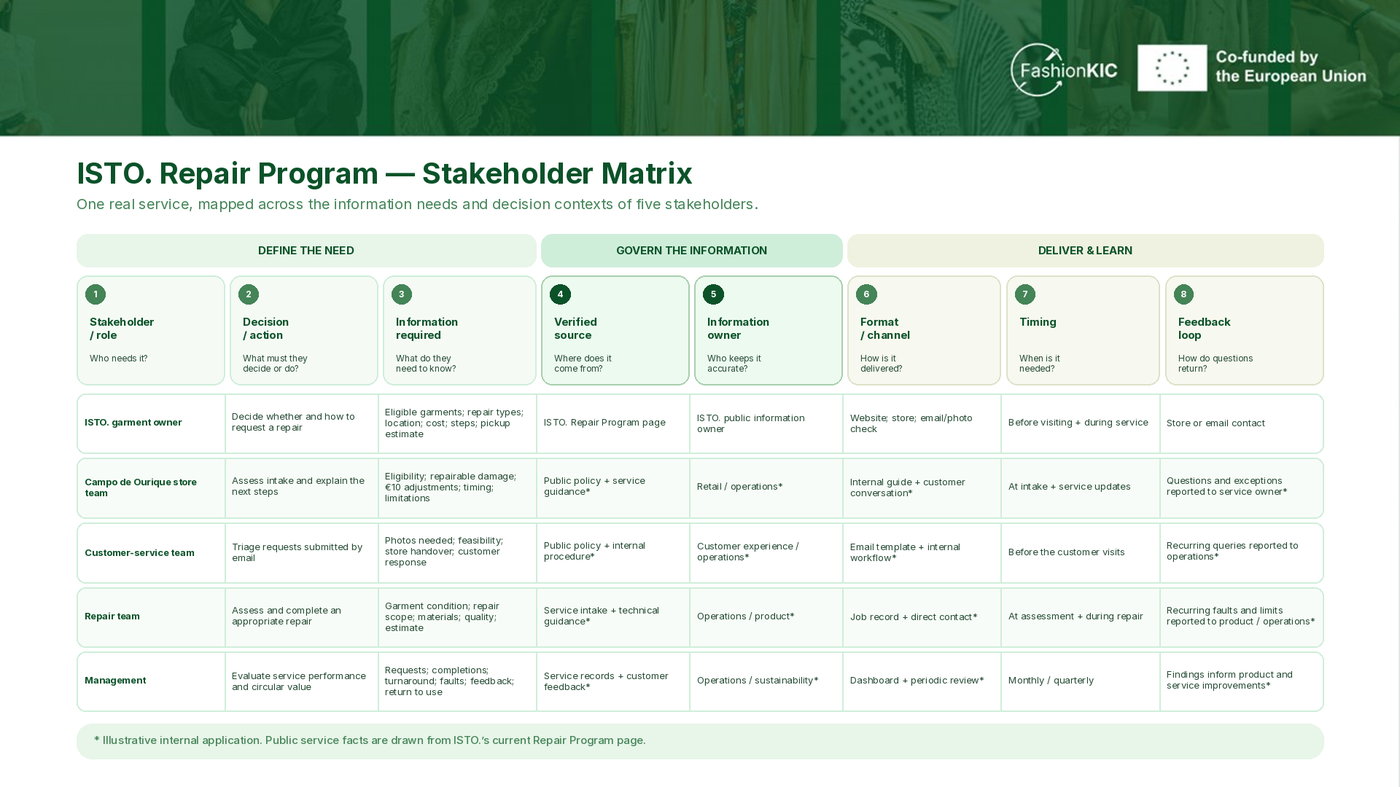
Figure 3.6. Applying the Stakeholder Information and Communication Matrix to the ISTO. Repair Program. The example maps how information about one repair service can be organised for different stakeholder roles while maintaining a consistent description of its scope, conditions, and limitations.