
Chapter 1 — full chapter
Chapter 1 — full chapter
1.2 Digitalization across the value chain
Reducing the impact of a fashion product requires knowing where the impact occurs in its life. This section maps the value chain stage by stage and locates the digital intervention points that the rest of the module develops.
1.2.1 Five Stages from Fiber to End-of-Life
The fashion product life cycle runs through five macro-stages, and holistic sustainability requires optimizing all of them rather than shifting burdens from one to another.
Stage 1, raw materials and design: decisions made here determine up to 80% of a product's environmental impact. Fiber choice (natural, synthetic, regenerated, each with a distinct impact profile), construction quality, mono-materiality, repairability and zero-waste pattern cutting are all locked in at the design table; the digital tools of Chapters 2 and 3 (3D design, parametric modeling, virtual sampling) operate here.
Stage 2, manufacturing and processing: the most energy- and chemical-intensive stage; dyeing alone can account for up to 20% of global industrial water pollution, and 15–20% of fabric is typically lost as cutting waste. Digital printing, automated cutting, and AI process optimization come into play here.
Stage 3, transportation and distribution: products often cross continents multiple times; logistics emissions depend on modal choices (air freight being the most carbon-intensive) and on the accuracy of demand planning.
Stage 4, use: around one-third of a garment's total impact can occur in households through washing and drying; durability and care information (communicated via the Digital Product Passport) act here.
Stage 5, end-of-life: garments are often discarded after only 7–10 uses, and roughly 85% of textile waste ends up in landfill or incineration; collection, sorting and recycling technologies close the loop. Reading the chain this way turns "sustainability" from a generic aspiration into an engineering discipline: each stage has measurable flows (materials, energy, water, emissions, data), and each flow has a digital tool that makes it visible and improvable. The chapters of this module are, in effect, a tour of this map.
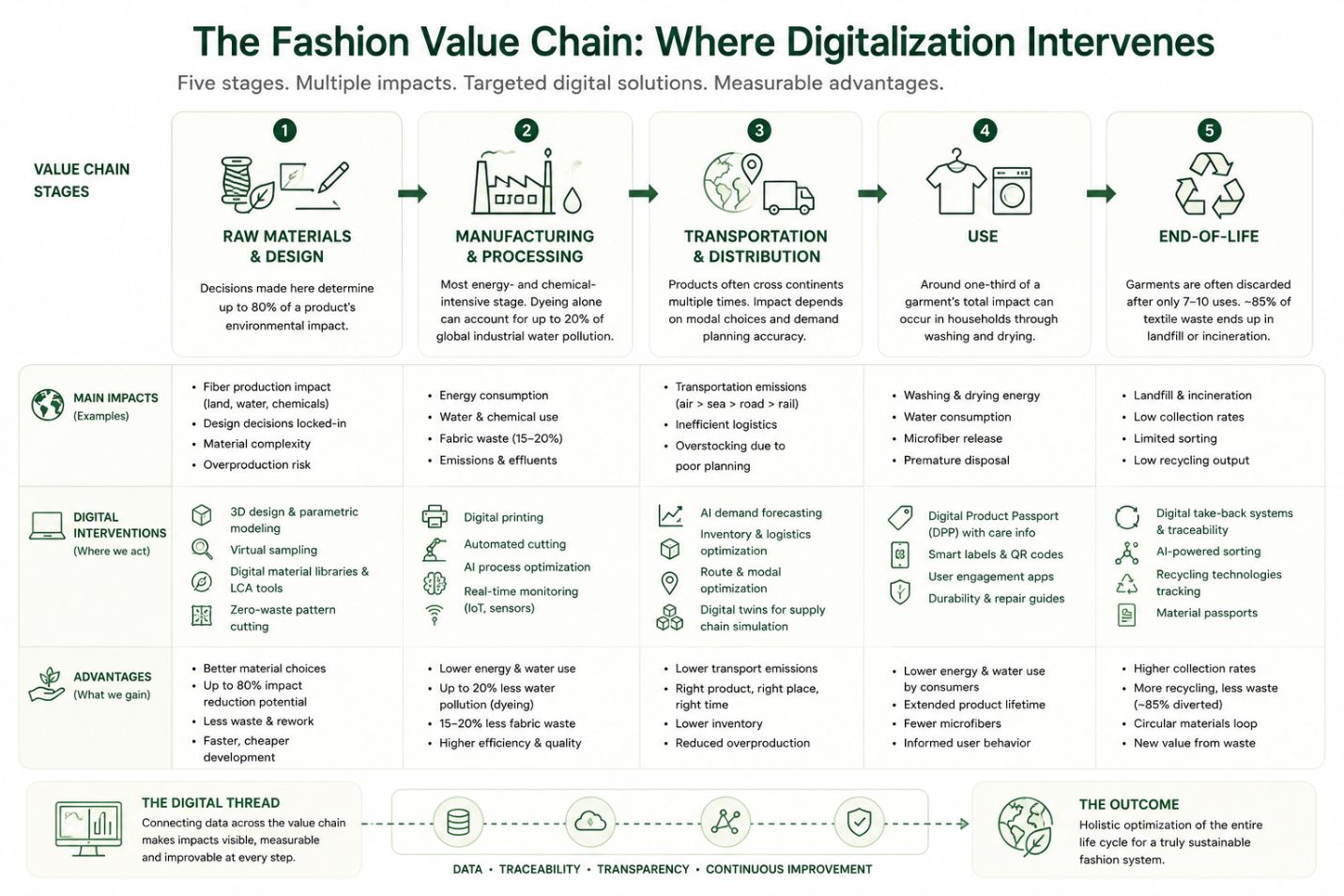
Figure 1.2, The fashion value chain and where digitalization intervenes: five stages from raw materials to end-of-life, each with its impacts, digital interventions and advantages.
1.2.2 The digitalization ladder
Digitalization is rarely adopted as a program. Companies adopt it one step at a time, and the order is not a matter of preference because each step consumes the data the previous one produces. A company that buys a traceability platform before it has a digital tech pack will populate that platform by hand, and a company that buys forecasting software before it has structured sell-through data will forecast noise. The ladder below sequences the six chapters of this module as an adoption path, ordered by prerequisite rather than by cost or ambition.
The first rung is design, where vector drawing and 3D modeling replace manual technical drawing and the ambiguity of a hand-annotated tech pack. It has no prerequisite, which is why it is the entry point, and it is developed in Chapter 2. The second rung is prototype: once a digital pattern and measured material data exist, garment simulation replaces sample rounds and the shipping that goes with them (Chapter 3). The third is produce, where digital printing, additive manufacturing and made-to-order flows replace tooling, setup costs and forecast-driven batches, which becomes possible only when a production-ready file and an approved digital sample already exist (Chapter 4). The fourth is measure, where structured sell-through and bill-of-material data allow demand forecasting and footprint calculation to replace experience-based planning and estimated impacts (Chapter 5). The fifth is trace, where item-level identifiers and the Digital Product Passport replace declarative claims verified by periodic audit, and where the supplier and composition data are assembled at the previous rung (Chapter 6). The sixth is circular, where resale, repair, rental and fiber-to-fiber recycling become operable once the product carries an identity that survives its first sale (Chapter 6).
To locate a company on this ladder, the useful question is not which software it owns, but which decisions it still makes about physical objects. A studio that still cuts four sample rounds per style stands on the first rung, whatever licenses it holds. The practical rule for an SME is to climb one rung rather than six, because the return on the first rung above the current position is almost always higher than the return on a full-stack adoption: each rung generates the data the next one needs, and a skipped rung produces an expensive system fed by manual data entry.
The digitalization ladder is not the compliance ladder of section 1.3, and the two should not be confused. The compliance ladder is ordered by regulatory deadline, so it can demand a rung the company has not yet reached: an SME may be required to publish structured product data before it has digitalized its design process. Where the two conflict, the obligation sets the date and the ladder sets the least wasteful way to meet it, which is normally to build the missing rung rather than buy a system that compensates for its absence.
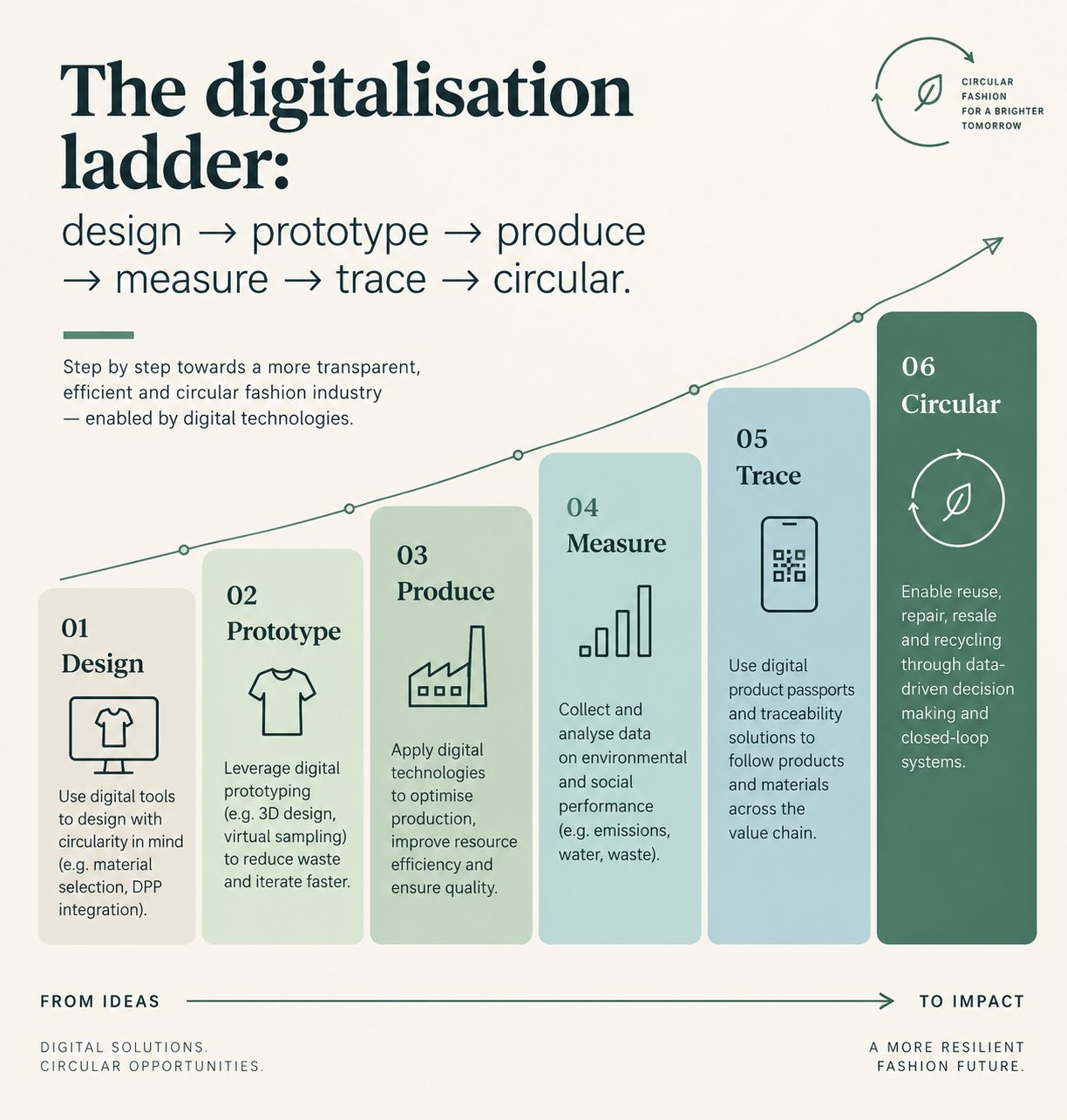
Figure 1.3, The Digitalization ladder shows the essential step to transition to digital production.
The technologies in this module belong to two overlapping industrial paradigms. Industry 4.0 supplies the digital infrastructure; Industry 5.0 redefines what it is for. This section distinguishes the two and previews the toolbox.
From the designer's chair, Industry 4.0 and 5.0 are not policy concepts but descriptions of daily work: 4.0 supplies the tools, 3D software, data pipelines, AI, and 5.0 reminds us who they serve. The human stays in the loop: the designer sets the brief, judges the AI output, makes the fit and material decisions, and takes responsibility for the result. Human-centered AI in fashion means the machine proposes and the designer disposes, prompt, critique, iterate. The rest of this module is the practical version of that idea: every chapter shows a digital tool taking over a task that used to be manual, and the designer deciding whether the result is good enough.
Industry 4.0, the fourth industrial revolution, is the integration of cyber-physical systems, the Internet of Things (IoT), cloud computing, big data analytics and AI into manufacturing and supply chains. Applied to fashion, it delivers end-to-end visibility (RFID and IoT sensors tracking materials and garments in real time), vertical and horizontal integration (data flowing from ERP through MES to shop-floor machines, and across supply chain partners), predictive analytics (demand forecasting, predictive maintenance, automated replenishment) and real-time decision support. Its limitation is its own optimization target: efficiency. Systems tuned only for speed and cost become brittle under disruption and blind to social and environmental externalities.
Industry 5.0, formally introduced by the European Commission (Breque, De Nul & Petridis, 2021), keeps the same technological stack but reorients it around three priorities: human-centricity (AI that augments rather than replaces human judgement, with workers' knowledge integrated into planning), resilience (redundancy, flexibility and stress-testing valued alongside efficiency) and sustainability (environmental and social metrics, carbon, water, waste, labour, tracked as first-class KPIs next to cost and speed, with circular flows such as take-back, repair and recycling integrated into core operations rather than treated as afterthoughts). For the TCLF sector this distinction is practical, not philosophical: the same RFID tag that optimizes inventory in an I4.0 reading becomes, in an I5.0 reading, the data carrier of a Digital Product Passport enabling reuse and recycling. The remaining chapters of this module can be read as the I5.0 toolbox in action: design tools that reduce impact before production, manufacturing technologies that produce on demand, analytics that measure and report, and traceability that closes the loop.
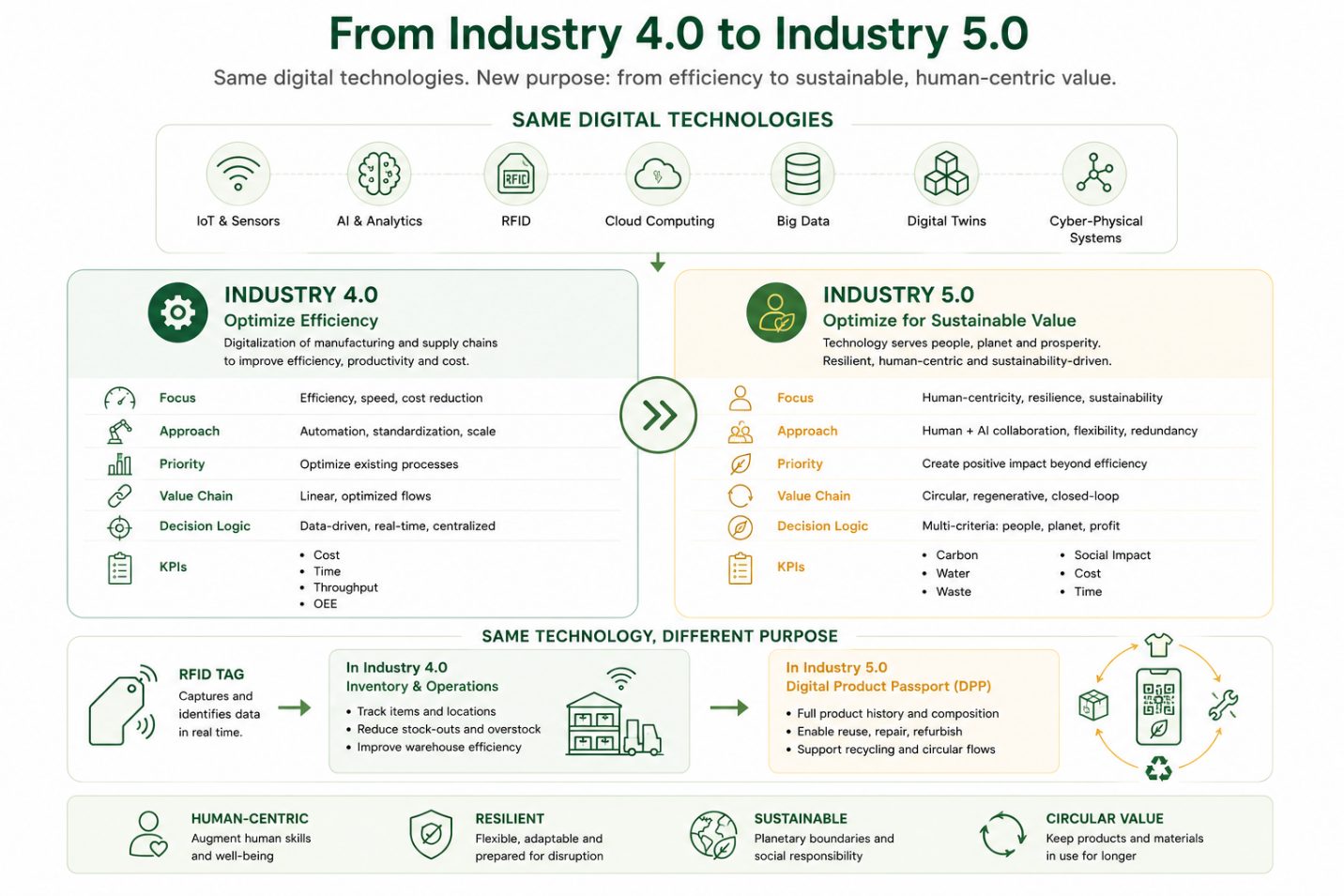
Figure 1.4, From Industry 4.0 to Industry 5.0: the same digital technologies redirected from efficiency toward sustainable, human-centric value.