Chapter 5 — full chapter
| Site: | FashionKIC Learning Platform |
| Course: | Sustainability Communication and Marketing |
| Book: | Chapter 5 — full chapter |
| Printed by: | Guest user |
| Date: | Sunday, 1 November 2026, 3:20 AM |
Chapter 5 — Responsible Storytelling and Campaign Design
Chapter purpose
This chapter explores how verified sustainability and circularity information can be translated into meaningful narratives, visual communication, and campaign concepts. It focuses on the creative decisions that follow compliance and substantiation: why the information matters, which story angle to use, how to build emotional relevance, how to visualise circular value and how to invite an appropriate response without broadening or exaggerating the verified meaning.
Chapter overview
This chapter explores how verified sustainability and circularity information can be transformed into responsible storytelling and campaign design. It focuses on the creative work that begins after information has been checked for legal admissibility, scope, and substantiation.
Learners will examine how to identify why verified information matters, develop an appropriate story angle and emotional hook, translate circular value into visual and channel-specific communication, and use digital tools and AI responsibly. The chapter concludes with a structured campaign-design process that helps preserve the meaning, qualifications and limitations of the verified input while making it relevant, engaging, and actionable.
Time: ≈ 2.5–4.5 h · reading & activities (2 h) · assignment (1–3 h) · quiz (10 min).
Introduction
Storytelling does not begin with a blank page or an untested sustainability claim. It begins with information that has already been checked for legal admissibility, scope, and substantiation using the principles and tools introduced in Chapters 1 and 2.
The creative task is not to make that information sound stronger. It is to make its verified meaning understandable, relevant, and engaging. Storytelling may connect a material, product feature, service or initiative to people, use, care, craft, memory or wider systems. However, it must not broaden the scope of the approved information, omit necessary qualifications or imply benefits that the evidence does not support.
Responsible storytelling therefore connects verified information with meaning, emotion, visual language, and an appropriate action. It helps audiences understand why something matters without turning a limited improvement into a wider environmental promise.
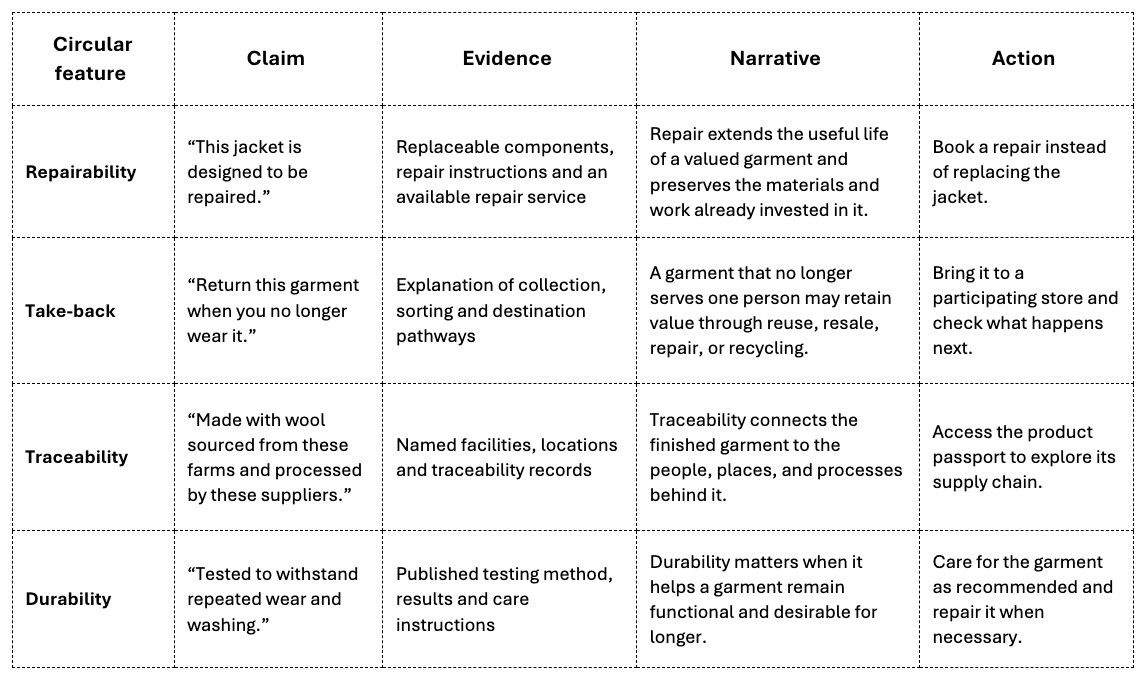
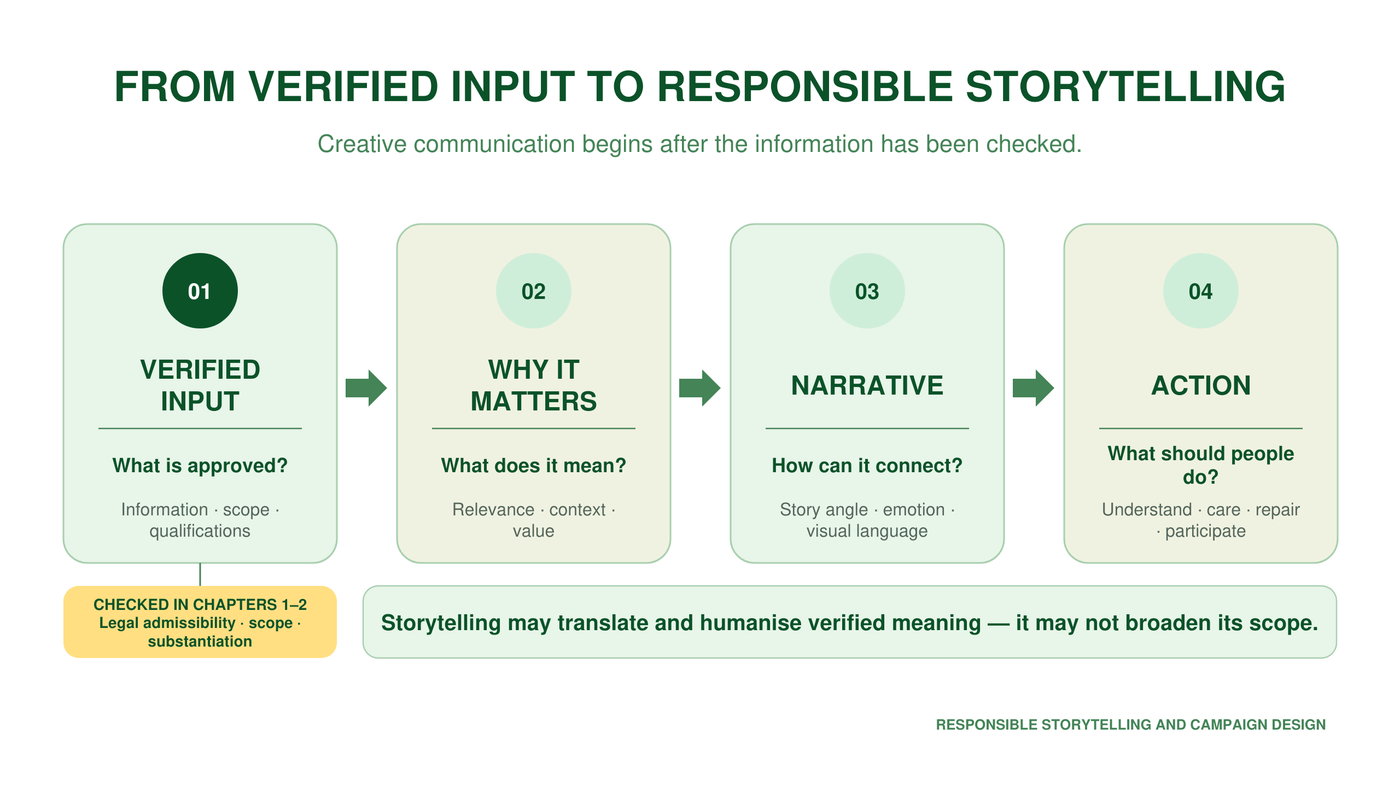
Figure 5.1. From Verified Input to Responsible Storytelling. Responsible storytelling begins with information already checked for legal admissibility, scope and substantiation, and translates its verified meaning into relevance, narrative and appropriate audience action without exaggerating or broadening it.
In this chapter:
- 5.1 The verified communication handover
- 5.2 Emotional connection and value perception
- 5.3 Building the circular story
- 5.4 Content strategy and digital tools
- 5.5 Designing the circular campaign
- 5.6 Case studies
5.1 The verified communication handover
Responsible storytelling begins with a clear handover from the teams responsible for product, sustainability, operations, and legal review to those developing communication and campaigns. The creative team should not receive an unverified claim or a general sustainability theme. It should receive a verified communication input that has already been checked using the processes introduced in Chapters 1 and 2.
This input should clearly state what may be communicated and identify the evidence or source supporting it. It should define the exact scope, including the product, service, material or initiative concerned, as well as any mandatory qualifications, limitations or uncertainties that must remain visible. The handover should also identify the responsible information owner, the date of approval, links to more detailed supporting information and any wording, comparisons or visual implications that must be avoided.
The Stakeholder Information and Communication Matrix introduced in Chapter 3 can provide the basis for this handover. By identifying each stakeholder’s information needs, the relevant evidence, tone, and communication channel, it helps translate verified organisational information into a focused creative brief. However, the matrix should only include claims and messages that have already passed the relevant evidence and approval checks.
This gives creative teams a reliable and audience-specific starting point. Writers, designers, and campaign teams can then explore why the information matters, which narrative angle can make it relevant and how it can be translated into visual and emotional communication.
Creative interpretation may simplify language and make information more engaging, but it must preserve the approved meaning. It must not remove necessary qualifications, extend a specific benefit to the whole product or brand, or imply a stronger outcome than the verified information supports.
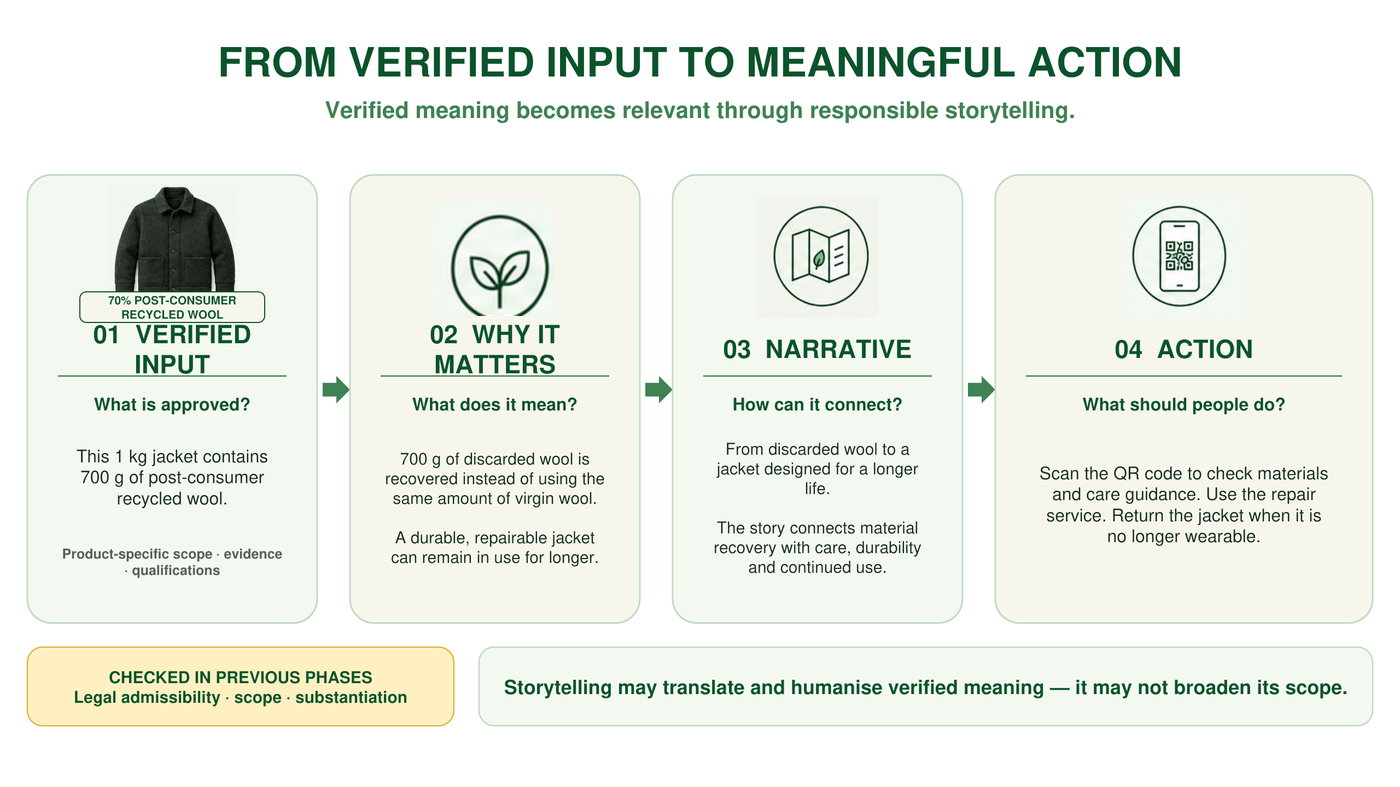
Figure 5.2. From Verified Product Information to Meaningful Action. A verified product claim provides the starting point for identifying why the information matters, developing a responsible narrative and inviting an appropriate audience action, while preserving the approved scope and meaning.
5.2 Emotional connection and value perception
Fashion is emotional. People often buy, keep and value clothes because of identity, memory, beauty, confidence, belonging, status or attachment. This is especially relevant in higher-price segments, where the emotional connection with the brand, product, and story may be as important as the product itself.
Circular communication should not become purely technical. Verified information is necessary, but it rarely creates desire on its own. Storytelling can help circular products feel meaningful and valuable by connecting them to design, craft, material history, care, repair, memory, longevity, or human skill.
This matters because emotional value can support longer use. A garment that feels meaningful is more likely to be cared for, repaired, and kept. Communication can therefore help shift desire away from constant novelty and towards deeper forms of value.
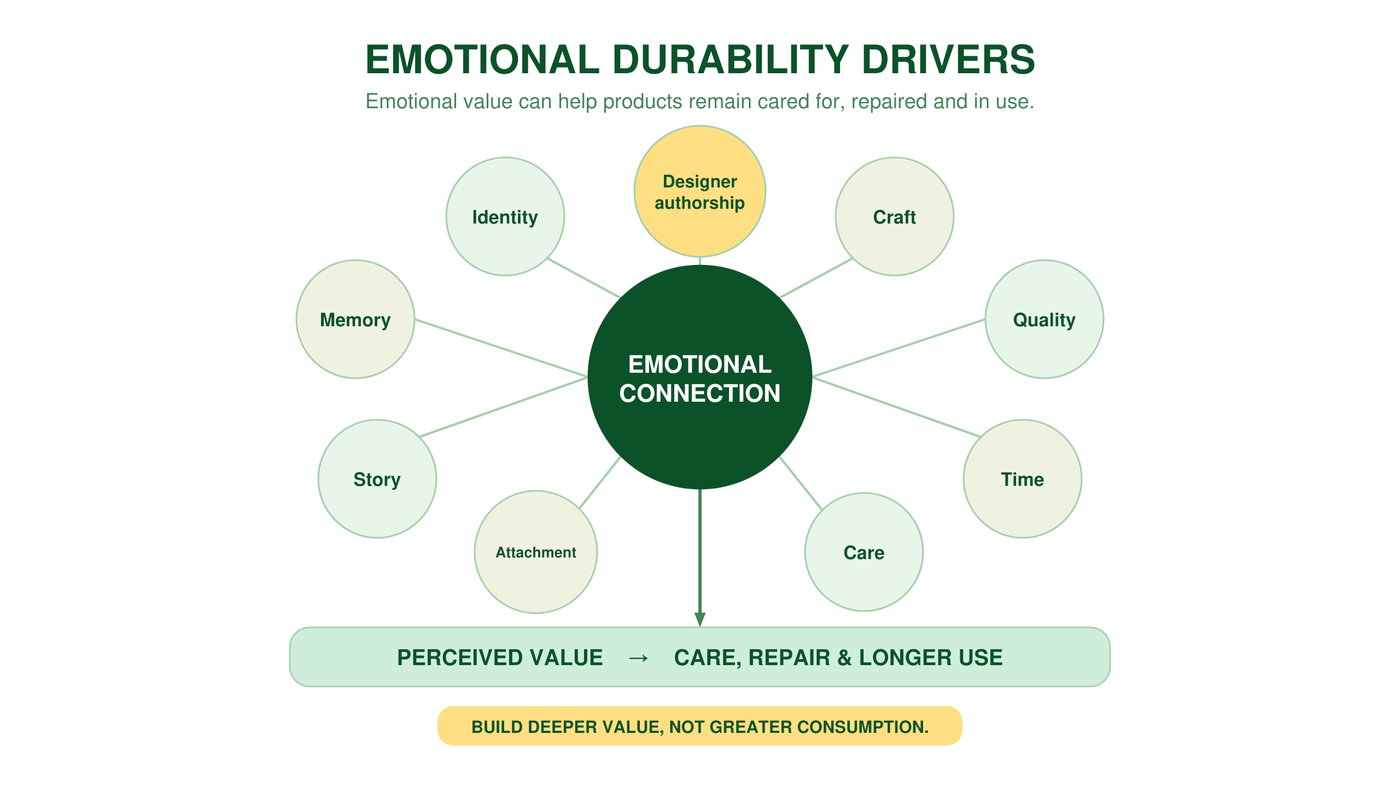
Figure 5.3. Emotional Durability Drivers. Memory, craft, identity, care, quality, attachment, story, time and designer authorship can strengthen emotional connection and perceived value, supporting care, repair and longer product use.
RESOURCE INSIGHT: The Marketing Playbook for a Circular Economy — Ellen MacArthur Foundation & Kantar, 2024. The playbook offers marketers four pathways: create scalable circular solutions, drive demand for circular propositions, make circular behaviours irresistible — “do not rely on people doing the right thing” — and hardwire circular KPIs such as customer lifetime value and revenue from circular models. Emotional connection comes from better offers, not moral pressure. Source: https://www.ellenmacarthurfoundation.org/marketing/overview
5.2.1 Case example — GANNI × Vestiaire Collective: giving clothes a new story
In 2025, GANNI partnered with Vestiaire Collective to enable customers to resell pre-owned GANNI products. Rather than communicating resale only as a transaction or environmental service, the campaign focuses on the memories and emotions held by clothing. Under the message “From One GANNI Girl to Another,” it refers to the stories associated with garments — from first dates to new beginnings — and presents resale as an opportunity for those stories to continue with another wearer.
This approach connects circular participation with GANNI’s existing identity of self-expression, community, and belonging. The garment’s previous life is not treated as a defect or something to erase; it becomes part of its emotional and cultural value. Resale therefore allows attachment to move beyond the first owner while maintaining the product’s desirability.
The partnership also provides a practical route into resale: customers submit information and images, receive an offer from Vestiaire Collective and, once the item has been assessed, receive a GANNI gift card with a 10% top-up. The incentive raises a design question common to many resale and take-back programmes: a gift card rewards participation but may also encourage a new purchase. How this is balanced shapes whether resale extends product life overall.
Reflection prompt
Does the campaign transfer emotional value from one wearer to another, or mainly reinforce attachment to the GANNI brand? How could the service demonstrate that resale is extending product life and replacing demand for new production?
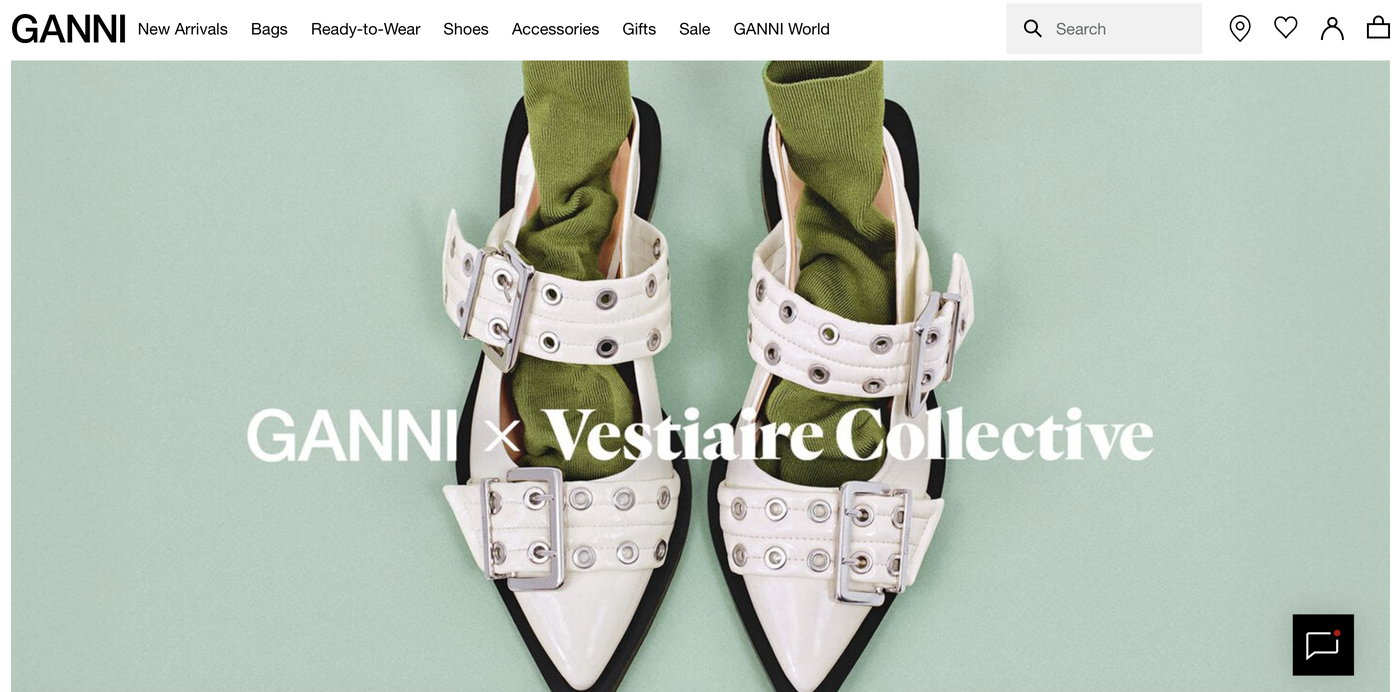
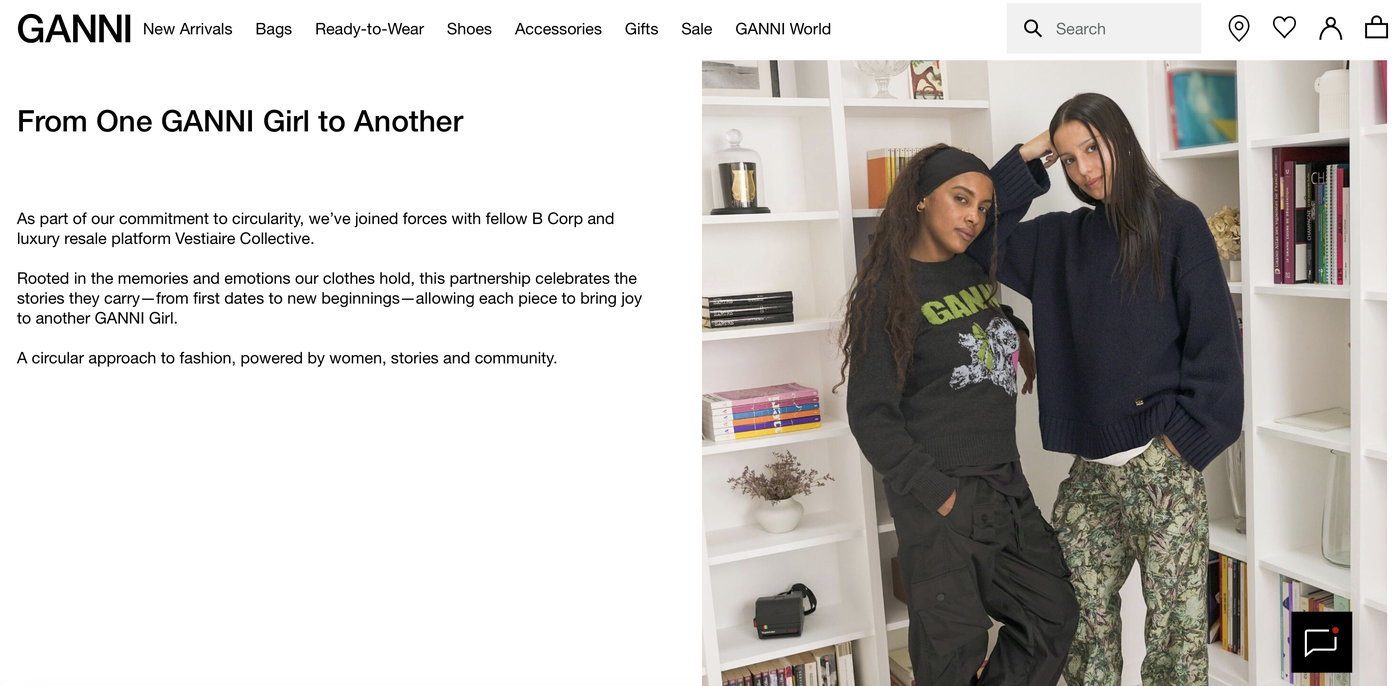
Figure 5.4. GANNI × Vestiaire Collective — “From One GANNI Girl to Another” (2025). The resale campaign presents garments as carriers of memories and stories, using emotional attachment and community belonging to preserve their desirability across successive users.
Image credit: “From One GANNI Girl to Another,” GANNI × Vestiaire Collective, 2025. Courtesy of GANNI and Vestiaire Collective.
5.3 Building the circular story
A circular story gives verified information a human, practical or systemic context. The starting point is not “what sustainability message do we want to tell?”, but which aspect of the product, service or initiative is most meaningful to the audience and best supported by evidence.
That story angle may focus on the material and construction of a product, the process through which it was made or recovered, the people and skills involved, the experience of using and caring for it, or its role within a wider circular system. Different angles can make the same underlying information more relevant without changing its meaning.
The following subsections explore how to select an appropriate story angle, translate it into a coherent visual language and use fashion’s aspirational power to reinforce longer-term value.
RESOURCE INSIGHT: Green Marketing in the Fashion Industry: A Critical Analysis of Sustainability Narratives — Journal of Marketing Management, 2024. This academic study deconstructs sustainability narratives in the communications of 41 fashion stores to ask how “eco-friendliness” is constructed — and whose interests the story serves. It cautions that sustainability is often framed to flatter the industry; circular stories should be tested for whether they advance change or merely polish the brand. Source: https://www.tandfonline.com/doi/full/10.1080/10253866.2024.2440557
5.3.1 Choosing a story angle
Circular storytelling can be organised through five main story angles. The appropriate angle depends on the communication goal, audience, desired response, and information available.
A product story focuses on materials, construction, durability, repairability, or other distinctive product characteristics. A process story explains how something is sourced, made, repaired, recovered, or transformed. A people story foregrounds the knowledge, labour and relationships of makers, repairers, artisans, users or communities. A use story connects the product to care, styling, memory, repair, resale or long-term ownership. A system story shows how the initiative relates to wider material flows, infrastructure, skills, collaboration, or industry change.
Each angle should answer two questions: what are we communicating, and why does it matter? A mono-material construction, for example, should not be communicated only as a technical feature. Its relevance may lie in making disassembly, sorting or recycling more feasible.
A campaign may combine angles, but it should establish a clear narrative priority. Trying to communicate every aspect at once can weaken both understanding and emotional impact.
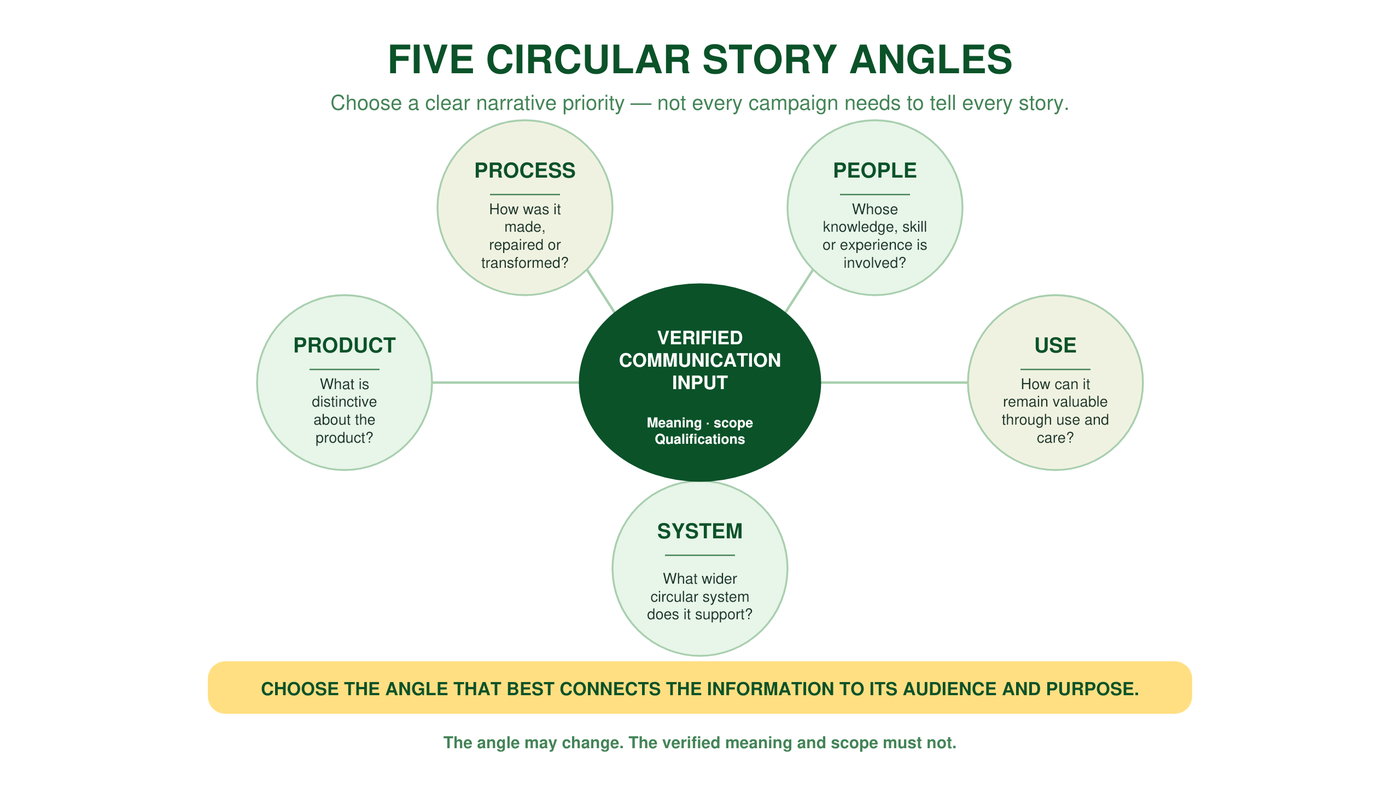
Figure 5.5. Five Circular Story Angles. Verified information can be explored through product, process, people, use, or system perspectives. Selecting a clear narrative priority helps make circular information relevant without altering its approved meaning or scope.
5.3.2 Translating the story into visual language
Visual language shapes how a circular story is understood and whether it feels credible, desirable, and culturally relevant. Photography, casting, styling, colour, composition, typography, and moving image do not simply decorate the message. They influence the meaning audiences take from it.
Generic sustainability codes, such as leaves, natural backgrounds, muted palettes or words such as “conscious” and “natural”, may create an environmental impression without communicating anything specific. They can also make different initiatives appear interchangeable or give weak information more significance than it deserves.
Visual decisions should therefore emerge from the verified input and chosen story angle. A repair story might show tools, hands, seams, damage and renewed use. A durability story could show repeated wear, material quality, or styling across time. A story about craft or designer authorship should represent the people, skills and processes involved accurately and respectfully.
Visual language must not imply a wider environmental benefit than the information supports. Its role is to make the story visible and emotionally resonant, not to compensate for missing evidence.
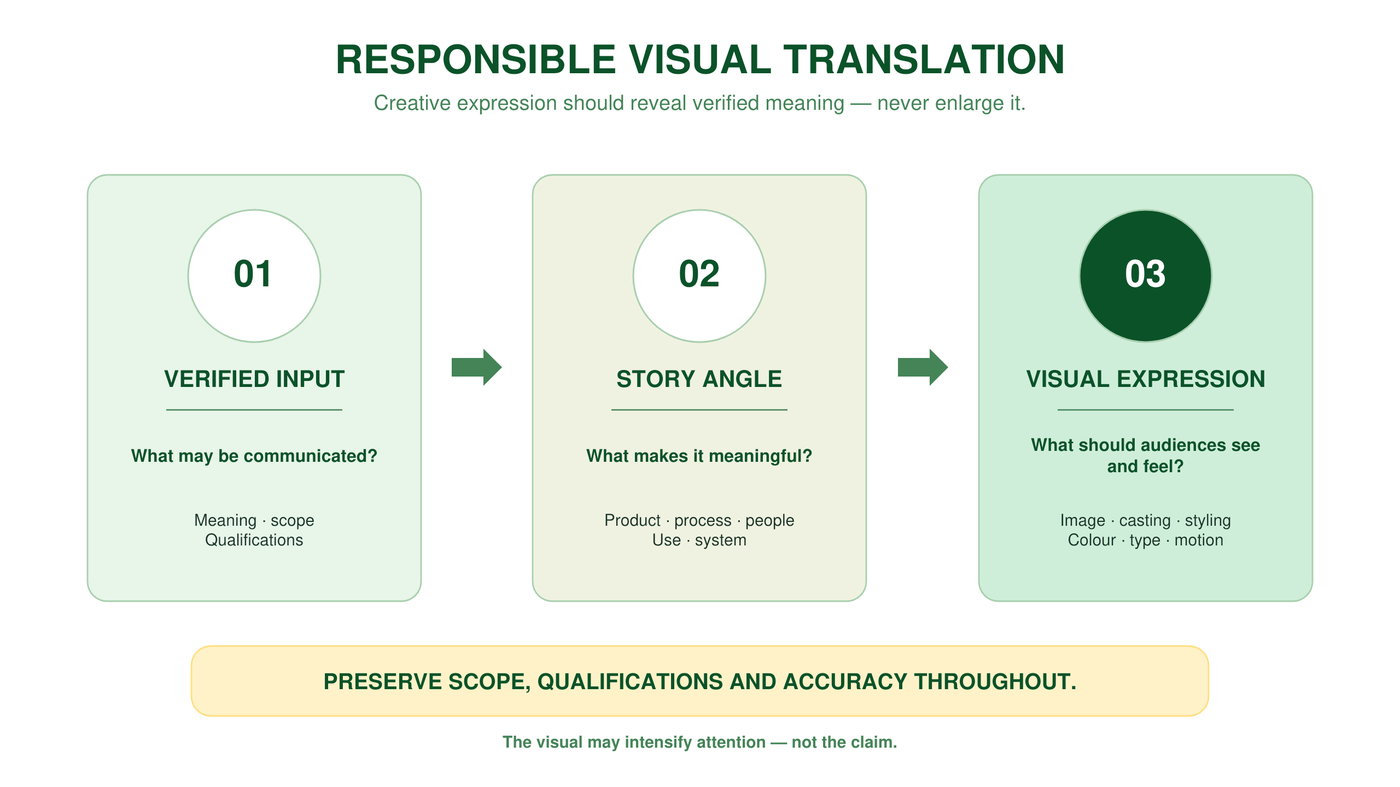
Figure 5.6. Responsible Visual Translation. Visual expression should develop from verified information and a defined story angle, preserving the scope and qualifications of the original input while making its meaning visible and engaging.
5.3.3 Redirecting aspiration
Fashion communication has historically created desire through novelty, seasonal change, scarcity, status, and replacement. Responsible circular communication needs to reconsider what is being made aspirational.
This does not mean removing beauty, emotion, or cultural relevance from fashion. It means using those qualities to make care, longevity, versatility, repair, memory, second life, and fewer, better products more desirable. A repaired garment can communicate skill and continuity. A pre-owned product can carry history and individuality. A long-lasting product can gain value through use rather than lose relevance as soon as a new collection appears.
Reframing aspiration therefore means expanding the sources of desirability available to fashion — from newness alone towards craftsmanship, continuity, uniqueness, use and retained value.
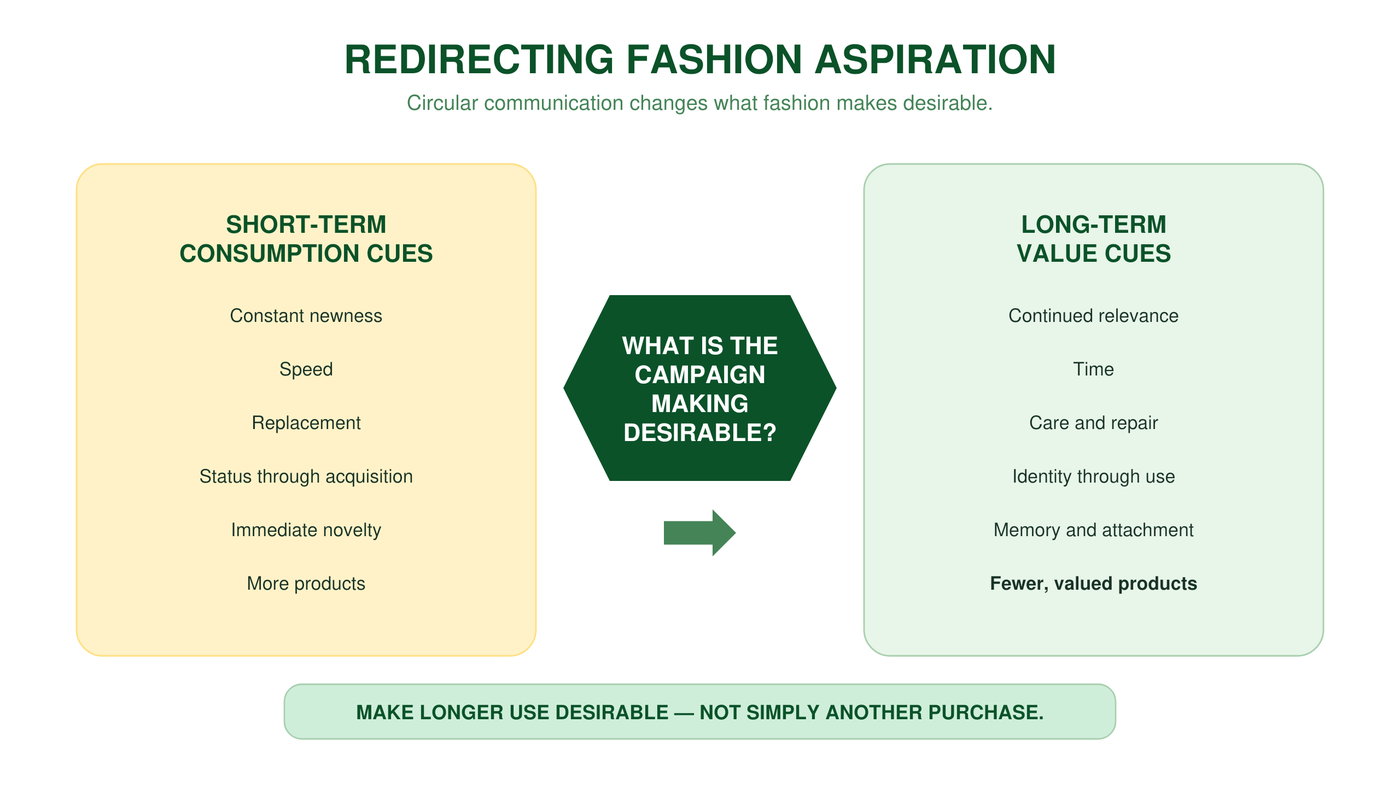
Figure 5.7. Redirecting Fashion Aspiration. Circular communication can redirect desire from constant novelty and replacement towards care, continued relevance, attachment, and longer product use.
GFA RESOURCE: 2030 Fashion Sector Vision — Global Fashion Agenda, 2023. Developed through a year-long consultation with over 900 fashion stakeholders, the Vision sets out a shared industry ambition for 2030, including championing consumer messaging that promotes circular models over traditional ones, publicly accessible and standardised transparency, and a 50% reduction in GHG emissions across scopes 1–3. For campaign designers, it signals a clear sector-wide direction: redirecting aspiration from novelty towards care, repair and reuse.
Source: https://globalfashionagenda.org/resource/2030-fashion-sector-vision/
5.3.4 Case example — Chloé × Mifuko: choosing a people angle
Chloé’s collaboration with Mifuko demonstrates how a commercial product story can be organised around the people involved in its production. The Maison’s basket bags are handwoven by independent craftswomen in rural Kenya using fair-trade materials. Chloé’s product communication foregrounds the artisans, fair pay and the possibility of earning income alongside agricultural work, reducing dependence on unpredictable farming conditions. Chloé — Woody basket
Although the communication could have focused primarily on the basket’s materials, construction or design, it adopts a predominantly people-centred angle. The makers’ skills and economic autonomy become part of the product’s value, connecting craftsmanship with Chloé’s wider commitment to advancing women.
The story is supported by an ongoing commercial relationship rather than a one-off campaign. Mifuko reports that the partnership contributed to business growth and helped finance the establishment of its Kenyan subsidiary, strengthening its local operations and relationships with artisan groups. Mifuko — Chloé collaboration
The case also shows that a people story can combine several supporting angles:
- People: the women who weave the baskets and the value of their expertise;
- Process: handweaving and distributed rural production;
- Product: the material, construction and individual character of each basket;
- System: fairer purchasing relationships and more resilient income opportunities.
The people angle remains the narrative priority, while the other angles provide context and evidence.
Reflection prompt
How does foregrounding the artisans change the perceived value of the basket? What additional information would help audiences assess the long-term social impact of the collaboration?
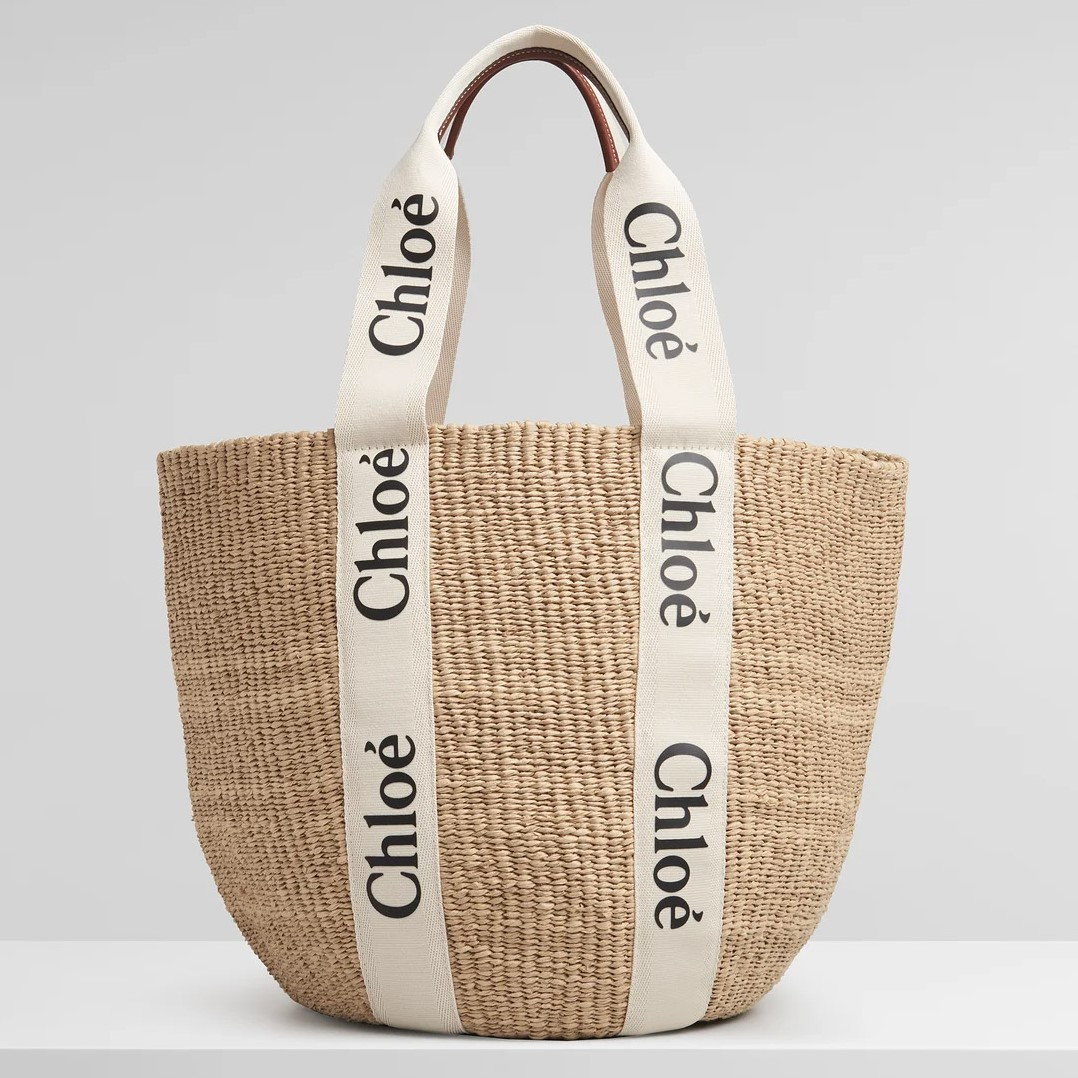
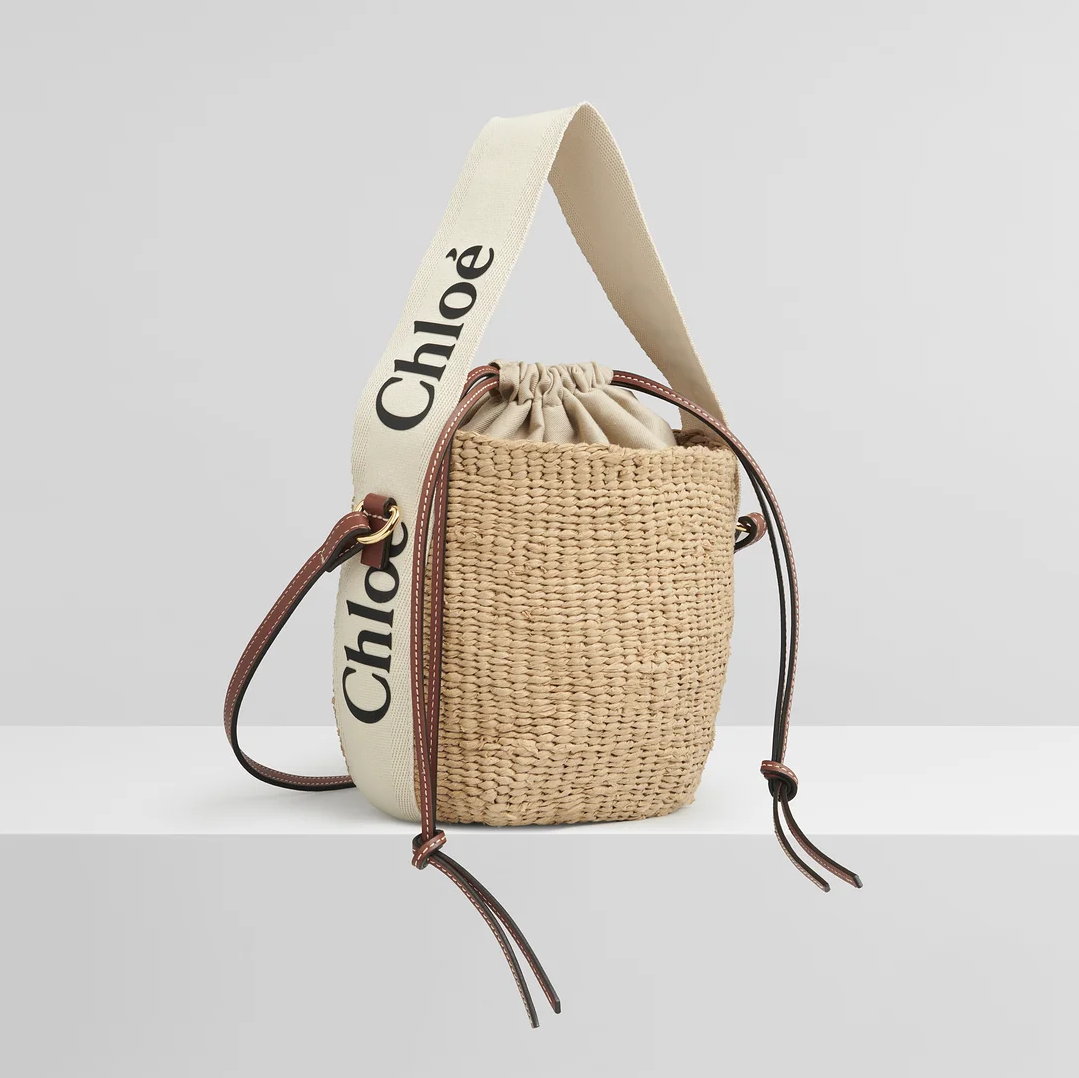
Figure 5.8. Chloé × Mifuko collaboration. By foregrounding the Kenyan craftswomen who handweave its basket bags, Chloé adopts a people-centred story angle that connects craftsmanship and product value with women’s skills, fair pay and economic opportunity.
Image credit: Chloé × Mifuko collaboration. © Chloé.
Chloé’s creative direction by Chemena Kamali further reinforces this narrative territory by presenting hand-finished details, textile knowledge, and folkloric references as sources of emotional and cultural value. However, craft-inspired imagery should not be treated as evidence of responsible production unless it is connected to identifiable makers, processes, and working conditions.
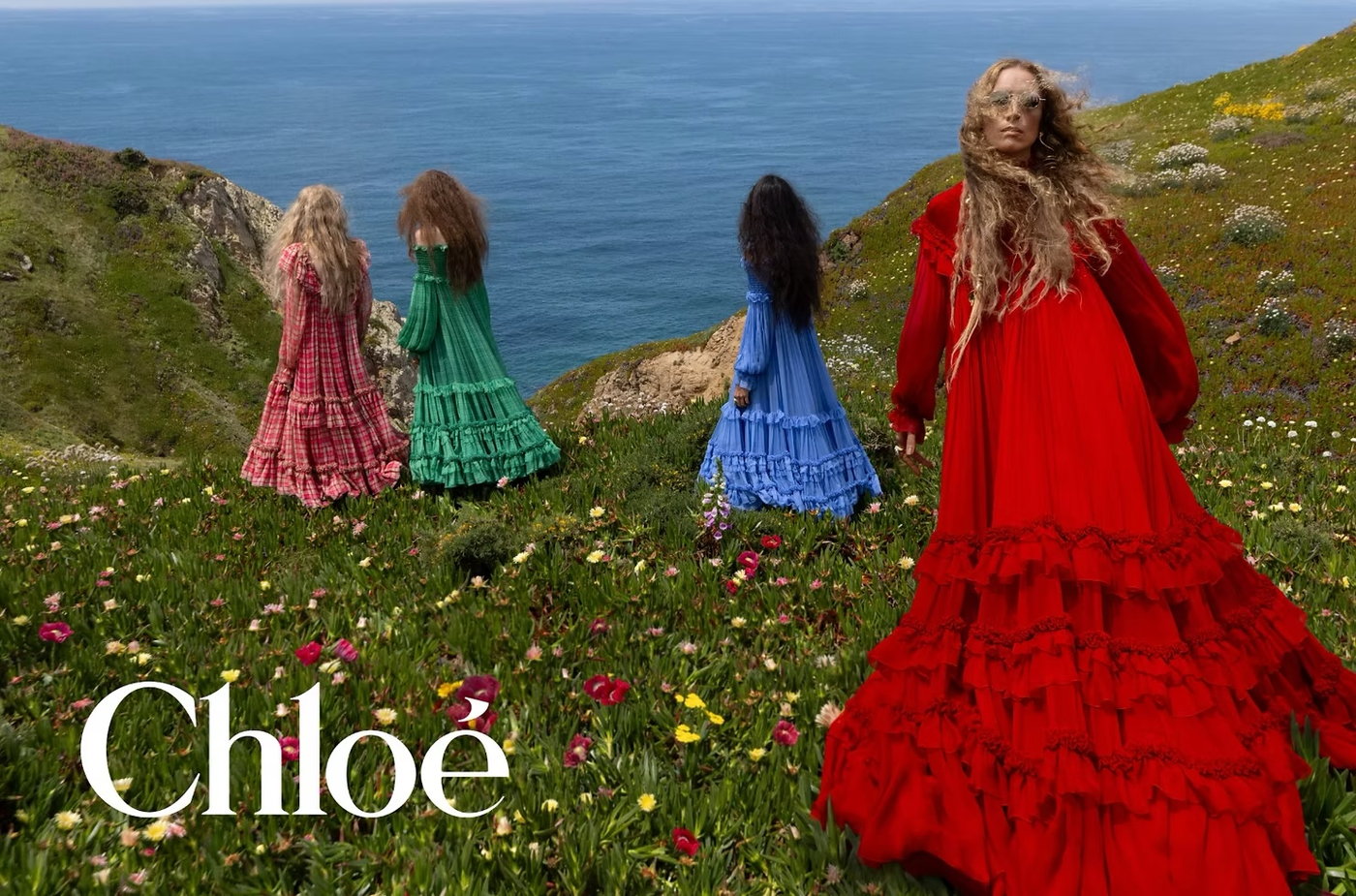
Figure 5.9. Chloé Winter 2026 Campaign. Through its focus on women, nature, craftsmanship and togetherness, the campaign transforms hand-finished details, inherited knowledge and material variation into sources of emotional and cultural value. It demonstrates how creative imagery can establish a narrative territory around craft, although the campaign itself does not constitute evidence of responsible production.
Campaign credits: Creative Direction — Chemena Kamali; Photography and Film Direction — Inez van Lamsweerde and Vinoodh Matadin; Styling — Elodie David Touboul; Models — Raquel Zimmermann, Jacqui Louise, Thalita Ferreira and Sarah Isaksen. Image © Chloé. Chloé Winter 2026 Campaign
5.3.5 Case example — PANGAIA × Coral Gardeners: choosing a system angle
PANGAIA’s collaboration with Coral Gardeners demonstrates how a commercial product story can be connected to a wider ecological system. The limited-edition capsule uses coral-inspired graphics and product communication to direct attention towards reef degradation, restoration science and the communities and ecosystems that depend on healthy coral reefs.
The primary narrative is therefore a system story. The garments provide a visible and purchasable point of participation, but the central subject is the wider reef-restoration effort. Supporting product angles include organic cotton and PPRMINT™ treatment, which is intended to extend wear between washes. PANGAIA states that each purchase generates a donation to Coral Gardeners. Specifying the amount or proportion donated would make the link between purchase and impact even clearer.
The case illustrates how partnerships can make complex ecological issues accessible through fashion. It also demonstrates why the boundaries between different claims must remain clear: the product’s materials, its care-related technology, and the contribution to reef restoration represent distinct forms of impact and require separate evidence.
PANGAIA also communicates the use of compostable TIPA® garment bags as part of its wider packaging approach. This is a separate operational claim and should not be presented as evidence of the Coral Gardeners partnership. Its credibility also depends on communicating the disposal conditions and availability of appropriate composting infrastructure.
Reflection prompt
How does the system angle change the meaning of the product? What information should PANGAIA provide to demonstrate the connection between each purchase and measurable reef-restoration outcomes?

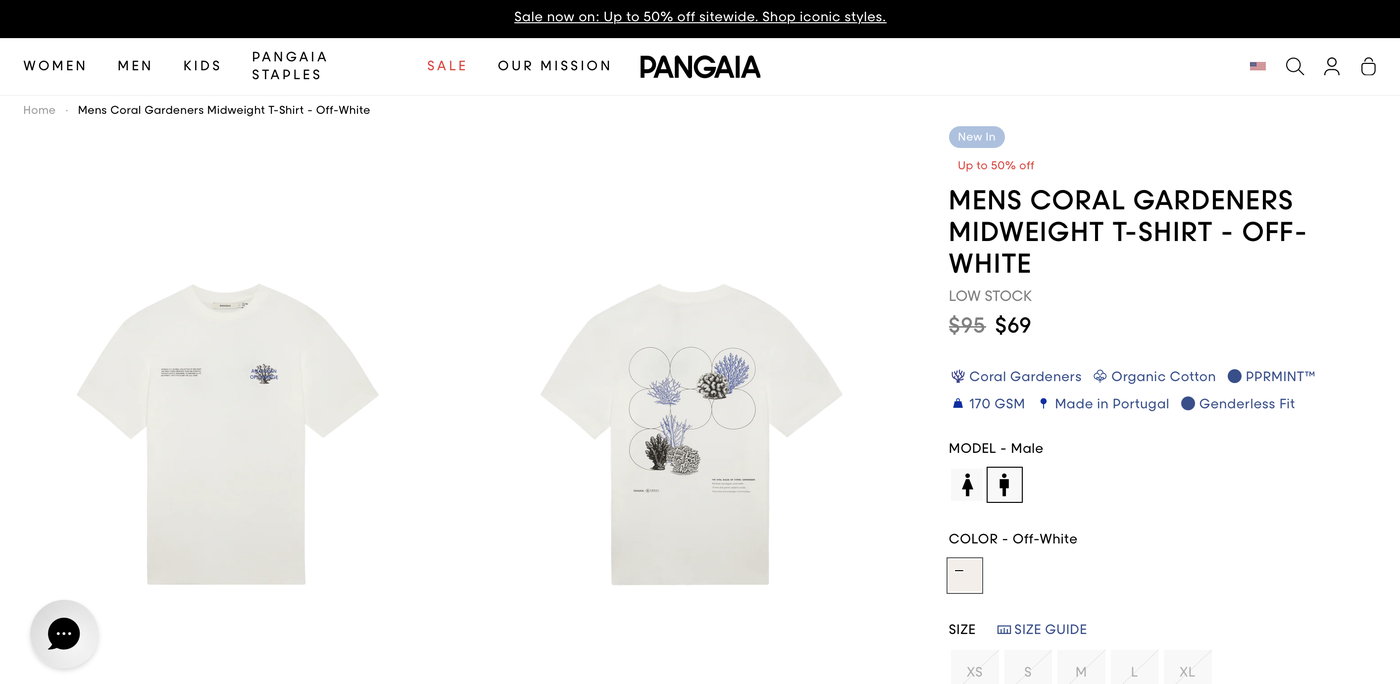
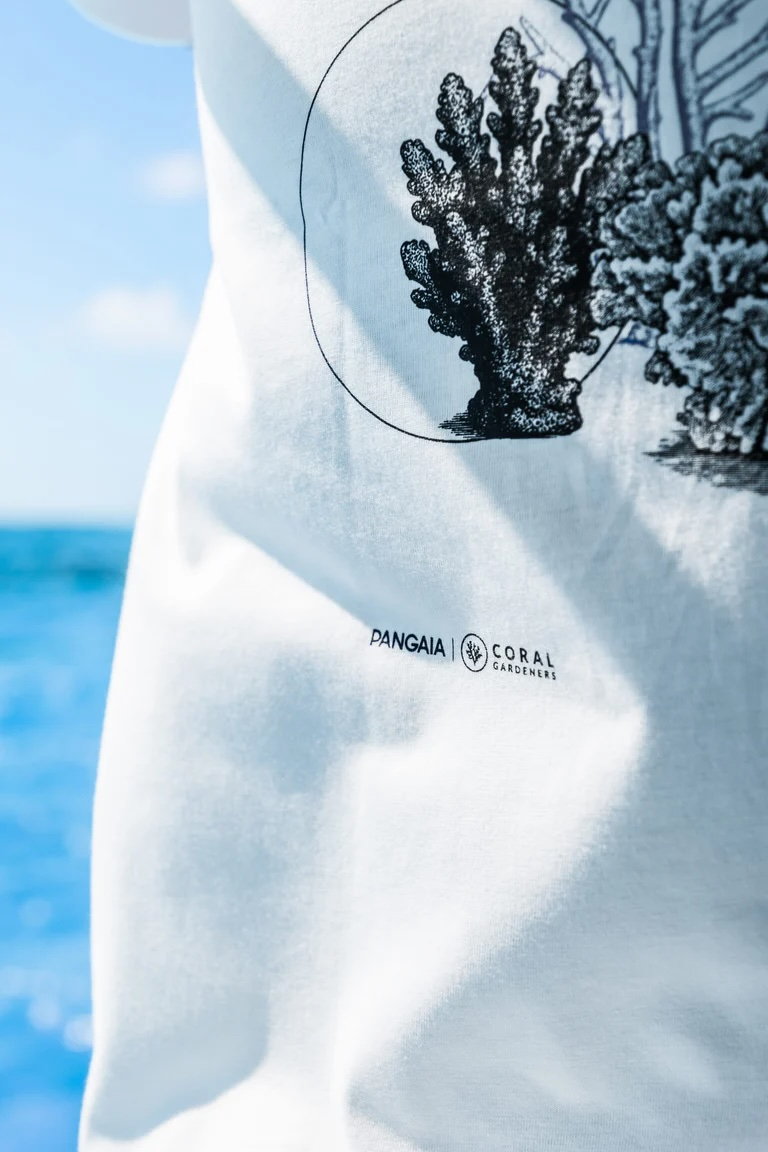
Figure 5.10. PANGAIA × Coral Gardeners collaboration. By connecting a limited-edition capsule with coral-restoration work, the collaboration adopts a system-centred story angle in which the product becomes an entry point into a wider narrative about reef ecosystems, conservation science and regeneration.
Image credit: PANGAIA × Coral Gardeners, second chapter. Courtesy of PANGAIA and Coral Gardeners.
5.4 Content strategy and digital tools
A responsible narrative must be adapted to the channels and formats through which audiences encounter it. Different messages require different levels of explanation, interaction, and supporting information. The objective is not to place every detail in every communication asset, but to create an accessible path from the initial message to the information needed to understand, evaluate, or act on it.
Digital tools can support this process by connecting short-form communication with product information, repair guidance, traceability data, service instructions, or deeper methodology. However, they can also accelerate oversimplification, generic language, and the production of content that appears credible without being adequately grounded.
The following subsections examine how communication depth can be matched to message complexity and how digital tools, including AI, can be used under appropriate human control.
RESOURCE INSIGHT: Social Media Marketing for Fashion Brands: A Complete Guide — Launchmetrics, 2026. Social commerce is mainstream: 44% of global consumers bought apparel three to seven times through social platforms in 2024, and 24% bought eight times or more. The guide’s core advice: run a cross-channel strategy (TikTok’s Media Impact Value grew 122% year-on-year while Instagram still drives 57% of US fashion impact) and measure outcomes beyond likes. Source: https://www.launchmetrics.com/resources/blog/social-media-marketing-fashion.
- PARTNER CASE STUDY: IRCEM — Romania. Topic: Digital Marketing. IRCEM, the Romanian Institute for Research in Circular Economy and Environment, uses digital marketing and sustainability communication to bring evidence-based circular-economy content to business, academic and policy audiences. Its activities show how a research organisation builds a credible digital presence and translates technical knowledge into accessible messages — directly relevant to content strategy and digital tools.
5.4.1 Matching format and depth to the message
Short-form content can make circular information accessible, but not every message can be communicated responsibly in a slogan, image or short video. The format should reflect the complexity of the information and the decision or action expected from the audience.
Care tips, repair reminders, take-back instructions and simple service updates may work as stand-alone social content. Product features and qualified claims often require a caption, product page, or FAQ. Process explanations, impact data and methodological information normally require deeper supporting material, such as traceability information, reports, certification details or technical notes.
Content strategy should therefore create levels of information rather than force all communication into a single format. A campaign film may generate interest, a carousel may explain the key message, a product page may define its scope, and a report may provide the underlying methodology.
Visual simplicity is not the same as informational simplification. A message can be clear and attractive while still directing audiences towards the context needed to interpret it correctly.
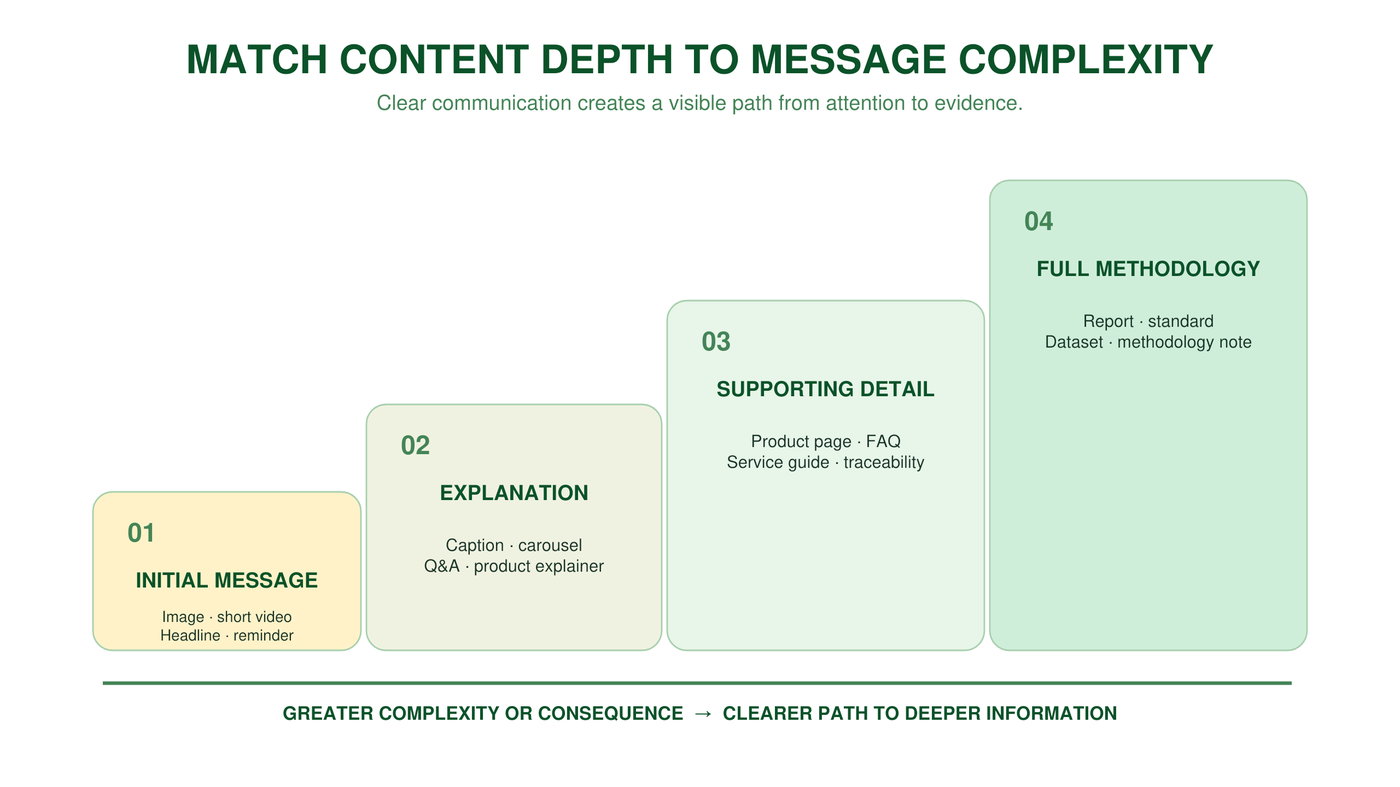
Figure 5.11. Matching Content Depth to Message Complexity. Content formats should provide an appropriate level of explanation and create a visible path towards deeper supporting information when the message cannot responsibly stand alone.
5.4.2 Using digital tools and AI responsibly
Digital tools can make circular information more accessible and actionable. QR codes, digital product information, interactive care guidance, repair tutorials, virtual product visualisation and take-back instructions can connect communication with practical participation.
AI can support parts of the communication workflow by helping to structure information, adapt language for different audiences, generate initial variations, or identify recurring customer questions. However, these uses create particular risks in sustainability communication. AI may introduce unsupported language, remove important qualifications, produce unrealistic imagery, reproduce bias, obscure authorship, or make a limited improvement appear more significant than it is.
Responsible AI use also requires considering its own environmental footprint. Training and running AI systems requires computing infrastructure, energy and water, and resource use increases with the scale and frequency of computation. For a brand communicating sustainability, this creates an important consistency question: AI should be used where it provides a clear benefit, rather than automatically generating multiple images, videos, texts or iterations simply because the technology is available. Lower-compute alternatives, existing assets and human-led processes may sometimes be sufficient.
Human editorial control is therefore essential. AI-generated content should be checked against the verified input, reviewed for scope and accuracy, and assessed for misleading visual or emotional implications. The use of AI should also respect copyright, representation, and organisational disclosure requirements.
AI can assist translation, information structuring and creative development, but it cannot determine whether a sustainability statement is adequately supported or whether its own use is proportionate to the task. Accuracy, judgement, accountability and responsible use of resources remain human responsibilities.
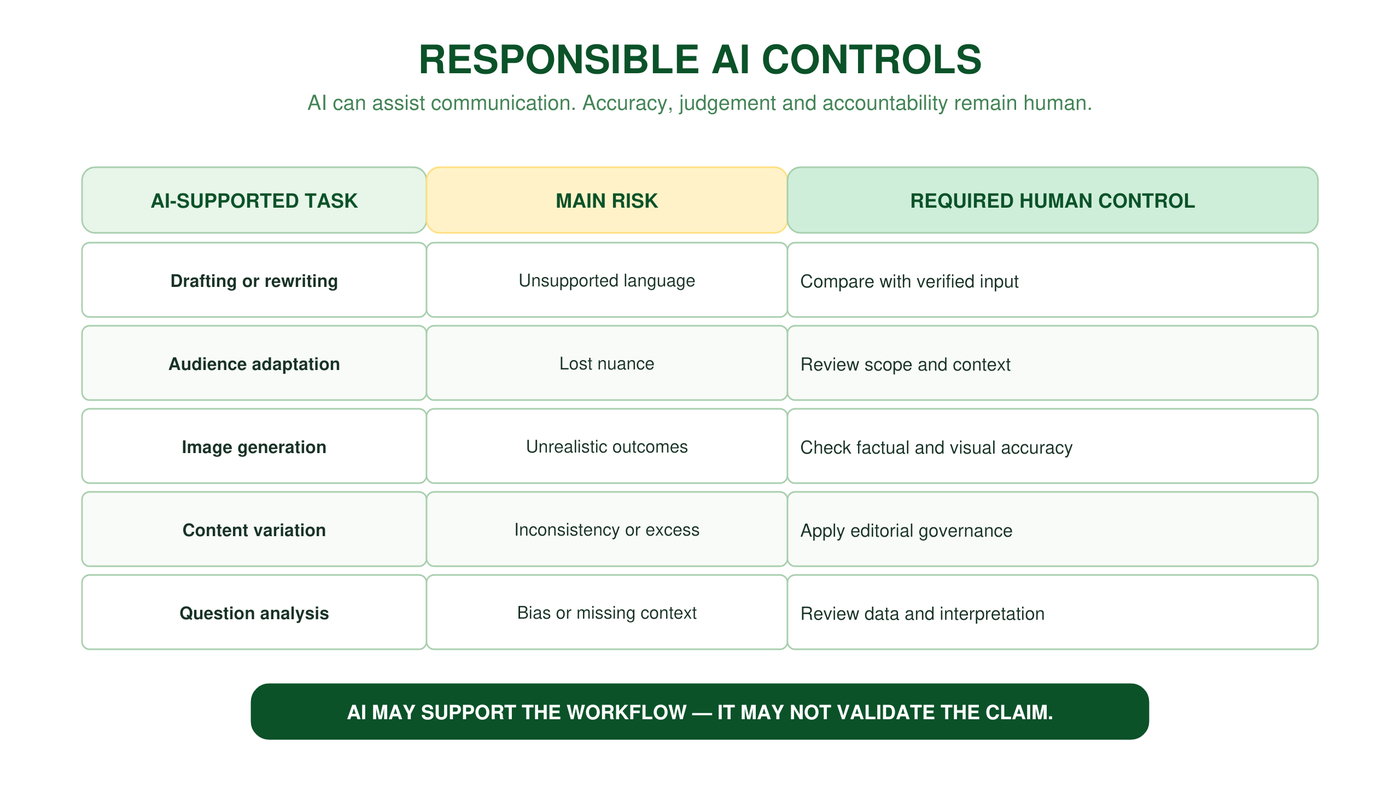
Figure 5.12. Responsible AI Controls. AI can support sustainability communication tasks, but each use introduces specific risks that require human review to preserve accuracy, context, consistency and accountability.
5.5 Designing the circular campaign
The Circular Campaign Brief brings the chapter’s principles together in a practical campaign-design process. It begins by defining the communication goal, audience, barrier, and desired action or understanding. The barriers identified through the Circular Engagement Journey in Chapter 4 provide a useful starting point. A campaign designed to increase take-back participation will require a different narrative and call to action from one intended to explain a material choice or strengthen trust in a repair service.
The verified communication input then establishes what the campaign may communicate, and which scope, qualifications or limitations must remain visible. The creative team can identify why this information matters, select a story angle, and develop an emotional hook, visual direction, and combination of content formats and channels.
Before release, the campaign should be reviewed as a complete audience experience, using the credibility principles from Chapter 1 and the Claim Checker Worksheet from Chapter 2. Learners should consider whether its language and visuals preserve the verified meaning, whether important limitations are visible, and whether the campaign could use circularity as a reason to encourage unnecessary consumption.
Finally, success indicators should relate to the campaign’s actual goal. These might include customer understanding, repair bookings, take-back participation, use of care information, resale engagement, reduced confusion, or improved trust.
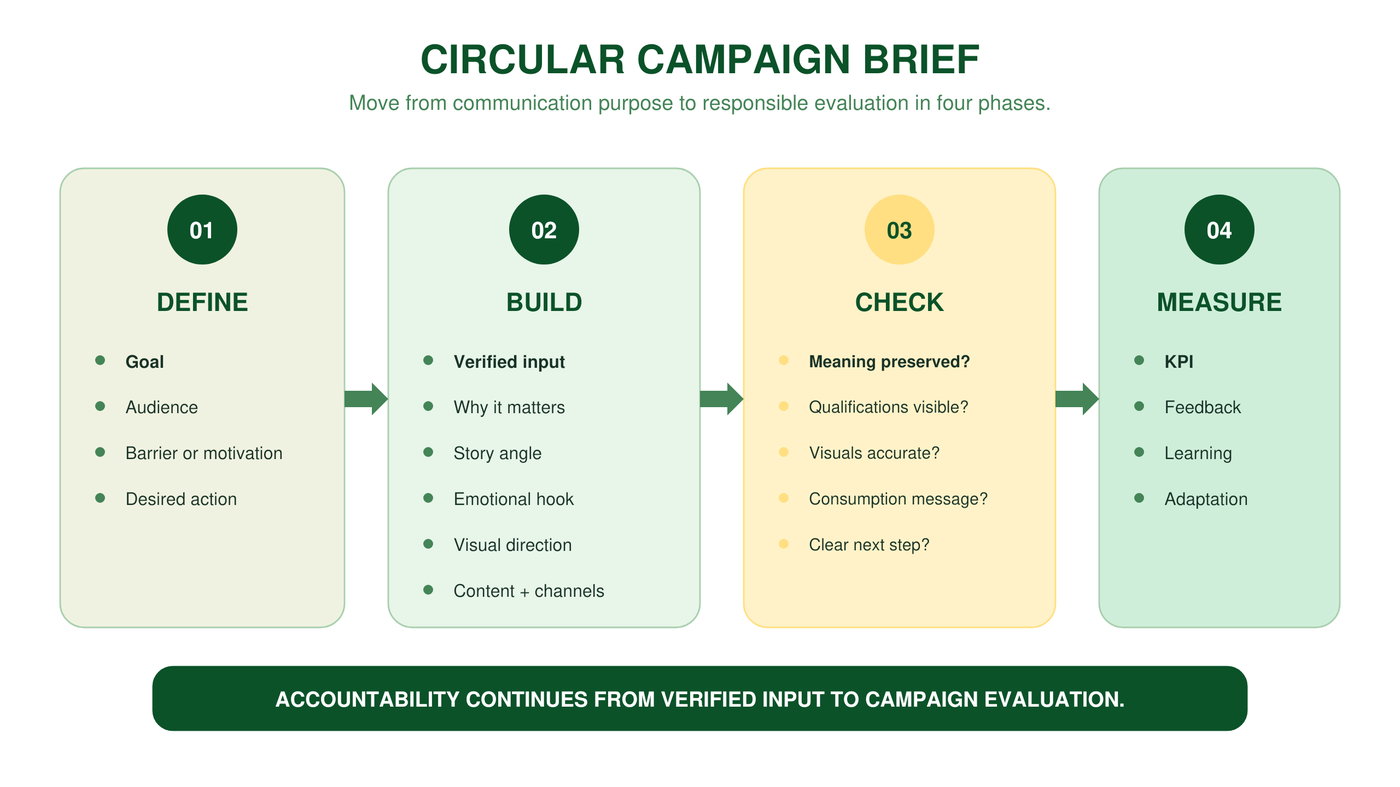
Figure 5.13. Circular Campaign Brief. The framework connects communication goals and audience barriers with verified information, creative development, responsible review, and measurable outcomes.
RESOURCE INSIGHT: The New Playbook for Fashion PR — The Business of Fashion, 2025. PR is being reshaped by new visibility channels — Substack newsletters, affiliate networks and AI-powered search — so earned-media playbooks built for an earlier era no longer reach circular-campaign audiences. BoF argues PR teams must rebuild how they establish brand credibility across these shifting platforms. Source: https://www.businessoffashion.com/case-studies/marketing-pr/case-study-the-new-playbook-for-fashion-pr/
- TRY IT NOW: pick one real campaign — GANNI × Vestiaire Collective, Chloé × Mifuko, PANGAIA × Coral Gardeners or Patagonia “Don’t Buy This Jacket” — and complete a one-page Circular Campaign Brief for it: goal, audience, barrier, key claim, evidence, emotional hook, story angle, visual direction, greenwashing risk check and success indicators. Free: the brief framework in section 5.5 and the Miro Creative Brief template.
- FOR YOUR SME / BUSINESS CASE: storytelling without evidence is now a business risk. A single unsubstantiated campaign visual can prompt complaints or regulatory scrutiny, while an internal sign-off process involving sustainability, legal and marketing teams need not be lengthy. Specific, verifiable claims (e.g. "free repairs in our store since 2019") are also far easier to defend than generic "sustainable" language.
5.6 Case studies
5.6.1 Marine Serre — regeneration, time and emotional value
Marine Serre presents the transformation of existing materials as a central part of the house’s creative identity. Deadstock fabrics, household textiles, and existing garments are not communicated as inferior substitutes for new materials. Through distinctive design codes, craftsmanship, styling and image-making, regeneration becomes visually recognisable and culturally desirable.
This approach is particularly visible in the Fall–Winter 2026 project The Grace of Time, developed through a dialogue with the Louvre and its curators. Photographed as a series of carefully composed tableaux resembling living paintings, the collection explores what allows objects, forms and gestures to endure across generations. Garments are presented not as fleeting seasonal products but as living objects capable of transforming, accumulating meaning and carrying material and cultural histories forward.
The narrative is supported by the collection’s use of upcycled silk scarves, reconstructed T-shirts, regenerated materials, and pieces involving extensive handwork. The original materials are not concealed or stripped of their previous identities. Their transformation becomes part of the product’s aesthetic and emotional value, combining verified material information with craft, designer authorship, memory, and continuity.
The case demonstrates how circular storytelling can shift perceptions of regenerated materials away from compromise and towards desirability. It also shows how a process story can be strengthened by product and use angles: the transformation explains how the garment was created, while the narrative of time and transmission suggests why it may deserve to be valued and kept.
However, a compelling story about transformation and longevity does not itself demonstrate circular impact. Communication should still clarify the proportion and source of regenerated material, how it was processed, and whether the product is designed and supported to remain in use for longer. Emotional value becomes credible as a circular strategy when it is connected to material evidence, durable construction, and practical conditions for continued use.
Discussion prompt: How does Marine Serre use transformation, craft and cultural imagery to make existing materials desirable? What evidence and practical conditions are needed for this emotional narrative to support longer product use?
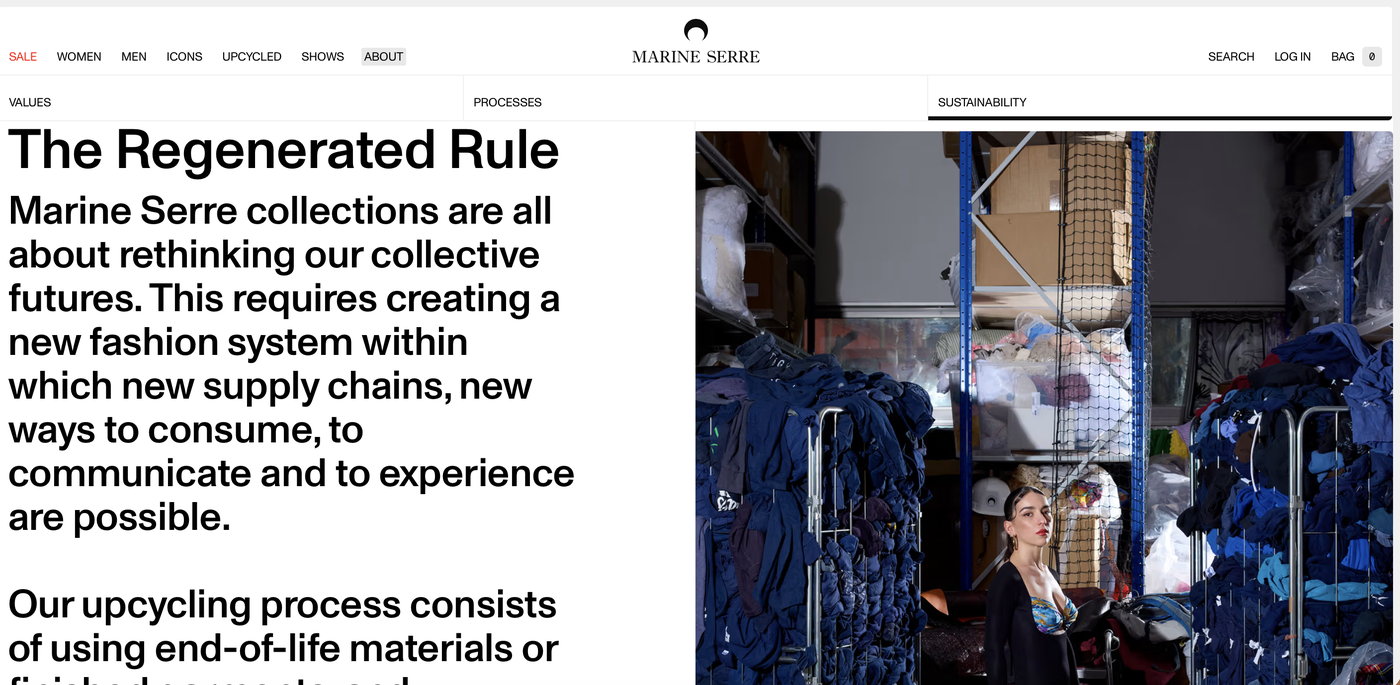
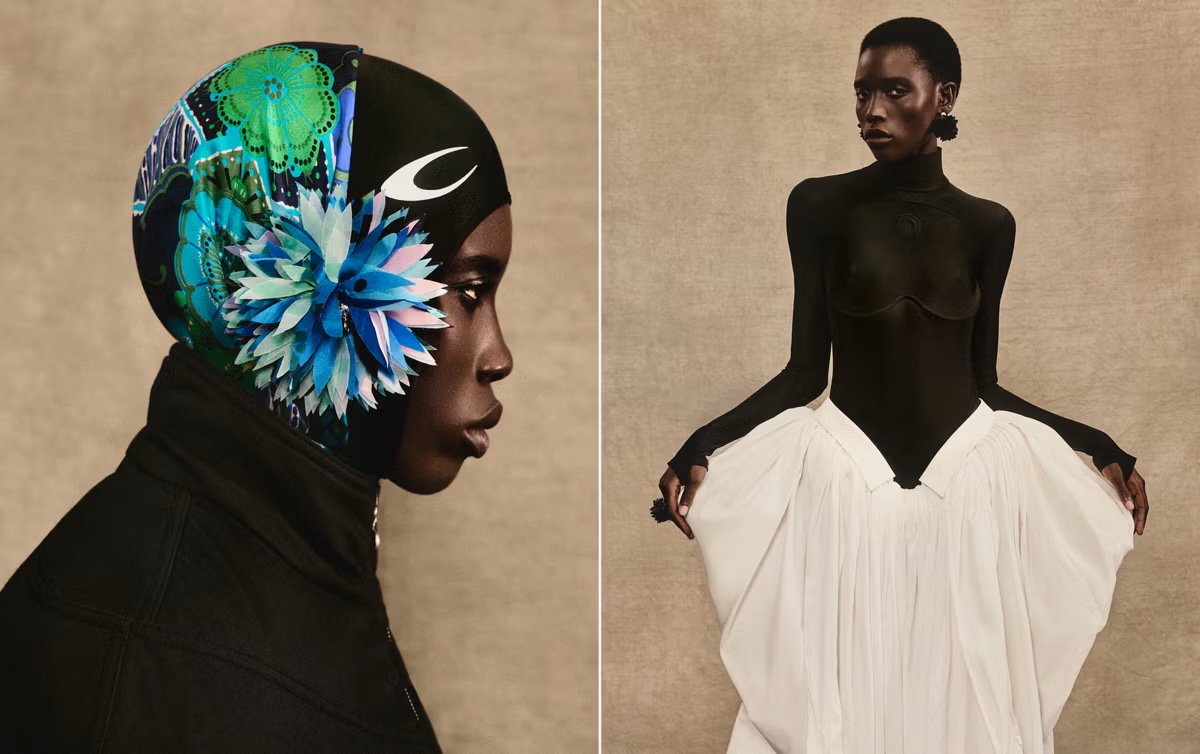
Figure 5.14. Marine Serre, The Grace of Time, Fall–Winter 2026. Presented as a series of living paintings, the campaign frames garments as objects that can endure, transform and gather meaning over time, connecting emotional value with craft, memory and transmission.
Campaign credits: Photography — Arash Khaksari; Models — Nyaluak Gatluak and Ambre Roumeau; Set Design — Sylvain Cabouat; Styling — Benoit Bethume; Hair — Pablo Kuemin; Makeup — Jenneke Croubels. Image © Marine Serre.
5.6.2 Case study — Patagonia: challenging the conventional purpose of marketing
On Black Friday in 2011, Patagonia published a full-page advertisement in The New York Times featuring one of its best-selling fleece jackets under the headline “Don’t Buy This Jacket.” Rather than presenting the product only through its benefits, the advertisement disclosed the water, carbon emissions and production waste associated with making it and asked readers to consider whether they genuinely needed to purchase it.
The campaign represented a radical departure from conventional marketing. Advertising normally creates urgency, stimulates desire and removes barriers to purchase—particularly on Black Friday. Patagonia used the same commercial space to question unnecessary consumption and acknowledge that even a durable product made with recycled material still carries an environmental cost. Marketing was therefore used not only to promote a product, but to challenge the assumption that business success must depend on continually selling more new products.
Its credibility came from the connection between message and system. Patagonia did not simply ask customers to consume differently: it accepted responsibility for product quality, repair, resale, and end-of-life recovery. This made the campaign an early example of circular communication supported by services and operational commitments.
The case nevertheless contains a tension. The campaign strengthened Patagonia’s reputation, distinctiveness and customer loyalty, potentially making the brand—and its products—even more desirable. Anti-consumption communication can therefore still function as powerful brand marketing. Its circular value depends on whether it leads to fewer unnecessary purchases and longer product use, rather than simply generating trust and additional sales.
Discussion prompt: What made Don’t Buy This Jacket more than a provocative advertising slogan? Could a brand use the same message credibly without providing durability, repair, resale, and take-back systems?
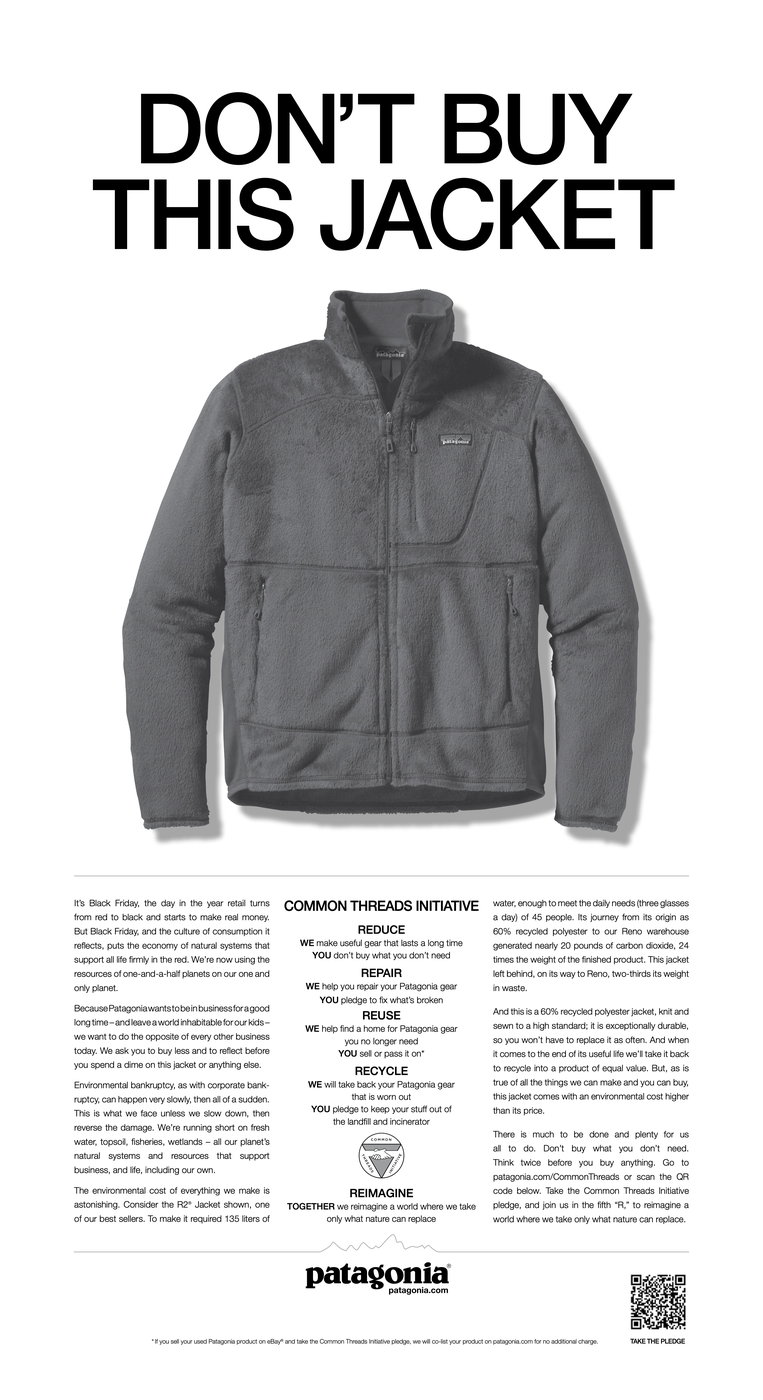
Figure 5.15. Patagonia, “Don’t Buy This Jacket,” 2011. Published on Black Friday as part of the Common Threads Initiative, the advertisement reversed the conventional logic of marketing by using commercial media to question unnecessary consumption and disclose the environmental cost of the product shown.
Image credit: “Don’t Buy This Jacket,” Common Threads Initiative, Patagonia, 2011. Originally published in The New York Times. © Patagonia.