
Chapter 2 — full chapter
Chapter 2 — full chapter
Chapter 2 — Design Approaches for Circular and Regenerative Innovation
This chapter introduces the design approaches that fashion uses to move beyond linear product development: ecodesign, Cradle to Cradle, biomimicry, biodesign and regenerative design. Each approach asks a different question about materials, processes and systems, and each is presented here with a case example and a critical assessment.
The approaches overlap in some areas but they are not interchangeable, and none of them guarantees a circular outcome on its own. A nature-inspired garment may still use materials that cannot circulate safely, and a bio-based material may require harmful processing or inappropriate disposal conditions. Each approach is therefore treated as a design choice that has to be tested against evidence, functional performance and the lifecycle consequences it produces.
Another way of moving beyond linear design is to draw on approaches that rethink how products relate to materials, production processes, living systems and the communities on which fashion depends.
Ecodesign, Cradle to Cradle, biomimicry, biodesign and regenerative design contribute different perspectives to circular innovation. They overlap in some areas, but they are not interchangeable. Ecodesign seeks to reduce environmental impacts; Cradle to Cradle plans safe material cycles; biomimicry learns from living systems; biodesign works with organisms or biological processes; and regenerative design seeks to restore and strengthen ecological and social systems.
None of these approaches automatically guarantees a circular or sustainable outcome. A nature-inspired garment may still use materials that cannot circulate safely, while a bio-based material may require harmful processing or inappropriate disposal conditions. Designers must therefore understand what each approach contributes, where its limits lie and how its environmental implications can be evaluated.
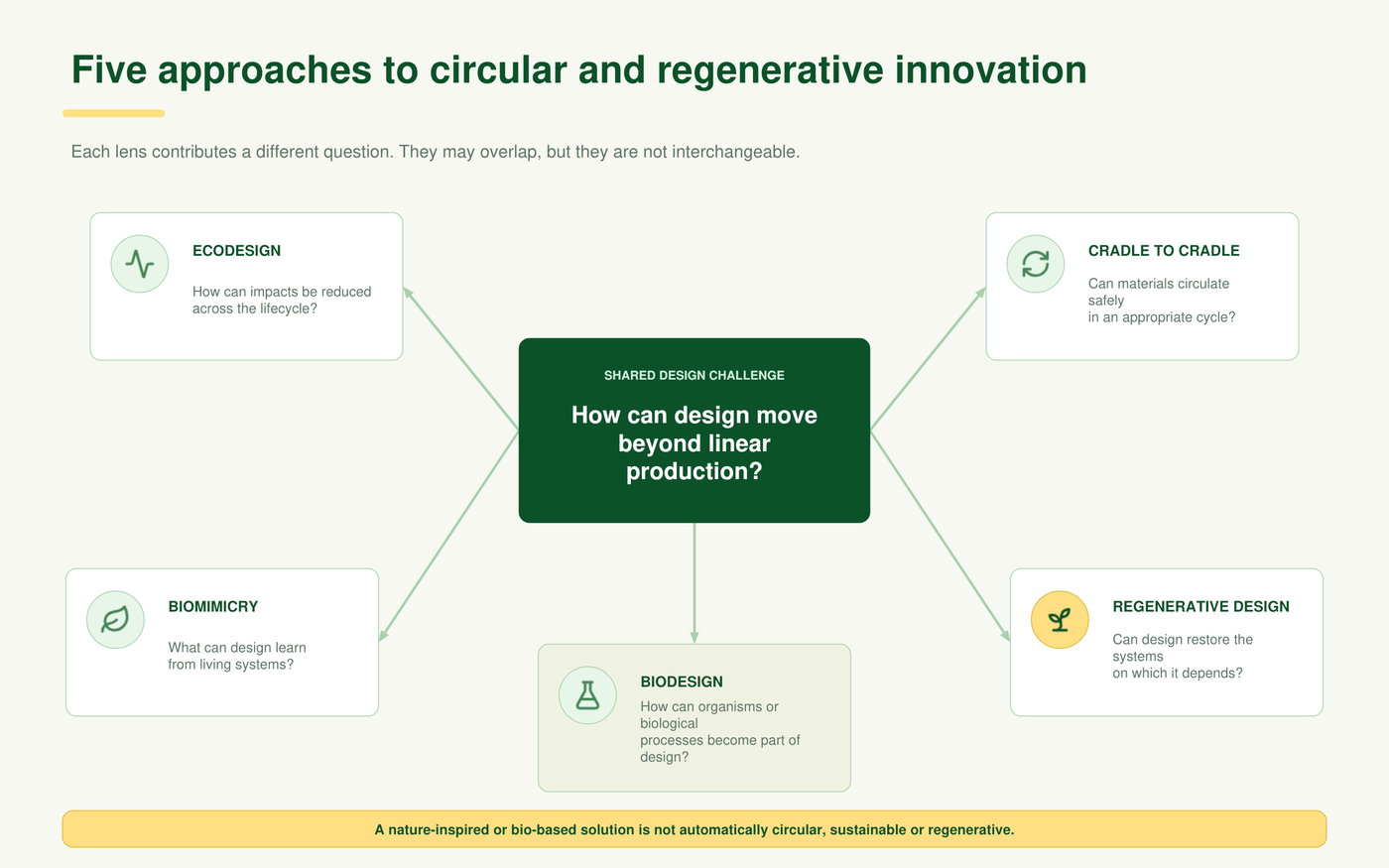
Figure 13. Five approaches supporting circular and regenerative innovation. Ecodesign reduces lifecycle impacts; Cradle to Cradle plans safe material cycles; biomimicry learns from living systems; biodesign works with organisms and biological processes; and regenerative design seeks positive ecological and social outcomes.
Biodesign and regenerative design can generate new materials, processes and relationships, but their environmental benefits should not be assumed. A biologically produced material may still require intensive processing; a regenerative approach may improve impacts at one stage while shifting them elsewhere; and an innovative material may remain difficult to repair, separate or recycle. These trade-offs reinforce the need to evaluate design choices across the full product life cycle rather than judging them by a single attribute or claim.
Life cycle thinking and Life Cycle Assessment provide methods for examining these wider consequences, comparing alternatives and identifying where a solution may reduce one impact while creating another.
In this chapter:
- 2.1 Ecodesign: Reducing Impacts Across the Lifecycle
- 2.2 Cradle to Cradle: Designing Safe Material Cycles
- 2.3 Biomimicry: Learning from Living Systems
- 2.4 Biodesign: Designing with Living Organisms
- 2.5 Regenerative Design: Restoring Ecosystems and Communities