
Chapter 7 — full chapter
Chapter 7 — full chapter
7.6.1 Recycling Technologies
In the EU, approximately 6.95 million tonnes of textile waste were generated in 2020, about 16 kg per person. Collection and treatment data remain fragmented, and separate collection does not by itself guarantee reuse or fibre-to-fibre recycling. At global level, less than 1% of the fibre market is supplied by pre- and post-consumer recycled textiles; this is different from the share of waste collected. Keep geography, year, denominator and whether a figure describes collection, recycling or fibre-market share explicit.
Collection statistics do not describe the final outcome of exported used textiles. EU exports reached about 1.4 million tonnes in 2023, with Africa and Asia receiving similar overall shares. At destination, items may be reused, sorted and re-exported, recycled, landfilled, burned or dumped. Assessment must therefore follow material beyond the exporting country and examine quality, contamination, local demand, sorting capacity, residual-waste management, worker conditions and environmental justice.
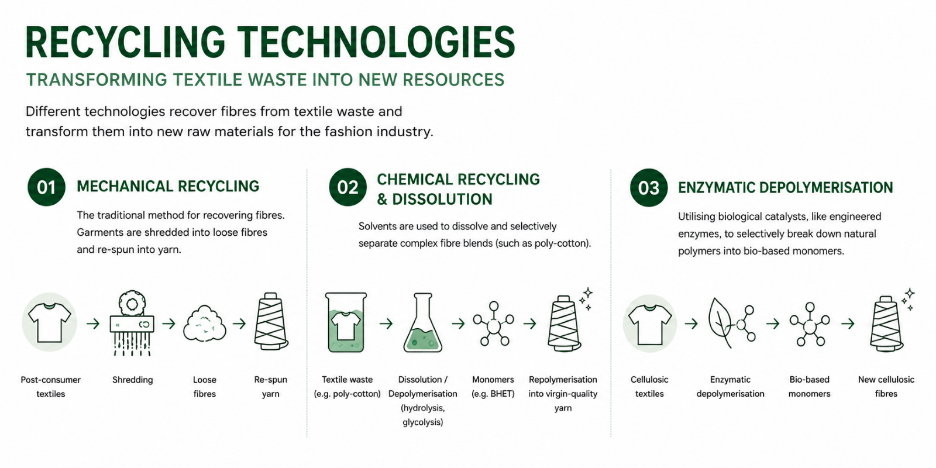
Textile recycling routes can be grouped as mechanical or thermomechanical processes, solvent-based separation or dissolution, chemical depolymerisation, and emerging biochemical or enzymatic processes. Mechanical recycling is established for selected streams but can shorten fibres; polymer-melting routes require compatible thermoplastics; dissolution and depolymerisation require controlled composition and removal of dyes, finishes and trims; biochemical routes remain feedstock- and maturity-dependent.
Reference: European Environment Agency, Management of used and waste textiles in Europe’s circular economy: https://www.eea.europa.eu/en/analysis/publications/management-of-used-and-waste-textiles-in-europes-circular-economy
RESOURCE INSIGHT: Circulose® — Circulose, Sweden. Circulose owns the Ortviken commercial-scale textile-to-textile recycling plant in Sundsvall, which converts cotton-rich textile waste into dissolving pulp for regenerated cellulosic fibres. Following Renewcell’s 2024 bankruptcy and Altor’s acquisition of the assets, Circulose announced that production was planned to resume in Q4 2026; update this status after restart evidence is published. Sources: https://www.circulose.com/circulose-restarts-commercial-scale-production-at-ortviken-plant-in-sundsvall-sweden/ and https://www.circulose.com/factory-o/
- CASE STUDY: Sylvia Calvo — Spain. Topic: Sustainable Upcycling. Sylvia Calvo is a Spanish designer who creates collections from recovered and upcycled materials, treating pre-existing textiles as a design resource. Her practice illustrates creative upcycling as a complement to recycling technologies — extending material life through design rather than reprocessing
- GFA RESOURCE: Scaling Circularity — Global Fashion Agenda and McKinsey & Company, 2021. Less than 1% of textile waste is currently recycled into new fibres for clothing, yet GFA estimates that existing recycling technologies could drive 80% circularity in fashion if fully scaled. Technologies already deliver fibre-to-fibre recycling for single-colour cotton, cellulosics and synthetics, with blended-fibre solutions emerging. The critical bottlenecks are collection and sorting infrastructure, investment in recycling capacity and confidence in feedstock quality and demand. Source: https://globalfashionagenda.org/wp-content/uploads/2022/12/Scaling-Circularity-November-2021.pdf.
- Mechanical recycling physically processes textiles into reusable fibres and is currently the most established textile recycling route, although it often shortens fibres and therefore commonly produces lower-grade applications or requires blending with virgin fibres. Chemical recycling dissolves or depolymerises selected materials to recover cellulose, polymers or molecular building blocks for new fibres. Several chemical recycling technologies have reached demonstration or early commercial scale, particularly for cotton-rich textiles and polyester, but their market presence remains limited by feedstock purity requirements, high investment and operating costs, and insufficient collection and sorting infrastructure. Enzymatic recycling is a more recent biological approach that uses specialised catalysts to selectively break down polymers under relatively mild conditions. While it may offer advantages in processing certain blends and reducing harsh chemical use, most textile-specific enzymatic systems remain at laboratory, pilot or demonstration stage rather than widespread commercial deployment. Overall, recycled fibres produced from textile waste still represent less than 1% of the global fibre market, showing that fibre-to-fibre recycling is technically promising but not yet economically or industrially mature at the scale needed to replace virgin fibre production.
Case study https://re-fresh.global/