Chapter 7 — full chapter
| Site: | FashionKIC Learning Platform |
| Course: | Circular Design Strategies |
| Book: | Chapter 7 — full chapter |
| Printed by: | Guest user |
| Date: | Sunday, 1 November 2026, 3:20 AM |
Chapter 7 — Downstream Strategies: Value Retention and Recovery
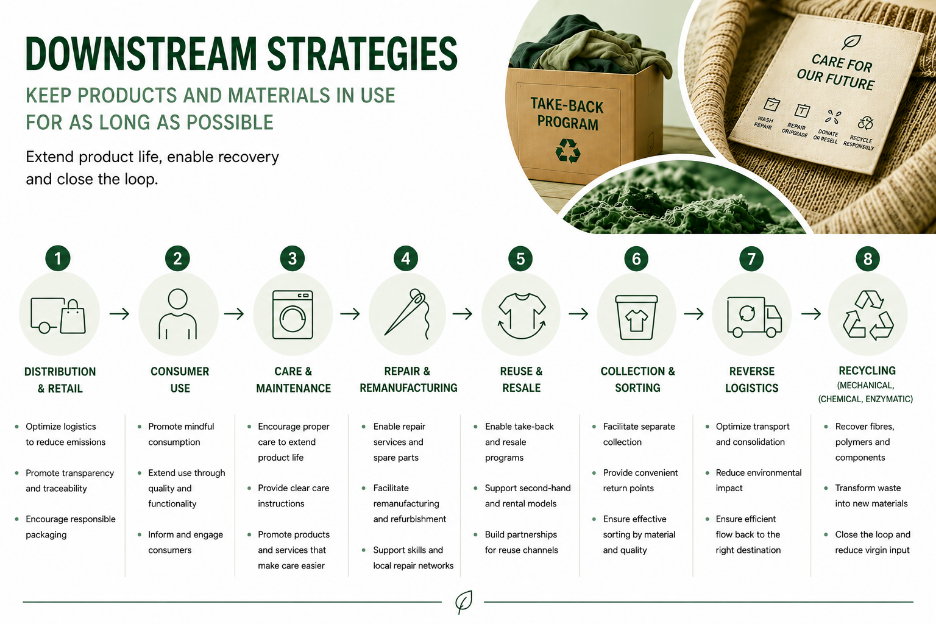
Downstream strategies address how products are distributed, used, maintained, recovered and transformed after production — from distribution and retail to consumer use and care, repair and remanufacturing, reuse and resale, collection and sorting, reverse logistics and recycling. Regulation (separate collection, EPR, the ESPR and the ban on destroying unsold textiles) is accelerating these practices, while economic, logistical and infrastructure challenges remain.
Chapter 6 ends where the product leaves production. Chapter 7 asks what has to exist after that point for the value created earlier to be preserved: how repair, resale, collection, sorting, reverse logistics and recycling services are designed, operated, measured and paid for, and how they connect back to product decisions. The conceptual pathways — multi-life design, inner and outer loops, the recovery hierarchy — are introduced in Chapter 1, and the instruments that shape them in Chapter 4; here the focus is implementation: service and route design, the actors and partnerships involved, the product information each route depends on, and the economics that decide whether a route is viable at all. Regulation is increasing responsibility for product design, information, unsold products and textile waste, which changes the conditions in which these services operate — separate collection, EPR, the ESPR and the prohibition on destroying unsold apparel do not make repair, resale or remanufacturing mandatory. Implementation remains uneven across Europe.
Reverse logistics is the management of the recovery operations that moves used or returned garments from consumers back to retailers, manufacturers or specialised recovery facilities. Reverse logistics supports take-back schemes, repair services, resale, remanufacturing and recycling by transporting products to the appropriate facilities. Reverse logistics is best understood as cross-cutting infrastructure rather than a late step in a sequence: it links take-back, repair, resale, remanufacturing, sorting and recycling, and its cost, speed and reliability often decide whether a service is viable at all.
Effective reverse logistics relies on integrated transport, handling and information systems that connect collection points, warehouses, service centres and recycling facilities. By optimising these return flows, companies can reduce transport costs, recover more products and materials, and support circular business models.
Guiding questions
- Which circular business models (rental, leasing, subscription, repair services) make most sense for our SME?
- How must product design change when we move from one-off sales to product–service systems over multiple life cycles?
- What organisational capabilities and partnerships do we need to support maintenance, upgrade, and take-back services?
- How can we design experiences and offers that encourage customers to participate in circular services?
In this chapter:
- 7.1 Distribution and Retail
- 7.2 Consumer Use, Care and Maintenance
- 7.3 Repair and Remanufacture
- 7.4 Reuse and Resale
- 7.5 Collection and Sorting
- 7.6 Recycling and Upcycling
7.1 Distribution and Retail
Companies can optimize transport routes, consolidate shipments, minimize packaging, and prioritize rail or sea freight over air transport. They can also optimize inventory through demand forecasting, digital inventory management and on-demand production to reduce overstock and avoid unsold products. Retailers can introduce reusable packaging, offer click-and-collect services, and provide customers with clear sustainability information at the point of sale. Stores can become circular hubs by collecting used garments, facilitating repair services, supporting resale programmes, and operating efficient reverse logistics systems that recover products for reuse, refurbishment or recycling. Together, these actions reduce environmental impacts while improving operational efficiency and strengthening customer engagement in circular business models.
Zalando has developed one of Europe's most advanced digital distribution networks by combining AI-driven demand forecasting, real-time inventory management, and a network of strategically located fulfilment centres. Its logistics system optimises stock allocation across warehouses, consolidates shipments, and reduces transport distances while improving product availability. Customers can use click-and-collect services, receive transparent delivery information, and choose lower-impact shipping options where available. Through digital inventory optimisation and efficient reverse logistics for returns, Zalando reduces unnecessary transport, avoids excess stock, and improves resource efficiency across its retail and distribution operations.
7.2 Consumer Use, Care and Maintenance
Brands can reduce the environmental impact of the use phase by encouraging consumers to use garments for longer and care for them properly. Care labels should promote lower-impact practices such as washing only when necessary, using low-temperature cycles, line drying, and avoiding unnecessary ironing. Awareness campaigns can encourage responsible garment use by promoting durability, repair, and mindful consumption. Extending garment life also requires making maintenance easy. Brands can provide spare buttons, repair kits, replacement components, and clear repair instructions, while products should be designed so that common failures, such as broken zippers or worn buttons, can be easily repaired. Professional services such as sustainable cleaning, maintenance, alterations, and style refresh further extend product lifetimes. Digital Product Passports, QR codes, and online platforms can provide care guidance, repair tutorials, maintenance advice, spare part information, and links to authorised repair services. Together, these measures extend product lifetimes, reduce replacement rates, and lower textile waste.
Responsibility is shared. As Chapter 3 sets out, circular behaviour depends on product design, service access, price, convenience, communication and infrastructure — so care guidance and repair services should be framed as making the low-impact option the easy option, not as a condition that rests mainly on the user.
In luxury products, care and maintenance often becomes part of a product's value proposition. High-quality leather, fur and heritage garments are often designed to remain in use for decades and are frequently passed between generations. Brands therefore offer specialised cleaning, conditioning, recolouring, repairs, component replacement and alteration services that preserve both functionality and appearance. Rather than encouraging replacement, these services maintain product value, strengthen customer relationships, and support a slow-fashion model based on longevity.
VAUDE encourages customers to extend the lifetime of their garments through comprehensive care guidance, repair services, and awareness campaigns. Care labels and online resources promote lower-impact practices such as washing only when necessary, using low-temperature cycles, line drying, and avoiding unnecessary ironing. The company provides repair tutorials, spare parts, and maintenance advice through its website, helping customers keep products in use for longer. By combining durable product design with customer education and accessible repair services, VAUDE reduces the environmental impact of the use phase while strengthening consumer engagement with circular and responsible consumption.
7.3 Repair and Remanufacture
Repair services allow damaged garments to remain in use instead of being discarded. Companies can provide repair guides for their products, establish repair workshops, partner with local repair businesses, or offer mail-in repair programmes. Products should be designed with replaceable components, accessible seams, and standardized trims to simplify repairs. Garments that cannot be repaired can be remanufactured by replacing damaged panels, redesigning styles, or combining components from multiple products. These strategies preserve material value while creating new business opportunities.
RESOURCE INSIGHT: Patagonia Worn Wear — Patagonia, USA. Patagonia's Worn Wear programme puts used gear back to work: a repaired collection, trade-in credits and a resale marketplace that keep products in use and out of landfill. It demonstrates repair and resale as an integrated brand strategy - used goods are presented as just as desirable ('plenty of miles to go') and easier on the wallet. Source: https://wornwear.patagonia.com.
7.4 Reuse and Resale
First, a distinction: reuse is the broader continuation of a product’s use — through donation, redistribution, swapping, gifting, repair-and-keep or resale — while resale is one specific commercial route to reuse. The two are often merged in brand communication; separating them matters because the actors, the economics and the evidence requirements differ.
Reuse and resale extend product lifetimes by enabling garments to move efficiently from one user to another, reducing demand for new production. This circular ecosystem is supported by a wide range of actors. Independent re-commerce platforms, charities, social enterprises, consignment stores and peer-to-peer marketplaces have established extensive infrastructures for collecting, authenticating, redistributing and reselling used garments. More recently, many brands have complemented these initiatives by launching take-back programmes, certified second-hand platforms, rental services and refurbishment schemes. Products that stay desirable over time — through quality, adaptability, repairability, emotional attachment or cultural relevance rather than one particular aesthetic — together with Digital Product Passports retain higher resale value, are easier to authenticate, and can circulate through multiple ownership cycles. Partnerships between brands and third-party re-commerce providers further increase recovery rates, expand access to second-hand markets, and strengthen circular business models.
RESOURCE INSIGHT: HURR Collective, United Kingdom. HURR began in 2018 as a technology-enabled peer-to-peer fashion-rental platform and has expanded into a broader rental and resale marketplace. Remove unverified discount percentages and evaluate the model through utilisation rate, garment durability, additional wears, transport, packaging and cleaning intensity. Rental changes access and ownership patterns, but its net environmental benefit is not automatic. Source: https://about.hurrcollective.com/about
- PARTNER CASE STUDY: Mai Bine Association — Romania. Topic: Circular Economy. Mai Bine ('Better') is a Romanian non-profit promoting conscious consumption through clothing swap events and awareness campaigns. Its community-based model shows how reuse can be organised at local level, extending garment lifetimes and shifting consumer behaviour. Partner evidence should be attached or replaced with a public source before publication.
7.4.1 Resale
CASE STUDY: Vinted. Founded in Lithuania in 2008, Vinted operates a peer-to-peer marketplace for second-hand goods. It demonstrates how a digital platform can support recirculation at scale, but its net impact depends on purchase displacement, shipping, packaging and user behaviour. Source: https://www.vinted.com/about
Rental and leasing models (events, occasion wear, workwear)
Take back programs
7.4.2 Case Example — Lindström: A Professional Textile Service Model
Lindström: a professional textile service model grounded in circular economy principlesThis Finnish company showcases the environmental benefits of a service-based rental model for professional textiles, extending product lifecycles through durable design, systematic maintenance, repair, and structured end-of-life recycling.
Reality check: the environmental case for a professional textile service rests on utilisation — how many times a garment is worn between services — and on the cost and intensity of collecting, washing and redistributing it. The model operates on business-to-business contracts with predictable volumes; reproducing it for consumer apparel is harder, because return rates, cleaning intensity and transport can offset the gains. This case illustrates one part of the downstream system (service design and logistics), not a result that transfers automatically to fashion retail.
7.4.3 Subscription Wardrobes and Wardrobe Management Services
CASE STUDY: By Rotation — United Kingdom. Topic: Rental Business Models. By Rotation is a UK peer-to-peer fashion rental app that lets members borrow and lend designer wardrobes. It shows how rental models shift consumption from ownership to access, multiplying the use of each garment and illustrating the subscription and wardrobe-service models covered here.
7.4.4 Shared Wardrobes
Use-oriented services decouple value from selling ever more new products by focusing on access and circulation. Resale platforms keep garments in use through second-hand marketplaces, supported by grading, cleaning and quality control. Rental and leasing models work especially well for occasion wear, workwear and uniforms, requiring robust fabrics, durable construction and efficient maintenance logistics. Take-back programmes create a route for users to return unwanted items into brand-managed streams that feed reuse, remanufacturing or recycling. Subscription wardrobes and wardrobe management services curate rotating assortments, while shared wardrobes facilitate peer-to-peer or community-based access. All these models depend on upstream design for multiple lifecycles and midstream capabilities to inspect, clean and repair items repeatedly.
Try it now
take one garment you own and map its potential second and third lives on a simple take-back-to-recovery flow: reuse/resale → repair → remanufacture → fibre-to-fibre recycling. For each step, note what your company (or a partner) would need to collect, inspect, clean and transport — this is the skeleton of a reverse-logistics cost model. Free tool: WRAP's circular business model canvas.
7.5 Collection and Sorting
Effective recycling begins with efficient collection and accurate sorting. Across Europe, most end-of-life textiles are collected through municipal separate collection systems, charities, social enterprises and specialised textile collection organisations, while brand-operated take-back programmes currently account for only a small proportion of collected textiles. Regardless of who collects them, garments should be sorted according to fibre composition, colour and condition to identify the most appropriate recovery pathway. Automated sorting technologies using near-infrared spectroscopy, computer vision and artificial intelligence improve sorting accuracy and produce higher-quality feedstocks for reuse and fibre-to-fibre recycling. Designing products with identifiable materials, minimising complex fibre blends, and providing Digital Product Passports or other product information further facilitates efficient sorting and material recovery.
This is where the product information created upstream pays off — the link back to Chapter 4. Material composition, product identity, care and repair information and recovery data determine whether an item can be authenticated, repaired, resold, sorted or recycled effectively. Where that information is missing or unreliable, the sorting decision defaults to the lowest-value route.
RESOURCE INSIGHT: Sorting for Circularity — Fashion for Good & Circle Economy. A multi-country research series (EU, India, USA) that maps textile waste flows and quantifies what is rewearable, recyclable or unrecoverable - showing that a large share of collected textiles can stay in use. The 'Sorting for Circularity' framework gives brands, collectors and sorters shared data to prioritise investments in reuse and fibre-to-fibre recycling. Source: https://www.fashionforgood.com/topic_area/textile-waste/.
7.5.1 Case Study — PICVISA: AI-Powered Textile Sorting
PICVISA is a Spanish technology company developing artificial intelligence and computer vision systems for automated textile sorting. Its ECOSORT TEXTILE platform uses optical sensors, near-infrared spectroscopy and AI algorithms to identify fibre composition, colours and garment characteristics, automatically separating textiles into high-quality recycling streams. By replacing manual sorting with intelligent automation, the system increases sorting accuracy, improves the quality of recycled feedstocks and enables more efficient fibre-to-fibre recycling. PICVISA's technology is currently being implemented in textile sorting facilities across Europe, including pilot projects in Portugal and Slovakia, demonstrating how digital technologies are becoming essential to scaling circular textile recycling.
Cross-link and reality check: this case answers the question raised by the LIPOR case in Chapter 1 — why sorting infrastructure is necessary for an urban textile mine to be accessible — by showing how automated identification and routing can raise the quality of what that infrastructure recovers. Its limits are equally instructive: optical sorting performs only as well as the condition and composition of the input and the data available about each item allow, and it depends on downstream recyclers being able to accept what is separated. Automated sorting produces better-sorted streams, not automatically recycled ones.
https://picvisa.com/optical-sorting/ecosort-textil/ and https://picvisa.com/textile-recycling-europe/
7.6 Recycling and Upcycling
Two different pathways are covered here and it is worth keeping them apart. Recycling converts products or material streams into secondary material feedstock — mechanical, chemical or enzymatic routes — while upcycling transforms existing products or materials into a new use or a higher-value application without necessarily returning them to fibre-level processing. They require different inputs, different partners and different evidence.
7.6.1 Recycling Technologies
In the EU, approximately 6.95 million tonnes of textile waste were generated in 2020, about 16 kg per person. Collection and treatment data remain fragmented, and separate collection does not by itself guarantee reuse or fibre-to-fibre recycling. At global level, less than 1% of the fibre market is supplied by pre- and post-consumer recycled textiles; this is different from the share of waste collected. Keep geography, year, denominator and whether a figure describes collection, recycling or fibre-market share explicit.
Collection statistics do not describe the final outcome of exported used textiles. EU exports reached about 1.4 million tonnes in 2023, with Africa and Asia receiving similar overall shares. At destination, items may be reused, sorted and re-exported, recycled, landfilled, burned or dumped. Assessment must therefore follow material beyond the exporting country and examine quality, contamination, local demand, sorting capacity, residual-waste management, worker conditions and environmental justice.
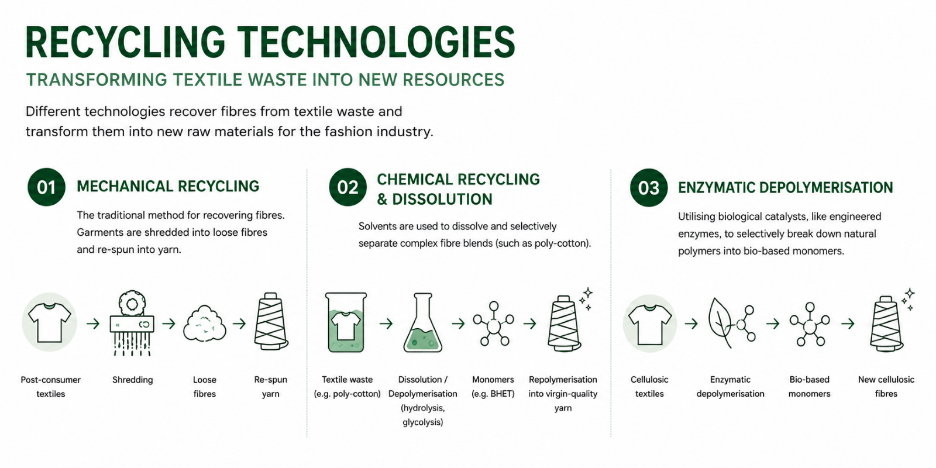
Textile recycling routes can be grouped as mechanical or thermomechanical processes, solvent-based separation or dissolution, chemical depolymerisation, and emerging biochemical or enzymatic processes. Mechanical recycling is established for selected streams but can shorten fibres; polymer-melting routes require compatible thermoplastics; dissolution and depolymerisation require controlled composition and removal of dyes, finishes and trims; biochemical routes remain feedstock- and maturity-dependent.
Reference: European Environment Agency, Management of used and waste textiles in Europe’s circular economy: https://www.eea.europa.eu/en/analysis/publications/management-of-used-and-waste-textiles-in-europes-circular-economy
RESOURCE INSIGHT: Circulose® — Circulose, Sweden. Circulose owns the Ortviken commercial-scale textile-to-textile recycling plant in Sundsvall, which converts cotton-rich textile waste into dissolving pulp for regenerated cellulosic fibres. Following Renewcell’s 2024 bankruptcy and Altor’s acquisition of the assets, Circulose announced that production was planned to resume in Q4 2026; update this status after restart evidence is published. Sources: https://www.circulose.com/circulose-restarts-commercial-scale-production-at-ortviken-plant-in-sundsvall-sweden/ and https://www.circulose.com/factory-o/
- CASE STUDY: Sylvia Calvo — Spain. Topic: Sustainable Upcycling. Sylvia Calvo is a Spanish designer who creates collections from recovered and upcycled materials, treating pre-existing textiles as a design resource. Her practice illustrates creative upcycling as a complement to recycling technologies — extending material life through design rather than reprocessing
- GFA RESOURCE: Scaling Circularity — Global Fashion Agenda and McKinsey & Company, 2021. Less than 1% of textile waste is currently recycled into new fibres for clothing, yet GFA estimates that existing recycling technologies could drive 80% circularity in fashion if fully scaled. Technologies already deliver fibre-to-fibre recycling for single-colour cotton, cellulosics and synthetics, with blended-fibre solutions emerging. The critical bottlenecks are collection and sorting infrastructure, investment in recycling capacity and confidence in feedstock quality and demand. Source: https://globalfashionagenda.org/wp-content/uploads/2022/12/Scaling-Circularity-November-2021.pdf.
- Mechanical recycling physically processes textiles into reusable fibres and is currently the most established textile recycling route, although it often shortens fibres and therefore commonly produces lower-grade applications or requires blending with virgin fibres. Chemical recycling dissolves or depolymerises selected materials to recover cellulose, polymers or molecular building blocks for new fibres. Several chemical recycling technologies have reached demonstration or early commercial scale, particularly for cotton-rich textiles and polyester, but their market presence remains limited by feedstock purity requirements, high investment and operating costs, and insufficient collection and sorting infrastructure. Enzymatic recycling is a more recent biological approach that uses specialised catalysts to selectively break down polymers under relatively mild conditions. While it may offer advantages in processing certain blends and reducing harsh chemical use, most textile-specific enzymatic systems remain at laboratory, pilot or demonstration stage rather than widespread commercial deployment. Overall, recycled fibres produced from textile waste still represent less than 1% of the global fibre market, showing that fibre-to-fibre recycling is technically promising but not yet economically or industrially mature at the scale needed to replace virgin fibre production.
Case study https://re-fresh.global/
7.6.2 Industrial and fibre-to-fibre recycling
Remanufacturing takes returned garments and transforms them into new or upgraded products, often through disassembly, repair and recombination. Upcycling uses waste materials (offcuts, damaged items) creatively, generating higher-value pieces without fully breaking fibres down. Recycling technologies aim to recover fibre or polymer value: mechanical recycling shreds and re-spins; chemical recycling dissolves and re-precipitates polymers; hydrothermal and enzymatic methods are emerging; nano-enabled approaches are being explored. Industrial fibre-to-fibre systems require consistent input quality, making upstream monomaterial design and reduced accessories critical. Sorting technologies—manual and automated, including spectroscopy, AI, robotics plus digital tagging and blockchain—are the bridge between returned products and appropriate recycling pathways. This subchapter ties the whole module together by showing how upstream and midstream choices determine which downstream technologies are feasible and economically viable.
Fibre-to-fibre recycling is one relevant recovery pathway, not the inevitable destination for every textile: the appropriate route depends on product condition, composition, contamination, available infrastructure and whether higher-value use, repair, reuse or remanufacturing remain viable. That is also how the upstream design requirement should be read — consistent composition and fewer incompatible trims make a fibre-to-fibre route possible where it exists, rather than making that route the goal in itself.