
Chapter 5 — full chapter
Chapter 5 — full chapter
5.1.2 Patagonia’s materials strategy — how far can material substitution go?
Learning question: how far can a materials strategy go when the volume, seasonality and replacement logic of the business stay the same?
Patagonia has been a pioneer in replacing conventional materials with lower-impact alternatives. In 1996, after investigating the environmental impacts of conventional cotton farming, the company became one of the first major apparel brands to switch its entire cotton collection to 100% organic cotton. Over the following decades, Patagonia progressively increased the use of recycled polyester, recycled nylon, recycled wool and recycled down, reducing dependence on virgin fossil-based and animal-derived materials. More recently, it has introduced Regenerative Organic Certified® cotton and Yulex® natural rubber as alternatives to conventional cotton and petroleum-based neoprene. Today, Patagonia continuously evaluates its material portfolio, prioritising renewable, recycled and regenerative fibres with lower environmental impacts.
Reality check: this case documents portfolio-level material substitution, not proof that the products or the business are circular. Substituting organic or recycled fibres reduces impacts per unit of fibre, but it does not by itself change production volumes, the number of collections or how many garments reach a second life; recycled polyester still depends on collection and sorting systems whose textile feedstock remains below 1% of the global fibre market. The relevant question is whether the material change was accompanied by a change in how much is produced and how long products are used — evidence the company reports only in part.
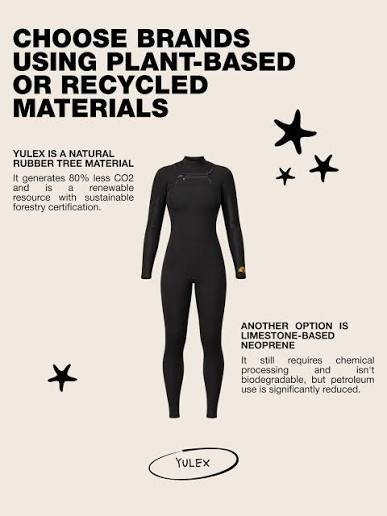
Natural Rubber Yulex wetsuits from Patagonia
RESOURCE INSIGHT: Materials Market Report 2025 — Textile Exchange, 2025. Global fibre production reached a record ~132 million tonnes in 2024 (up from ~125 Mt in 2023) and could hit ~169 Mt by 2030 under business as usual. Despite industry commitments, less than 1% of the global fibre market comes from pre- and post-consumer recycled textiles - a gap that defines the material-selection challenge for designers. Source: https://textileexchange.org/app/uploads/2025/09/Materials-Market-Report-2025.pdf.
- TRY IT NOW: compare three candidate fibres for one of your products using free sources — Textile Exchange's Material Snapshots, the Higg Materials Sustainability Index (free tier) or the Ellen MacArthur Foundation material library. Record climate, water, land use and end-of-life options for each fibre. Then check which of your current fibres already carries a certification (GRS, GOTS, OCS) and request the supplier's certificate number and validity date.
- RESOURCE INSIGHT: Designing Garments for Textile-to-Textile Recyclability — T-REX Project, 2025. The EU Horizon Europe T-REX project (13 partners, 2022-2025) demonstrated chemical recycling of cotton, polyester and polyamide from household textile waste. Its technical guidance uses a 'traffic-light' system to rate fabric and garment recyclability, and explains de-trimming - why buttons, zippers, rivets and other hard trims must be easily removable for recycling. Source: https://static1.squarespace.com/static/666b018c0edddc61de8d4e7c/t/684c41e9ba6af41e38335bf2/1749828079264/T-REX-Technical-Guidance-For-Recyclable-Garments.pdf.
RESOURCE INSIGHT: Eco Design Strategies — RegioGreenTex project (University of Florence & Next Technology Tecnotessile), 2025. A practical guide for textile and fashion designers: ecodesign is visualized as a wheel of five phases - pre-production, production, distribution, use and end-of-life - because resource consumption is largely determined at the design stage. It maps strategies per phase and connects them to ESPR, Extended Producer Responsibility and the Digital Product Passport. Source: https://www.tecnotex.it/wp-content/uploads/2025/09/ECO-Design-Strategies-05-def-ENG-int.pdf.