Chapter 5 — full chapter
| Site: | FashionKIC Learning Platform |
| Course: | Circular Design Strategies |
| Book: | Chapter 5 — full chapter |
| Printed by: | Guest user |
| Date: | Sunday, 1 November 2026, 3:20 AM |
Table of contents
- Chapter 5 — Upstream Strategies: Integrating the Brief before Production
- 5.1.1 Compare materials against function, lifetime and impact priorities
- 5.1.2 Patagonia’s materials strategy — how far can material substitution go?
- 5.2.1 Design products to use fewer resources and last longer
- 5.2.2 HOUDINI sportwear — designing for one recovery route
- 5.3.1 Build a transparent and responsible supply chain
- 5.3.2 Veja Responsible and Transparent Sourcing — what the premium pays for
- 5.4 Define Manufacturing Requirements and Select Production Partners
- 5.5 Plan Responsible Business Strategies
Chapter 5 — Upstream Strategies: Integrating the Brief before Production

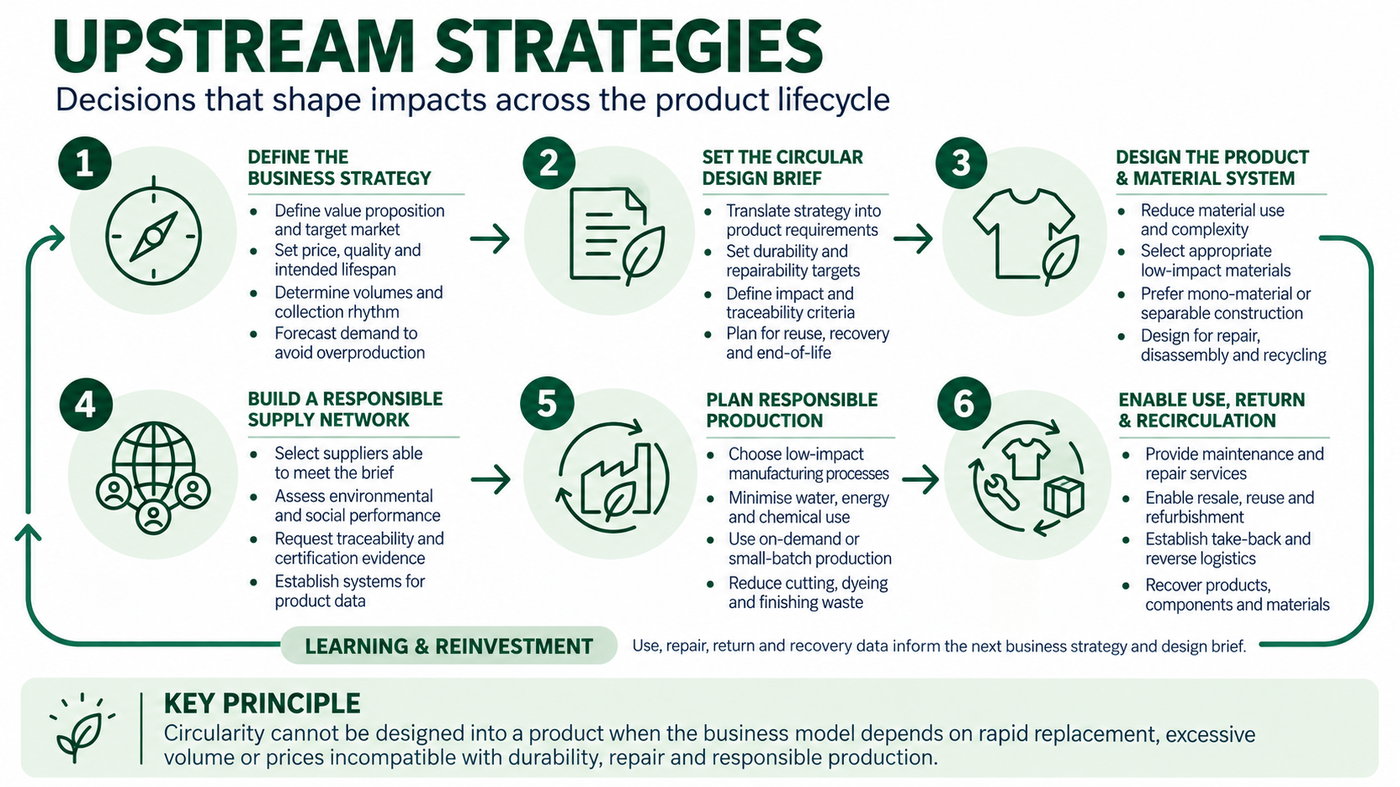
Chapter 5 is the integration layer for the upstream stages. It shows when, by whom and with which evidence the principles introduced in Chapters 1–4: lifecycle thinking, circular design criteria, regulation and standards, claims and traceability, are translated into a design brief, a material decision, sourcing requirements and a production plan. Upstream decisions are made before manufacturing begins and many of them are high-leverage, although their relative weight depends on the product, the impact category and the system boundaries used in the evidence behind them.
Upstream decisions begin with the business model and market positioning: the value proposition, price point, quality level, expected volumes, collection rhythm, target customer and intended product lifespan. These choices shape the design brief, and the brief in turn constrains or enables the material, sourcing and production decisions that follow. This is where many high-leverage choices are made, since the relative weight of upstream, manufacturing, use and end-of-life stages varies by product type and impact category. Upstream activities run from raw material cultivation, extraction and fibre production to the decisions taken by brands during product development, material selection, sourcing and production planning.
Upstream strategies aim to minimize the environmental and social impacts embedded in products by improving material selection, product design, sourcing practices, and production planning before manufacturing begins. Key approaches include selecting materials against stated criteria (recycled or regenerative feedstock, verified chemistry, traceability), often labelled 'preferred fibres' in industry benchmarks such as Textile Exchange, a criteria-based sourcing label rather than a universal ranking, applying circular design principles, engaging responsible suppliers, integrating traceability and transparency, using environmental assessment tools during product development, and adopting sustainable procurement and production planning practices.
Different upstream strategies apply to raw material producers, fiber and textile manufacturers, and designers and brands. As this course focuses on strategies for brand owners, designers and SMEs, we summarize these upstream strategies into five main categories. These five areas are not equivalent sequential steps: business strategy and market positioning set the brief first, product design responds to it, and sourcing and production planning implement it. Evidence, measurement and collaboration cut across all five.
In this chapter:
- 5.1 Select Materials for the Intended Lifecycle and Impact Priorities
- 5.2 Design for Circularity
- 5.3 Source Responsibly
- 5.4 Define Manufacturing Requirements and Select Production Partners
- 5.5 Plan Responsible Business Strategies
5.1.1 Compare materials against function, lifetime and impact priorities
Material selection is a high-leverage upstream decision, but no fibre is inherently sustainable in every context. SMEs should compare candidate materials against the same function and expected lifetime, considering climate, water, land, toxicity, biodiversity, durability, care, recycled-content quality, traceability and realistic end-of-life pathways. Prefer primary supplier data where available, document assumptions and uncertainty, and avoid treating a single score or certification as proof of overall superiority.
Key actions
- Prioritize recycled, renewable, or regenerative fibers, safer chemistry.
- Request certifications and environmental data from suppliers.
- Reduce complex fiber blends where possible.
- Compare materials using LCA or sustainability databases.
CORE REFERENCES: Textile Exchange, Materials Market Report 2025: https://textileexchange.org/knowledge-center/reports/materials-market-report-2025/; European Environment Agency, Circular design and sustainable production: https://www.eea.europa.eu/en/europe-environment-2025/thematic-briefings/circular-economy-and-other-enablers-of-transformative-change/circular-design-and-sustainable-production
IMPACT NOTE: Compare materials and products using an explicit functional unit, system boundary, data year, geography and uncertainty range. The European Commission’s Product Environmental Footprint Category Rules for apparel and footwear provide an emerging common life-cycle method, but they do not make every environmental claim complete: microplastic shedding and biodiversity remain areas for further refinement. Reference: https://environment.ec.europa.eu/news/new-eu-rules-measuring-environmental-impact-clothes-and-shoes-2025-06-25_en
5.1.2 Patagonia’s materials strategy — how far can material substitution go?
Learning question: how far can a materials strategy go when the volume, seasonality and replacement logic of the business stay the same?
Patagonia has been a pioneer in replacing conventional materials with lower-impact alternatives. In 1996, after investigating the environmental impacts of conventional cotton farming, the company became one of the first major apparel brands to switch its entire cotton collection to 100% organic cotton. Over the following decades, Patagonia progressively increased the use of recycled polyester, recycled nylon, recycled wool and recycled down, reducing dependence on virgin fossil-based and animal-derived materials. More recently, it has introduced Regenerative Organic Certified® cotton and Yulex® natural rubber as alternatives to conventional cotton and petroleum-based neoprene. Today, Patagonia continuously evaluates its material portfolio, prioritising renewable, recycled and regenerative fibres with lower environmental impacts.
Reality check: this case documents portfolio-level material substitution, not proof that the products or the business are circular. Substituting organic or recycled fibres reduces impacts per unit of fibre, but it does not by itself change production volumes, the number of collections or how many garments reach a second life; recycled polyester still depends on collection and sorting systems whose textile feedstock remains below 1% of the global fibre market. The relevant question is whether the material change was accompanied by a change in how much is produced and how long products are used — evidence the company reports only in part.
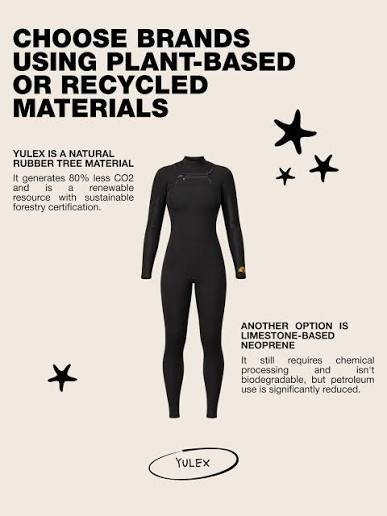
Natural Rubber Yulex wetsuits from Patagonia
RESOURCE INSIGHT: Materials Market Report 2025 — Textile Exchange, 2025. Global fibre production reached a record ~132 million tonnes in 2024 (up from ~125 Mt in 2023) and could hit ~169 Mt by 2030 under business as usual. Despite industry commitments, less than 1% of the global fibre market comes from pre- and post-consumer recycled textiles - a gap that defines the material-selection challenge for designers. Source: https://textileexchange.org/app/uploads/2025/09/Materials-Market-Report-2025.pdf.
- TRY IT NOW: compare three candidate fibres for one of your products using free sources — Textile Exchange's Material Snapshots, the Higg Materials Sustainability Index (free tier) or the Ellen MacArthur Foundation material library. Record climate, water, land use and end-of-life options for each fibre. Then check which of your current fibres already carries a certification (GRS, GOTS, OCS) and request the supplier's certificate number and validity date.
- RESOURCE INSIGHT: Designing Garments for Textile-to-Textile Recyclability — T-REX Project, 2025. The EU Horizon Europe T-REX project (13 partners, 2022-2025) demonstrated chemical recycling of cotton, polyester and polyamide from household textile waste. Its technical guidance uses a 'traffic-light' system to rate fabric and garment recyclability, and explains de-trimming - why buttons, zippers, rivets and other hard trims must be easily removable for recycling. Source: https://static1.squarespace.com/static/666b018c0edddc61de8d4e7c/t/684c41e9ba6af41e38335bf2/1749828079264/T-REX-Technical-Guidance-For-Recyclable-Garments.pdf.
RESOURCE INSIGHT: Eco Design Strategies — RegioGreenTex project (University of Florence & Next Technology Tecnotessile), 2025. A practical guide for textile and fashion designers: ecodesign is visualized as a wheel of five phases - pre-production, production, distribution, use and end-of-life - because resource consumption is largely determined at the design stage. It maps strategies per phase and connects them to ESPR, Extended Producer Responsibility and the Digital Product Passport. Source: https://www.tecnotex.it/wp-content/uploads/2025/09/ECO-Design-Strategies-05-def-ENG-int.pdf.
5.2.1 Design products to use fewer resources and last longer
Design decisions influence most of the options available later: material choice, construction, repair potential, recoverability and the information that can be attached to a product are largely fixed at this stage. Lifecycle evidence should therefore be an input to the brief rather than a check performed after the product exists. The size of that influence varies with the product, the impact category and the system boundary: a durable product may carry a higher material burden but avoid several replacement cycles, and the net effect has to be assessed, not assumed. SMEs can improve sustainability by reducing unnecessary material and trim complexity, improving pattern efficiency, designing for durability and repair, and testing whether mono-material construction is compatible with the intended use and the recovery infrastructure that actually exists.
Reference: European Parliament, implementation of the Ecodesign Directive: https://www.europarl.europa.eu/doceo/document/A-8-2018-0165_EN.html
Key actions
- Reduce the number of materials and trims.
- Improve pattern efficiency to minimize cutting waste.
- Design products for repair and durability.
- Prefer mono-material constructions where feasible.
- Optimise product portfolios by reducing unnecessary product variations and low-performing collections.
Resource insight: WRAP, Circular Design Toolkit for Fashion and Textiles: https://www.wrap.ngo/resources/guide/circular-design-toolkit; Ellen MacArthur Foundation and IDEO, Circular Design Guide: https://www.circulardesignguide.com/; Aalto University, T-REX textile-to-textile design and recycling project: https://circulartextiles.aalto.fi/trexproject/
5.2.2 HOUDINI sportwear — designing for one recovery route
Learning question: what has to be true for a mono-polymer product to be recycled into a new fibre rather than downcycled or discarded?
Founded in Sweden in 1993, Houdini Sportswear has integrated circular design principles into every stage of product development. Its products are designed to be durable, extending their useful life through high-quality materials and functional performance. Garments are created to be repairable, allowing components to be maintained rather than replaced. Wherever possible, Houdini simplifies construction and uses mono-material designs, making products easier to disassemble and recycle at the end of their life. The company also prioritises timeless aesthetics over short-lived fashion trends, encouraging long-term use and emotional attachment. By combining these strategies, Houdini demonstrates how thoughtful design can minimise waste and support a circular textile system.
The Mono Air Houdi is 73% recycled polyester and 27% virgin stretch polyester, and its recyclability depends on the garment returning through Houdini’s take-back system and on the availability of a fibre-to-fibre route for that polymer. The composition removes one barrier: blend separation, but leaves collection, transport and recycling capacity as conditions. Mono-polymer construction is not automatically lower-impact, it is the right choice where it is compatible with performance and with a recovery pathway that exists.
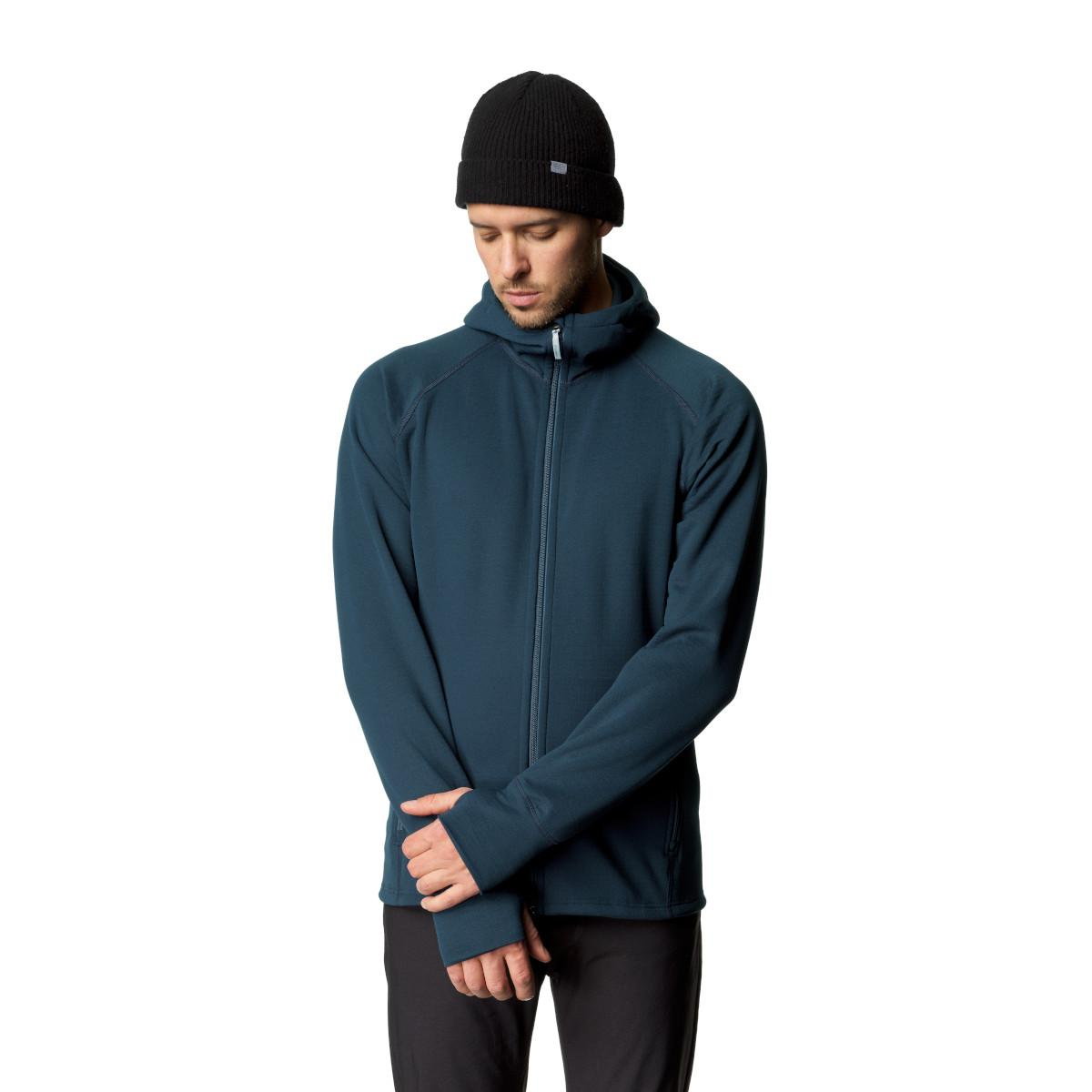
https://houdinisportswear.com/en-us/campaigns/project-mono-air/mono-air-circular-design-principles
CASE STUDY: Constança Entrudo. The Portuguese designer is recognised for a signature “unwoven” textile technique using bonded recycled-polyester yarns. The case is useful for discussing material experimentation, distinctive aesthetics, recycled-content evidence and end-of-life trade-offs. It should not be described as zero-waste construction unless a specific collection and cutting method are documented. Source: https://www.constancaentrudo.com/constancas-world/about
GFA RESOURCE: Global Fashion Agenda Monitor Update 2024. Among respondents to the consultation, 65% of brands and 74% of producers reported targets to design all products across the textile value chain for a circular economy by 2040. These are respondent results, not estimates of industry-wide prevalence. The report also recommends reducing unnecessary material complexity and collaborating across design, manufacturing, sorting and recycling. Source: https://globalfashionagenda.org/wp-content/uploads/2024/11/GFA-Monitor-Update-2024-Final-4.pdf
5.3.1 Build a transparent and responsible supply chain
Responsible sourcing means assessing supplier capability, working conditions, traceability, evidence of continuous improvement and commercial practice. A long-standing relationship is not by itself evidence of responsible practice, and price alone is not a criterion — but the two are connected: stable contracts, realistic lead times and fair payment terms are among the conditions that make improvement possible.
Certification can support evidence, but it does not replace due diligence. Check what is certified (organisation, site, process, material or product), the chain-of-custody model, certificate validity and exclusions, and whether the scheme addresses the specific environmental or social risk being claimed.
Key actions
- Develop supplier sustainability criteria.
- Request traceability and certification documentation.
- Include sustainability in supplier evaluations.
- Prioritise regional sourcing when appropriate.
5.3.2 Veja Responsible and Transparent Sourcing — what the premium pays for
Learning question: which part of this sourcing model can be decided by a designer or a small brand, and which part depends on a price point the market has to accept?
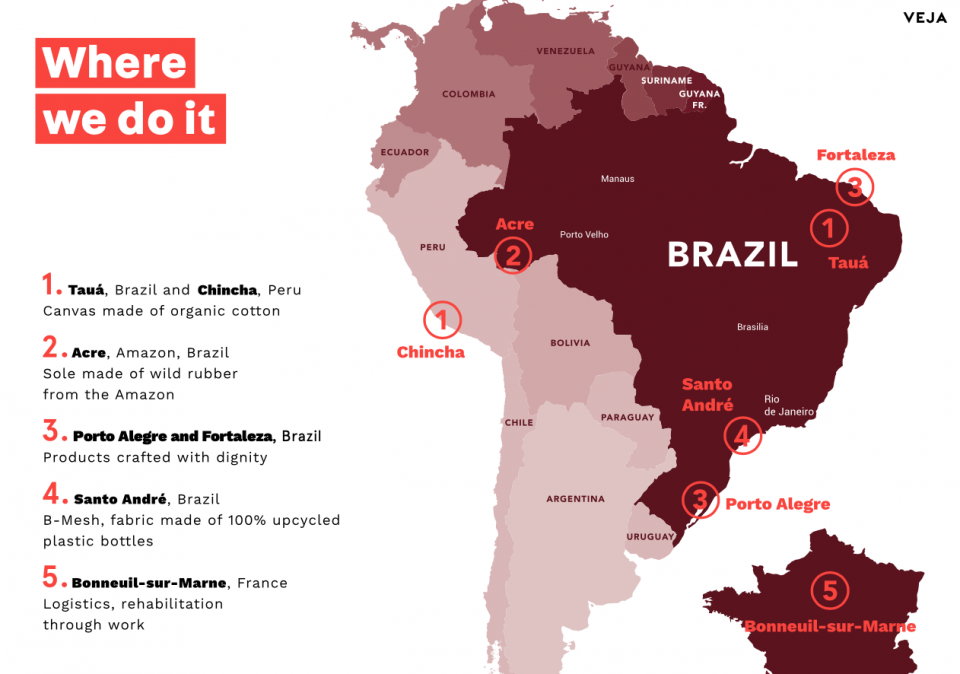
VEJA launched its project in 2004 and built its sourcing model around direct, longer-term relationships with producer organisations. The company reports two-year price contracts and pre-financing of up to 50% of harvests. In 2024, 1,350 cotton-producing families in Brazil and Peru supplied more than 280 tonnes, with VEJA paying approximately three times the market price for cotton. For Amazonian rubber, VEJA reports working with more than 2,500 families in 22 associations and paying approximately five times the market price per kilogram of CVP, including quality and environmental-service bonuses. Keep the cotton and rubber figures distinct and update them as company reporting changes.
Reality check: paying above market price and pre-financing harvests are possible because the products are sold at a price point that carries those costs, and the figures are reported by the company. Above-market payment is not by itself evidence of working conditions beyond the cotton and rubber producers involved, and the model does not transfer automatically to a brand whose cost structure or volumes differ. Read the case as a sourcing model with a specific economic base, not as a general template.
https://project.veja-store.com/en/single/transparency
VAUDE Case Study
VAUDE is a German outdoor equipment and apparel company known for products for hiking, mountaineering, cycling, camping, and everyday outdoor use. Vaude uses strict supplier selection, traceability systems, long-term supplier partnerships, and certified materials. The company publicly reports supplier performance and integrates environmental and social criteria into purchasing decisions.
Reality check: the publicly available evidence is the company’s own supplier reporting and communication. It documents the management approach and the criteria applied rather than verified outcomes for each product; before generalising, ask which suppliers, which criteria and which measured results are covered.

FOR YOUR SME / BUSINESS CASE: set a measurable material and supplier-evidence policy for the next two collections. For example, define a verified preferred-material threshold, limit fibre families where this does not compromise performance or durability, and request valid certificates plus scope and transaction documentation. Build the target from your baseline and supplier quotations rather than using a generic cost premium. Environmental claims made to consumers must be specific, substantiated and clear about scope. Directive (EU) 2024/825 had to be transposed by 27 March 2026 and national measures apply from 27 September 2026. Reference: https://eur-lex.europa.eu/eli/dir/2024/825/oj/eng
5.4 Define Manufacturing Requirements and Select Production Partners
Scope note: this section covers the upstream decision — what is required of production, who will execute it, and with which evidence. The operational execution and control of dyeing, finishing, cutting and sewing is midstream and is covered in Chapter 6.
5.4.1 Set Environmental Requirements and Evaluate Production Partners
Before placing an order, a brand or SME must translate its product and sustainability objectives into a manufacturing brief and supplier-selection criteria. This upstream decision should define required performance rather than prescribe a technology without evidence. Requirements may cover restricted substances, input traceability, process and product certification, water and energy data, wastewater quality, greenhouse-gas reporting, waste segregation, worker safety, quality, lead time and improvement plans.
Candidate production partners should demonstrate capability with facility-specific evidence, valid certificates, sample results and agreed KPIs.
OECD garment and footwear due-diligence guidance: https://www.oecd.org/en/topics/sub-issues/due-diligence-guidance-for-responsible-business-conduct/responsible-garment-and-footwear-supply-chains.html; EU Textiles BAT conclusions: https://eur-lex.europa.eu/eli/dec_impl/2022/2508/oj/eng; ZDHC Wastewater Guidelines: https://www.zdhc.org/zdhc-wastewater-guidelines
Key actions
- Define measurable environmental and social requirements for the production brief.
- Request facility-specific evidence, including scope, baseline, units and reporting period.
- Evaluate production partners against capability, compliance, transparency and improvement criteria.
- Agree KPIs, responsibilities, corrective-action procedures and data-sharing requirements before ordering.
PARTNER CASE STUDY: Tintex (Pedro Magalhães). Topic: Dyeing & Finishing. Tintex is a Portuguese textile manufacturer specialised in sustainable dyeing and finishing, including low-impact processes and digital textile printing. It is a concrete example of how production processes can be upgraded to reduce water, energy and chemical use. See PARTNERS CASE STUDIES_MAPPED.xlsx.
5.5 Plan Responsible Business Strategies
Even before a product is designed or manufactured, businesses make strategic decisions that shape its environmental and social impacts. Responsible business strategies aim to align production with actual demand, optimize resource use, and create long-term value rather than short-term sales. By improving forecasting, reducing overproduction, integrating circular business models and increasing transparency, companies can minimise waste, improve supply chain resilience and support more sustainable consumption. These decisions influence not only how products are developed and sold, but also how they are used, recovered and reintegrated into the value chain, contributing to a more circular and resource-efficient fashion industry.
Key Actions
- Forecast demand using market data and analytics.
- Plan production volumes to minimise overproduction.
- Adopt on-demand or small-batch production where appropriate.
- Set sustainability objectives and measurable business KPIs.
- Use Life Cycle Assessment (LCA) and environmental data to support strategic decisions.
- Prepare for regulatory compliance through Digital Product Passports and sustainability reporting.
Case Study: Son of a Tailor, Denmark and Portugal
Danish fashion firm Son of a Tailor adopts a demand-driven, made-to-order system, producing garments only once purchased. Most manufacturing occurs in Portugal, reducing the need for forecasts, eliminating finished-goods inventory, and avoiding overproduction typical of seasonal fashion. The brand emphasises durable, mono-material garments to prolong lifespan and facilitate recycling.
Son of a Tailor – Production
A third-party-verified ISO 14040/44 Life Cycle Assessment comparing its cotton T-shirt with a made-to-stock equivalent found a 25% lower carbon footprint—2.83 kg CO₂e versus 3.79 kg CO₂e—alongside significant reductions in water use, ecotoxicity, and land impact.
Son of a Tailor – T-shirt footprint
The company has set measurable climate goals covering energy, waste, Scope 1–3 emissions, supplier metrics, and logistics. Its Re-Spun programme reuses production waste, creating garments with 50% recycled Supima cotton, showcasing circular product development informed by production data. Climate Action Plan · Re-Spun initiative
This case exemplifies demand-led production, waste prevention, quantifiable sustainability targets, LCA-informed insights, and waste reintegration. While it lacks documented Digital Product Passports, developing one should be a next strategic step.
Reality check: made-to-order removes finished-goods inventory, but it lengthens lead times, shifts cost into production and logistics, and depends on reliable demand signals. The reported LCA compares one T-shirt model, and the Re-Spun styles contain 50% recycled cotton rather than being fully recycled. The case shows a specific production model with its own trade-offs, not a general argument that small batches are automatically lower-impact.
RESOURCE INSIGHT: Circular Fashion Business Toolkit — European Creative Hubs Network (S4Fashion project), 2022. An EU COSME-funded toolkit that walks fashion entrepreneurs through the building blocks of a circular business - from lifecycle thinking and circular value propositions to revenue models and partnerships. It is designed for creative hubs and incubators to run hands-on workshops with early-stage fashion businesses. Source: https://creativehubs.net/images/upload/CIRCULAR-FASHION-BUSINESS-TOOLKIT_A4_4final-with-links_lowres_EM_corrected.pdf. (ID CDS011, T3.1 Mapping Knowledge Resources)
- PARTNER CASE STUDY: ISTO. — Portugal. Topic: Sustainable Fashion. ISTO. is a Portuguese fashion brand built on a slow, responsible business model: small-batch production, natural materials, and transparent pricing and supply chains. It is a working example of the responsible business strategies in this section — how an SME aligns strategy, sourcing and communication around sustainability. See PARTNERS CASE STUDIES_MAPPED.xlsx.