
Chapter 3 — full chapter
Chapter 3 — full chapter
3.5 Trends and Innovation Opportunities
Several trends and innovations are emerging in response to the challenges of circular fashion. These include recycled and regenerative fibres, bio-based materials, mechanical and chemical recycling, hydrothermal and enzymatic processes, low-impact dyeing and printing, three-dimensional knitting and weaving, zero-waste cutting, traceability tools, digital product passports, resale, rental, repair and take-back platforms.
This subchapter introduces these developments at a strategic level. Technical detail on fibres, dyeing, finishing, processing technologies and material performance is developed in the dedicated Sustainable Materials and Processes module.
Innovation should always be connected to a clearly identified problem. A new fibre may reduce reliance on virgin resources but create new processing or recyclability challenges. A recycling technology may require clean and consistent feedstock that current collection and sorting systems cannot provide. A digital product passport may improve traceability but only if the underlying information is reliable, accessible and maintained over time.
Learners should therefore ask: What challenge does the innovation address? What evidence supports it? What conditions does it require? Is it compatible with the product and its intended circular pathway? Is it feasible at the required scale?
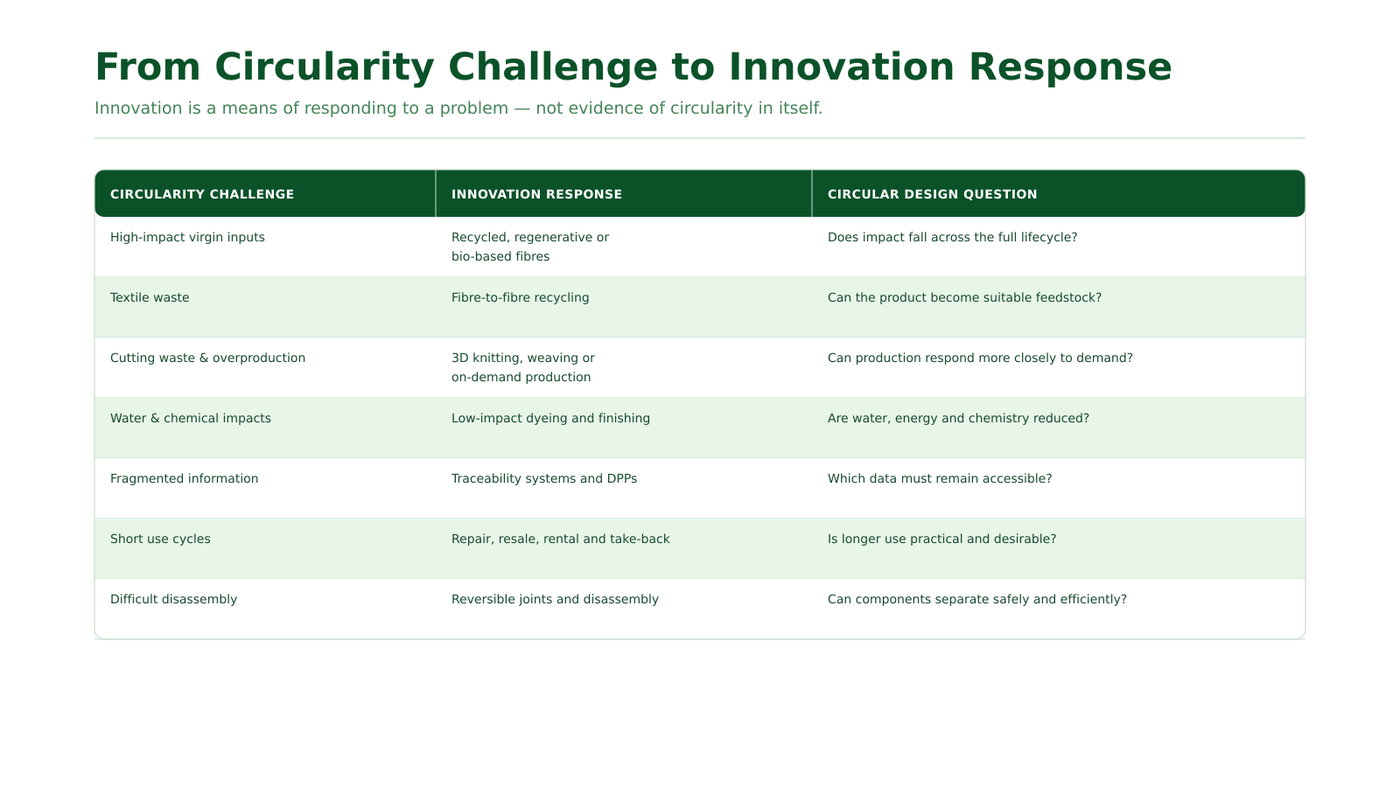
Figure X. From circularity challenge to innovation response. Circular innovations should be selected according to the specific problem they address, the evidence supporting them, and their compatibility with the intended product lifecycle. Innovation is a means of responding to a challenge, not evidence of circularity in itself.
RESOURCE INSIGHT: Reimagining Growth: Landscape Analysis — Textile Exchange, 2024. This report questions whether 'unending growth' can ever be decoupled from resource use on the scale needed, and compares degrowth with green growth. For fashion it recommends decoupling revenue from production volumes and virgin inputs, increasing the revenue share of circular business models such as repair and rental, and eliminating wasteful practices like deliberate excess. Source: https://textileexchange.org/app/uploads/2024/12/Reimagining-Growth-Landscape-Analysis.pdf.
RESOURCE INSIGHT: Fashion for Good Innovation Platform — Fashion for Good. An open, searchable innovation database mapping start-ups and scale-ups across the value chain - raw materials, processing, manufacturing and retail, end of use, and transparency and traceability - plus topic areas such as next-generation materials, decarbonisation and waste mapping. SMEs can use it to scout technology partners and track proven innovations before investing. Source:
Source: https://www.fashionforgood.com/innovation-platform-2/innovators/.