Chapter 3 — full chapter
| Site: | FashionKIC Learning Platform |
| Course: | Circular Design Strategies |
| Book: | Chapter 3 — full chapter |
| Printed by: | Guest user |
| Date: | Sunday, 1 November 2026, 3:20 AM |
Table of contents
- Chapter 3 — Circular Design Challenges and Innovation Opportunities
- 3.1 Six Interrelated Challenges to Circular Fashion
- 3.2 Why Circular Fashion Is Difficult to Implement
- 3.3 Material and Product Complexity
- 3.4 Environmental, Social and Economic Dimensions: What Can Be Material in Fashion?
- 3.5 Trends and Innovation Opportunities
- 3.6 Prioritizing Responses for SMEs
Chapter 3 — Circular Design Challenges and Innovation Opportunities

Building on Chapter 1, which introduced circular design as a lifecycle and systems-based approach, this chapter examines why translating circular principles into practice remains difficult. It explores six interrelated challenge areas: technical and material, systemic and organisational, environmental, social and ethical, cultural and behavioural, and economic and implementation-related.
Rather than presenting innovation as a list of new technologies, the chapter connects each challenge to possible design, process, service, and business responses. Learners are encouraged to assess innovations — such as advanced recycling, low-impact processing, design for disassembly, traceability tools and circular services — according to the problem they address, the evidence supporting them, their trade-offs and their feasibility in a specific context.
Circular fashion depends on more than the characteristics of an individual product. A garment may be designed for durability, repair or recyclability, yet still fail to circulate if the surrounding systems do not support those pathways. Collection infrastructure may be absent, repair may be inaccessible or economically unviable, material information may not travel across the value chain, or business incentives may continue to favour rapid replacement over prolonged use.
This makes circularity an implementation challenge as much as a design challenge. Decisions about materials, construction, sourcing, production, services and end-of-use pathways are interconnected, and improvements in one area can create limitations or trade-offs in another. Technical feasibility must therefore be considered alongside environmental and social impacts, organisational capacity, user behaviour, infrastructure and economic viability.
For designers and fashion businesses, the practical question is not simply whether a solution can be described as “circular”, but whether it can function within a real system. This requires understanding the conditions that enable or constrain circular strategies and identifying where coordinated action across different actors is needed.
In this chapter:
- 3.1 Six Interrelated Challenges to Circular Fashion
- 3.2 Why Circular Fashion Is Difficult to Implement
- 3.3 Material and Product Complexity
- 3.4 Environmental, Social and Economic Dimensions: What Can Be Material in Fashion?
- 3.5 Trends and Innovation Opportunities
- 3.6 Prioritizing Responses for SMEs
3.1 Six Interrelated Challenges to Circular Fashion
Circular fashion is shaped by six interrelated challenge areas. These barriers appear across the textile value chain and cannot be addressed through isolated product-level changes.
The first challenge is technical and material. Fibre blends, coatings, finishes, adhesives, trims and complex product constructions can make garments difficult to identify, repair, disassemble or recycle. A material may offer durability or performance during use while limiting the product’s end-of-use options. Designers must therefore consider material compatibility, construction methods, and the intended circular pathway together.
The second challenge is systemic and organisational. Textile value chains are fragmented across fibre producers, mills, manufacturers, brands, retailers, users, repair services, collectors, sorters, and recyclers. Information and responsibilities are often distributed between organisations that use different systems or have limited visibility beyond their own operations. Brands and designers may influence product decisions but still depend on external infrastructure and collaboration to enable collection, repair, resale, or recycling.
The third challenge is environmental. Textile production and consumption are associated with resource use, emissions, water and soil pollution, hazardous substances, microfibre release, and waste. Circular responses can reduce some of these impacts, but they may also create trade-offs. Recycling, for example, requires energy, transport, and processing. Environmental improvements should therefore be assessed across the lifecycle to avoid shifting impacts from one stage to another.
The fourth challenge is social and ethical. Circularity should support safe working conditions, fair wages, appropriate skills, transparency, and fair value distribution. These concerns apply not only to conventional production but also to emerging circular activities such as collection, sorting, repair, recycling, and remanufacturing. A system should not be considered circular if environmental gains depend on unsafe work or the transfer of social burdens to lower-income regions.
The fifth challenge is cultural and behavioural. Fashion systems built around novelty, volume and short product cycles encourage underuse and disposability. Longer use may involve care, repair, reuse, resale, rental or return, but responsibility cannot be placed only on consumers. Products, services, communication, retail environments and policy conditions must make circular practices accessible, attractive, and convenient.
The sixth challenge is economic and implementation-related. Circular materials, technologies and services may involve higher initial costs, infrastructure investment, uncertain demand, limited margins, and new logistical requirements. SMEs may also have limited influence over suppliers, minimum order quantities, or downstream service providers. Implementation therefore depends on prioritisation, partnerships, organisational capacity, and viable business conditions.
These challenges interact. Technical choices influence environmental impacts and economic feasibility; infrastructure affects which design strategies are realistic; and social, cultural and organisational conditions determine whether circular solutions can operate at scale.
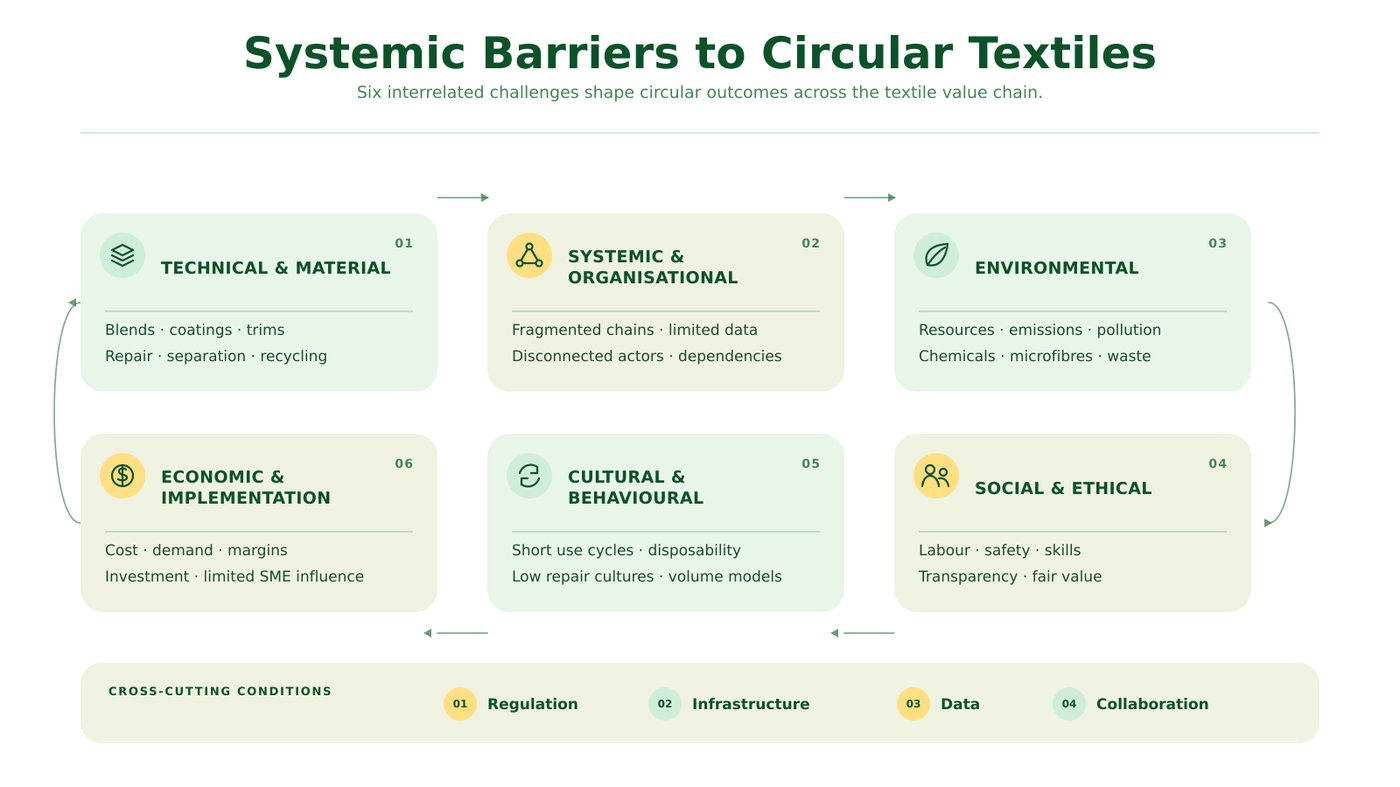
Figure 2.1. Systemic barriers to circular textiles. Six interrelated technical, systemic, environmental, social, cultural, and economic challenges shape the circular textile transition. Regulation, infrastructure, data, and collaboration act as cross-cutting implementation conditions.
3.1.1 Case Example — The Jeans Redesign: Coordinating Change Across a Value Chain
The Jeans Redesign, led by the Ellen MacArthur Foundation from 2019 to 2023, demonstrated how to create circular jeans through shared guidelines developed with input from brands, manufacturers, fabric mills, academia, NGOs, collectors, and recyclers. These standards focused on durability, material health, recyclability, and traceability. Companies were encouraged to adopt these principles, report progress, and share challenges. By 2023, over 100 organizations across 25+ countries participated, producing 1.5 million redesigned jeans between 2021 and 2023.
The initiative highlights that achieving circularity requires both design and coordination. Brands can modify fibers or improve details, but they cannot build the collection, sorting, and recycling infrastructure alone. Mills and suppliers must also meet new standards and provide transparent information.
While not eliminating all barriers or establishing a universal denim system, the project proved that shared criteria, transparency, and collaboration accelerate progress beyond isolated pilots. Systemic change depends on aligned efforts across the entire value chain, not just individual optimization.

Source:
Ellen MacArthur Foundation — The Jeans Redesign
The Jeans Redesign – Insights Report
Reflection prompt
Which of the six challenge areas could participating brands influence directly, and which required collaboration with mills, manufacturers, collectors or recyclers?
3.2 Why Circular Fashion Is Difficult to Implement
Circularity is difficult to implement because it depends on interconnected decisions, actors, and systems. Circular outcomes for a product depend on the alignment of design, sourcing, production, use, collection, sorting and appropriate next-use or recovery pathways. Product-level design is essential, but it cannot enable circularity on its own.
Fashion is still shaped by systemic lock-ins, including linear supply chains, short product cycles, low-cost production, pressure on margins, fragmented data and dependence on external infrastructure for repair, collection, sorting and recycling. SMEs may also face limited budgets, restricted influence over suppliers, lack of technical information, and uncertain access to circular partners.
Product complexity does not affect every circular pathway in the same way. Multiple materials, bonded layers and complex trims generally make sorting, automated disassembly and fibre-to-fibre recycling more difficult. However, a complex or higher-value product may still be economically attractive to maintain, repair, resell, or remanufacture. This depends on its durability, desirability, construction, available product information, and access to appropriate services. Complexity should therefore be assessed in relation to the intended circular pathway rather than treated as a single measure of circularity.
Circularity must therefore be approached as both a design and coordination challenge. Learners should identify the intervention points they can realistically influence, such as product architecture, material choices, supplier requirements, care information, repairability, take-back partnerships, resale potential and data collection. They should also recognise where implementation depends on collaboration with suppliers, service providers, infrastructure operators, and other value-chain actors.
RESOURCE INSIGHT: Circular Economy Action Agenda: Textiles — Platform for Accelerating the Circular Economy (PACE), 2021. A multi-stakeholder roadmap that identifies 14 key barriers collectively slowing the textile transition and sets seven action areas, including incentivising design for longevity and recyclability, shifting to safe material inputs, and strategically planning collection, sorting and recycling operations. It frames circularity as a systemic challenge that no single company can solve alone. Source: https://environmentaldocuments.com/pace/circular-economy-action-agenda-textiles.pdf.
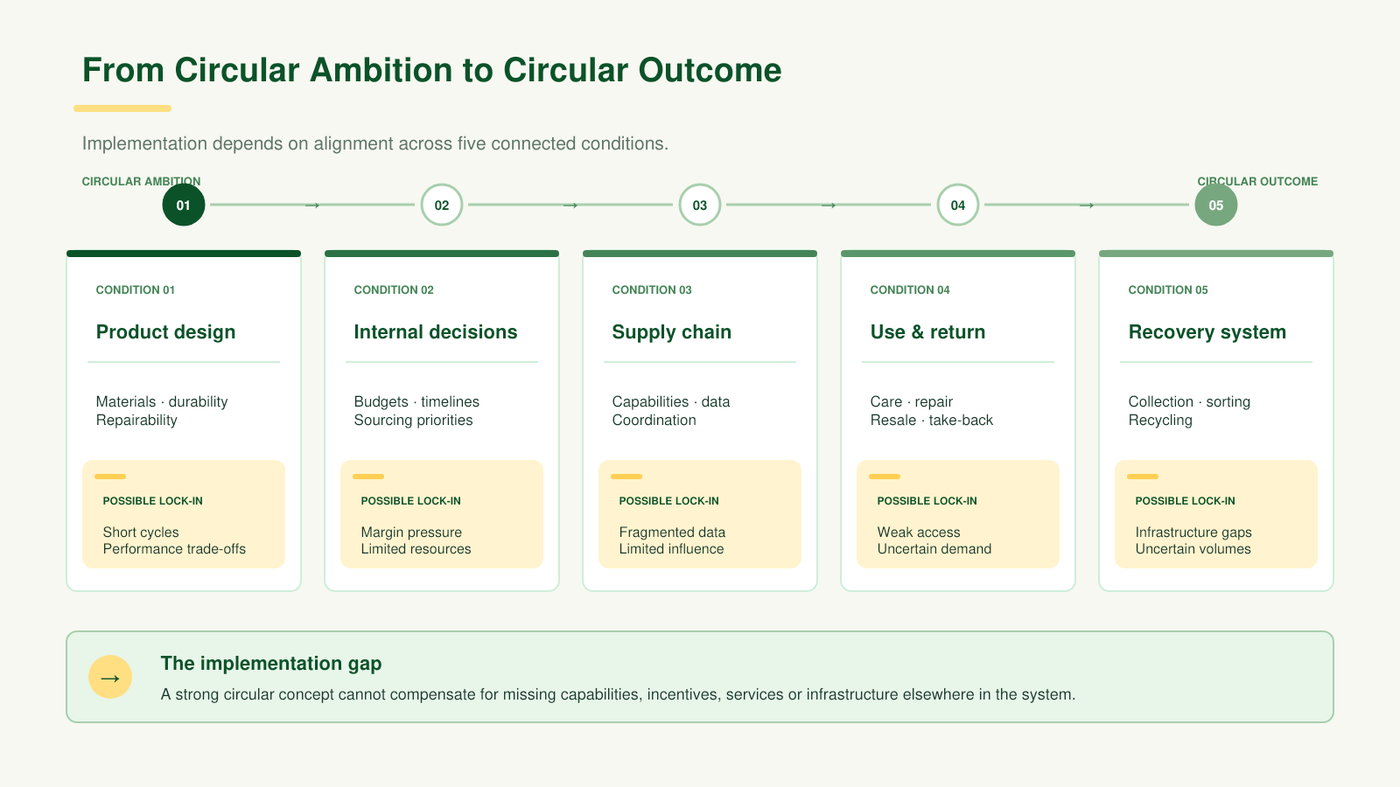
Figure X. From circular ambition to circular outcome. Circular design requires alignment between product decisions, organisational priorities, supply-chain capabilities, user-facing systems, and recovery infrastructure. Gaps in resources, incentives, data, services, or infrastructure can prevent technically viable ideas from achieving circular outcomes.
3.2.1 Case Example — Renewcell/Circulose: When Technical Innovation Is Not Enough
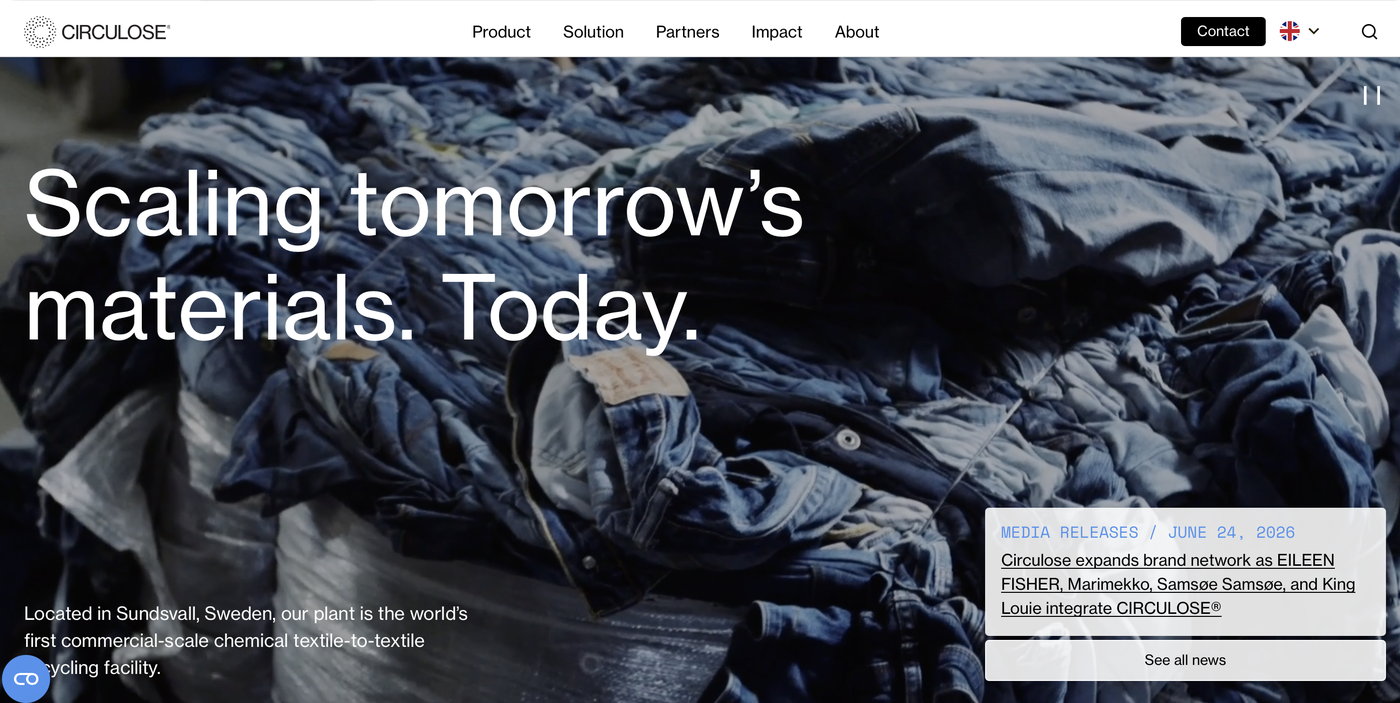
Renewcell, founded in Sweden, developed CIRCULOSE®—a recycled dissolving pulp from discarded cotton textiles—to replace virgin wood pulp in viscose and lyocell. The company invested in an industrial facility to scale textile-to-textile recycling, gaining industry recognition. However, despite progress, Renewcell filed for bankruptcy in 2024 due to slow sales and insufficient funding, revealing that demonstrating a circular tech's viability isn't enough; market conditions matter.
CIRCULOSE® couldn't go directly from recycling to finished garments. Its adoption depended on complex coordination across the supply chain, with price premiums increasing at each stage. Brands showed interest, but this didn’t translate into consistent, large-scale orders.
Renewcell's assets were acquired by Altor and relaunched as Circulose. The new model emphasizes supply chain integration, traceability, conversion support, and pricing to reduce costs. Brands are now expected to commit more fully to replacing virgin materials, rather than using the recycled material in isolated products.
This case shows that technological innovation alone isn’t enough to shift a linear system. Success requires aligned incentives, investment, supplier readiness, and demand. Designers can influence demand, but implementation depends on sourcing, finance, production, and corporate strategy decisions.
Reflection prompt:
Why did a proven industrial-scale recycling solution fail despite technological viability? What actors, commitments, and market conditions are needed to make circular material innovation commercially viable?
Sources: Circulose — FAQ and Circulose Impact.
3.3 Material and Product Complexity
Material and product complexity are one of the main technical barriers to textile circularity. Blended fibres are common because they can improve durability, softness, stretch, price, or performance. However, they can also make sorting, separation and fibre-to-fibre recycling more difficult, especially when composition is unclear or feedstock quality is inconsistent.
Other product elements also create complexity. Coatings, finishes, prints, elastane, linings, bonded layers, trims and accessories may affect recyclability, repairability and material health. They can also contaminate recycling streams or make disassembly too costly.
Design can reduce these barriers by simplifying material strategies, using compatible materials, avoiding unnecessary trims, designing detachable components, improving durability, and providing clear product information. The aim is not to remove all complexity, but to ensure that every material and component can justify its role in performance, use, and future recovery.
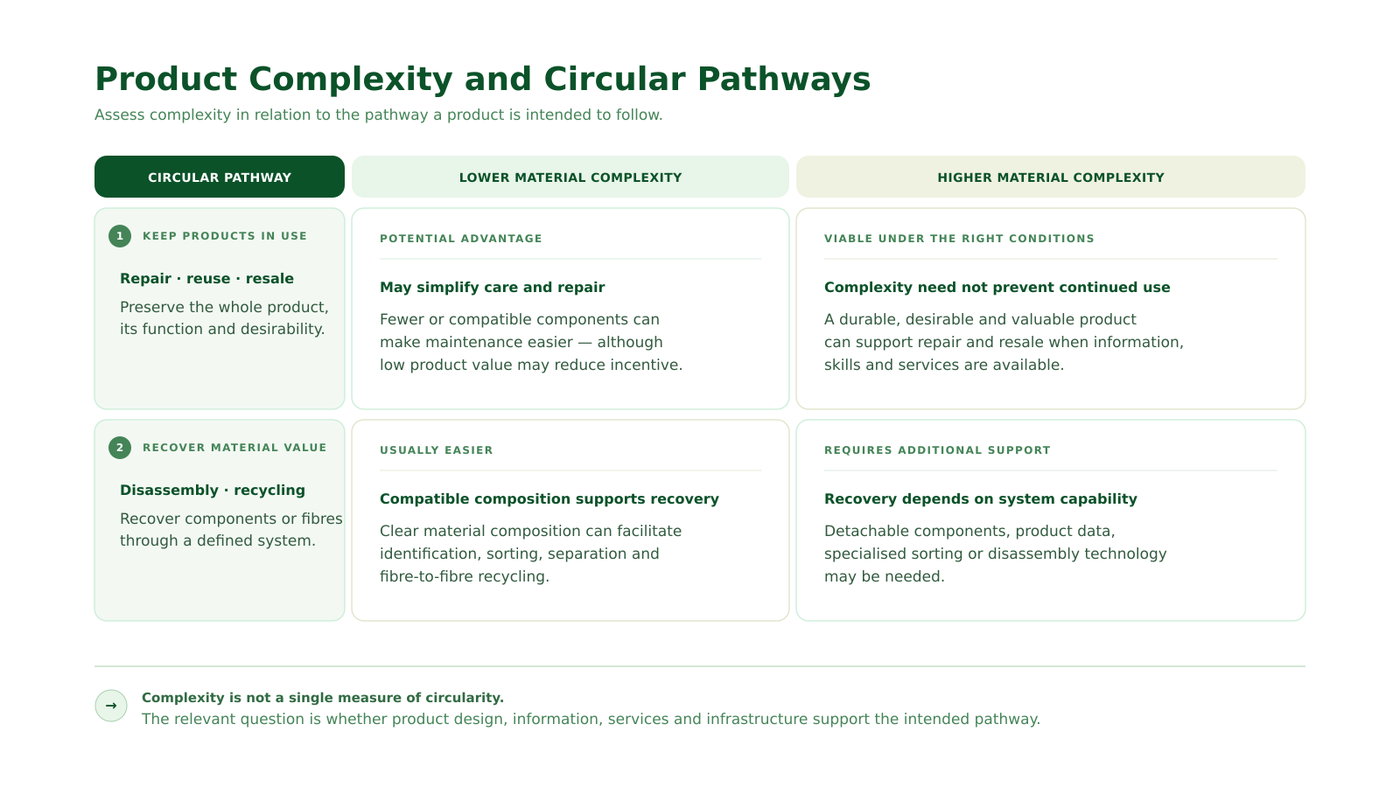
Figure X. Material and product complexity across circular pathways. Material composition and construction complexity affect circular strategies differently. Simpler products may facilitate sorting and recycling, while more complex products can still support repair, reuse and resale when they are durable, desirable and supported by appropriate services and information.
3.3.1 Case Example — Napapijri Circular Series: Simplifying a Complex Product
Outdoor jackets are technically demanding products. They may combine an outer fabric, lining, insulation, zips, elastic components, labels, trims, and functional finishes. These elements support warmth, weather protection, and performance but can also make the garment difficult to disassemble and recycle.
Napapijri’s Circular Series explored how this complexity could be reorganised around a defined material pathway. The main fabric was made from ECONYL® regenerated Nylon 6, while the filling and trims were also developed using Nylon 6. By keeping the principal components within the same polymer family, the company aimed to enable the complete garment to enter a compatible recycling process without the extensive separation normally required for a multi-material jacket.
The product was connected to a registration and return programme. Each garment included a unique code through which the purchaser could register it and later access the recycling pathway. This shows that material simplification alone is insufficient: product identification, customer information, reverse logistics, and access to a recycler are also part of the design system.
The case demonstrates that product complexity should be assessed in relation to the intended circular pathway. The jacket retained the functional and visual characteristics expected from outdoor clothing while simplifying its material architecture for recycling. However, its circular outcome still depends on garments being registered, retained for an appropriate period, returned and processed as intended. Evidence about return volumes, recovery yields, and the use of the resulting material would therefore be necessary to evaluate the system at scale.
Reflection prompt:
What was simplified to support recycling, and which forms of operational evidence would be needed to determine whether the return and recycling system works at scale?
Source: Napapijri — Circular Series

Figure X. Napapijri Circular Series jacket. The outer fabric, insulation and trims were designed using Nylon 6 to simplify the garment’s material architecture and support a defined take-back and recycling pathway. Source: Napapijri, Circular Series.
3.4 Environmental, Social and Economic Dimensions: What Can Be Material in Fashion?
Circular strategies need to be assessed across environmental, social, and economic dimensions at the same time. Improving performance in one area does not automatically improve the others. A material with lower environmental impacts may be more expensive or difficult to source at scale; a recycling process may recover valuable fibres while requiring significant energy, infrastructure and skilled labour; and a repair or resale model may extend product life but depend on logistics and service costs that are difficult for some businesses to absorb.
Social considerations are equally important. New circular activities — including sorting, repair, remanufacturing and recycling — create different forms of work and redistribute responsibilities across the value chain. Their contribution to circularity therefore depends not only on environmental outcomes, but also on safe working conditions, appropriate skills, transparency, and fair distribution of value.
For SMEs in particular, circular decision-making often involves balancing ambition with feasibility. Rather than searching for a universally “best” solution, businesses need to understand which impacts are most significant in their context, where trade-offs occur, what resources and partnerships are required, and which improvements can realistically be implemented and scaled.
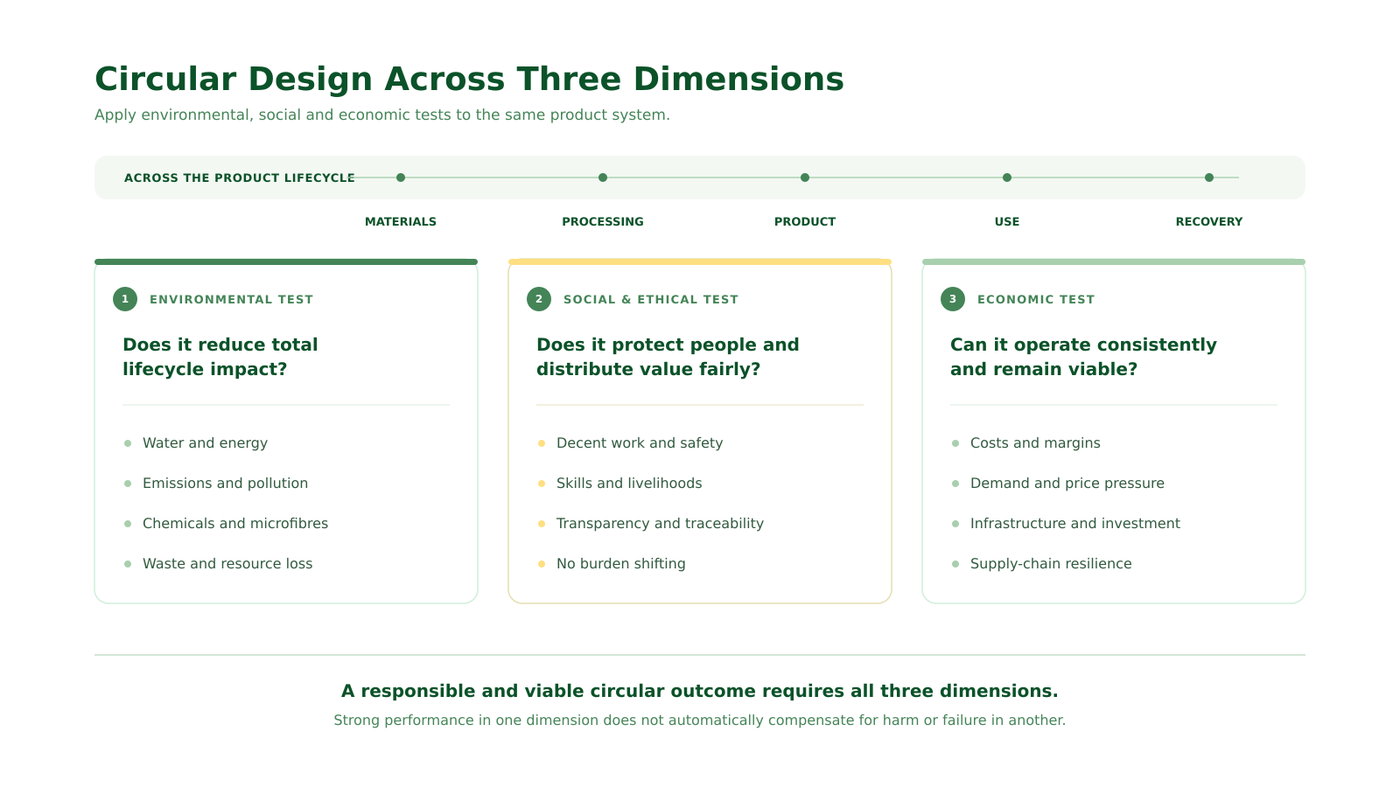
Figure X. Environmental, social, and economic challenges in circular design. Circular solutions must reduce environmental impacts, protect people, and distribute value fairly, while remaining economically viable throughout the product lifecycle. Progress in one dimension should not be achieved at the expense of another.
RESOURCE INSIGHT: Living Within Planetary Boundaries: The Circular Economy — Ellen MacArthur Foundation, 2025 (7-minute video). Six of the Earth's planetary boundaries have now been crossed, driven by the linear 'take, make, waste' system. This short film argues that because that system was designed, it can be redesigned: circular economy solutions - eliminating waste and pollution, circulating materials, regenerating nature - are already operating and can help turn things around. Source:
3.4.1 Case Example — Gabriela Hearst × Manos del Uruguay: Craft, Livelihoods and Luxury Value
Gabriela Hearst has worked with Manos del Uruguay to produce distinctive hand-knitted pieces that form part of the designer’s main collections. Founded in 1968, Manos del Uruguay is a non-profit organisation and network of cooperatives that provides employment, training and economic opportunities for women living in rural areas of Uruguay. Its artisans work with handknitting, weaving and small-batch dyeing techniques, combining specialist knowledge with natural, high-quality fibres.
The collaboration demonstrates how environmental, social, and economic value can be connected through design. From an environmental perspective, the emphasis on natural fibres, skilled construction, material quality, and enduring design can support products intended to remain desirable and in use for longer. Socially, production sustains specialised craft skills and creates paid work for women who might otherwise have limited employment opportunities within their local communities. Economically, artisanal expertise is positioned as an essential component of contemporary luxury rather than treated as an anonymous or low-cost production input.
The pieces are not presented as a separate charitable initiative. Hand-knitted garments by Manos del Uruguay appear within Gabriela Hearst’s seasonal collections and contribute directly to the brand’s aesthetic language. The visible texture, colour, construction and time invested in each piece become part of its creative and commercial value. This makes the collaboration particularly relevant to designers: responsibility is not added after the design process but helps shape the product itself.
However, artisanal production and natural materials do not automatically make a product circular. Further assessment would require evidence about fibre sourcing, processing impacts, durability, repair options, production volumes, value distribution, and end-of-use pathways. The case nevertheless shows how fashion design can recognise social and environmental conditions as sources of quality, authorship and value rather than as constraints on creative ambition.
Reflection prompt:
How does collaboration transform craft knowledge and production time into creative, social, and economic value? What additional evidence would be required to assess its environmental and circular outcomes?
Sources: Gabriela Hearst — Spring/Summer 2025 Collection and Manos del Uruguay — collaboration with Gabriela Hearst.
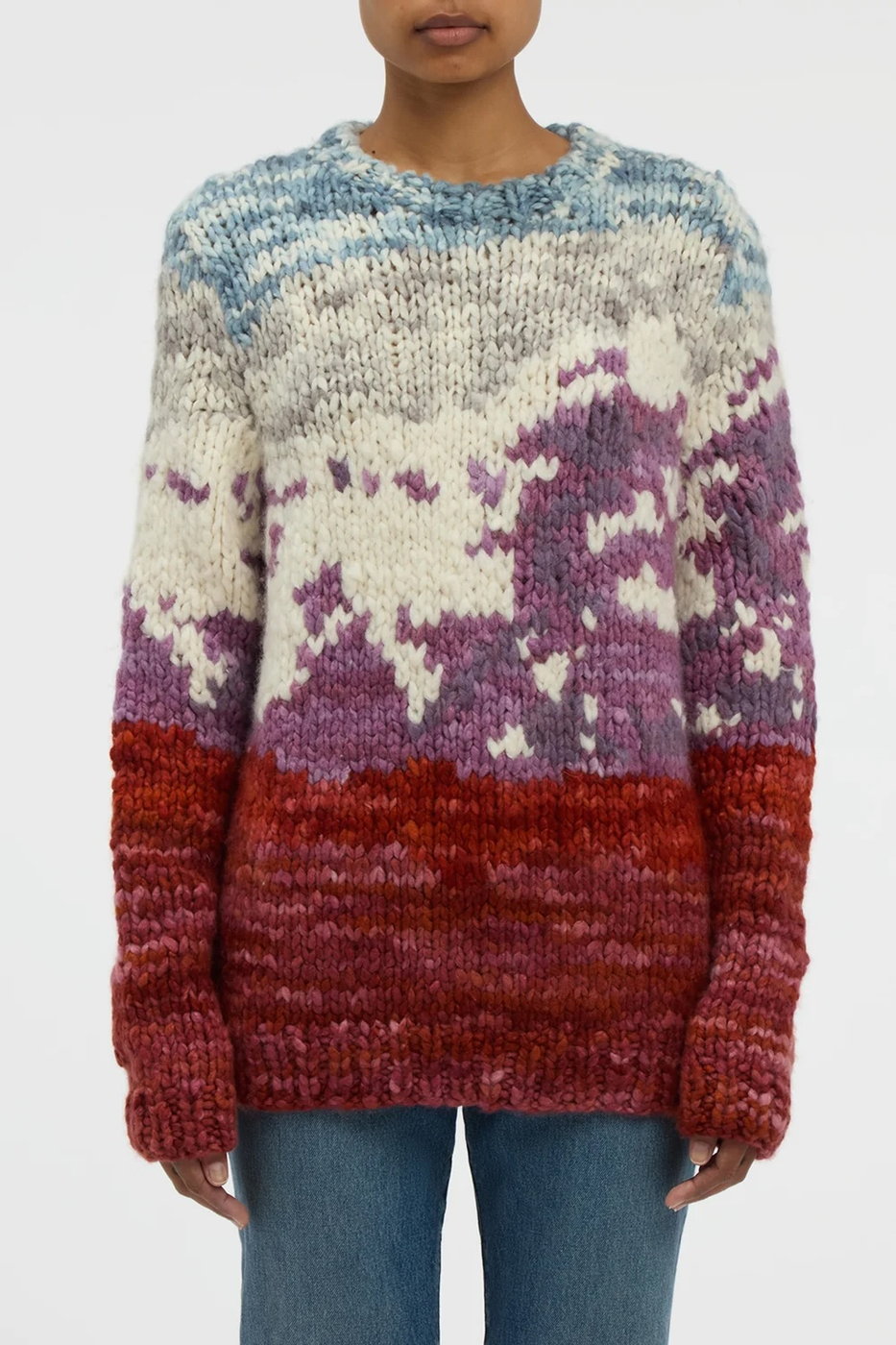
Figure X. Hand-knitted sweater by Gabriela Hearst, produced in collaboration with Manos del Uruguay. The piece brings artisanal skills, visible construction and production time into the creative and economic value of contemporary luxury. Source: Gabriela Hearst.

Video X. The artisans of Manos del Uruguay. The video presents the cooperative network, specialist craft knowledge and rural livelihoods behind its collaboration with Gabriela Hearst, making the people and processes of production visible. Source: Manos del Uruguay.
3.4.2 Material Sustainability Topics in Fashion
Not every sustainability issue has the same relevance for every fashion business. In sustainability practice, material topics are the environmental, social or business issues that are significant enough to require attention because of the impacts a company causes, contributes to or is connected with, and/or because they may affect the organisation’s performance and resilience.
For the fashion sector, Global Fashion Agenda’s Fashion CEO Agenda groups some of the industry’s most pressing socio-environmental priorities around five areas: respectful and secure work environments, better wage systems, resource stewardship, smart material choices and circular systems. These provide a useful sector-level starting point, but the relative importance of each issue will differ according to a company’s products, materials, supply chain, geography, business model and stakeholders.
The following environmental, social and economic dimensions therefore represent potentially material topics, rather than a universal checklist. Section 3.6.1 will show how organisations can identify and prioritise the issues that are most material in their own context.
3.4.3 Environmental Dimensions
Environmental dimensions may include climate and energy use, water consumption and pollution, biodiversity and land use, raw-material sourcing, hazardous chemicals, microfibre release, production waste, textile waste and end-of-life impacts. Their relevance varies across fibre production, processing, dyeing and finishing, manufacturing, distribution, use and end-of-life.
These issues should be considered across the lifecycle. An intervention that improves one indicator or stage may create additional impacts elsewhere — for example through higher energy demand, reduced durability or more difficult recovery. Circular design therefore requires decisions to be assessed in context rather than assuming that a single material or strategy is inherently “better”.
3.4.4 Social and Ethical Dimensions
Social and ethical dimensions concern the people and communities connected to fashion’s value chain. Potentially material topics include wages and income security, occupational health and safety, working hours, freedom of association, discrimination and gender equality, child and forced labour, skills and livelihoods, and the effects of sourcing, production and waste systems on local communities.
Circular strategies can also create social trade-offs. New technologies may change skills requirements and employment patterns; resale, repair and remanufacturing can create new forms of work; and changes in sourcing can either strengthen or undermine existing livelihoods. The Gabriela Hearst × Manos del Uruguay case above illustrates why circular and sustainability decisions should consider the value created for people and communities alongside environmental performance.
3.4.5 Economic and Business Model Implications
Environmental and social priorities also have economic and operational implications. Circular materials, improved processes, traceability systems, repair services, reverse logistics and new recovery pathways may require upfront investment, new supplier relationships, different skills or additional infrastructure. At the same time, businesses face price pressure, low margins, uncertain demand, supply-chain volatility and changing regulatory requirements.
The relevant question is therefore not whether sustainability has a cost, but where value, cost and risk occur across the system and over time. Some interventions may increase short-term costs while reducing exposure to resource volatility, waste, compliance risk or product failure; others may require collaboration or scale before they become economically viable. For SMEs, prioritisation is therefore essential — a process explored in Section 3.6.
3.5 Trends and Innovation Opportunities
Several trends and innovations are emerging in response to the challenges of circular fashion. These include recycled and regenerative fibres, bio-based materials, mechanical and chemical recycling, hydrothermal and enzymatic processes, low-impact dyeing and printing, three-dimensional knitting and weaving, zero-waste cutting, traceability tools, digital product passports, resale, rental, repair and take-back platforms.
This subchapter introduces these developments at a strategic level. Technical detail on fibres, dyeing, finishing, processing technologies and material performance is developed in the dedicated Sustainable Materials and Processes module.
Innovation should always be connected to a clearly identified problem. A new fibre may reduce reliance on virgin resources but create new processing or recyclability challenges. A recycling technology may require clean and consistent feedstock that current collection and sorting systems cannot provide. A digital product passport may improve traceability but only if the underlying information is reliable, accessible and maintained over time.
Learners should therefore ask: What challenge does the innovation address? What evidence supports it? What conditions does it require? Is it compatible with the product and its intended circular pathway? Is it feasible at the required scale?
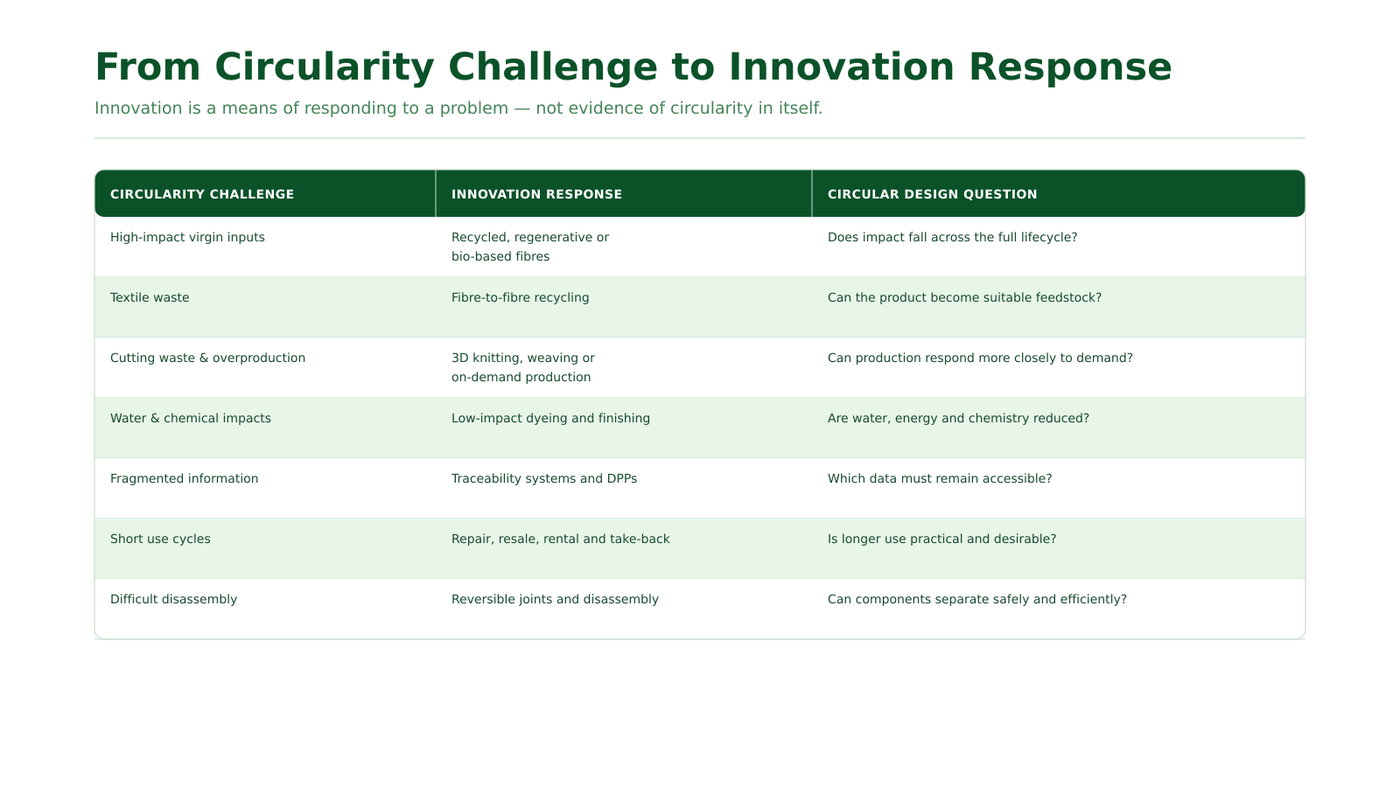
Figure X. From circularity challenge to innovation response. Circular innovations should be selected according to the specific problem they address, the evidence supporting them, and their compatibility with the intended product lifecycle. Innovation is a means of responding to a challenge, not evidence of circularity in itself.
RESOURCE INSIGHT: Reimagining Growth: Landscape Analysis — Textile Exchange, 2024. This report questions whether 'unending growth' can ever be decoupled from resource use on the scale needed, and compares degrowth with green growth. For fashion it recommends decoupling revenue from production volumes and virgin inputs, increasing the revenue share of circular business models such as repair and rental, and eliminating wasteful practices like deliberate excess. Source: https://textileexchange.org/app/uploads/2024/12/Reimagining-Growth-Landscape-Analysis.pdf.
RESOURCE INSIGHT: Fashion for Good Innovation Platform — Fashion for Good. An open, searchable innovation database mapping start-ups and scale-ups across the value chain - raw materials, processing, manufacturing and retail, end of use, and transparency and traceability - plus topic areas such as next-generation materials, decarbonisation and waste mapping. SMEs can use it to scout technology partners and track proven innovations before investing. Source:
Source: https://www.fashionforgood.com/innovation-platform-2/innovators/.
3.5.1 Case Example — unspun × Eckhaus Latta: From Technology to Desirable Fashion
Conventional garment production usually involves weaving flat fabric, cutting pattern pieces, and sewing them together. This process can generate cutting waste, require several production stages, and encourage companies to manufacture stock before knowing exactly what will be sold.
unspun’s Vega™ technology explores a different production model by weaving three-dimensional garment forms directly from yarn. In its collaboration with Eckhaus Latta, the technology was used to create 3D-woven garments presented as part of the brand’s Spring/Summer 2024 collection. The process produced woven forms shaped as garment components, reducing the cutting and conventional assembly normally associated with trouser production.
The collaboration is important because it positioned advanced manufacturing within a recognisable fashion context. Eckhaus Latta’s experimental approach to materials and form helped demonstrate that production innovation does not need to result in a generic technical prototype. Technology became part of the collection’s design language and creative identity.
The case also shows why innovation should be evaluated in relation to the specific problem it addresses. Three-dimensional weaving may reduce cutting waste, simplify assembly, and support more responsive production. It does not automatically resolve the impacts of fibre production, dyeing, energy use, durability, or end-of-use.
Its wider contribution will depend on material choices, production efficiency, commercial accessibility, and whether manufacturing closer to demand genuinely reduces unsold inventory. The aspirational value of the collaboration lies in connecting technical change with desirable fashion while leaving these wider questions open to assessment.
Source: unspun — Eckhaus Latta × Vega™
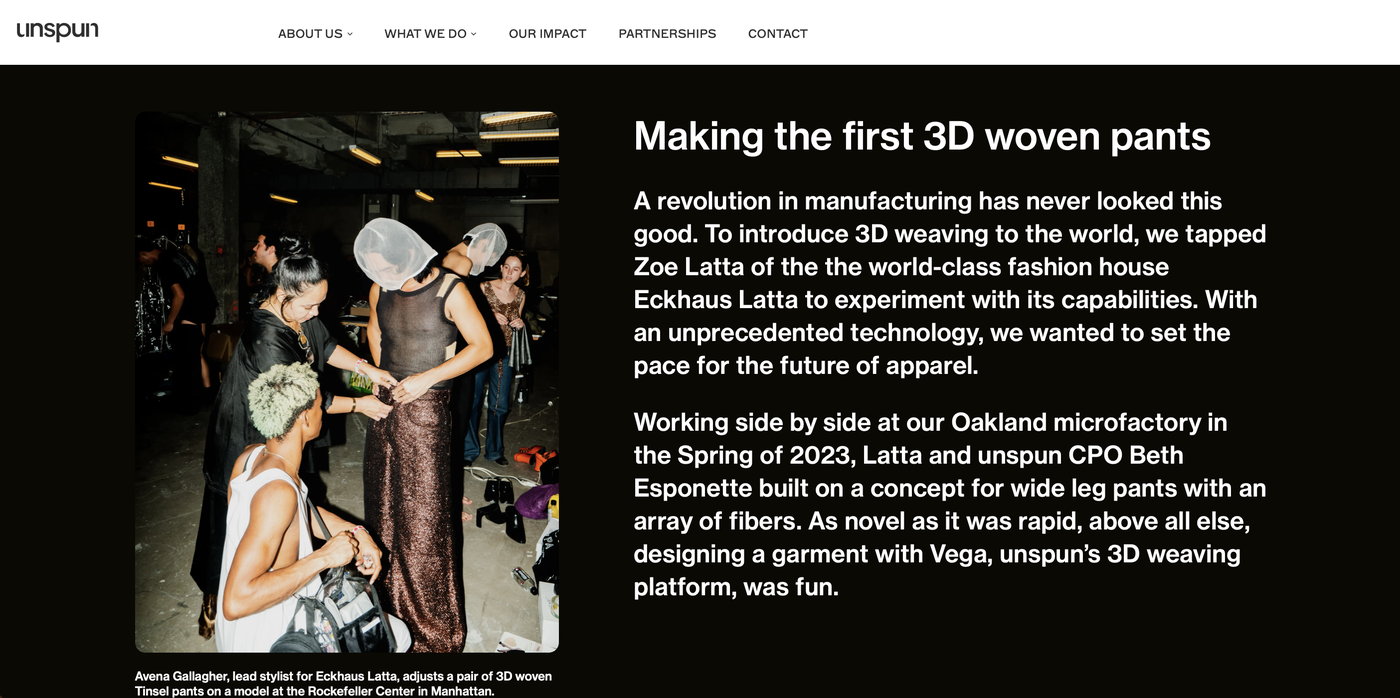
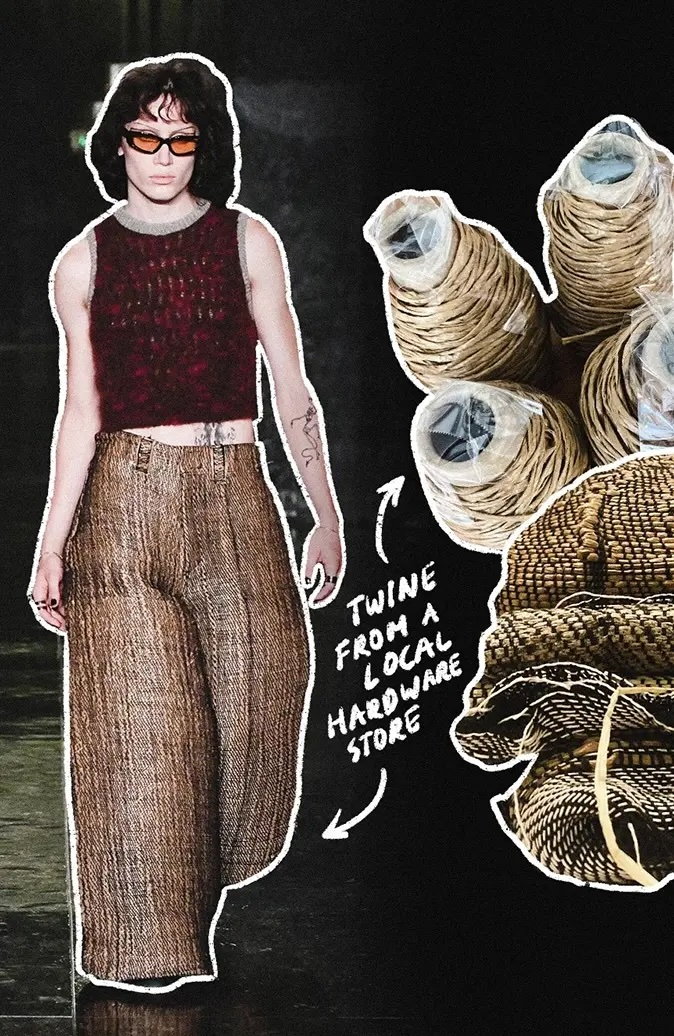
Figure X. 3D-woven garment from the Eckhaus Latta × unspun collaboration, presented as part of the Spring/Summer 2024 collection. The project used Vega™ technology to explore how three-dimensional weaving could reduce conventional cutting and assembly while contributing to an experimental fashion language. Source: unspun.
3.6 Prioritizing Responses for SMEs
For SMEs, circular transition cannot mean attempting to change everything at once. Prioritisation should begin with a clear understanding of which environmental, social, technical, and economic issues are most relevant to the organisation, its stakeholders, products, and value chain.
Materiality assessment can help identify the issues that require the greatest attention. Relevant topics may include material sourcing, durability, textile waste, chemical safety, water use, repairability, supplier transparency, labour conditions, product information, take-back systems, and recyclability. Materiality should not be reduced to a reporting exercise: it can inform product briefs, sourcing requirements, investment decisions and partnership priorities.
Stakeholder mapping then identifies who influences, or is affected by, each decision. Designers and internal teams may control product architecture, material specifications, and communication. Suppliers, manufacturers, repair partners, sorters, recyclers, logistics providers, resale platforms, municipalities and regulators may determine whether the intended circular pathway is operationally possible.
Possible responses should subsequently be compared according to their expected impact and feasibility. Some actions may be implemented directly, such as removing unnecessary trims or improving care information. Others require partnerships, investment, or infrastructure, such as advanced recycling, take-back logistics, or digital product passport systems.
Company-level tools such as B Impact can support this process by connecting product circularity with wider questions of governance, workers, communities, environmental impact and customers. Such frameworks do not replace circular design. They help identify the organisational and governance conditions required to support it.
ESG as a prioritisation lens. ESG is commonly used to describe the environmental, social, and governance dimensions through which a company assesses its wider responsibilities, risks, and impacts. In the context of circular fashion, it can help SMEs connect product-level circularity decisions with broader business considerations — from sourcing and biodiversity to working conditions, supplier relationships, data ownership and accountability for claims.
Environmental considerations may include traceability, certifications, biodiversity and sourcing impacts; social considerations include fair wages, safe working conditions, freedom of association and the prevention of child or forced labour; and governance covers areas such as supplier evaluation, codes of conduct, audits, data responsibilities and accountability. ESG does not replace circular design, but it can help identify the organisational conditions needed to support it.
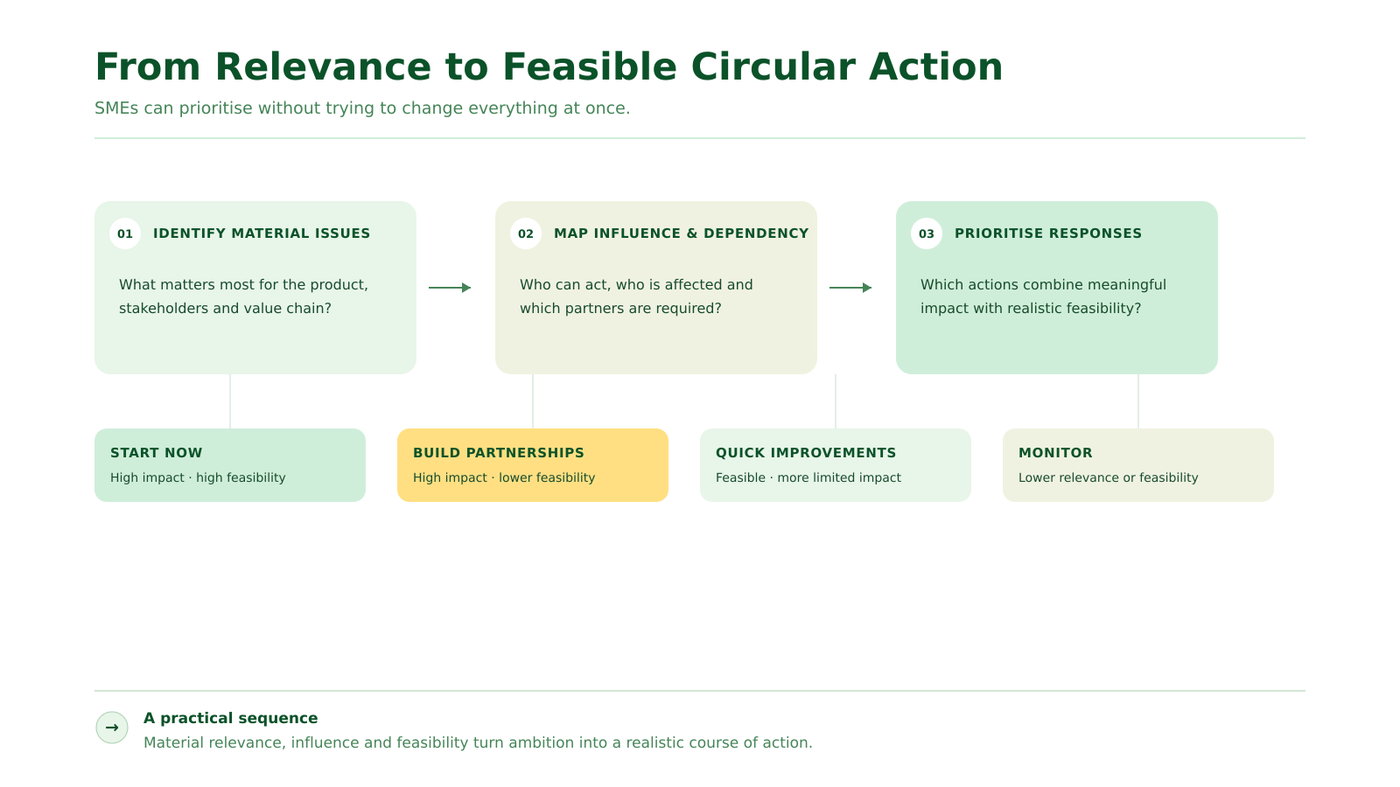
Figure X. From material relevance to feasible circular action. SMEs can prioritise circular strategies by identifying their most material challenges, mapping the actors required for implementation, and comparing possible responses according to expected impact and feasibility.
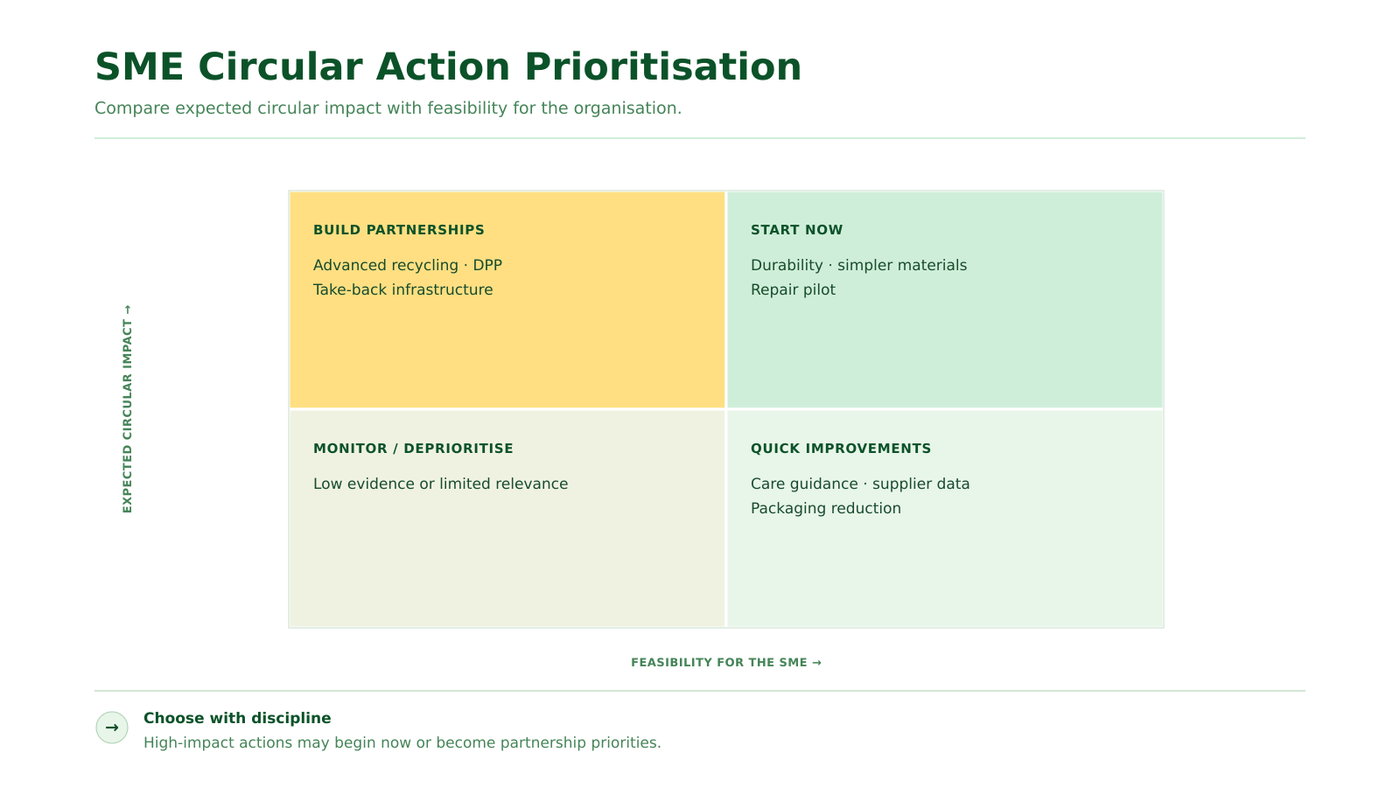
Figure X. SME circular action prioritisation. Circular strategies should be selected by comparing their expected impact with feasibility, available resources, evidence, and partnership requirements.
GFA RESOURCE: Fashion CEO Agenda 2025 — Global Fashion Agenda, 2025. The Agenda distils industry consensus into five priorities — Respectful and Secure Work Environments, Better Wage Systems, Resource Stewardship, Smart Material Choices and Circular Systems — each with defined ambitions and immediate, short-term actions. For SMEs it advises prioritising by materiality: adapt actions to your company’s baseline, resources and most material issues rather than attempting everything at once. Circular Systems ambitions include designing all products fit for the circular economy, reducing overproduction and growing revenue from circular business models. Source: https://globalfashionagenda.org.
FOR YOUR SME / BUSINESS CASE: use a 2×2 impact–feasibility matrix on five candidate circular actions. Example: replacing mixed trims with mono-material equivalents can add roughly 2–5% to unit cost but improves recyclability and can lower future EPR sorting fees; removing one colourway from your range can cut fabric stock by about 15–20% and reduce overproduction write-offs. Score each action 1–3 for expected impact and 1–3 for feasibility, then implement the two top-scoring actions within 90 days.
3.6.1 ESG in Practice: Mapping Stakeholders and Material Priorities
ESG provides a practical lens for connecting circular design with wider organisational responsibility.
Environmental considerations may include material sourcing, water and energy use, chemical safety, waste, emissions, biodiversity, durability, and end-of-use recovery. Social considerations include working conditions, wages, worker safety, skills, accessibility, and the effects of production or waste systems on local communities. Governance concerns how decisions are made and supported through responsibilities, supplier requirements, data ownership, traceability, targets, and accountability for claims.
ESG does not replace circular design. It helps organisations understand the environmental, social, and governance conditions required to make circular strategies credible and achievable.
What is stakeholder mapping?
Stakeholder mapping identifies the people and organisations that affect, are affected by or hold knowledge relevant to a product, business model or circular pathway.
In circular fashion, stakeholders may include internal teams, fibre producers, suppliers, manufacturers, workers, customers, repairers, resale and rental platforms, logistics providers, collectors, sorters, recyclers, municipalities, regulators, industry networks, researchers and local communities.
Stakeholder mapping should not focus only on stakeholders with the greatest commercial power. Workers, communities, or other affected groups may have limited influence over company decisions but experience significant environmental or social impacts. Their perspectives may reveal risks, needs, or knowledge that an exclusively internal analysis would overlook.
For each stakeholder, learners should consider:
- How are they affected by the product or business model?
- What knowledge, capabilities, or resources do they hold?
- Which decisions can they influence?
- At what stage should they be involved?
- Could they enable or prevent the intended circular pathway?
- What form of engagement would be appropriate?
How to map stakeholders
A simplified stakeholder mapping process can follow four steps:
- Define the scope. Select the product, service, product category, or business decision being analysed.
- Map the value chain. Identify where materials, production, use, repair, collection, and recovery activities take place.
- Identify affected and influential stakeholders. Include internal decision-makers, value-chain partners, users, affected groups, and circular ecosystem actors.
- Map influence and dependency. Determine who controls relevant decisions, who holds essential information, and which external capabilities are required.
The result should identify relationships and dependencies, not merely produce a list of names. For example, a brand may want to introduce a take-back service but depend on logistics providers, sorters, resale partners and recyclers to determine what happens to the returned products.
What is materiality?
Materiality helps organisations determine which sustainability issues are significant enough to guide priorities, resources, targets, and decisions.
In a simplified circular design exercise, potential material issues might include fibre sourcing, durability, repairability, chemical safety, working conditions, traceability, water use, production waste, microfibre release, recyclability or access to circular services.
Double materiality considers two connected perspectives:
- Impact materiality: how the organisation, its products and its value chain affect people and the environment.
- Financial materiality: how environmental and social issues may create risks or opportunities for the organisation.
A sustainability issue may be material from either perspective or from both. For example, hazardous chemicals may create impacts on workers and ecosystems while also creating regulatory, reputational, operational, or financial risks for the company.
Learners can assess each issue through the following questions:
- What actual or potential impact occurs?
- Where in the value chain does it occur?
- Which people, groups or ecosystems are affected?
- How severe and likely is the impact?
- Does it create a business risk or opportunity?
- How urgent is the issue?
- Can product or business model decisions influence it?
- Is collaboration with another stakeholder required?
- What evidence is available, and what information is still missing?
From mapping to action
Stakeholder mapping and materiality assessment should lead to a decision, rather than ending with a matrix or stakeholder list.
The practical sequence is:
Map the value chain → Identify stakeholders → Assess impacts, risks and opportunities → Prioritise material issues → Define actions and indicators
The final output should connect four elements:
Material priority → Stakeholders involved → Design or business response → Evidence or indicator
For example, if repairability is identified as a material priority, the organisation may need to involve designers, manufacturers, repair partners, and users. The response could include replaceable components, accessible seams, spare parts, and a repair service. Evidence might include repair instructions, repair uptake, common failure points, and the percentage of products successfully repaired.
Stakeholder mapping identifies the people, knowledge and capabilities required to make circularity possible. Materiality helps organisations decide which issues deserve priority attention. Together, they prevent circular design from becoming a collection of isolated product features disconnected from real impacts, infrastructure, and business decisions.
Learning note: This simplified exercise introduces stakeholder mapping and materiality as strategic decision-making tools. It is not a substitute for a formal double materiality assessment conducted for regulatory reporting.
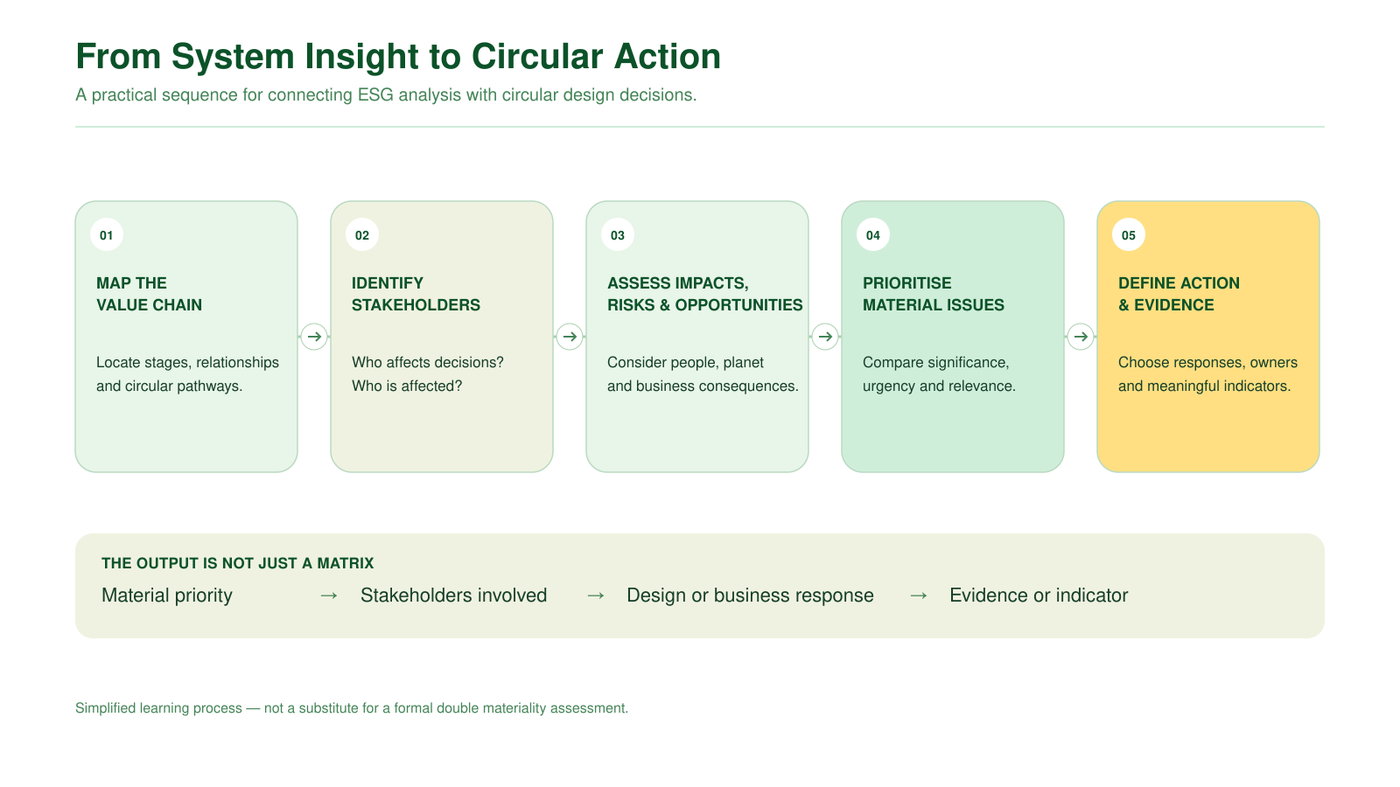
Figure X. From system insight to circular action. Stakeholder and materiality analysis connect value-chain hotspots with prioritised circular design actions, responsible actors and evidence.
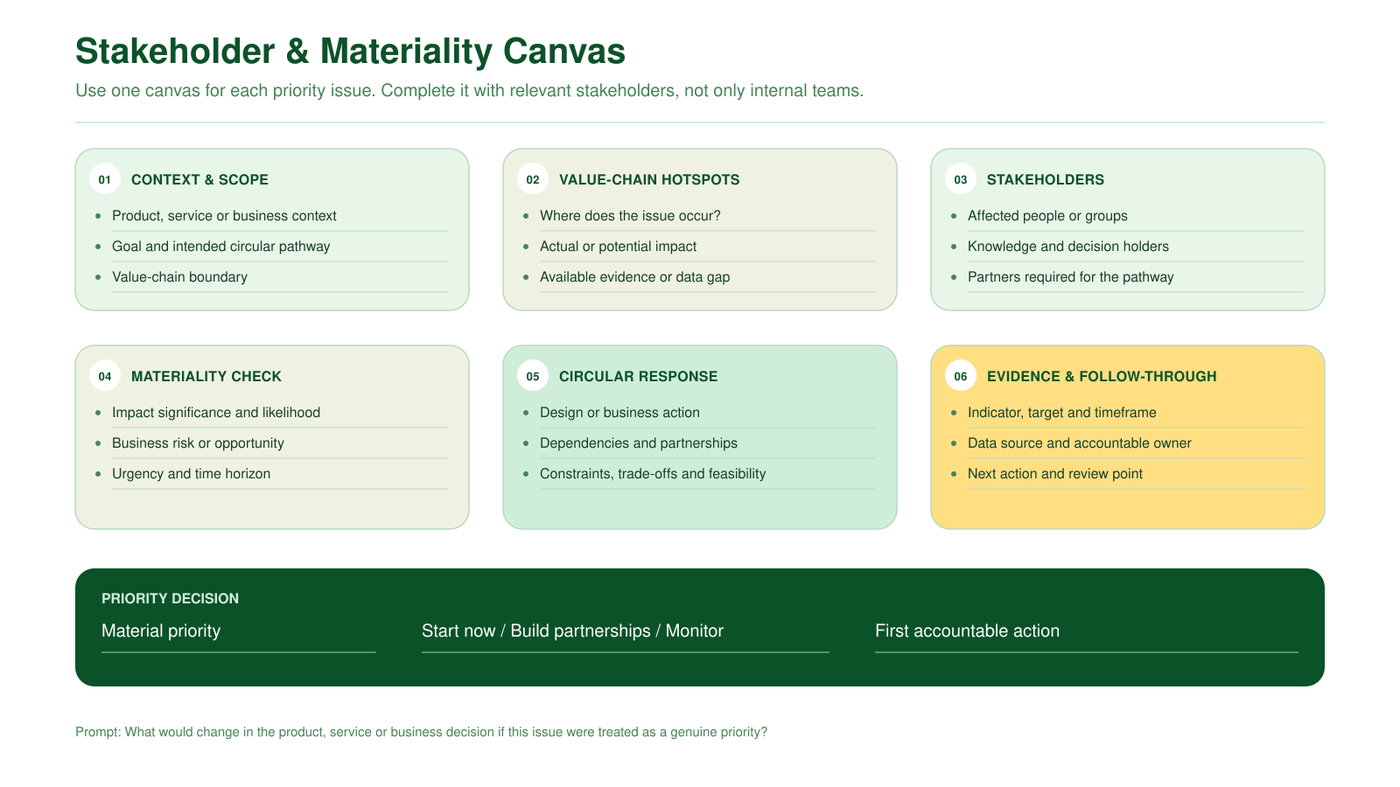
Worksheet X. Stakeholder and Materiality Canvas. A simplified tool for identifying value-chain hotspots, relevant stakeholders, material issues, feasible responses, and indicators.
Sources: EFRAG — Materiality Assessment Implementation Guidance, GRI 3 — Material Topics e OECD Due Diligence Guidance for Garment and Footwear.
Try it now
run a 20-minute stakeholder map for one of your products on paper or a free Miro board: list 8–10 stakeholders along the value chain, mark who can enable or block your chosen circular pathway (e.g., a take-back scheme), and note one engagement action per stakeholder. Then complete the free B Impact Assessment quick version (bcorporation.eu) to see which ESG areas your company scores lowest on.
3.6.2 Case Example — Resortecs: Enabling Design for Disassembly Through Smart Stitch™
Separating trims, fastenings and other non-textile components at end of use is often slow and expensive when done manually. Mechanical shredding can avoid manual disassembly, but may shorten fibres and mix recyclable textile content with trims, threads, and other contaminants. As a result, even garments made from potentially recyclable fabrics may not become suitable recycling feedstock.
Resortecs approaches this problem through design for disassembly. Its Smart Stitch™ system consists of heat-activated sewing threads designed to perform during normal production and use but release at specific elevated temperatures. The threads can be integrated using widely available industrial sewing machinery, allowing disassembly capability to be introduced during garment construction without fundamentally changing the appearance of the product.
At the end of use, garments can be processed through the company’s Smart Disassembly™ thermal system. In a controlled low-oxygen environment, the threads release and enable textile panels to be separated from components such as zips, buttons, labels and elastic bands. This can produce cleaner and more consistent material streams for subsequent sorting and recycling.
The case demonstrates that end-of-use outcomes can be influenced by a decision as apparently small as the choice of sewing thread. Designers and product developers must anticipate which components need to remain secure during use, which should be replaceable for repair, and which must eventually be separated for recycling.
However, design for disassembly does not create a circular system by itself. Garments still need to be collected, identified, sorted, and directed towards compatible disassembly and recycling infrastructure. The recovered textile material must also meet the requirements of a viable recycling process and be connected to demand for the resulting output.
Resortecs therefore connects product architecture with industrial infrastructure. Its value lies not only in the thread, but in the relationship between an early design decision and a defined downstream process. The case shows designers that circularity can be embedded in construction details, while also demonstrating that those details only produce value when the wider recovery system exists.
In 2026, Resortecs announced a partnership with industrial thread manufacturer AMANN Group to support the industrialisation and distribution of its design-for-disassembly approach. This development reinforces a central lesson of the chapter: circular innovation reaches scale through coordination between designers, manufacturers, technology providers, waste managers and recyclers, rather than through isolated product experiments.
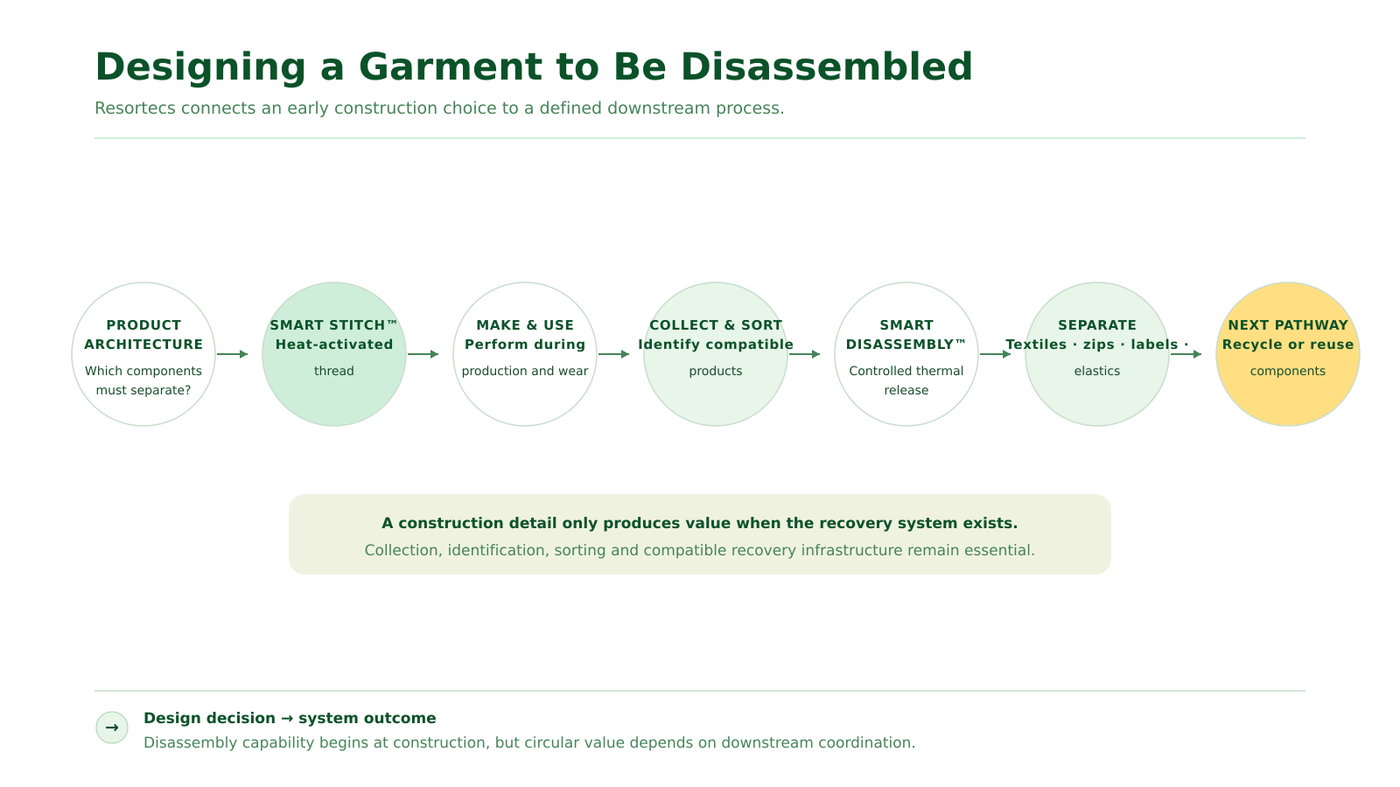
Figure X. Designing for disassembly with Resortecs. Smart Stitch™ introduces disassembly capability during product construction, while Smart Disassembly™ enables components to be separated at the end of use. The circular outcome still depends on collection, sorting, and access to compatible recovery infrastructure.
Critical Assessment
The Resortecs system responds directly to a recognised recycling bottleneck: the cost and difficulty of separating recyclable textile content from incompatible components. Nevertheless, its effectiveness should be assessed through evidence concerning:
- thread performance and durability during use;
- compatibility with different textiles and garment constructions;
- access to thermal disassembly infrastructure;
- collection and sorting volumes;
- energy requirements;
- purity and yield of recovered materials;
- compatibility with subsequent recycling processes;
- costs compared with manual or mechanical disassembly;
- demand for the recovered textile feedstock.
Reflection prompt:
At which point in the design and development process would Smart Stitch™ need to be specified? Which actors and infrastructures must remain connected for that decision to produce a circular outcome at the end of use?
Sources: Resortecs — Technology and Resortecs × AMANN Group
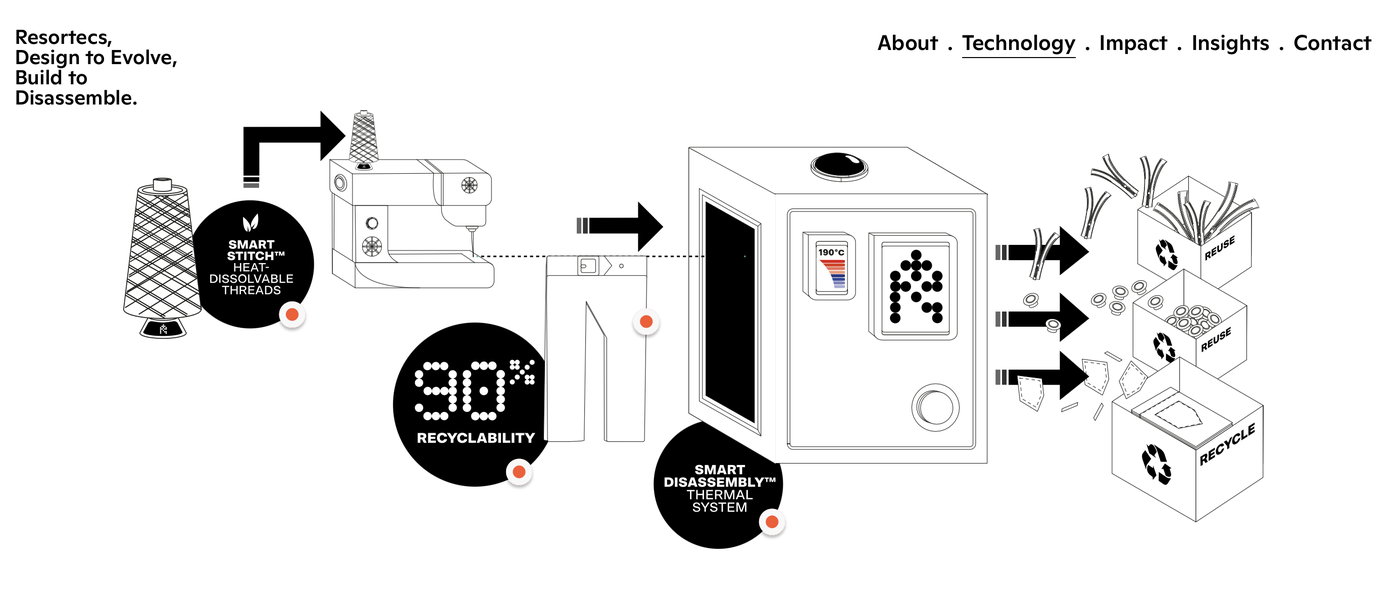
Figure X. Resortecs Smart Stitch™ and Smart Disassembly™ system. Heat-activated sewing threads allow textile panels and incompatible components to be separated through a controlled thermal process, supporting cleaner material streams for recycling. Source: Resortecs.

Video X. Resortecs design-for-disassembly process. The demonstration shows how a construction decision made during manufacturing can facilitate automated component separation when a garment reaches the recovery system. Source: Resortecs.