
Chapter 1 — full chapter
Chapter 1 — full chapter
1.1.2 Critical Reflection — Can fashion be circular if its creative system is extractive?
Circularity is often discussed in relation to materials, products, and waste. However, the fashion system can also be extractive in the way it uses people’s time, skills, and creative labour. Behind every collection, campaign and fashion show is a wide network of assistants, interns, pattern cutters, stylists, photographers, producers, set designers, casting professionals and other freelancers. Their contribution is not always adequately recognised or remunerated, and access to the industry may depend on accepting unpaid internships, low-paid entry-level positions, unpaid overtime or financially insecure freelance work.
This is not only a labour issue but also a question of whose creativity the industry can afford to include. When professional entry and progression depend on being able to work for little or no pay, opportunities become concentrated among those with sufficient financial support. A fashion system cannot be considered sustainable if it preserves materials while exhausting or excluding the people whose labour creates its cultural and commercial value.
At the most visible end of this system, luxury creative directors may be responsible for multiple annual outputs across Spring/Summer, Autumn/Winter, resort, pre-fall, menswear, womenswear and couture, alongside campaigns, collaborations and continuous digital content. Although their position and remuneration differ substantially from those of interns and precarious freelancers, the accelerated calendar exposes the same underlying expectation: the continuous production of novelty, regardless of the time required for research, reflection and creative development.
In 2015, Raf Simons left Dior after publicly questioning the speed of fashion and the limited time available for reflection and creative development. His departure, after producing six Dior collections a year, became an important reference in debates about the human and creative consequences of the fashion calendar. More recently, the high turnover of creative directors across luxury houses has renewed questions about commercial pressure, constant novelty, and the time required to build a coherent creative vision. These departures have different causes and should not all be interpreted as acts of protest, but together they expose tensions within the current system.
In 2020, designers and industry leaders—including Dries Van Noten, Gabriela Hearst and Marine Serre—called for a reset of the fashion calendar, proposing fewer products, better alignment with real seasons, reduced travel and less waste. Gucci’s Alessandro Michele also announced that the brand would reduce its annual shows from five to two.
These examples raise a wider circular design question: can products be designed for longevity within a system organised around permanent acceleration and replacement?
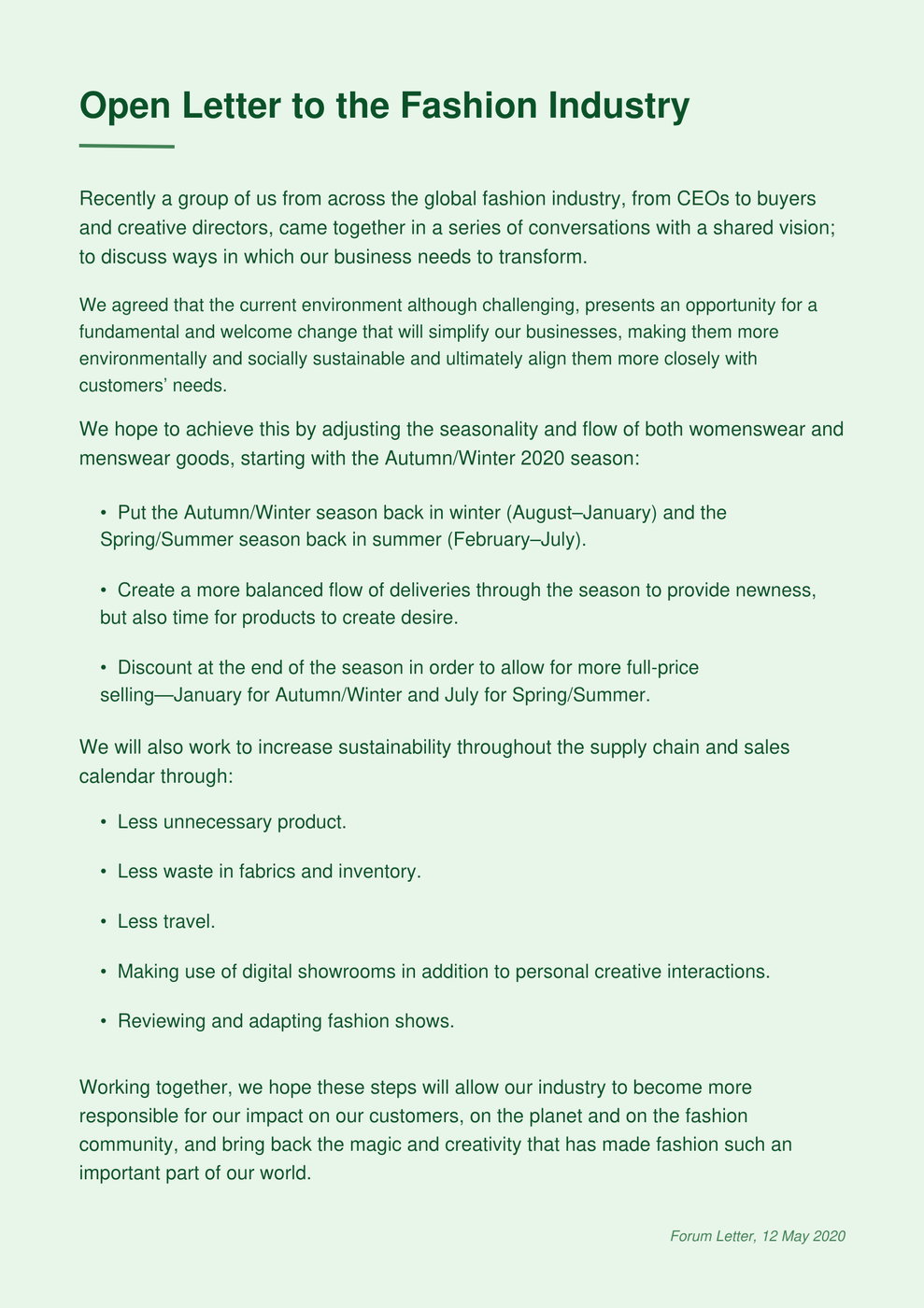
Figure 4. Open Letter to the Fashion Industry, published on 12 May 2020 following discussions led by Dries Van Noten, Andrew Keith of Lane Crawford and Shira Sue Carmi of Altuzarra. Its initial signatories included designers, executives and retailers such as Joseph Altuzarra, Gabriela Hearst, Marine Serre, Tory Burch, Craig Green, Erdem Moralioglu, Mary Katrantzou, Proenza Schouler, Acne Studios, Jil Sander, Nordstrom, Bergdorf Goodman, Selfridges and Mytheresa. The major luxury groups LVMH and Kering were not represented on the published signatory list. The initiative called for a more seasonally aligned calendar, fewer unnecessary products, reduced fabric and inventory waste, less travel, and a reassessment of fashion-show formats.
In the years that followed, some of the practices accelerated during the pandemic became embedded in the industry, particularly the use of digital showrooms, more flexible presentation formats and, for some brands, a reduction or consolidation of seasonal presentations. However, the wider system did not fundamentally slow down: multiple collections, frequent product drops and strong pressure for continual newness remain characteristic of much of the fashion market. The Open Letter can therefore be read less as a completed industry reset than as an important articulation of tensions that remain unresolved between longevity, commercial growth and the accelerated fashion calendar. Source: Forum Letter (2020), Open Letter to the Fashion Industry. Original text and signatories documented by Vogue Business, Fashionista and The Fashion Law
Designed and developed by FashionKIC, based on Forum Letter (2020), Open Letter to the Fashion Industry.
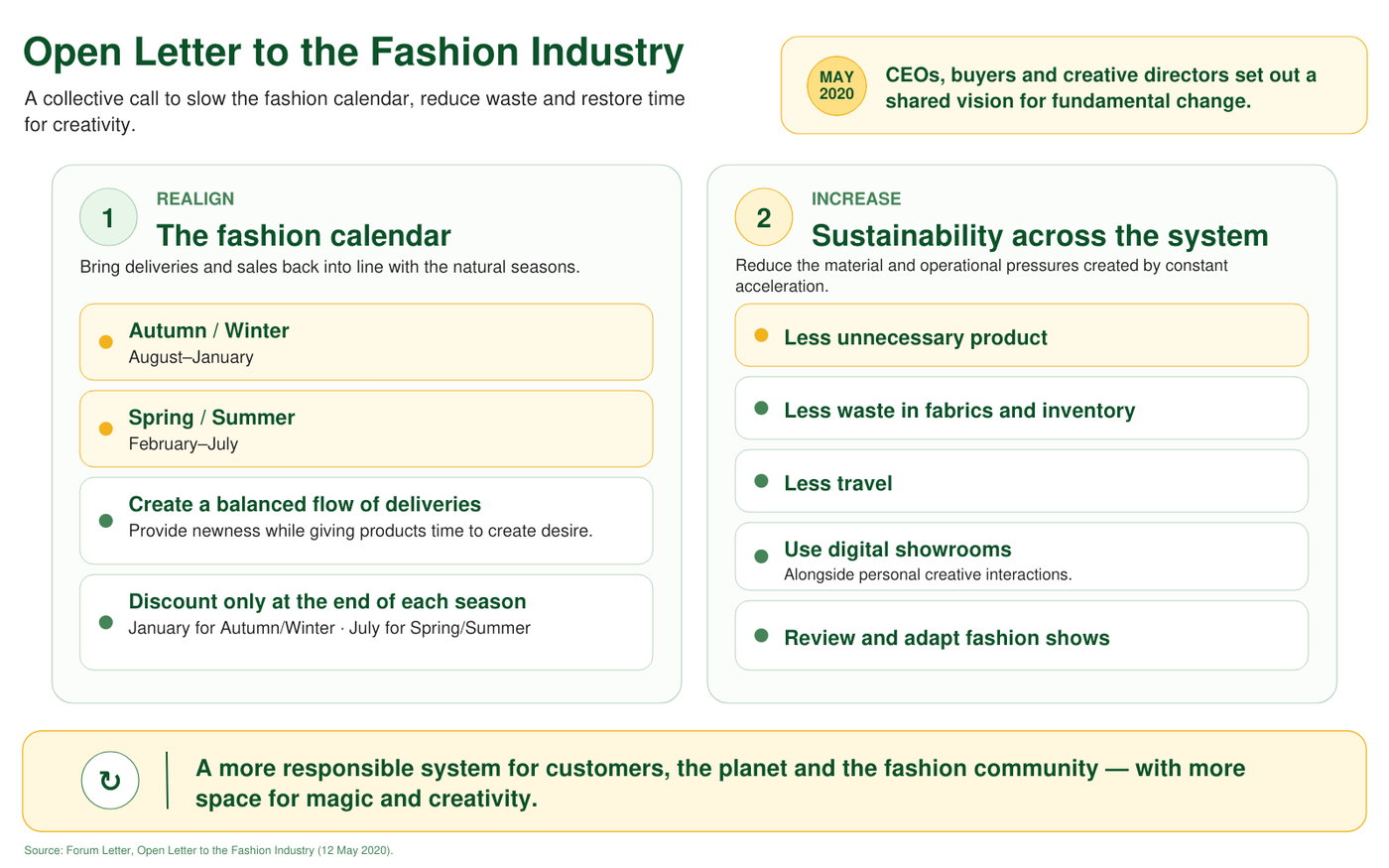
Figure 5. Key proposals from the 2020 Open Letter to the Fashion Industry, calling for a realignment of the fashion calendar and coordinated action to reduce overproduction, waste, and operational pressure across the industry. Adapted from Forum Letter (2020), Open Letter to the Fashion Industry, published 12 May 2020.
Sources
BoF — Raf Simons
Vogue — Dior departure
Vogue — Fashion Open Letter
Vogue — Gucci calendar
Diversity & Inclusion in the Fashion Industry
Good Work Review: Job Quality in the Creative Industries
A Quantitative Baseline of Job Quality in the Creative Industries