
Chapter 1 — full chapter
Chapter 1 — full chapter
1.1.4 Who Creates and Uses a DPP?
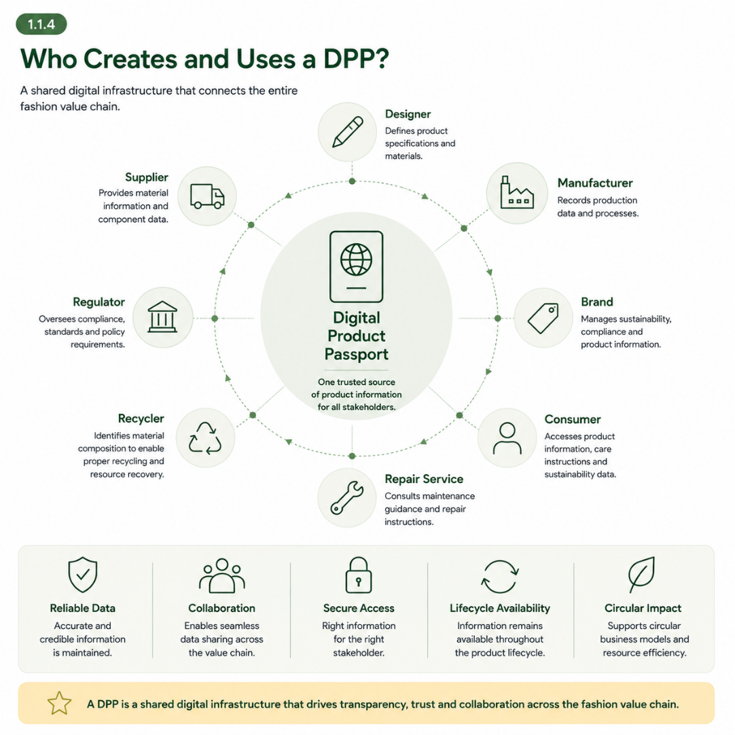
Digital Product Passports are created and updated by multiple stakeholders across the fashion value chain. Designers define product specifications, manufacturers record production data, and brands manage sustainability information. Consumers access product information, repair services consult maintenance guidance, and recyclers identify material composition to support material recovery.
Rather than serving a single organisation, a DPP acts as a shared digital infrastructure that enables collaboration while ensuring reliable information remains available throughout the product lifecycle.
RESOURCE INSIGHT : EU DPP Updated Guide for Fashion and Textiles — GreenStitch, 2025. A DPP has three layers: the carrier/system layer (QR/NFC plus the EU registry, built on GS1 Digital Link), the data layer — about 90% of the effort and risk — and the customer-experience layer. The textile delegated act is expected 2027–2028 with enforcement after an 18-month transition; Tier 2 data collection takes 12–24 months, so start early. Source: https://greenstitch.io/blogs/eu-digital-product-passport-dpp-guide/. (ID DPP036, T3.1 Mapping Knowledge Resourceshttps://greenstitch.io/blogs/eu-digital-product-passport-dpp-guide/
RESOURCE INSIGHT : Digital Product Passport System Overview — Circularise, 2024. DPPs are mandatory under the ESPR for regulated products: each passport links a unique product identifier on a data carrier (QR, NFC, RFID) to structured, machine-readable data compliant with ISO/IEC 15459. Battery passports (from 2026) are the test case; access rights are role-based under ESPR Article 10. Source: https://www.circularise.com/blogs/digital-product-passports-dpp-what-how-and-why. (ID DPP009, T3.1 Mapping Knowledge Resources)https://www.circularise.com/blogs/digital-product-passports-dpp-what-how-and-why