Chapter 1 — full chapter
| Site: | FashionKIC Learning Platform |
| Course: | Digital Product Passports |
| Book: | Chapter 1 — full chapter |
| Printed by: | Guest user |
| Date: | Sunday, 1 November 2026, 3:20 AM |
Table of contents
- Chapter 1 — Introduction to Digital Product Passports
- 1.1 What DPPs are
- 1.2 Why do they matter?
- 1.3 Business value
- 1.3.1. From compliance cost to competitive advantage
- 1.3.2. New value across the product lifecycle
- 1.3.2.1. Resale and Recommerce
- 1.3.2.2. Repair
- 1.3.2.3. Take-back and trade-in
- 1.3.2.4. Rental and product-as-a-service
- 1.3.2.5. Refurbishment and upcycling
- 1.3.2.6. Authentication and ownership
- 1.3.2.7. Post-purchase engagement and customer data
- 1.3.3. Trust, authentication and protection against greenwashing
- 1.3.4. Operational efficiency and better decisions
- 1.4 Scope and limitations
Chapter 1 — Introduction to Digital Product Passports
Guiding question : If every garment carried its own digital record — what it is made of, where it has been, how to repair or resell it — what would change about how we buy, use and discard fashion?
This chapter introduces circular design as a decision framework for product creation, that treats EU textile strategies and regulations as input param shaping product structure, material logic, and information requirements. The chapter situates fashion products using the idea of the “textile urban mine” to reframe garments as assets moving through city systems rather than disposable items. The chapter establishes lifecycle thinking as the foundation for all design decisions and introduces how garments operate as multi-life assets within urban material systems
Learning objective Learners will be able to explain what a Digital Product Passport is, how it works across the product lifecycle, what data it carries and who creates it, and why DPPs matter for transparency, circularity and business value in fashion.
Learning outcome: Learners will be able to identify the essential data fields of a textile DPP, explain how a passport travels with a garment from design to end-of-life, and assess the business value and limitations of DPPs for an SME.
Time: ≈ 3–5 h · reading & activities (2 h) · assignment (1–3 h) · quiz (10 min).
In this chapter:
- 1.1 What DPPs are
- 1.2 Why do they matter?
- 1.3 Business value
- 1.4 Scope and limitations
1.1 What DPPs are
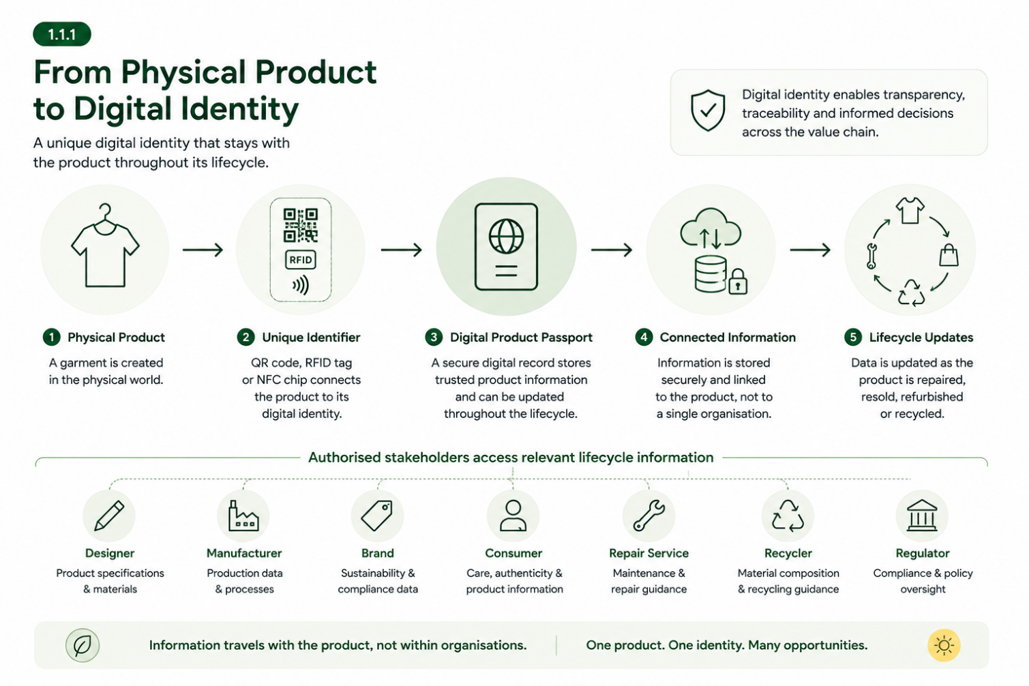
1.1.1 From Physical Product to Digital Identity
A Digital Product Passport (DPP) gives every product a unique digital identity that remains linked to it throughout its lifecycle. Using technologies such as QR codes, RFID tags, or NFC chips, a physical garment is connected to a digital record containing reliable product information. Unlike traditional labels, which provide only limited static data, a DPP can be updated as the product is repaired, resold, refurbished, or recycled.
This digital identity enables information to travel with the product rather than remaining within individual organisations. As a result, all authorised stakeholders can access relevant lifecycle information, supporting transparency, traceability, and more informed decision-making across the fashion value chain.
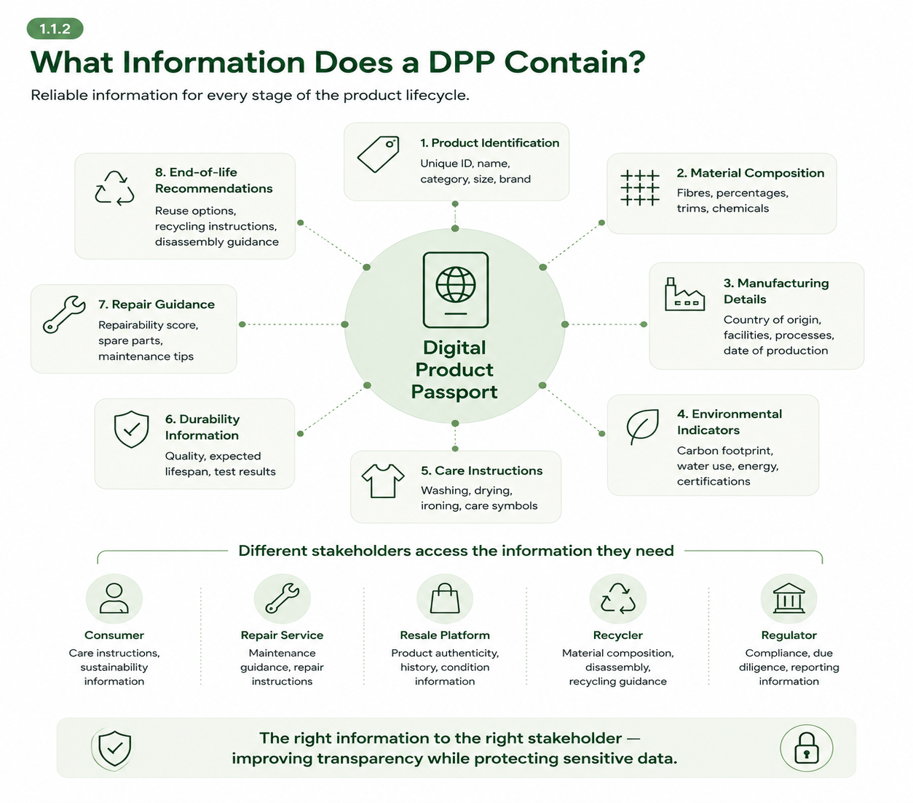
1.1.2 What Information Does a DPP Contain?
A Digital Product Passport stores essential information needed throughout a product's lifecycle. Typical data includes product identification, material composition, manufacturing details, environmental indicators, care instructions, durability information, repair guidance, and end-of-life recommendations.
Different users require different information. Consumers may access care instructions and sustainability information, while repair services need maintenance guidance, and recyclers require accurate material composition. By providing the right information to the right stakeholder, DPPs improve transparency while protecting commercially sensitive data.
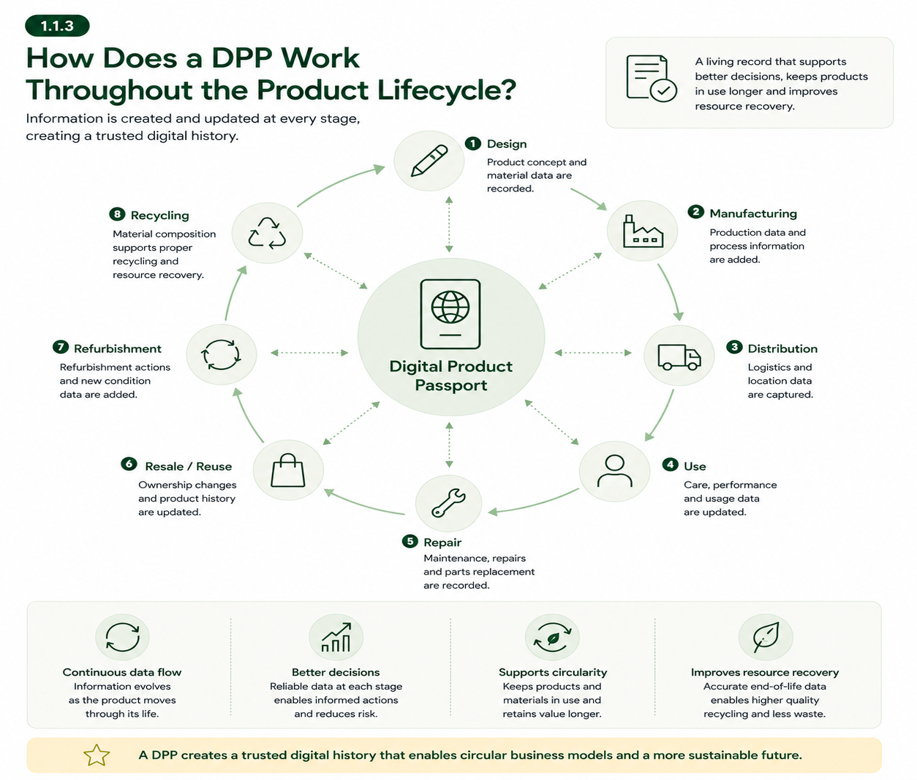
1.1.3 How Does a DPP Work Throughout the Product Lifecycle?
Unlike conventional product documentation, a Digital Product Passport evolves throughout the product's life. Information is created during design and manufacturing and can be updated during distribution, use, repair, resale, refurbishment, and recycling.
This continuous flow of information creates a digital history that supports better decisions at every stage. By preserving reliable lifecycle data, DPPs help products retain value, facilitate circular business models, and improve resource recovery at the end of life.
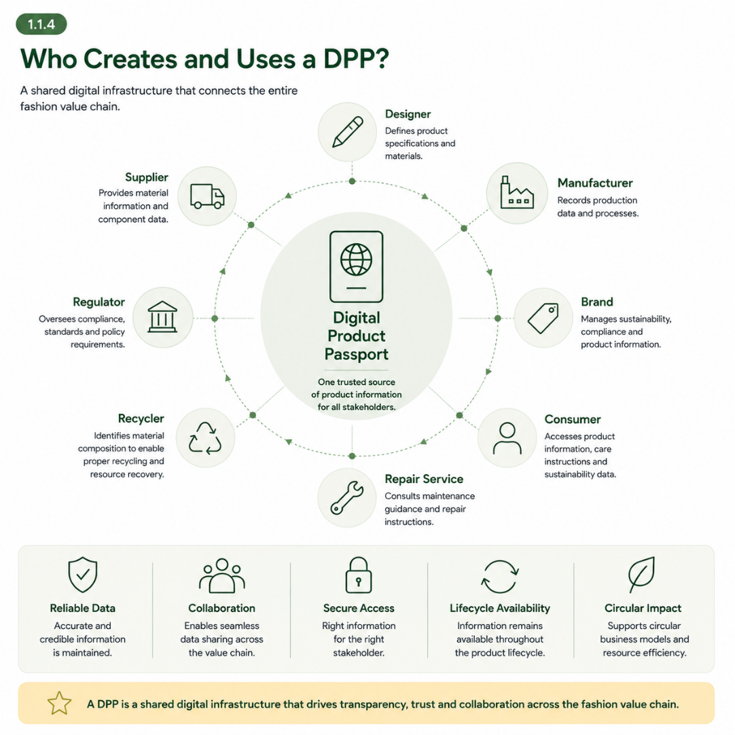
1.1.4 Who Creates and Uses a DPP?
Digital Product Passports are created and updated by multiple stakeholders across the fashion value chain. Designers define product specifications, manufacturers record production data, and brands manage sustainability information. Consumers access product information, repair services consult maintenance guidance, and recyclers identify material composition to support material recovery.
Rather than serving a single organisation, a DPP acts as a shared digital infrastructure that enables collaboration while ensuring reliable information remains available throughout the product lifecycle.
RESOURCE INSIGHT : EU DPP Updated Guide for Fashion and Textiles — GreenStitch, 2025. A DPP has three layers: the carrier/system layer (QR/NFC plus the EU registry, built on GS1 Digital Link), the data layer — about 90% of the effort and risk — and the customer-experience layer. The textile delegated act is expected 2027–2028 with enforcement after an 18-month transition; Tier 2 data collection takes 12–24 months, so start early. Source: https://greenstitch.io/blogs/eu-digital-product-passport-dpp-guide/. (ID DPP036, T3.1 Mapping Knowledge Resourceshttps://greenstitch.io/blogs/eu-digital-product-passport-dpp-guide/
RESOURCE INSIGHT : Digital Product Passport System Overview — Circularise, 2024. DPPs are mandatory under the ESPR for regulated products: each passport links a unique product identifier on a data carrier (QR, NFC, RFID) to structured, machine-readable data compliant with ISO/IEC 15459. Battery passports (from 2026) are the test case; access rights are role-based under ESPR Article 10. Source: https://www.circularise.com/blogs/digital-product-passports-dpp-what-how-and-why. (ID DPP009, T3.1 Mapping Knowledge Resources)https://www.circularise.com/blogs/digital-product-passports-dpp-what-how-and-why
1.2 Why do they matter?
Digital Product Passports are more than a new digital tool—they are an enabler of a more transparent, circular, and data-driven fashion industry. As products become more complex and sustainability expectations increase, reliable information is essential for making better decisions throughout the value chain. A DPP ensures that product information remains connected to the garment, allowing different stakeholders to access the data they need at the right time. Beyond supporting future regulatory requirements, Digital Product Passports help businesses improve transparency, enable circular business models, strengthen consumer trust, and create new opportunities for innovation. The following sections explore the key reasons why DPPs are becoming a strategic asset for the future of fashion
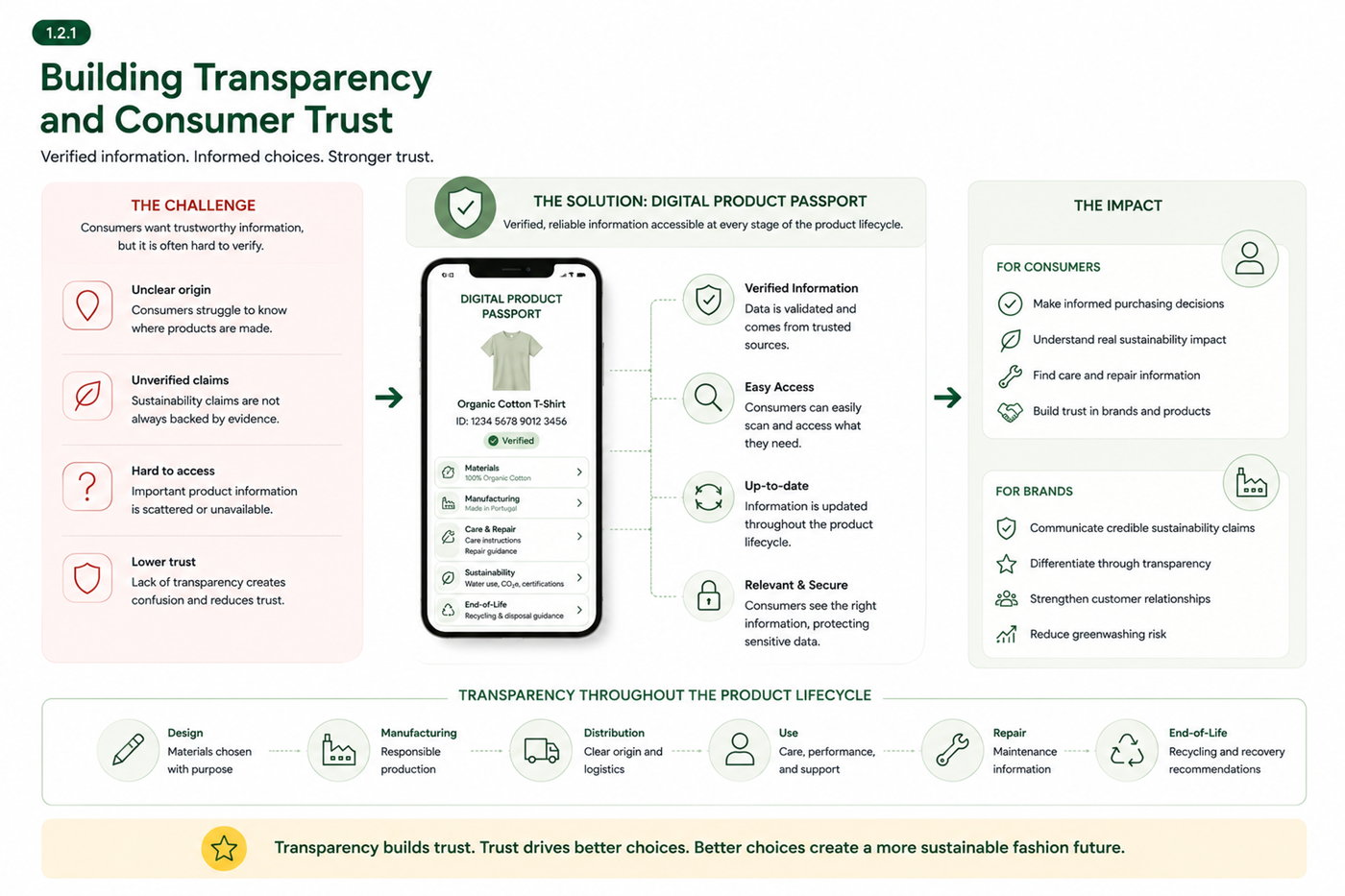
1.2.1 Building Transparency and Consumer Trust
Consumers increasingly expect clear and reliable information about the products they buy. They want to know where products were made, which materials were used, and whether sustainability claims are supported by evidence. However, this information is often difficult to verify, creating confusion and reducing trust.
Digital Product Passports improve transparency by providing verified product information that can be easily accessed throughout the product lifecycle. By making information on materials, manufacturing, care, repair, and sustainability available, DPPs help consumers make more informed purchasing decisions while enabling brands to communicate credible sustainability claims. Greater transparency reduces the risk of greenwashing and strengthens trust between businesses and consumers
1.2.2 Enabling Circularity Through Better Product Information
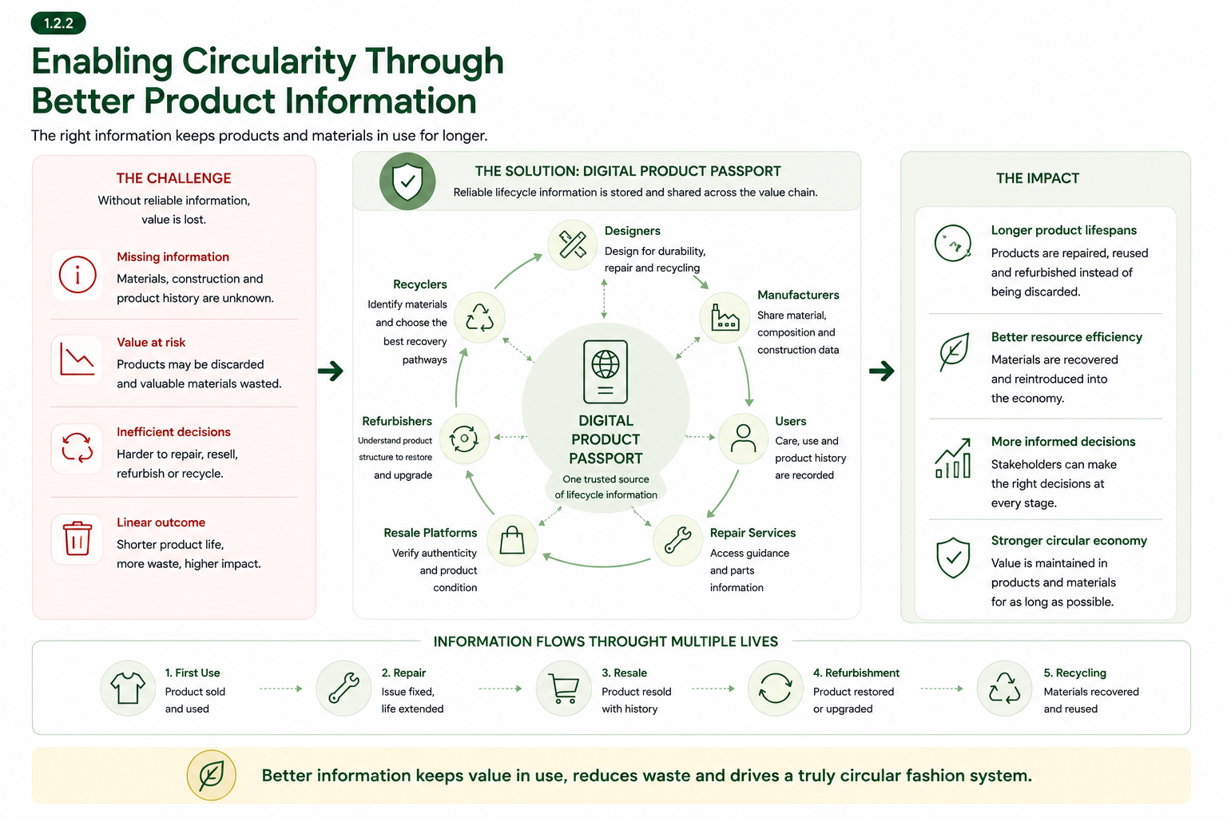
Circular business models depend on products remaining valuable beyond their first use. Activities such as repair, resale, refurbishment, and recycling require accurate information about materials, construction, and product history. Without this information, valuable products and materials may be lost.
Digital Product Passports preserve lifecycle information throughout multiple product lives. Designers, repair services, resale platforms, and recyclers can access the information needed to maintain product value and identify the most appropriate recovery pathways. By connecting reliable information with physical products, DPPs support longer product lifespans, better resource efficiency, and more effective circular economy strategies.
1.2.3 Creating Business Value Beyond Regulatory Compliance
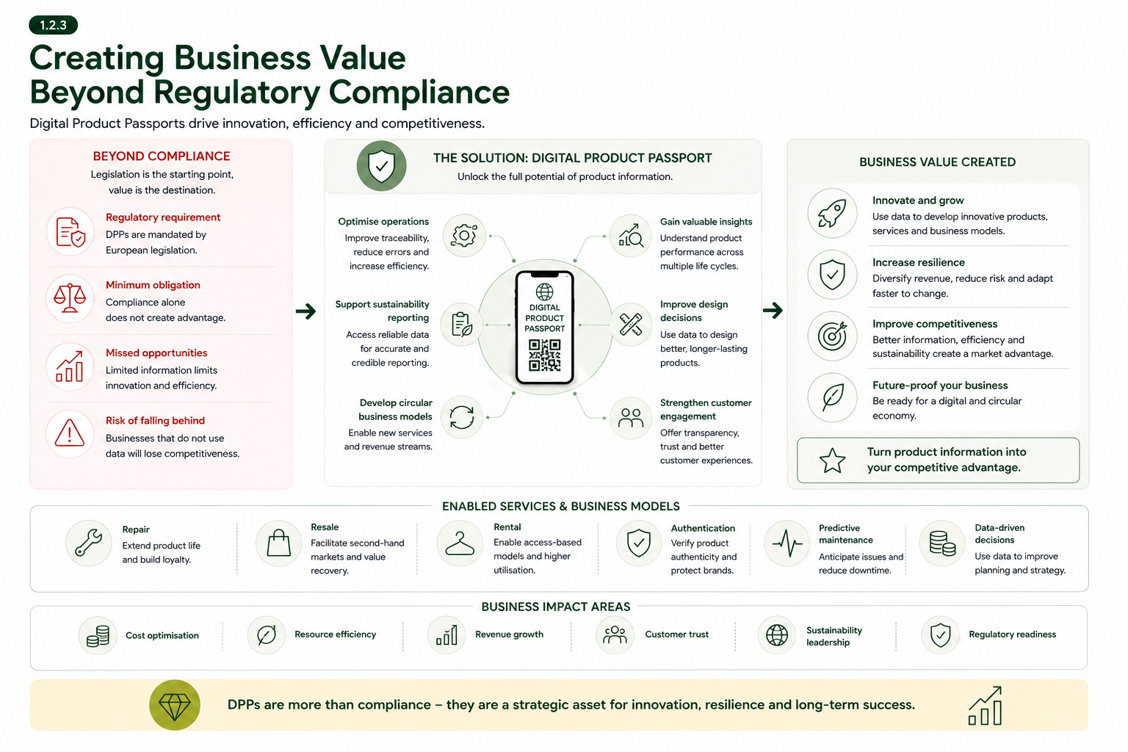
Although Digital Product Passports are being introduced through European legislation, their benefits extend well beyond regulatory compliance. By improving access to product information, DPPs help organisations optimise operations, support sustainability reporting, and develop new circular business models.
For fashion companies, Digital Product Passports enable services such as repair, resale, rental, authentication, and predictive maintenance while providing valuable insights into product performance across multiple life cycles. The data collected can also support better design decisions, improve resource management, and strengthen customer engagement. Businesses that effectively use product information will be better positioned to innovate, increase resilience, and remain competitive in an increasingly digital and circular economy.
RESOURCE INSIGHT : Environmental Concerns in Fashion: A Twin Transition with the DPP — Colasante et al., Business Strategy & the Environment, 2025. A survey of 549 Italian consumers found low familiarity with DPPs but strong confidence in digital labels for corporate transparency. Respondents were willing to pay a 17% premium for DPP-labelled products, most strongly among women, ages 31–50 and higher-income shoppers — evidence that DPPs can shift purchasing behaviour. Source: https://onlinelibrary.wiley.com/doi/full/10.1002/bse.70078. (ID DPP040, T3.1 Mapping Knowledge Resources)https://onlinelibrary.wiley.com/doi/full/10.1002/bse.70078
1.3 Business value
Section 1.2 explained why Digital Product Passports matter for the fashion system as a whole. This section turns to the more practical question facing a small or medium-sized enterprise (SME): what is actually in it for my business?
Many companies see Digital Product Passports as a regulatory requirement, where compliance is the main driver. This view, however, overlooks the much greater strategic value DPPs have across the product lifecycle when it comes to value capture.
While DPPs are a way of making product data structured, accessible and interoperable throughout the value chain, they also unlock the ability to capture value beyond the point of sale of the product. At their core, DPPs are a way of transforming information into a business asset by leveraging not only pre-sale data, but also post-sale product lifecycle information. Overall, SMEs that treat the DPP as a strategic investment, rather than a box to tick, can use it to strengthen customer relationships, open new revenue streams, and compete on transparency against much larger rivals.
The sections below set out where that value comes from and how smaller fashion and textile companies can capture it.
1.3.1. From compliance cost to competitive advantage
The clearest early lesson from the market is that transparency can win business. Larger buyers, retailers and public-sector procurers increasingly demand credible sustainability data, so a smaller supplier that can provide it stands out.
For example, the French workwear brand Coverguard, working with the carbon-data platform Carbonfact, began sharing product-level environmental information and passport links with its business customers well before any mandate applied. Its team reports that being able to demonstrate a serious data strategy helped reassure clients and secure additional sales, according to Carbonfact. Another example is presented by a danish sportswear maker Fusion Sportswear which took a similar route, co-developing passport features that make transparency part of the brand experience rather than a back-office obligation.
For an SME, moving early means the passport becomes a differentiator on the market, but only while it is still voluntary. This is an advantage that disappears once every competitor is legally required to publish the same information. Consumer research points the same way: a Certilogo survey of 1,741 shoppers found that 71% expect DPPs to increase their trust in brands, and around half anticipate greater brand loyalty.
Overall, early adoption of the DPP indicates a better positioning for companies, more visibility and more trust from their customers.
RESOURCE INSIGHT : How Fashion Brands Prepared for DPP — Carbonfact, 2026. Workwear brand Coverguard already uses its DPP as a competitive advantage, winning customers through data transparency rather than treating it as pure compliance. The textile delegated act is expected in 2027, with implementation from 2028 onward after a minimum 18-month transition period. Source: https://www.carbonfact.com/blog/policy/digital-product-passport-fashion. (ID DPP073, T3.1 Mapping Knowledge Resources)https://www.carbonfact.com/blog/policy/digital-product-passport-fashion
1.3.2. New value across the product lifecycle
Traditionally, a company captures value only at the point of sale, the remainder of the product lifecycle, like resale, repair or upcycling being outside its viewpoint and control. DPPs change the status quo by linking a digital identity to the product for its entire lifecycle. This allows the company and its partners recognize, service and re-engage a product long after it has left the shop. Analysts increasingly describe this as a shift from customer lifetime value to product lifetime value, also known as the total value a single item can generate across all its uses.
Bain & Company estimates that, once post-sale and resale activity is counted, a product’s lifetime value could roughly double; and while consumers capture much of that new value, a visible, well-documented after-sales life also raises the appeal of first-hand goods. The passport is what makes these activities practical at scale, because each service can be anchored to the same product-level data rather than rebuilt separately every time. The avenues below show where that value tends to sit, with real examples, and the final part explains how a company can work out which of them fit its own products.
1.3.2.1. Resale and Recommerce
This is the largest and fastest-growing avenue. The global second-hand apparel market was worth roughly 230 billion US dollars in 2024 and is expanding several times faster than the clothing market overall. Brands that run their own resale keep the customer relationship instead of handing it to a third-party marketplace.
For example Patagonia’s Worn Wear programme takes back used gear for store credit (typically in the range of 10 to 100 US dollars), curates it, and resells it at a margin on its own platform. In its first year it reportedly moved more Patagonia products than the brand’s items sold on eBay. Eileen Fisher has reclaimed over a million garments through its take-back scheme, and Madewell collected around 180,000 pairs of jeans within six months of launching its resale programme.
Smaller labels need not build this alone: resale-as-a-service platforms such as Trove and Recurate operate in-house resale for dozens of brands. A passport strengthens resale in two ways — it lets a customer list an item almost automatically instead of photographing and describing it by hand, and it can support dynamic resale pricing based on the item’s documented history.
1.3.2.2. Repair
Repair keeps products in use and brings customers back.
The Swedish denim brand Nudie Jeans offers free lifetime repairs and has mended on the order of half a million pairs of jeans; its own customer research shows that repairs are one of the main reasons people engage with the brand, and repair visits frequently lead to a new purchase in store.
For an SME this is instructive: repair is comparatively cheap to pilot, deepens loyalty, and aligns with EU policy on product longevity and the right to repair. A passport supports it by carrying care and repair instructions and by recording repair history, so a serviced product’s condition, value and warranty status stay clear.
1.3.2.3. Take-back and trade-in
Take-back schemes let a brand recover products at the end of their first life and decide their next one. Eileen Fisher has reclaimed over a million garments through its take-back programme, and Madewell collected around 180,000 pairs of jeans within six months of launching its resale scheme — both feed refurbishment, resale or recycling.
For an SME, take-back works best when the passport records condition and composition at intake, so each returned item can be routed automatically to the most valuable next step: resale as-is, repair, refurbishment, or material recovery.
1.3.2.4. Rental and product-as-a-service
Renting or subscribing gives customers access without ownership and turns a product into a recurring revenue stream. The global fashion-rental market was valued at around 6.2 billion US dollars in 2023 and has more than doubled since 2016. Because rental depends on knowing exactly which item is where and in what condition, it relies on dependable product identity, which is precisely what a passport provides. Nike, for example, has used passport-style data to manage rental logistics and authenticate returned gear.
1.3.2.5. Refurbishment and upcycling
When an item can no longer be resold as-is, its materials still hold value. A strong example is given by Eileen Fisher, which upcycles worn pieces into new designs, and Nudie turns unsalvageable denim into smaller products or recycles it into new yarn.
Doing this well depends on knowing what a garment is made of, exactly the material composition data a passport store, which lets sorters, upcyclers and recyclers identify the best recovery route quickly rather than guessing.
1.3.2.6. Authentication and ownership
A verifiable digital identity is itself a service. It proves a product is genuine, deters counterfeits, and provides a clean record of ownership as an item changes hands, all of which raise resale confidence and value. In the Certilogo survey, authentication was the feature consumers most wanted from a passport, and the company has also found that shoppers are more willing to buy second-hand when a passport is attached.
For smaller premium brands whose designs are easily copied, this protection can be as valuable as any new revenue line.
1.3.2.7. Post-purchase engagement and customer data
Every scan of a passport is a point of contact. Brands can use it to send care and warranty reminders, offer loyalty perks, or invite owners into digital experiences and, importantly, to see parts of a product’s life that were previously invisible, such as who buys and resells items on the secondary market.
That visibility, combined with data on which products last and hold their value, feeds directly back into better design, sourcing and strategic decisions for the company.
It is noteworthy to mention that not every avenue suits every business. The aim of implementing a digital product passport is not to pursue all value avenues at once, but to identify which is best suited to a company's situation, market, product, and capabilities. Exploring these avenues starts with understanding what is realistic for the business.
SMEs should begin by mapping the product and supplier data they already collect, then assess which products have the greatest potential for resale, repair, rental, take-back or recycling based on durability, value and customer behavior. A Digital Product Passport can help identify where products retain the most value and where to focus efforts. Rather than building new systems from scratch, SMEs can partner with specialized service providers, test one product line or market first, measure results and scale what works.
Success depends on balancing economic viability with genuine sustainability, avoiding initiatives that simply add a sustainability label without creating meaningful value. In this way, the passport can evolve from a compliance requirement into a foundation for new circular business models and long-term customer relationships.
1.3.3. Trust, authentication and protection against greenwashing
Transparency is only valuable if buyers believe it, and here the passport does double duty.
First, it supports authentication: verifiable proof that a product is genuine. In the Certilogo survey, authentication was the single most requested feature, cited by 56% of respondents, ahead of care instructions (45%) and material composition (44%). For SMEs whose designs are easily copied, a tamper-resistant digital identity protects both brand reputation and resale value.
Second, the passport helps companies make sustainability claims that regulators and consumers will accept. Under the EU’s tightening rules on environmental claims, vague or unsubstantiated ‘green’ messaging is increasingly risky; a passport backed by real supply-chain data lets a brand substantiate what it says. The same research found that fear of counterfeiting (29%) and concerns about greenwashing (22%), alongside cost (37%), are among the main reasons shoppers hesitate to buy sustainable clothing, precisely the doubts that verified passport data can ease. The Trace4Value pilot run by GS1 Sweden and TrusTrace, in which more than 3,000 Kappahl and Marimekko garments carried consumer-facing QR codes linking to information on materials, suppliers and circularity, shows that even mainstream, mid-market ranges can deliver this kind of credible transparency in practice.
1.3.4. Operational efficiency and better decisions
Beyond customer-facing benefits, the data gathered for a passport pays back internally. Collecting material, origin and supplier information in a structured form once, rather than repeatedly for different purposes, reduces duplicated effort and supports other obligations such as sustainability reporting.
Richer product information can also cut costly returns, which account for roughly a quarter of online clothing purchases, by giving shoppers clearer detail before they buy. Over time, the insight a company gains into which products last, which are resold, and which materials perform well feeds back into better design and sourcing decisions. In this sense the passport is not only a communication tool but a management tool: it gives smaller firms a level of product-level visibility that was previously the preserve of large, data-rich competitors, helping them allocate resources, reduce waste, and design for durability and circularity from the outset.
For a smaller company, the sensible conclusion is not to chase every one of these value pools at once, but to recognize that the data required for compliance is the same data that underpins trust, resale and efficiency. Building it well, and early, converts an unavoidable cost into a foundation for competitiveness.
1.4 Scope and limitations
A realistic view of what the Digital Product Passport can and cannot do is essential before committing resources. The passport is a powerful traceability and information layer, but it is neither a finished, plug-and-play product nor a guarantee of sustainability in itself.
This section outlines the boundaries of the technology: what it is designed to cover, which products and timelines apply, and where practical limitations remain, so that potential adopters, and SMEs in particular, can plan with clear expectations rather than assumptions.
1.4.1. What a DPP covers
At its core, a DPP is a structured digital record linked to a physical product through a data carrier such as a QR code. It stores and shares information. It does not, by itself, make garment more durable, less polluting or easier to recycle. Those outcomes depend on design, materials, and business model choices that the passport can document and inform but cannot replace.
A passport is also only as reliable as the data entered into it, so it complements tools such as life-cycle assessment, third-party certification and extended producer responsibility schemes rather than substituting them.
In regulatory terms the DPP is established under the EU’s Ecodesign for Sustainable Products Regulation (ESPR), which entered into force in July 2024 and applies to virtually any physical product placed on the EU market, regardless of where the company is based. Textiles and apparel are named as a priority group, but the detailed, product-specific requirements are set separately through delegated acts. For textiles that act is expected around 2027, followed by a transition period of at least 18 months, so mandatory compliance is not yet established. Requirements are also expected to phase in, with earlier stages focused on data such as fiber composition, country of manufacture, chemical compliance and certifications, and indicators like carbon and water footprints introduced later.
Smaller enterprises are expected to receive extended transition periods for some obligations, though not open-ended exemptions. Because these acts are not yet final, adopters should treat the exact data fields and dates as still subject to change.
1.4.2. Data availability and quality: the central challenge
The most demanding part of a passport is rarely technology. It is obtaining accurate data across a fragmented supply chain.
Fashion and textile production is typically spread across many outsourced tiers, and the information a digital passport needs often sits with suppliers several steps removed from the brand. A European survey of more than 80 textile-sector stakeholders found that gathering data from deeper supply-chain tiers is especially difficult because of language barriers, technology gaps and limited resources. Supplier data is frequently incomplete, inconsistent or scattered across different systems, and building a dependable data foundation commonly takes a year or more, often longer once first, second and third-tier suppliers are involved.
Because a passport built on poor data can mislead rather than inform, adopters should budget time for data collection and verification, not just for software. Engaging suppliers early is one of the most reliable ways to avoid gaps and last-minute compliance pressure.
1.4.3. Cost, skills and the SME gap
Implementing a passport requires investment in systems, integration and training, and these costs fall unevenly.
Larger firms can spread them across high product volumes, but smaller firms cannot, which is why researchers repeatedly warn that traceability requirements may weigh disproportionately on SMEs with limited IT infrastructure, budgets and specialist expertise.
Set-up costs vary widely with product complexity and portfolio size, and a shortage of digital and sustainability skills can slow adoption further. The technology itself need not be expensive as the European Commission regards the QR code as the most common and lowest-cost data carrier, but the surrounding data work and change management are where effort concentrates.
Practical ways to manage this include using shared or platform-based DPP services rather than building bespoke systems, collaborating with larger supply-chain partners who can share data-management resources, and adopting the technology in phases so that costs are staged rather than incurred all at once.
1.4.4. Standards, interoperability and evolving technology
A passport only delivers value if its data can be read and exchanged across the many organizations that touch a product, and here the ecosystem is still maturing.
There is not yet a single established global standard, and companies work with heterogeneous systems that do not always communicate with one another. In fact, industry analysis drawing on the EU-backed CIRPASS initiative found that around 47% of companies encounter integration difficulties caused by inconsistent data structures, which increases reliance on manual mapping and middleware. Therefore, it is useful to distinguish established building blocks from emerging ones: identification standards such as GS1’s are widely adopted and stable, whereas approaches like blockchain-based traceability remain at the pilot stage and carry their own trade-offs, including energy consumption.
For adopters two risks follow. The first is choosing a solution that later proves incompatible with the final EU requirements or with key partners; the second is vendor lock-in, where data becomes trapped in one provider’s proprietary format. By favoring solutions that follow open, widely used standards and allow data to be exported companies can reduce both risks.
1.4.5 Data governance, privacy and trust
Finally, sharing product data raises questions of governance. A passport must make the right information available to the right stakeholder while protecting commercially sensitive details and complying with data protection rules.
Companies need clarity on who owns each data field, who may access or update it, and how its accuracy is verified over the product’s life. Weak governance undermines the very trust the passport is meant to create, so clear rules on data ownership, access rights and auditability are part of a sound implementation rather than an afterthought.
Overall, none of these limitations is a reason to delay. They are, rather, the parameters within which a well-rounded adoption plan is built.
For SMEs, the recurring advice across pilots and studies is consistent: start early, start with a manageable product range, lean on shared standards and platforms, and engage suppliers as partners. Approached this way, the constraints become manageable, and the digital product passport can be implemented as a durable business asset rather than a rushed compliance exercise.
Case Example: Moncler – Digital Product Passport for Product Authentication and Traceability
Moncler is an Italian luxury fashion brand best known for its premium outerwear, particularly its down jackets. Founded in 1952, the company has built a strong global reputation based on high-quality materials, innovative design, and craftsmanship. As one of the world's leading luxury fashion brands, Moncler sells its products through boutiques, department stores, and online platforms across numerous international markets.
However, the popularity and high market value of Moncler products have also made the brand a frequent target for counterfeiters. Fake jackets and accessories are widely sold through unauthorized retailers, online marketplaces, and social media platforms. Counterfeit products negatively affect the company's reputation, reduce consumer confidence, and generate significant financial losses. These challenges encouraged Moncler to adopt advanced digital technologies capable of ensuring product authenticity and improving transparency across the entire product lifecycle.
Challenge
Traditional anti-counterfeiting solutions, such as printed labels, holograms, and serial numbers, gradually became less effective because they could be copied or manipulated by counterfeit manufacturers. At the same time, customers purchasing luxury products increasingly expected greater transparency regarding product origin, authenticity, and manufacturing information.
Moncler needed a solution that would not only protect its products against counterfeiting but also provide consumers with an easy and reliable way to verify that a garment was genuine. In addition, the company wanted to improve traceability throughout its supply chain while preparing for future European digital product transparency requirements.
Digital Product Passport Implementation
To address these challenges, Moncler implemented a digital authentication system based on unique digital identities assigned to every garment. The company partnered with Certilogo, a specialized digital authentication platform used by several fashion brands to verify product authenticity.
Certilogo is a technology company that provides secure digital identities for fashion products. Through this platform, every Moncler garment receives a unique QR code and authentication code linked to a secure cloud-based database. When customers purchase a product, they can simply scan the QR code using their smartphone or enter the authentication code on the platform to instantly verify whether the item is genuine.
This system functions as a Digital Product Passport because it creates a permanent digital identity connected to each physical product. Instead of relying only on information printed on labels, Moncler stores verified product data digitally, allowing customers, retailers, and the company itself to access reliable information throughout the product's lifecycle. The digital record includes authentication data and supports traceability by linking each product to verified information stored in a secure database.
Technologies Used
The implementation combines several digital technologies that support Digital Product Passport principles. Every product is assigned a unique digital identifier connected to QR codes and secure cloud-based records. These digital identities allow products to be individually recognized and authenticated throughout their lifecycle.
The Certilogo platform continuously records authentication requests, allowing Moncler to identify suspicious activities such as duplicated codes or repeated verification attempts from unexpected locations. This information helps the company detect counterfeit products, identify unauthorized distribution channels, and respond more quickly to fraud.
The system also creates greater transparency between the manufacturer, retailers, and consumers by making verified product information easily accessible through digital technologies.
Results and Benefits
The introduction of digital product authentication has significantly strengthened Moncler's anti-counterfeiting strategy. Customers can independently verify product authenticity within seconds, increasing trust in the brand and improving the overall purchasing experience.
The system has also enhanced product traceability by connecting every garment to a secure digital record throughout its lifecycle. Authentication data provides valuable insights into how products move through different markets and helps identify counterfeit activities more efficiently than traditional methods.
Another important benefit is improved brand protection. By reducing the circulation of fake products and strengthening transparency, Moncler protects both its reputation and the value associated with its luxury products. At the same time, the digital authentication infrastructure supports future sustainability initiatives and prepares the company for upcoming European Digital Product Passport regulations.
Relevance to the Digital Product Passport
Moncler represents an excellent example of how Digital Product Passport principles can be successfully applied in the fashion industry. Although the company initially implemented the system to combat counterfeiting, its digital authentication platform also supports the core objectives of the DPP by providing product traceability, transparency, and reliable digital information throughout the product lifecycle.
The case demonstrates that a Digital Product Passport is not only a regulatory requirement but also a valuable business tool that enhances consumer confidence, improves supply chain visibility, protects intellectual property, and supports more transparent and sustainable product management. Moncler's collaboration with Certilogo shows how digital technologies can connect physical garments with secure digital identities, creating long-term value for manufacturers, retailers, and consumers alike.