
Chapter 4 — full chapter
Chapter 4 — full chapter
4.7 Engagement in practice — brand examples
This chapter uses several short cases rather than one long case study. The aim is to show that consumer engagement can take different forms depending on the circular action: repair, resale, take-back, care, community or co-creation. Each example below pairs a communication approach with the enabling system behind it.
Eileen Fisher Renew — take-back and second life
Renew invites customers to return garments, which are then resold, repaired, or transformed. This shows why take-back communication must explain what happens after return.
GANNI Postmodern — engaging through resale
GANNI Postmodern enables customers to buy and resell pre-owned GANNI garments. By integrating resale into the brand experience, it encourages customers to see ownership as temporary and products as having value beyond their first user.
VEJA — clean, repair and collect
VEJA engages customers through services that clean and repair footwear and collect unwanted pairs. The initiative makes product-life extension visible and gives customers practical ways to participate after purchase.
PANGAIA — product information as engagement
PANGAIA has used digital product passports to connect customers with information about product origin, materials, and care. This shows how product-level information can support engagement throughout use and potentially enable future resale, repair, or recycling.
Stella McCartney — values-led customer engagement
Stella McCartney connects material innovation, repair, resale and circularity with a consistent brand position. The example shows how engagement can be strengthened when circular services are presented as part of the brand’s wider identity rather than as isolated initiatives. Stella McCartney Sustainability Statement
ASKET — care, repair and take-back
ASKET combines care and repair guidance with repair services and a take-back programme for unwanted garments. Customers are engaged at different stages of ownership, from maintaining a product to returning it for resale, remanufacturing, or recycling.
BODE — emotional durability through memory and craft
BODE uses antique textiles, crafts, and provenance to give garments a sense of history and uniqueness. This can strengthen emotional attachment and encourage customers to value clothing as something to preserve rather than quickly replace.
Everlane — transparency as customer engagement
Everlane engages customers by explaining product costs, materials, and manufacturing information. Its approach shows how access to relevant information can make customers more active in evaluating products, although transparency must remain specific, verifiable, and connected to meaningful action.
ECOALF — collective engagement through ocean recovery
Through Upcycling the Oceans, ECOALF works with fishing communities to collect marine waste and transform suitable recovered materials into new resources. The initiative expands engagement beyond customers and shows how brands can connect products with collective environmental action.
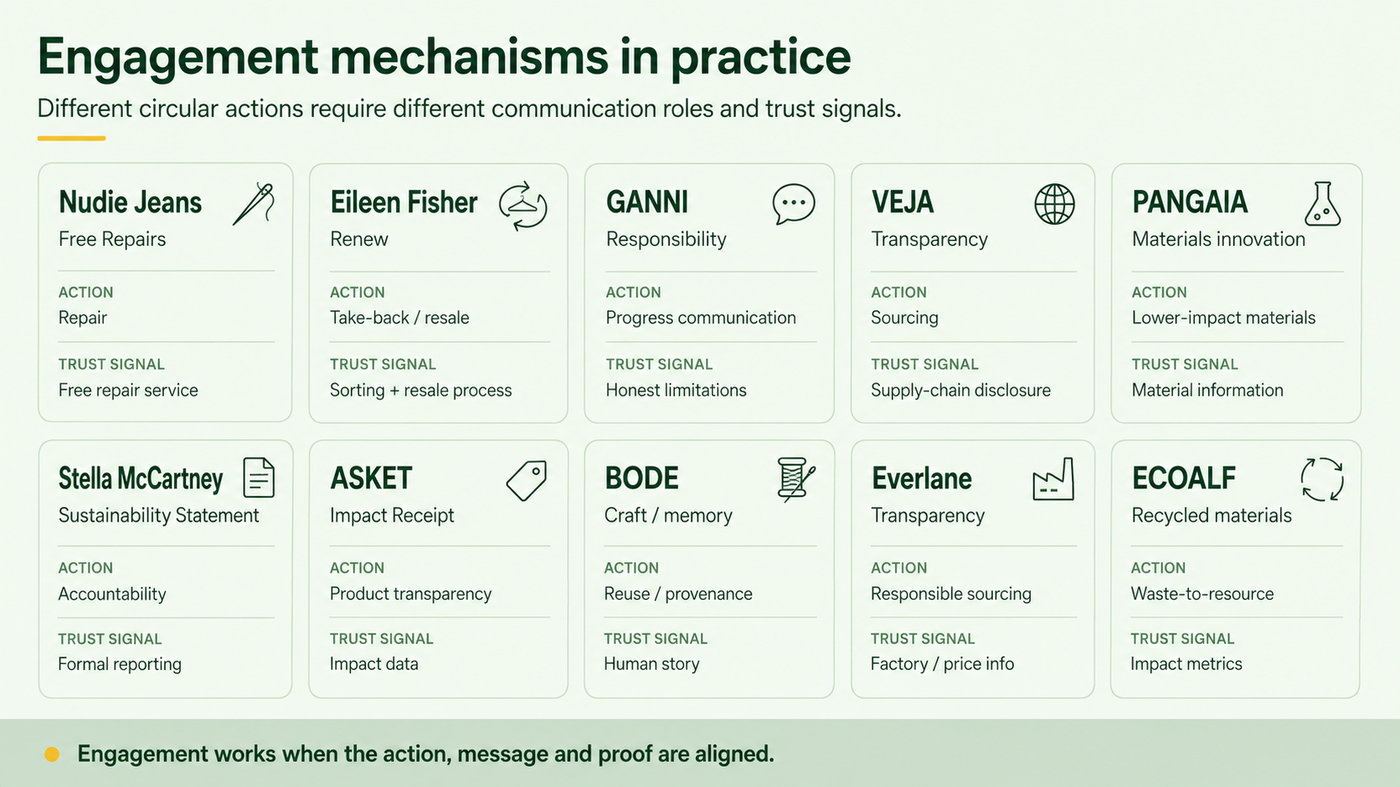
Figure 4.11. Engagement mechanisms in practice. Different fashion brands activate circular engagement through different mechanisms — repair, take-back, resale, transparency, materials innovation, reporting or storytelling — but each example depends on a clear communication role and a visible trust signal.