Chapter 4 — full chapter
| Site: | FashionKIC Learning Platform |
| Course: | Sustainability Communication and Marketing |
| Book: | Chapter 4 — full chapter |
| Printed by: | Guest user |
| Date: | Sunday, 1 November 2026, 3:20 AM |
Table of contents
- Chapter 4 — Consumer Engagement, Trust and Co-Creation
- 4.1 Drivers and barriers to circular participation
- 4.2 From the attitude-action gap to participation design
- 4.3 Circular loyalty loops
- 4.4 P2P models, resale and trust-based marketing
- 4.5 Co-creation and community participation
- 4.6 Closing the participation loop
- 4.7 Engagement in practice — brand examples
Chapter 4 — Consumer Engagement, Trust and Co-Creation
Chapter purpose
This chapter explores how communication can support participation in circular fashion practices such as care, repair, reuse, resale, rental, take-back, sharing, and co-creation.
The primary responsibility for the transition to circular fashion does not lie with consumers. Consumers cannot repair products that were not designed to be repaired, access services that do not exist, verify claims unsupported by evidence, or overcome barriers created by price, convenience and inadequate infrastructure. Companies are responsible for designing durable and repairable products, developing accessible circular services, providing reliable information, and reducing the practical barriers to participation. Policymakers are responsible for establishing and enforcing the rules, incentives and infrastructure needed to make circularity viable at scale.
Communication can help people understand, trust and use the circular options available to them, but it cannot replace better products, services, business models or regulation. Nor should it be used to transfer accountability from organisations to individuals by simply asking consumers to “make better choices”.
The chapter therefore examines how brands and organisations can use clear information, accessible services, credible evidence, appropriate incentives, and meaningful participation to make circular practices easier, more desirable and more trustworthy. Consumer engagement is treated as an enabled response to well-designed systems, rather than the starting point or primary driver of the transition.
Supporting sources: The EU policy framework places primary responsibility on producers and public authorities through product-design requirements, Extended Producer Responsibility schemes, and support for repair, reuse and circular infrastructure. Behavioural research also shows that environmental concern alone is insufficient when sustainable options are unavailable, unaffordable, or inconvenient.
- European Commission — EU Strategy for Sustainable and Circular Textiles. The strategy establishes that textile producers should take responsibility for their products throughout the value chain and foresees requirements for durability, repairability and recyclability, as well as widely available repair and reuse services.
- European Commission — Revised Waste Framework Directive enters into force (2025). The Directive introduces mandatory Extended Producer Responsibility schemes for textiles and footwear. Producers must finance collection, sorting, reuse, recycling and waste management, with fees linked to criteria including durability and recyclability.
- European Environment Agency — Scaling Circular Business Models in Europe (2026). The EEA identifies regulation and policy, finance, technology, behavioural change and ecosystem collaboration as essential conditions for scaling circular business models beyond niche markets.
- OECD — How Green Is Household Behaviour? Sustainable Choices in a Time of Interlocking Crises (2023). Based on a survey of more than 17,000 households, the OECD concludes that availability, affordability and convenience are decisive for sustainable choices and that environmental concern alone is often insufficient to change behaviour.
Central message: communication can encourage care, repair, resale, take-back and co-creation when the product, service and infrastructure support them.
Chapter overview
In circular fashion, consumers are not only buyers. They are users, carers, repairers, resellers, returners, community members, and sometimes co-creators. Communication can help them understand how to participate in circular systems, but only when those systems are accessible and trustworthy.
This chapter introduces consumer engagement as a design challenge. Learners will explore the attitude-action gap, circular loyalty, peer-to-peer models, trust-based communication, and co-creation. They will learn how communication can support circular behaviours across the product lifecycle, from purchase and use to care, repair, return, resale and second life.
The chapter also shows that consumer engagement should not be confused with shifting responsibility onto consumers. Brands and organisations must create the conditions that make circular participation possible.
Time: ≈ 2.5–4 h · reading & activities (2 h) · assignment (1–3 h) · quiz (10 min).
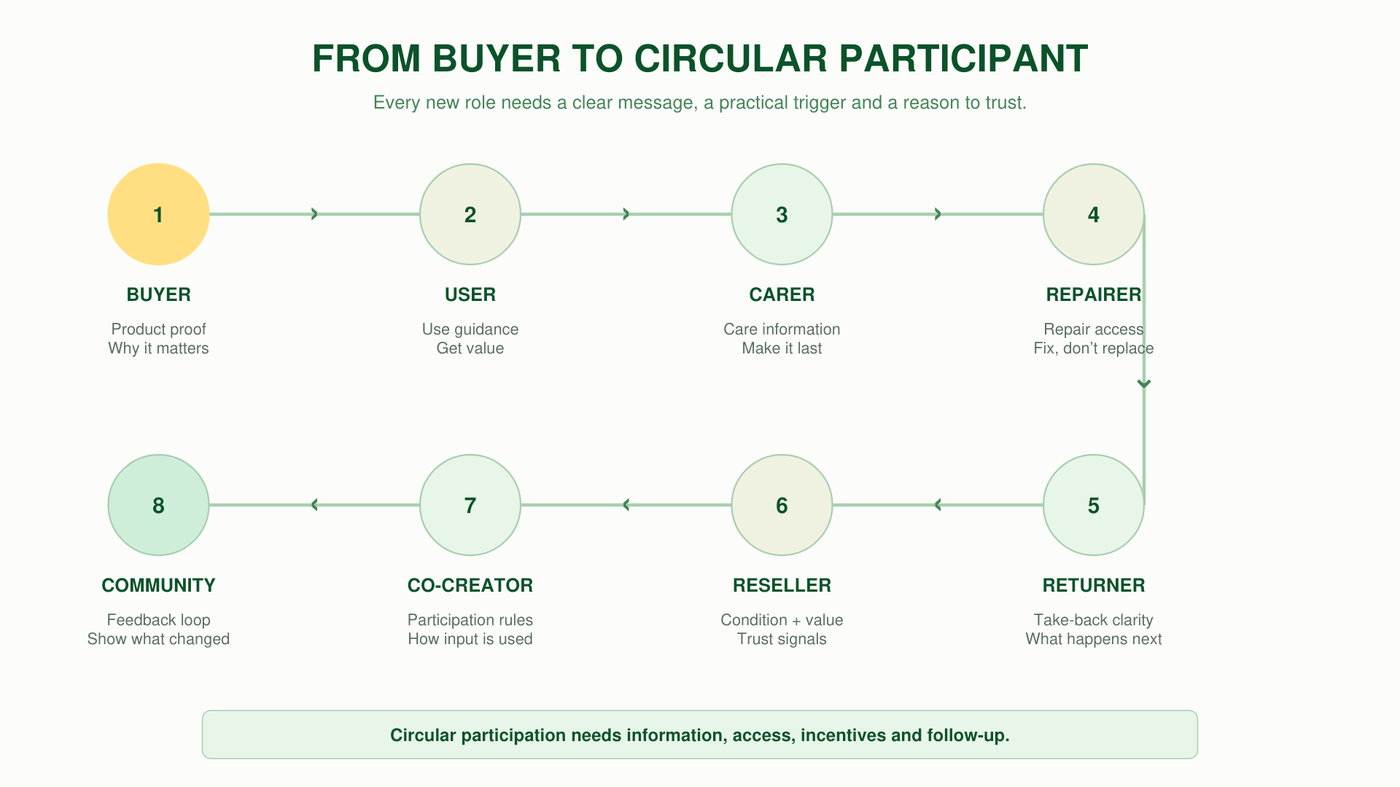
Figure 4.1. From buyer to circular participant. Circular engagement depends on more than awareness: each role requires specific information, access to services, incentives and trust signals to make participation possible.
Introduction — From passive audience to active participant
Linear fashion communication often focuses on encouraging people to buy new products. Circular fashion communication has a broader role: it can help people use products for longer, care for them better, repair them, return them, resell them, share them or pass them on.
This changes the role of the consumer. The consumer becomes part of the product lifecycle. However, this does not mean the consumer should carry the burden of sustainability alone. If repair is expensive, take-back is confusing, resale is inconvenient, product information is unclear or circular options are unattractive, communication alone will not change behaviour.
Circular engagement depends on both message and system. A brand can communicate a repair service effectively only if the service is easy to access. It can promote resale only if customers trust the process. It can invite take-back only if people understand what happens after return.
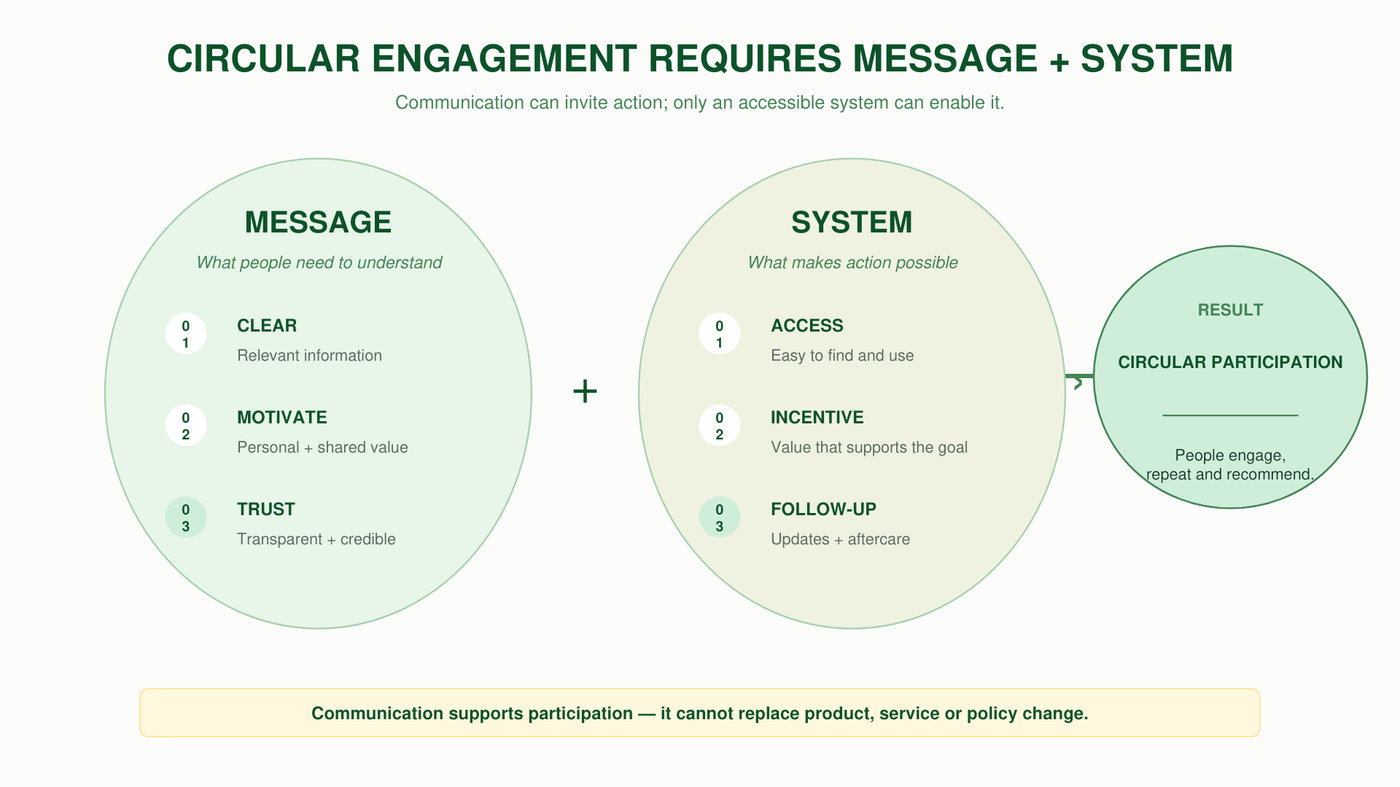
Figure 4.2. Circular engagement requires message + system. Circular participation depends on both clear communication and accessible infrastructure: people need to understand the action, trust the process, and find it easy enough to participate.
In this chapter:
- 4.1 Drivers and barriers to circular participation
- 4.2 From the attitude-action gap to participation design
- 4.3 Circular loyalty loops
- 4.4 P2P models, resale and trust-based marketing
- 4.5 Co-creation and community participation
- 4.6 Closing the participation loop
- 4.7 Engagement in practice — brand examples
4.1 Drivers and barriers to circular participation
Consumer behaviour is shaped by more than values. People may care about sustainability but still make choices based on price, convenience, aesthetics, identity, habit, availability, trust, or social pressure.
In fashion, this is especially important because clothing is emotional and cultural as well as functional. People use clothes to express identity, confidence, belonging, aspiration, or pleasure. Circular communication therefore needs to do more than provide information. It must make circular practices feel understandable, normal, and desirable.
This does not mean manipulating consumers or moralising behaviour. The aim is to understand what prevents people from participating in circular actions and how communication can reduce those barriers. A barrier may be practical, such as uncertainty about how a service works; perceptual, such as doubts about quality or desirability; or informational, when circular options are difficult to compare or understand. Communication can help reduce these barriers by making processes clearer, providing relevant evidence, and presenting circular choices in ways that feel credible and easy to act on.
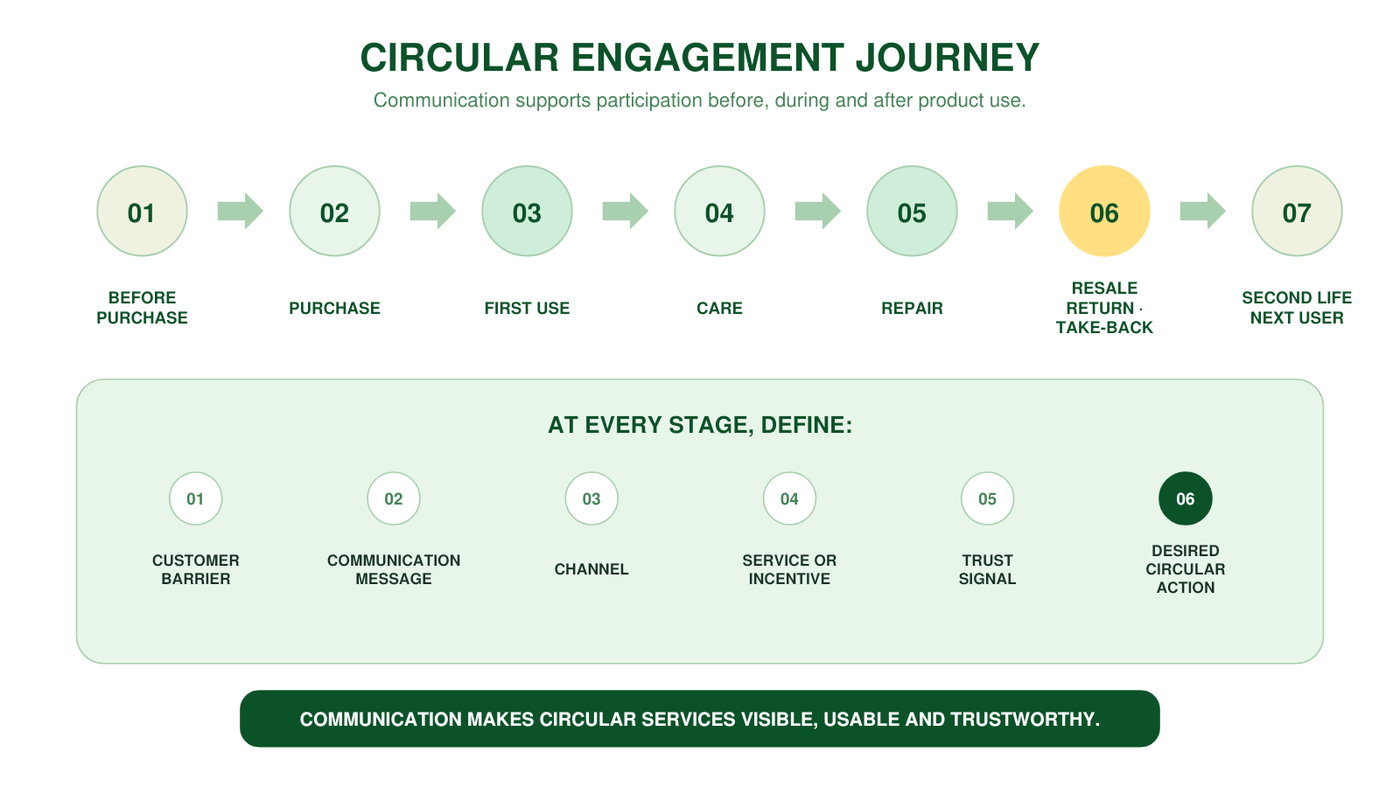
Figure 4.3. Circular Engagement Journey. Mapping barriers, messages, channels, services, incentives and trust signals across the product journey helps connect communication with the practical conditions required for circular participation.
RESOURCE INSIGHT: Keeping Customer Connections: Lessons from the Circular Economy — Ellen MacArthur Foundation (CE100). Customer relationships do not have to end at the point of sale. This CE100 collaborative project — including a 250-consumer survey across the US, UK, France and Spain — explores how repair, resale and take-back services keep products in use and customers engaged, converting one-off purchases into ongoing relationships and new revenue streams. Source: https://content.ellenmacarthurfoundation.org/m/4ce60e6f114ee252/original/Keeping-Customer-Connections.pdf.
PARTNER CASE STUDY: Exploring Sustainable Clothing Consumption in Middle-Income Countries — arXiv, Romania. Topic: Report / resource. This study of Romanian consumers, available on the open-access repository arXiv, maps what drives and what holds back sustainable clothing purchases, giving communication teams evidence on real barriers such as price, trust and convenience. It supports the drivers-and-barriers discussion by grounding it in consumer research from a middle-income EU market. Source:
4.1.1 Reflection exercise — What is the real barrier to participation?
The following examples illustrate how participation in circular practices depends not only on consumer motivation or communication, but also on how the service itself is designed. Nudie Jeans’ repair service and H&M’s garment collection programme enable different circular actions and reduce different barriers. Comparing them helps reveal how accessibility, practical support and incentives can influence participation — and whether the behaviour encouraged is consistent with the intended circular objective.
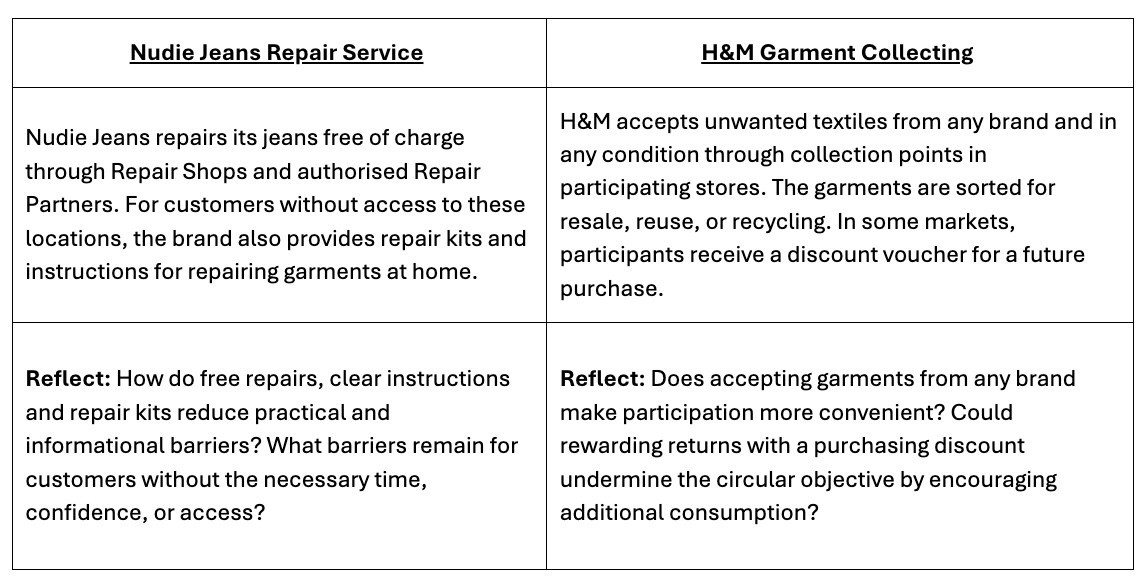
Figure 4.4. What Enables Circular Participation? The Nudie Jeans and H&M examples show how participation is shaped not only by communication, but also by service accessibility, practical support and the behaviours encouraged by incentives.
Questions for comparison
- What behaviour does each programme make easier?
- How does service design influence participation?
- What role does communication play in each case?
- Which barriers cannot be solved through communication alone?
- Does the incentive support longer product use or stimulate replacement?
Key learning: Communication can make circular services visible and understandable, but participation also depends on how accessible, affordable and coherent the service is. Incentives should be assessed not only by whether they increase participation, but also by the behaviour they encourage afterwards.
4.2 From the attitude-action gap to participation design
The attitude-action gap describes the distance between what people say they value and what they actually do. In fashion, consumers may say they care about sustainability but still buy low-cost, low-quality or fast-changing products. They may support repair in principle but never use repair services. They may like the idea of resale but feel uncertain about quality, hygiene, fit, or trust.
This gap should not be treated as consumer hypocrisy. It often reflects structural barriers. Circular options may be too expensive, too difficult to access, poorly explained or not emotionally appealing enough.
Communication can help reduce the gap when it responds to a specific barrier. If the barrier is lack of knowledge, use education. If the barrier is distrust, show evidence. If the barrier is inconvenience, simplify instructions. If the barrier is low desirability, improve storytelling and visual language.
The practical question is: what prevents this person from acting, and what communication would make the next step easier?
Try it now
Map the attitude–action gap for one circular service you know: list three structural barriers (price, convenience, trust, access) and one communication response to each. Then check a real example — TOAST Circle, Nudie Jeans Free Repairs Forever or Patagonia Worn Wear — and note which barriers the service itself removes and which remain for communication to address.
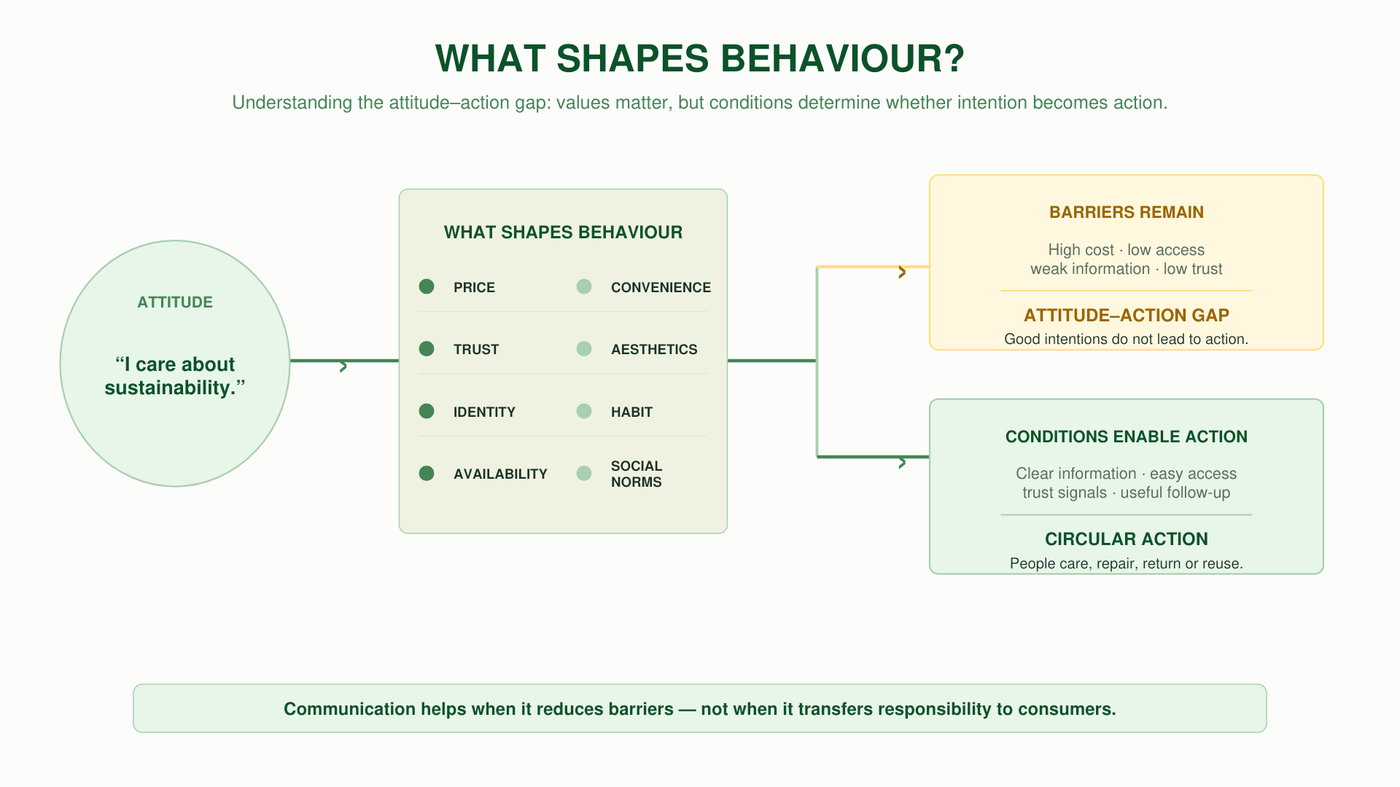
Figure 4.5. What shapes behaviour? Understanding the attitude–action gap.Consumer behaviour is influenced by factors such as price, trust, convenience, and identity. Circular action becomes more likely when communication and services reduce barriers and make participation easier.
RESOURCE INSIGHT: The Green Divide Report — NielsenIQ, 2023. NIQ quantifies the attitude–action gap: 70% of global consumers say sustainable living is important, yet only 19% (the “Green Dividers”) consistently act. The gap is a design problem — brands close it by making sustainable choices easy, visible and worth the switch, rather than appealing to intention alone. Source: https://nielseniq.com/global/en/insights/report/2023/how-to-turn-green-consumer-intentions-into-sustainable-actions/.
4.3 Circular loyalty loops
Circular loyalty programmes can use incentives to support behaviours that keep products and materials in use for longer. Rather than rewarding only repeat purchases, they can recognise actions such as care, repair, return, resale, rental, sharing, participation in workshops or long-term ownership.
The key design question is what behaviour the incentive is reinforcing. A repair credit, take-back voucher or resale benefit can support product life extension, but poorly designed rewards may simply stimulate another new purchase. Circular loyalty therefore depends not only on offering a benefit, but on ensuring that the reward is aligned with the circular outcome the programme is intended to support.
A useful loyalty loop connects action, value and return: the customer participates in a circular action, receives a meaningful benefit, and is encouraged to remain engaged with the product, service or brand without necessarily increasing the consumption of new products.
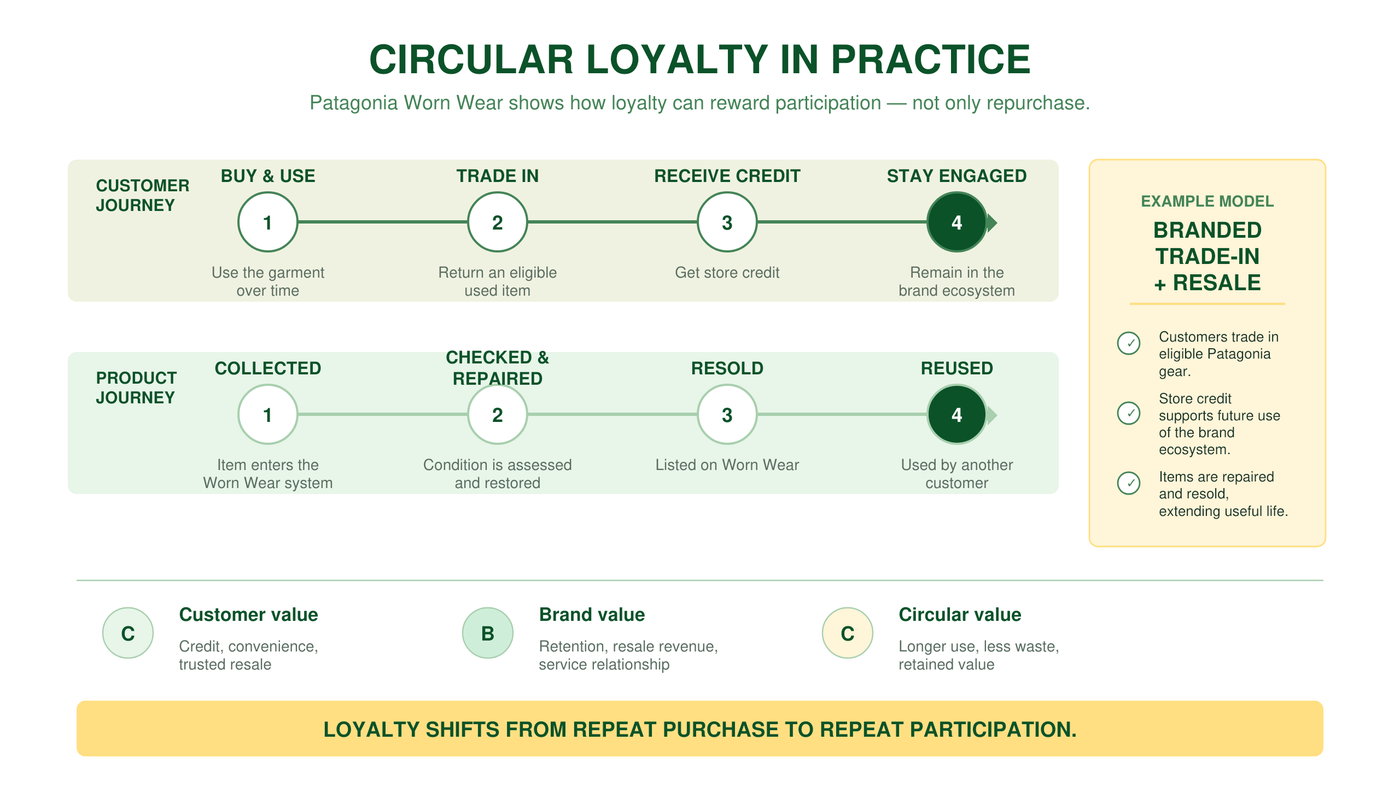
Figure 4.6. Circular loyalty in practice: Patagonia Worn Wear. The Patagonia Worn Wear programme shows how loyalty can move beyond repeat purchase by connecting trade-in, store credit, repair, resale and reuse, keeping products in circulation while maintaining an ongoing relationship with the customer.
RESOURCE INSIGHT: Creating Value from Sustainable Products — Deloitte, 2023. Deloitte’s survey of 311 Canadian business leaders and 1,008 consumers found leaders overestimate consumer trust: shoppers are sceptical and confused by the proliferation of claims, question premium prices, and increasingly expect sustainability to be the default. The route to loyalty: purpose-driven brands that provide clearer, better information — trust is the currency of circular loyalty loops. Source: https://www.deloitte.com/content/dam/assets-shared/docs/industries/consumer/2023/gx-consumer-creating-value-from-sustainable-products-aoda.pdf.
4.4 P2P models, resale and trust-based marketing
Person-to-person models include resale, rental, exchange, lending, or sharing between users. By keeping existing products in circulation and increasing their use, these models can reduce demand for new production and avoid some of the material, energy and emissions impacts associated with manufacturing a new garment. This environmental benefit is strongest when accessing a pre-owned, rented or shared item genuinely replaces the purchase of a new product rather than enabling additional consumption.
For brands and designers, these models can also create business value. Resale, rental and other access-based models can extend the commercial relationship with a product beyond its first sale, open new revenue or service opportunities, strengthen customer retention and differentiate the brand through quality, longevity and after-sales engagement. They can also provide insights into how products perform over time, which categories retain value and what customers are willing to recirculate.
These models depend heavily on communication because trust is central to participation. In P2P environments, people need confidence in the product, the seller, the platform, and the transaction. Trust can be built through clear photography, accurate condition grading, size and fit information, authentication, seller ratings, return policies, transparent pricing, reviews and secure payment systems.
P2P models can also shift cultural perceptions by making second-hand fashion feel desirable, normal, and socially accepted. However, they can reproduce fast-fashion behaviours if lower prices, rapid turnover or the ease of resale encourage people to acquire more products or replace them more frequently.
Communication should therefore present resale, rental and exchange not only as circular alternatives to buying new, but as credible and desirable ways of accessing value. For brands, this means communicating quality, longevity, retained value, trust and service — while avoiding incentives that simply reproduce high-frequency consumption in a different format.
RESOURCE INSIGHT: State of Fashion 2025 — Consumer Behaviour and Value — BoF & McKinsey, 2025. Value-seeking is reshaping demand: 64% of US shoppers traded down in Q3 2024, and over 70% plan to keep buying from outlets and off-price channels. Resale grew 15 times faster than the broader apparel market in 2023 and is projected to reach US$350 billion by 2028. Circular models must therefore compete on value and trust — not ethics alone. Source: https://www.businessoffashion.com/articles/series/the-state-of-fashion-2025-report-consumer-behaviour-value-shopping-resale/
GFA RESOURCE: Fashion CEO Agenda 2025 — Global Fashion Agenda, 2025. Consumer behaviour is shifting: the US second-hand market grew 14% in 2024 — five times the rate of the broader retail clothing market — and the global second-hand apparel market is projected to reach USD 367 billion. The CEO Agenda encourages brands to increase the share of consumer marketing messages promoting circular business models over traditional ones. For SMEs, framing resale around value, longevity and quality, not novelty, captures this demand responsibly. Source:
Source: https://globalfashionagenda.org/resource/fashion-ceo-agenda-2025/
4.4.1 Mini case example — Vestiaire Collective: trust infrastructure in resale
Person-to-person resale platforms depend on trust. Buyers need confidence that products are authentic, accurately described, fairly priced, and safe to purchase. Sellers, in turn, need clear processes for payment, communication, shipping, and dispute resolution.
Vestiaire Collective is a useful example because its resale model is built around several layers of trust: detailed product information, condition descriptions, seller profiles, buyer protection, authentication and quality control. Together, these mechanisms reduce uncertainty and help make second-hand luxury fashion feel more credible, desirable, and socially accepted.
From a communication perspective, the important lesson is that trust is not created by brand messaging alone. It is supported by the information, verification mechanisms, and transaction safeguards that surround the exchange. In resale, these elements become part of the customer experience and part of the value proposition itself.
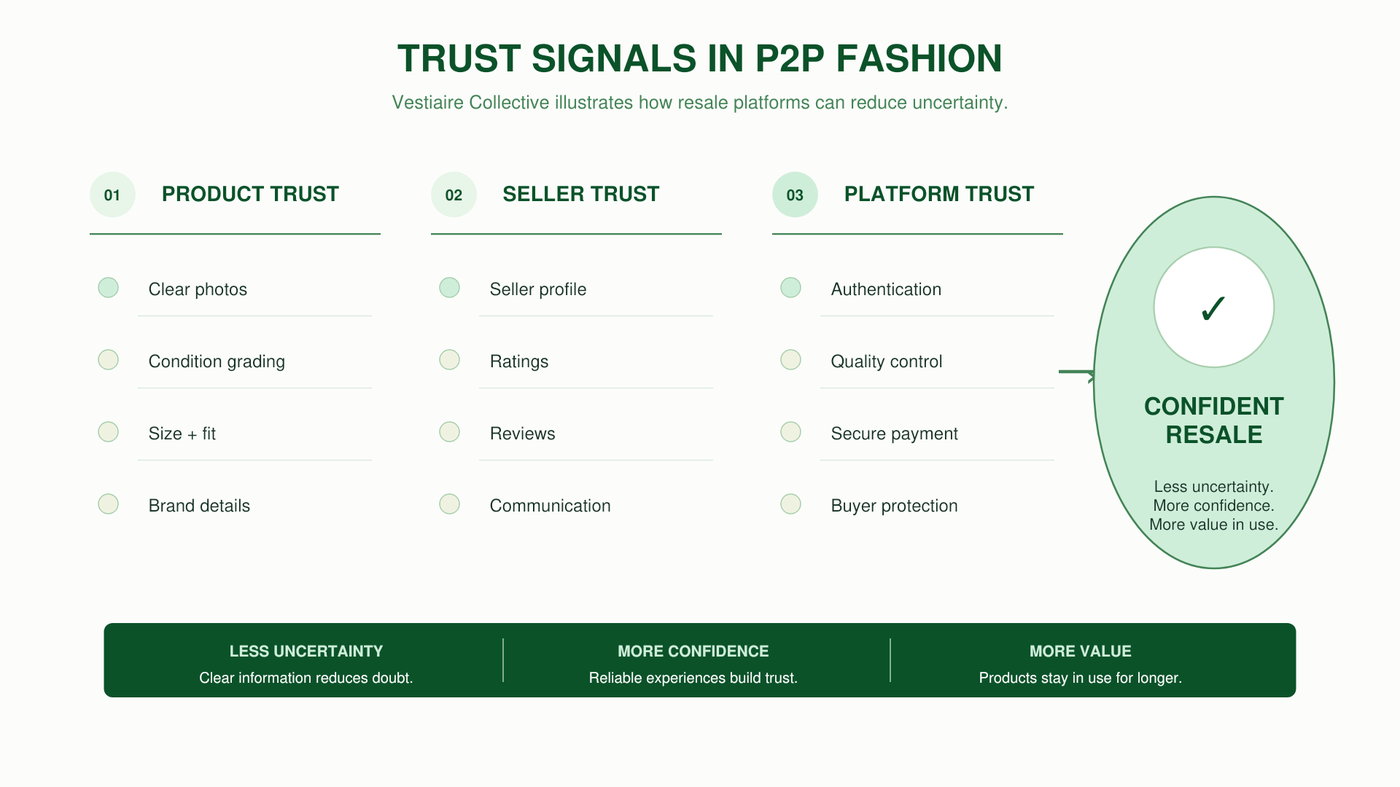
Figure 4.7. Trust signals in P2P fashion: Vestiaire Collective. Vestiaire Collective illustrates how resale platforms can reduce uncertainty through product information, seller reputation, authentication, quality control and transaction protection, making second-hand fashion easier to trust and participate in.
4.5 Co-creation and community participation
Co-creation means involving consumers, users or communities in shaping products, services, narratives or circular practices. In circular fashion, this may include repair workshops, clothing care events, swap events, upcycling challenges, feedback on durability, participatory redesign, user-generated care tips, or community storytelling around garment life.
Co-creation can build trust because people feel part of the transition rather than simply being targeted by it. It can also generate practical insights. Users often know where products fail, what instructions are unclear, which services are inconvenient, or why take-back systems are not used.
For brands and designers, building a community around circular practices can create value beyond individual campaigns. It can strengthen customer loyalty, generate ongoing feedback, increase participation in services such as repair or resale, and help brands understand how products are actually used over time. A strong community can also become a source of advocacy, peer-to-peer learning and brand differentiation, particularly when participation is based on shared values and meaningful exchange rather than one-off promotion.
However, co-creation needs clear boundaries. Brands should avoid extracting unpaid creative labour from communities or using participation as a superficial engagement tactic. Participation should be purposeful, transparent, and, where appropriate, credited or compensated.
For SMEs, co-creation does not need to be complex. A small repair event, feedback session or local clothing swap can create valuable learning and stronger community relationships.
Co-creation is strongest when participation does not end with the activity itself, but is followed by clear communication about what happened, what was learned and what value was created.
4.5.1 Mini Case Example — FREITAG Yourself: Co-Creation as Product Experience
FREITAG brings customers directly into the creation process through its FREITAG Yourself stations and digital customisation tools. Instead of choosing only from finished products, participants can select and combine components made from used truck tarps and other recovered materials to create an individual bag. This turns material reuse into a visible and participatory experience rather than something that happens only behind the scenes.
For the brand, co-creation creates value on several levels. It gives customers a stronger role in the product story, makes the characteristics and uniqueness of reclaimed materials easier to understand, and can increase emotional attachment to the finished product. Earlier FREITAG Yourself initiatives have also helped the company test product concepts that later informed its permanent offer.
The case shows how co-creation can connect circular material use, customer experience, and brand differentiation. Participation is not added as a communication campaign around the product; it becomes part of how the product itself is created and understood.
Thought prompt: How can involving customers in product creation strengthen both their understanding of circular materials and their relationship with the finished product?
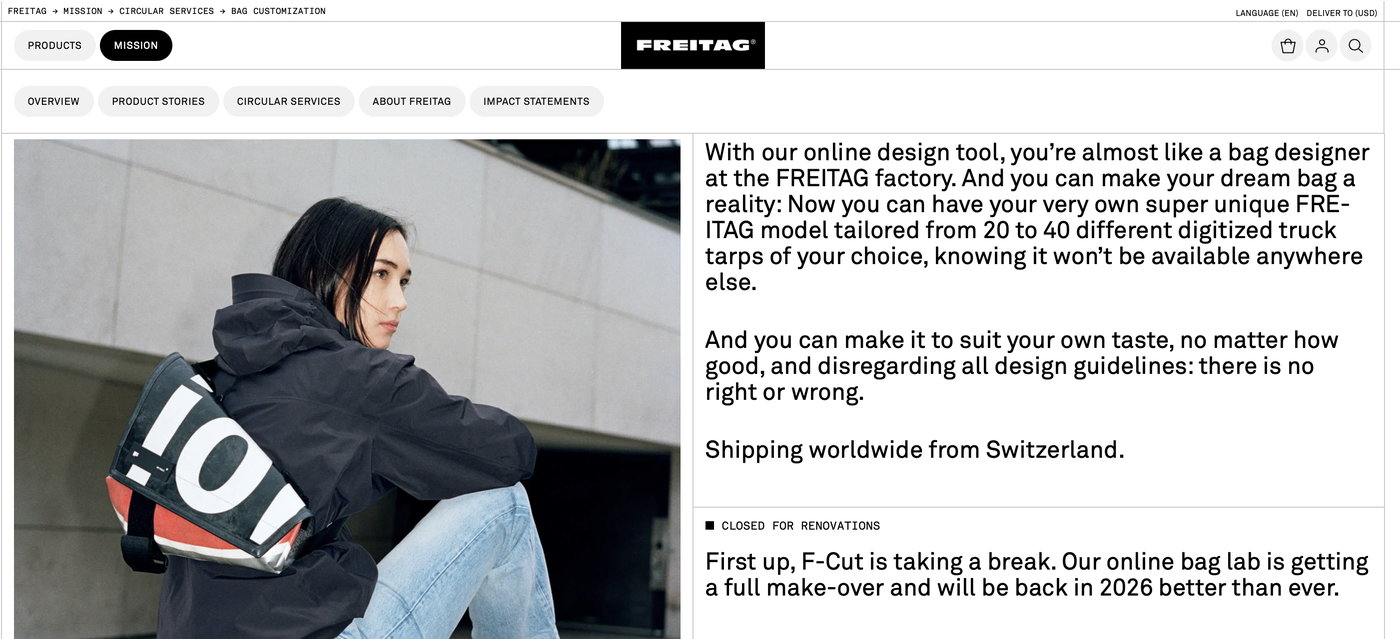
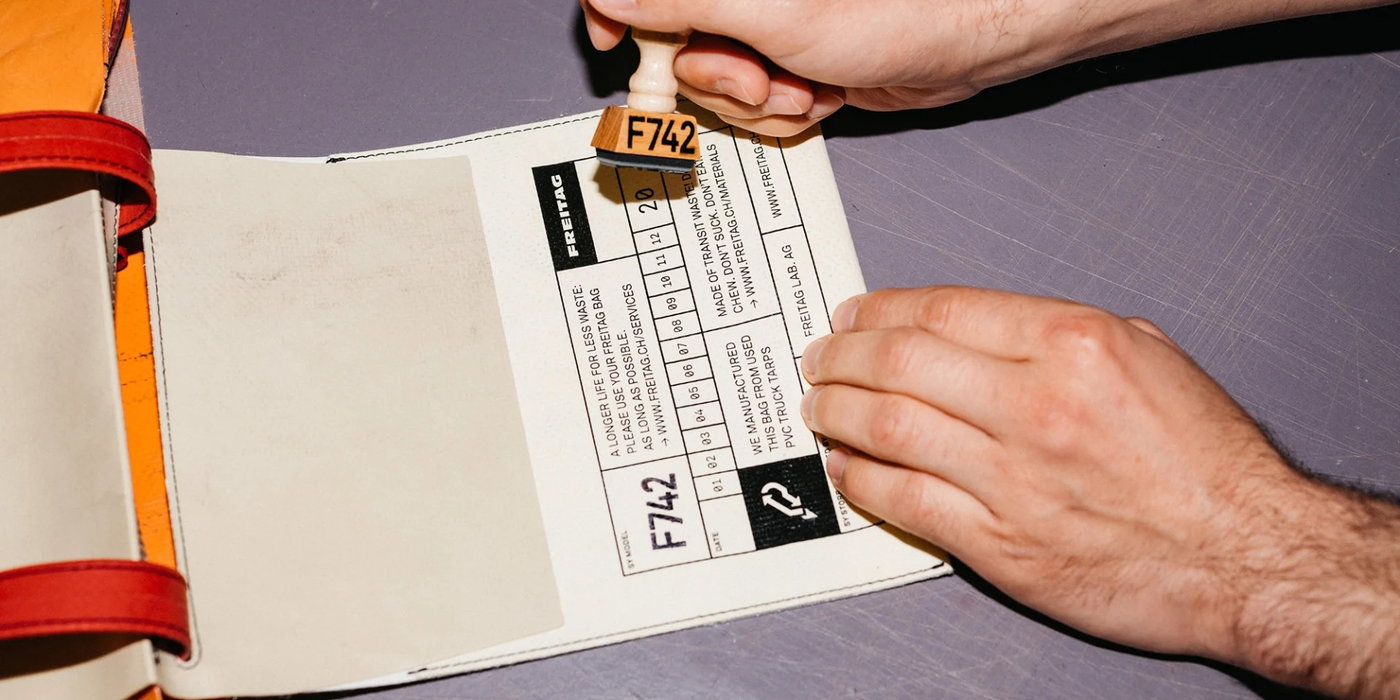
Figure 4.8. FREITAG’s F-Cut customisation experience, allowing customers to select sections of digitised used truck tarps to create a unique bag. The process makes material reuse visible and turns the customer into an active participant in product creation.
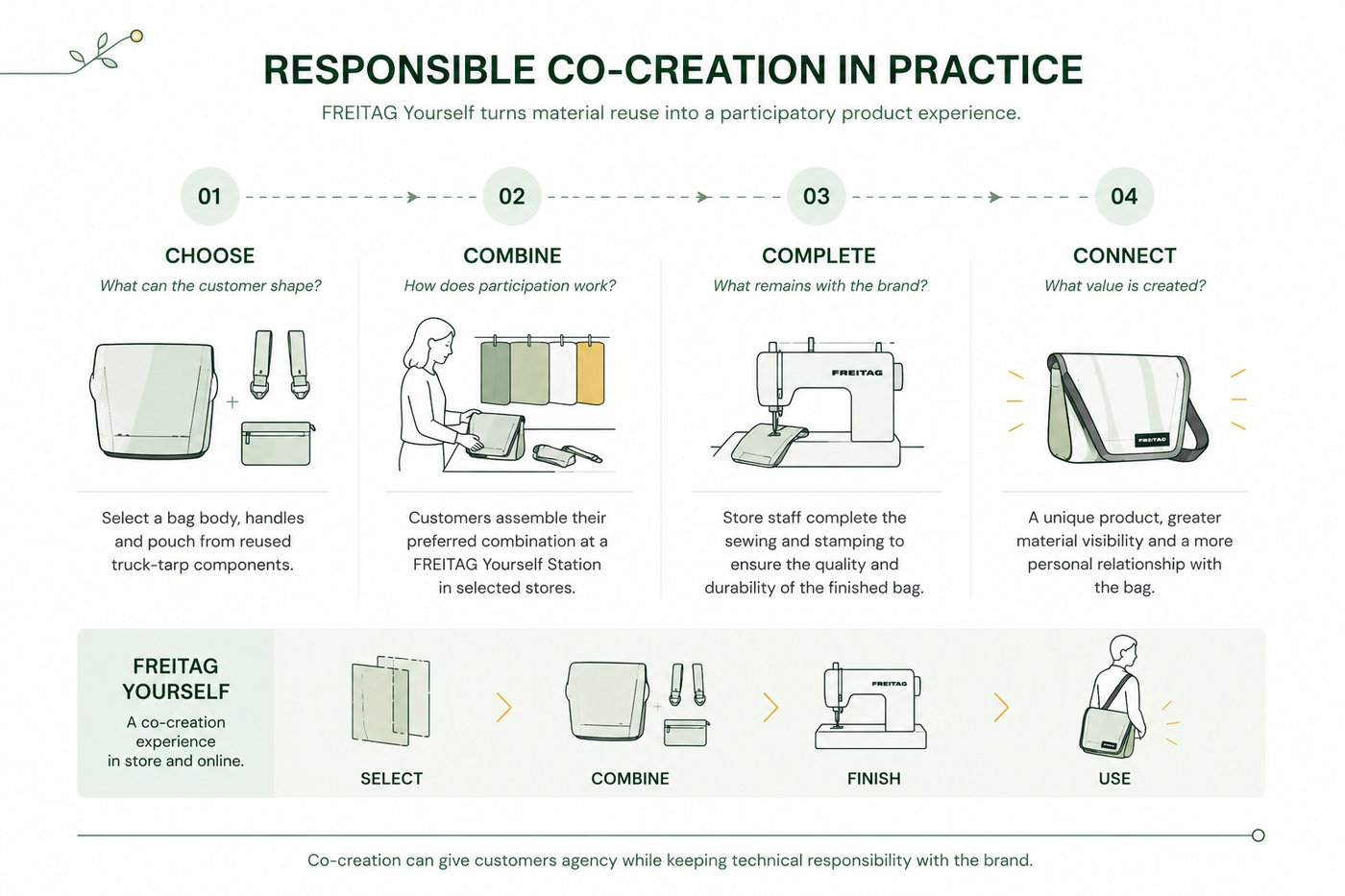
Figure 4.9. Responsible co-creation in practice: FREITAG Yourself. The FREITAG Yourself experience allows customers to select and combine components made from reused truck tarps, while the brand retains responsibility for final assembly and product quality. The model illustrates how co-creation can increase customer agency, material understanding, and attachment to the finished product.
4.6 Closing the participation loop
Trust in a circular service is built across the full participation journey, not only through the initial invitation. Before participation, people need to understand eligibility, access, cost, timing, and expected outcomes. During participation, the process should be clear and reliable. After participation, the organisation should explain what happened and report back where appropriate.
A take-back programme should explain how returned garments are assessed and whether they are repaired, resold, donated, recycled or discarded. It should also explain what happens to items that are not accepted. A repair service should communicate turnaround times, possible costs, service limitations, and the outcome of the repair.
Closing the loop may also involve sharing aggregate results: how many products were collected, repaired or returned to use; what proportion followed each destination pathway; and what the organisation learned from the process.
In this chapter, transparency therefore means service accountability: making the participation process and its outcome visible to the participant.
4.6.1 Case example — TOAST Circle: communicating what happened next
TOAST Circle brings together the brand’s repair, exchange, resale, and creative renewal initiatives. What makes the programme particularly relevant from a communication perspective is that participation does not end when a customer hands over a garment. TOAST also explains the possible pathways that follow and reports back on some of the collective outcomes generated through the programme.
Garments and textiles entering the system may be returned to use through TOAST Reworn, creatively repaired or transformed through TOAST Renewed, remade, recycled or passed to the charity partner Traid for reuse. By making these different destinations visible, the brand gives participants greater context about what happens after an item leaves their hands.
TOAST also communicates aggregate results. Its Circle page reports that, since 2019, participants have helped give 25,232 garments a second life. It also states that its partnership with Traid has diverted 2,976 kilograms of textiles from landfill since 2023 and contributed to funding 308 scholarships through Traid’s partner organisation, READ. Reporting these outcomes helps connect individual participation with a wider collective result.
A natural next step for this kind of reporting would be to show how many, or what proportion, of collected items follow each pathway, such as reuse, repair, remaking, donation or recycling. Because these outcomes preserve product and material value to different degrees, pathway-level reporting would help participants see the full result of their contribution.
Key lesson: Closing the participation loop means communicating not only how to take part, but also what happened afterwards and what the participation achieved.
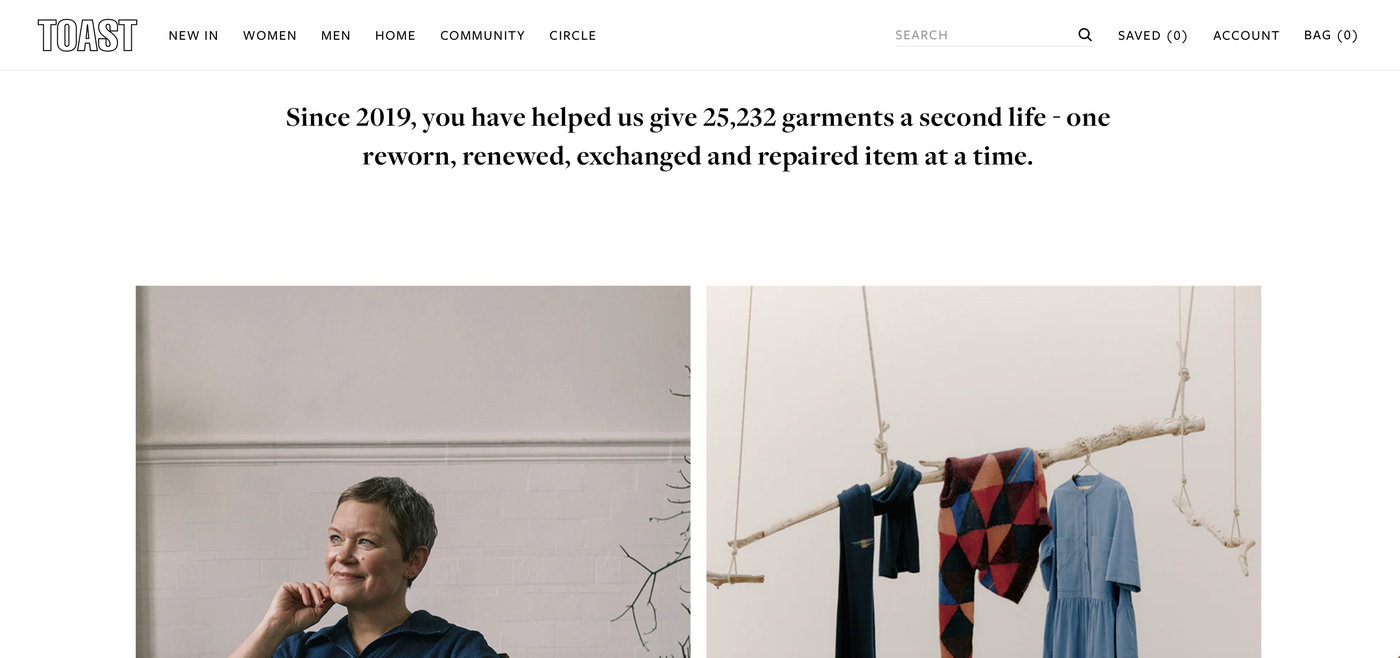
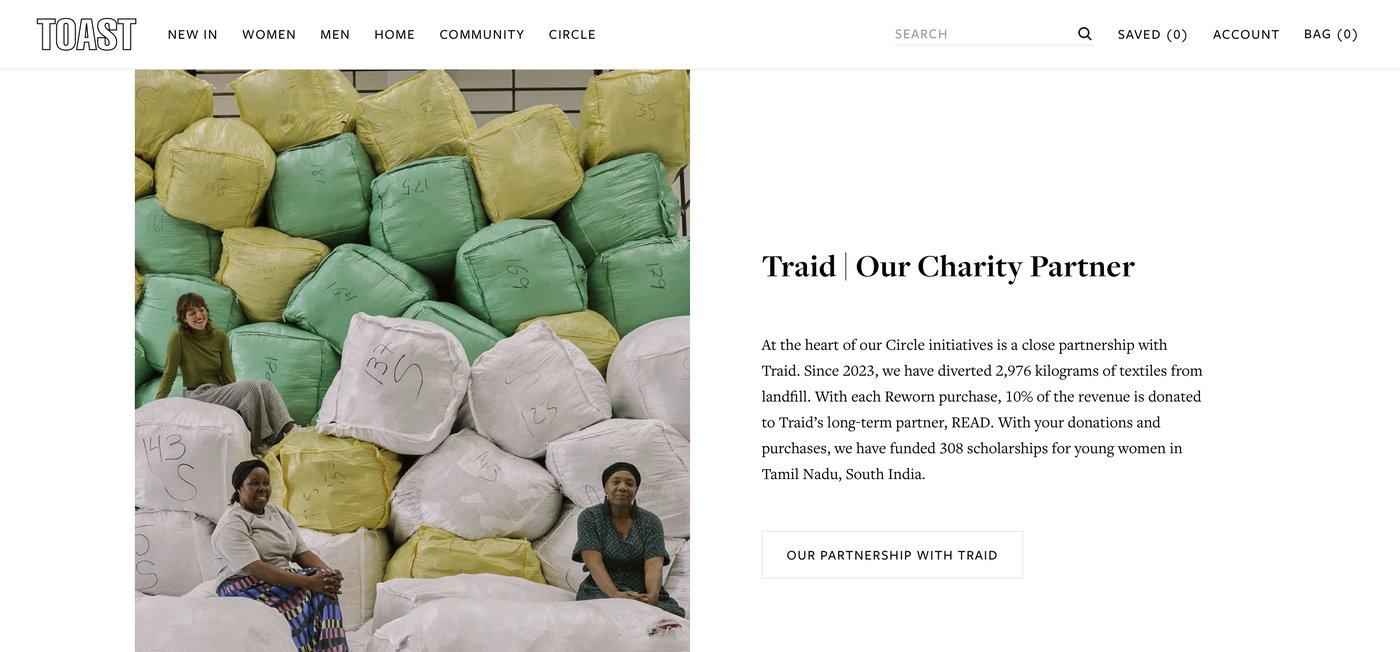
Figure 4.10. Closing the participation loop through aggregate reporting. TOAST Circle reports the collective outcomes of its circular initiatives and connects customer participation with repair, renewal, resale and social-impact results. Further disclosure of the proportion of garments following each destination pathway would provide a more complete account of what happens after return.
Thought prompt:
What does TOAST make visible after participation, and what information would still be needed to understand whether the highest possible value was retained from every returned garment?
FOR YOUR SME / BUSINESS CASE: participation can create business value. Nudie Jeans offers free repairs as a service that also drives store visits and customer loyalty, and TOAST Circle reports 25,232 garments given a second life since 2019. For e-commerce, where apparel return rates are often estimated at 20–30%, clearer fit and care communication can also reduce the cost of handling returns. Check these figures against your own data.
4.7 Engagement in practice — brand examples
This chapter uses several short cases rather than one long case study. The aim is to show that consumer engagement can take different forms depending on the circular action: repair, resale, take-back, care, community or co-creation. Each example below pairs a communication approach with the enabling system behind it.
Eileen Fisher Renew — take-back and second life
Renew invites customers to return garments, which are then resold, repaired, or transformed. This shows why take-back communication must explain what happens after return.
GANNI Postmodern — engaging through resale
GANNI Postmodern enables customers to buy and resell pre-owned GANNI garments. By integrating resale into the brand experience, it encourages customers to see ownership as temporary and products as having value beyond their first user.
VEJA — clean, repair and collect
VEJA engages customers through services that clean and repair footwear and collect unwanted pairs. The initiative makes product-life extension visible and gives customers practical ways to participate after purchase.
PANGAIA — product information as engagement
PANGAIA has used digital product passports to connect customers with information about product origin, materials, and care. This shows how product-level information can support engagement throughout use and potentially enable future resale, repair, or recycling.
Stella McCartney — values-led customer engagement
Stella McCartney connects material innovation, repair, resale and circularity with a consistent brand position. The example shows how engagement can be strengthened when circular services are presented as part of the brand’s wider identity rather than as isolated initiatives. Stella McCartney Sustainability Statement
ASKET — care, repair and take-back
ASKET combines care and repair guidance with repair services and a take-back programme for unwanted garments. Customers are engaged at different stages of ownership, from maintaining a product to returning it for resale, remanufacturing, or recycling.
BODE — emotional durability through memory and craft
BODE uses antique textiles, crafts, and provenance to give garments a sense of history and uniqueness. This can strengthen emotional attachment and encourage customers to value clothing as something to preserve rather than quickly replace.
Everlane — transparency as customer engagement
Everlane engages customers by explaining product costs, materials, and manufacturing information. Its approach shows how access to relevant information can make customers more active in evaluating products, although transparency must remain specific, verifiable, and connected to meaningful action.
ECOALF — collective engagement through ocean recovery
Through Upcycling the Oceans, ECOALF works with fishing communities to collect marine waste and transform suitable recovered materials into new resources. The initiative expands engagement beyond customers and shows how brands can connect products with collective environmental action.
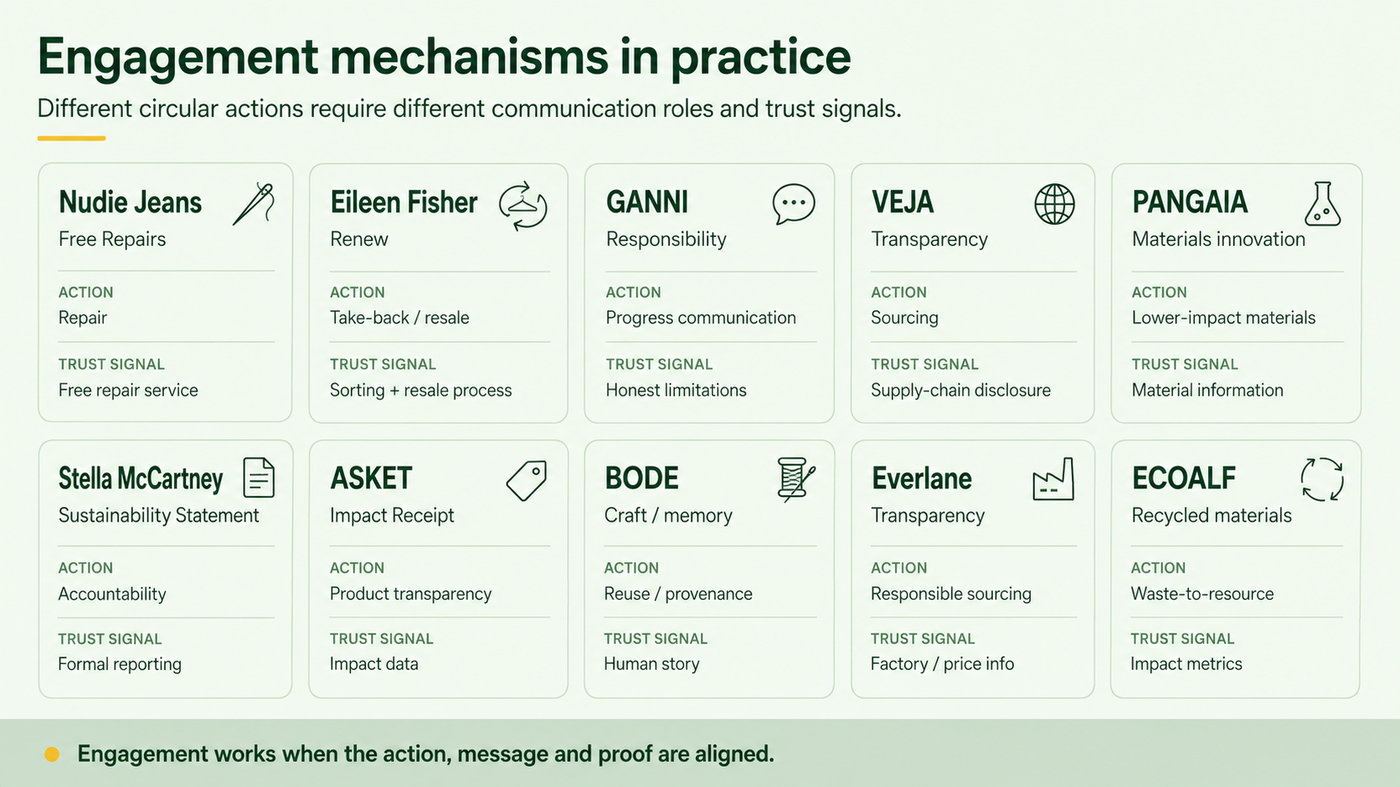
Figure 4.11. Engagement mechanisms in practice. Different fashion brands activate circular engagement through different mechanisms — repair, take-back, resale, transparency, materials innovation, reporting or storytelling — but each example depends on a clear communication role and a visible trust signal.