
Chapter 3 — full chapter
Chapter 3 — full chapter
3.5 Circular Material Compatibility
Compatible components are what make future recovery realistic. Incompatible materials create contamination, downcycling or waste, while compatible ones restore quality and value at end-of-life and enable closed-loop recycling, reuse and regeneration (Sandin & Peters, 2018).
A circular material decision tree captures this logic step by step: is the product designed for disassembly; are the main materials of the same family, such as all-cellulosic, all-polyester or all-wool; can components be separated without damage; and are trims, threads and accessories made from compatible materials and clearly labelled and traceable?
The answers place a product on a scale from high compatibility, where closed-loop recycling or regeneration is possible, down to very low compatibility, where materials cannot realistically be recovered at all.
Compatibility starts with a simple question sequence. Working through it for any garment shows how disassembly, material family and trim choices combine to determine how recoverable that product really is.
The purpose of this assessment is to identify compatibility, not to prescribe the complete product architecture. Once compatibility problems are identified, designers can decide how construction, interfaces and component choices should change. These design strategies are developed in Chapter 4 — Circular Product Architecture.
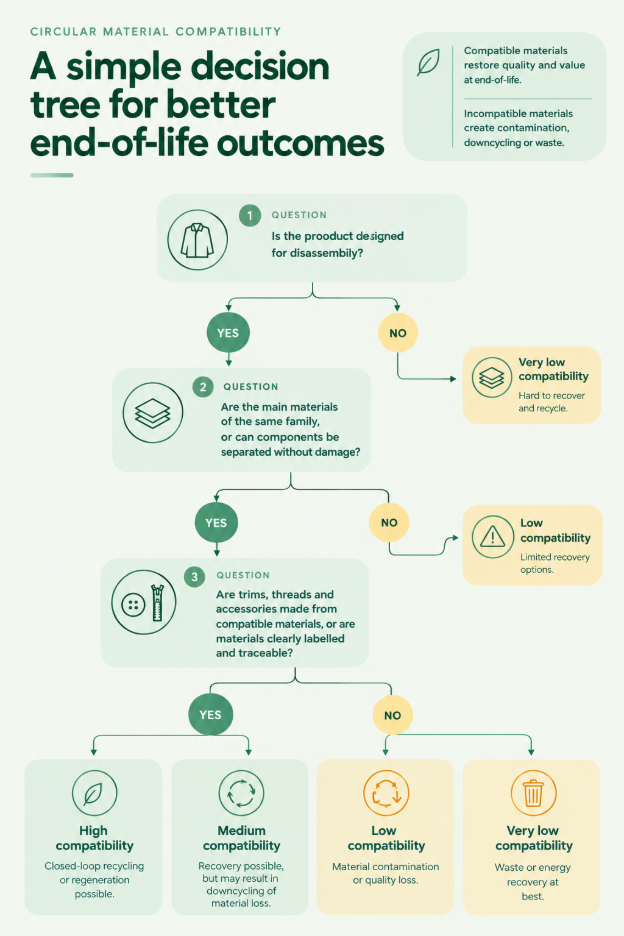
Figure 3.4. Circular Material Decision Tree: is the product designed for disassembly, are the materials of the same family, and are trims compatible? Credit: FashionKIC, Circular Material Decision Tree, 2026.
Use the decision tree to convert each incompatibility into a design action: remove an unnecessary component, select a compatible alternative, introduce a reversible connection or provide accurate composition and disassembly information. The selected route should be checked with an actual recovery partner because theoretical recyclability is not the same as an available, viable process (Sandin & Peters, 2018).
Compatibility is route-specific. A blend may be accepted by one mechanical process but rejected by a fibre-to-fibre recycler; a coating may support long use yet prevent a particular chemical-recycling route. Ask potential recovery partners for written input specifications covering fibre content, blend tolerances, elastane, colour, finishes, contamination, minimum volume and required preparation. These operational limits should inform design targets rather than being checked only after products return.
Validate the proposed route with a representative sample or pilot batch. Record input mass, separation time, rejected components, process yield and output quality, and compare these results with the assumptions made during design. If infrastructure is unavailable at the expected place and time of collection, document an alternative route instead of claiming theoretical recyclability. Feedback from the pilot can then be converted into purchasing rules, attachment standards and component restrictions for the next iteration (Sandin & Peters, 2018).