Chapter 3 — full chapter
| Site: | FashionKIC Learning Platform |
| Course: | Sustainable Materials and Processes |
| Book: | Chapter 3 — full chapter |
| Printed by: | Guest user |
| Date: | Sunday, 1 November 2026, 3:20 AM |
Chapter 3. What is a garment really made of
In this chapter:
- 3.2 Introduction
- 3.3 Textile Product Anatomy
- 3.4 Material Selection Decision Matrix
- 3.5 Circular Material Compatibility
- 3.6 Dyeing and Finishing
- 3.7 Material Sustainability Analyzer by FashionKIC
3.1.Chapter Overview
This chapter introduces learners to the hidden complexity of textile products by examining every component, from fibres and yarns to fabrics, trims, labels, coatings and accessories. Learners discover that circularity is determined not only by the primary fibre but by every design and material decision made throughout product development. The chapter explains how material composition, blends, finishes and product construction influence reuse, repair, remanufacturing, recycling and biodegradation. Learners are encouraged to adopt a systems-thinking approach and begin evaluating products from a circular design perspective.
3.2 Introduction
A garment is rarely made of a single material. Even a simple T-shirt combines a main fabric with sewing thread, a neck label, a care label and sometimes printed inks or coatings. A tailored jacket or an evening dress can involve a dozen different materials: shell fabric, lining, interlining, closures, threads, trims and accessories. Understanding this anatomy is the technical foundation of this chapter; It is the starting point for judging whether a product can realistically be repaired, recycled or returned safely to nature.
These material choices carry real environmental, social and economic weight. Fibre production, dyeing, finishing and trims all draw on water, energy and chemical inputs, and low-quality or unnecessary components shorten a product's useful life and complicate its recovery. Seen through a circularity and life-cycle lens, the central question is not only “what is this fibre?” but “how do all these components interact?”. A mono-material product is far easier to keep in a closed loop than a blended one, and products designed for disassembly keep more recovery options open at end-of-life.
For SMEs, material selection is where sustainability commitments become concrete. Balancing performance, cost and circularity means asking, for every component, whether it is necessary, whether it is compatible with the rest of the product, and whether a next user, repairer, sorter or recycler will be able to identify and separate it. This is increasingly not optional: regulation such as the Ecodesign for Sustainable Products Regulation (ESPR), the EU Textile Strategy, the Green Claims Directive and the Digital Product Passport are all converging on the same requirement that companies know, and can prove, what their products are made of (European Parliament and Council, 2024; Niinimäki et al., 2020).
A practical material review begins with a component-level bill of materials. The main fabric should be recorded alongside sewing thread, labels, linings, interlinings, fasteners, elastic, prints, coatings and adhesives. For each element, teams can document fibre or polymer type, weight, supplier, certification, function and method of attachment. This turns a general sustainability claim into information that can guide design, purchasing, quality control and future recovery. It also reveals small components that are easy to overlook but may prevent separation or contaminate a recycling stream (Sandin & Peters, 2018).
Material decisions should then be tested against the product’s intended use, service life, care conditions and recovery route. A material that performs well in isolation may create a weak system if it requires an incompatible coating, short-lived elastic or permanent adhesive. Teams should therefore assess the whole component system and its likely use and end-of-use scenarios (Niinimäki et al., 2020; Sandin & Peters, 2018).
Document the options considered, the evidence used, the assumptions made and the reasons for accepting each trade-off. Revisit the decision at sampling and supplier-review stages when verified data becomes available. This creates a traceable rationale for purchasing, product claims and future Digital Product Passport records.
The inventory should describe function as well as composition. A lining, membrane or finish may be justified by safety, weather protection or durability, while the same component in another product may add complexity without enough benefit. Define the expected service conditions first, then assess whether every component contributes to them and whether a simpler construction could meet the same need. This avoids treating mono-material design as an automatic goal when performance failure would shorten product life.
Evidence quality also matters. Supplier declarations and product-specific test reports should be distinguished from generic databases, estimates and marketing claims. Record the source, date, geography and level of confidence for each data point, and assign responsibility for resolving gaps before production approval. Consistent component identifiers make this information reusable across purchasing, compliance, care guidance and end-of-use decisions, while version control prevents obsolete specifications from entering future product records (European Parliament and Council, 2024; Finnveden et al., 2009).
3.3 Textile Product Anatomy
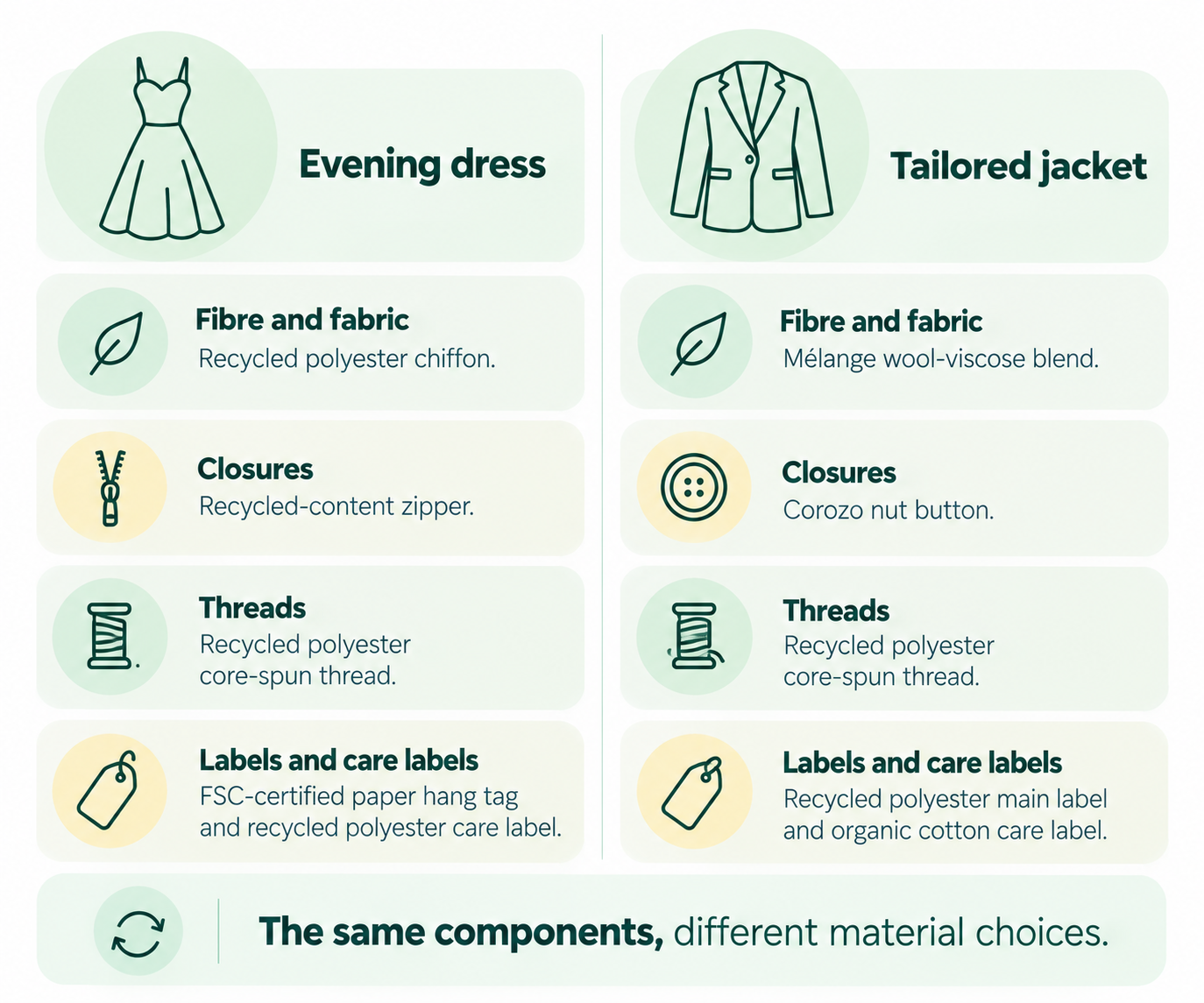
An exploded garment diagram is a useful teaching tool because it makes every hidden component visible at once. Taking an office evening dress and a tailored jacket as examples, the same eight-part anatomy applies to almost any garment: fibres and yarns, fabric, interlinings, linings, closures, threads, trims and accessories, and labels and care labels.
Each of these components carries its own circularity impact: material choice, whether it is mono- or multi-material, how easily it can be disassembled, whether it is repairable and recyclable, and what realistically happens to it at end-of-life.
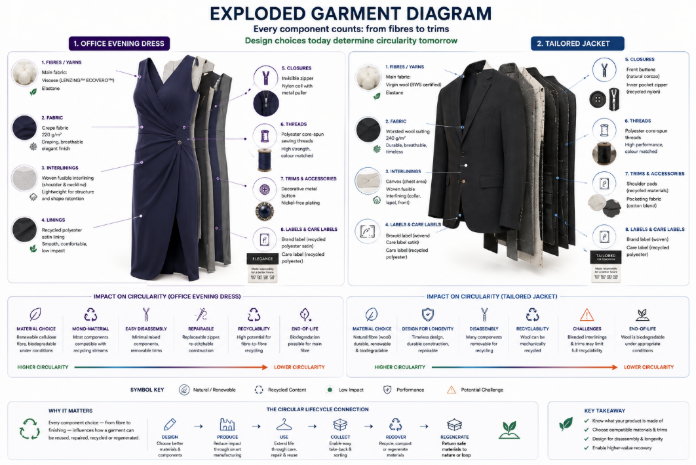
Figure 3.1. Exploded garment diagram — the eight-part anatomy of a textile product (fibres, fabric, interlinings, linings, closures, threads, trims, labels). Credit: FashionKIC, Exploded Garment Diagram, 2026.
Each component carries its own circularity impact, and the choices made at the design stage decide which recovery options stay open later:
- Reuse and repair depend on durable materials and easy access for repair.
- Refurbishment depends on modular design.
- Recycling depends on mono-materials and compatible components.
- Biological recovery is only realistic for genuinely biodegradable materials.
- Energy recovery remains the last, lowest-value option, used only when nothing else is possible.
In short: circularity is designed in from the first material choice, not added on at end-of-life.
Looking at a garment component by component turns circularity into a product-level question: what is each part made from, what function does it perform, how is it attached, and what happens to it later?
This chapter focuses on identifying and evaluating those materials and components. Chapter 4 builds on this analysis by exploring how product architecture can be redesigned for durability, repair, disassembly and recovery, while Chapter 6 examines the recovery routes available after use.
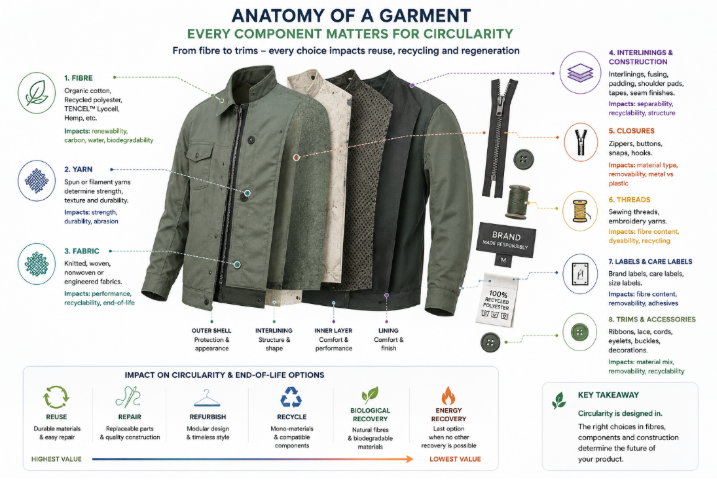
Figure 3.2. Garment component groups from fibre to trims and their effect on separability, recyclability and recovery. Credit: FashionKIC, Garment Component Groups Diagram, 2026.
3.4 Material Selection Decision Matrix
Once the components of a product are mapped, the next step is comparing candidate materials on equal terms.
A material selection decision matrix does this by scoring each option against a consistent set of criteria: carbon footprint (total greenhouse gas emissions per kilogram of material), water footprint (litres used per kilogram), durability (how well the material keeps performing over time and use), repairability (how easily it can be fixed or have parts replaced), recyclability (its potential to be recycled or regenerated), supplier transparency (traceability, ethics and certifications) and Digital Product Passport readiness (how easily data about the material can be captured and shared).
To use the matrix, a team first defines its product needs and priorities, then rates each candidate material from 1 (very poor) to 5 (excellent) on every criterion, calculates an overall score, and analyses the trade-offs before selecting the material that best balances performance, sustainability and circularity.
Comparing organic cotton, TENCEL™ Lyocell, recycled polyester, hemp, RWS-certified wool and recycled cotton this way shows that natural fibres generally score well on repairability and recyclability, that regenerated and low-impact fibres such as Lyocell and hemp tend to have the strongest overall sustainability performance, and that recycled synthetics can offer good durability but weaker repairability.
Supplier transparency and DPP readiness are becoming just as important to this comparison as the traditional environmental footprints, since future compliance depends on being able to evidence these choices.
For a robust comparison, the criteria should be weighted before options are scored. A workwear product may give durability and repairability more importance than water use, while a lightweight seasonal garment may prioritise low-impact processing and fibre recovery. The team should agree the weights, the minimum acceptable performance and the evidence required from suppliers. Scores based on assumptions should be marked clearly and revisited when verified data becomes available (Finnveden et al., 2009).
The matrix is a decision aid, not a universal sustainability ranking. Results depend on the product, geography, production system and data quality. A fibre with a favourable generic score may perform differently when it is blended, heavily finished or produced with a different energy system.
Run a sensitivity check by changing the most influential weights and uncertain scores. If a small change reverses the preferred option, collect better primary data, keep alternatives open or redesign the product to remove the disputed requirement. Record the final scores, evidence quality and decision rationale so the comparison can be reviewed as supplier data improves (Finnveden et al., 2009).
Before weighting, define each criterion, unit and scoring rule. Threshold requirements such as restricted-substance compliance, minimum strength or supplier traceability should be treated as pass-or-fail conditions rather than compensated by a high score elsewhere. Remaining alternatives can then be compared using weighted preferences. This separation reduces the risk that good performance on a less critical indicator conceals failure on a mandatory or safety-related requirement.
Use the matrix collaboratively. Design can define function and aesthetics, sourcing can test availability and cost, technical teams can review quality, and sustainability specialists can examine boundaries and evidence. Keep the raw data beside the score and record who approved each assumption. When two options are close, report the range and uncertainty instead of forcing a false precision. A dated version of the matrix provides an auditable decision record and makes it easier to update the choice when supplier-specific or product-level data replaces generic values (Finnveden et al., 2009).
For example, a team choosing the shell material for a work jacket can first set minimum requirements for abrasion resistance, colour fastness, chemical compliance and supplier documentation. Any option that fails a threshold is removed before weighting. The remaining candidates can be scored for climate impact, water use, durability, repair implications, recycling compatibility, cost and availability. The team should retain the supporting test report or dataset beside every score rather than entering an unexplained number.
Next, compare at least two scenarios: the agreed weighting and a second scenario that gives more importance to the most uncertain or mission-critical criteria. If the preferred material changes, the decision is sensitive and needs better evidence or a reversible design choice. If it remains stable, the team has a stronger basis for selection. After sampling, replace predicted performance with test and production data, record any change in the recommendation, and carry the final rationale into the bill of materials and product record. This iterative use of the matrix is consistent with life-cycle decision support under uncertainty (Finnveden et al., 2009).
3.5 Circular Material Compatibility
Compatible components are what make future recovery realistic. Incompatible materials create contamination, downcycling or waste, while compatible ones restore quality and value at end-of-life and enable closed-loop recycling, reuse and regeneration (Sandin & Peters, 2018).
A circular material decision tree captures this logic step by step: is the product designed for disassembly; are the main materials of the same family, such as all-cellulosic, all-polyester or all-wool; can components be separated without damage; and are trims, threads and accessories made from compatible materials and clearly labelled and traceable?
The answers place a product on a scale from high compatibility, where closed-loop recycling or regeneration is possible, down to very low compatibility, where materials cannot realistically be recovered at all.
Compatibility starts with a simple question sequence. Working through it for any garment shows how disassembly, material family and trim choices combine to determine how recoverable that product really is.
The purpose of this assessment is to identify compatibility, not to prescribe the complete product architecture. Once compatibility problems are identified, designers can decide how construction, interfaces and component choices should change. These design strategies are developed in Chapter 4 — Circular Product Architecture.
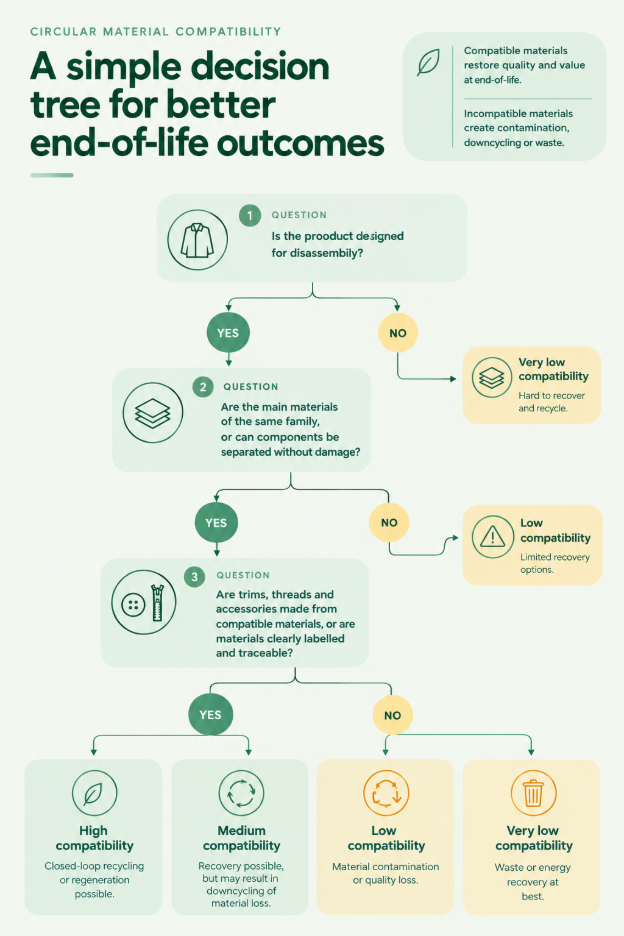
Figure 3.4. Circular Material Decision Tree: is the product designed for disassembly, are the materials of the same family, and are trims compatible? Credit: FashionKIC, Circular Material Decision Tree, 2026.
Use the decision tree to convert each incompatibility into a design action: remove an unnecessary component, select a compatible alternative, introduce a reversible connection or provide accurate composition and disassembly information. The selected route should be checked with an actual recovery partner because theoretical recyclability is not the same as an available, viable process (Sandin & Peters, 2018).
Compatibility is route-specific. A blend may be accepted by one mechanical process but rejected by a fibre-to-fibre recycler; a coating may support long use yet prevent a particular chemical-recycling route. Ask potential recovery partners for written input specifications covering fibre content, blend tolerances, elastane, colour, finishes, contamination, minimum volume and required preparation. These operational limits should inform design targets rather than being checked only after products return.
Validate the proposed route with a representative sample or pilot batch. Record input mass, separation time, rejected components, process yield and output quality, and compare these results with the assumptions made during design. If infrastructure is unavailable at the expected place and time of collection, document an alternative route instead of claiming theoretical recyclability. Feedback from the pilot can then be converted into purchasing rules, attachment standards and component restrictions for the next iteration (Sandin & Peters, 2018).
3.6 Dyeing and Finishing
Dyes, prints, coatings and finishes are part of a textile product’s material composition. They may represent only a small proportion of its weight, but they can strongly influence colour, appearance, performance, chemical safety and future recovery.
Textile colouration and finishing can involve dyes, pigments, binders, salts, surfactants, water-repellent treatments, flame retardants, softeners, printing pastes and other chemical formulations. Their environmental impact depends on the specific chemistry, process, fibre type and treatment system used. Dyeing and finishing wastewater can contain complex mixtures of colourants, salts, organic compounds and other pollutants, which is why appropriate chemical management and wastewater treatment are important (Holkar et al., 2016; Yaseen & Scholz, 2019).
From a product-anatomy perspective, the important question is not only what the main fibre is, but also what has been added to it. A recyclable fibre may become more difficult to recover when it carries incompatible coatings, prints, laminates or substances of concern.
When analysing a garment, consider:
- what dyes or pigments have been used;
- whether coatings, membranes or finishes are present;
- whether the treatment changes the material’s recyclability;
- whether substances of concern may remain in future material cycles;
- whether the supplier can provide reliable chemical and processing information.
Dyeing and finishing should therefore be treated as part of the product’s material identity rather than as an invisible production step.
Chapter 5 examines how manufacturers can reduce the water, energy and chemical impacts of dyeing and finishing through process efficiency, cleaner technologies, closed-loop systems and chemical management.
Key takeaway: A fibre does not determine circularity on its own. What is added to the fibre during colouration and finishing can change both its environmental impact and its future recovery options.
3.7 Material Sustainability Analyzer by FashionKIC
Every material decision is a trade-off made with incomplete information: the recycled option may save water but use more energy; the bio-based fibre may beat cotton on carbon but lose on durability; the cheaper blend may be the one your factory cannot actually source. The FashionKIC Material Sustainability Analyzer is designed to support the preliminary environmental assessment and comparison of fashion and textile materials and recommend more sustainable alternatives, while remaining transparent about data quality and methodological limitations (Finnveden et al., 2009).
The Material Sustainability Analyzer database was built and enriched using data from the following sources:
- Textile Exchange – Life Cycle Inventory (LCI) Library: environmental/LCA data for textile materials.
- FashionMatImpact (Hugging Face): additional material and environmental impact data used to expand the material database.
- Sustainable Fashion: Eco-Friendly Trends (Kaggle): used mainly for additional material information and enrichment, including eco-scores, country of origin, and certifications.
We then processed, cleaned, merged, and standardized these data into the internal material database used by the Material Sustainability Analyzer.
Data sources:
Textile Exchange LCI Library
FashionMatImpact dataset
Sustainable Fashion: Eco-Friendly Trends dataset
The analyzer is a screening and comparison aid, not a substitute for a product-specific life-cycle assessment. Users should record data year, geography, system boundaries and uncertainty, verify supplier-specific information where possible, and avoid presenting a relative score as an absolute environmental claim (Finnveden et al., 2009).
A practical workflow starts by defining the product function and the properties that cannot be compromised. Compare only materials that can meet those requirements, use the same units and system boundaries, and separate measured supplier data from proxy values. Review both the total score and the indicators that drive it; an average can hide a serious burden or a weak result for durability. Sensitivity testing helps show whether the recommendation remains stable when uncertain inputs change.
Results should be communicated as conditional evidence, not as a universal ranking. Save the dataset version, access date, assumptions and any manual adjustments with the project file. Before using a result in a public claim, confirm it with product-specific evidence and applicable verification requirements. The tool is most useful when it narrows options, reveals data gaps and prompts a better supplier conversation; final approval still requires technical performance, cost, availability and circular-recovery checks (Finnveden et al., 2009; Niinimäki et al., 2020).