
Chapter 1 — full chapter
Chapter 1 — full chapter
1.1 Why Transition to Circular Textile Systems?
The textile and fashion industry has traditionally operated through a linear model: resources are extracted, transformed into products, used and eventually discarded. This approach depends on a continuous supply of virgin resources and loses much of the value already invested in materials and products when they become waste.
A circular textile system takes a different approach. It aims to keep products, components and materials in use for longer, reduce unnecessary resource use and create realistic routes for reuse, repair and material recovery. This requires decisions across the whole value chain, rather than focusing on recycling alone (Ellen MacArthur Foundation, 2017; European Commission, 2022).
Looking across the value chain
The Fashion Impact Toolkit, developed by Global Fashion Agenda and Deloitte, offers a useful overview of the textile value chain. It maps activities from raw material production and processing to manufacturing, distribution, consumer use, collection and sorting, while also showing circular routes such as reuse, repair, resale, remanufacturing and recycling.
The map helps show an important point: impacts and circular opportunities are connected. A decision made during material sourcing or product design can influence manufacturing impacts, product longevity and the recovery options available later.
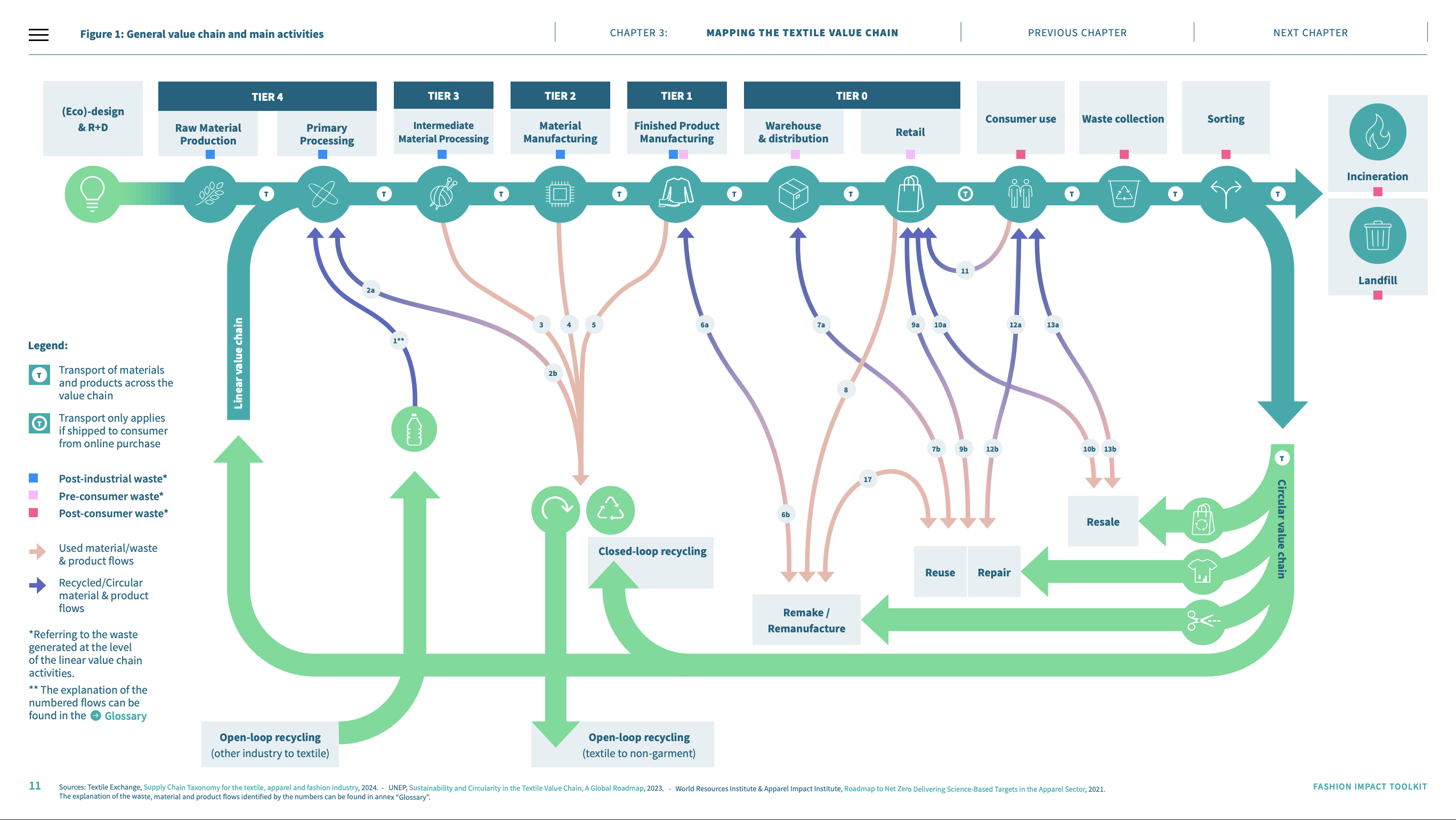 Figure 1.1. Textile value chain and circular flows. Source: Global Fashion Agenda & Deloitte Global, Fashion Impact Toolkit, 2025, Figure 1, p. 11.
What does this mean for SMEs?
For SMEs, circularity does not mean changing everything at once. A useful starting point is to identify where the company has the greatest influence: material sourcing, product design, manufacturing, supplier relationships, product use or recovery.
Looking across the value chain can help identify where resources are being lost, where impacts can be reduced and where collaboration with suppliers, manufacturers, customers or recovery partners may be necessary.
Key takeaway: Circularity is not a single action at the end of a product’s life. It depends on connected decisions made across the textile value chain.
Resources
- Ellen MacArthur Foundation. (2017). A new textiles economy: Redesigning fashion’s future.
- European Commission. (2022). EU strategy for sustainable and circular textiles.
- Global Fashion Agenda & Deloitte. (2025). Fashion Impact Toolkit. https://globalfashionagenda.org/resource/fashion-impact-toolkit/