
Chapter 6 — full chapter
Chapter 6 — full chapter
6.3 Advanced Sorting and Textile Recycling Technologies
Traceability earns its keep at end-of-life. Sorting is the gatekeeper of recycling, and recycling technology dictates what sorting must deliver: a process that needs mono-material cotton at 99% purity imposes a sorting requirement that no manual line can meet, while a process tolerant of blends changes what is worth collecting in the first place. This section reviews both layers, the sensing technologies that separate the stream and the recycling routes that consume it, and the European scale-up now under way.
6.3.1 Sorting Decides Value: NIR Recognition and Textile Recycling
Sorting decides value. Manual sorting, still dominant, separates garments by reuse grade, material, color and pattern; it is flexible but labor-intensive and cannot verify fiber content. Automated sorting uses near-infrared (NIR) spectroscopy and hyperspectral imaging to identify materials from their spectral fingerprint, with color cameras for color streams; hyperspectral systems scan larger areas than point-NIR and handle patterned textiles better. Physics imposes limits: NIR reads only the surface (multilayer fabrics and elastane-core yarns are misread), dark shades absorb the signal, and blends visually resemble mono-materials, which is why the DPP's verified composition data (section 6.2) and RFID identification (6.2) are sorting technologies as much as data policies. Downstream, three recycling routes have different appetites. Mechanical recycling (shredding, tearing, re-spinning) is mature and low-cost, works for cotton and polyester, but degrades fiber length, only 5–20% of cotton input becomes spinnable fiber, and removes no dyes or chemicals: mostly downcycling. Thermo-mechanical recycling re-melts thermoplastics (PET, PA, PP) into granules, but molar mass falls with each cycle and virgin polymer must be blended in. Chemical recycling either dissolves polymers selectively (separating polyester from cotton) or depolymerizes them, PET back to PTA and MEG monomers, PA6 to caprolactam, enabling true fiber-to-fiber loops at virgin quality, at the price of high energy and capital costs and a demand for clean, well-sorted, mono-material feedstock. Elastane at even 3–5% blocks both mechanical and chemical routes; laminates, membranes and mixed trims block disassembly. The loop therefore closes only end-to-end: ecodesign (mono-materials, detachable components, Ch. 1.3) → identification (6.2) → verified data (6.2) → automated sorting → matched recycling route.
The loop therefore closes only end-to-end: ecodesign (mono-materials, detachable components, Ch. 1.3) → identification (6.2) → verified data (6.2) → automated sorting → matched recycling route.
The world's first fully automated textile sorting plant, SIPTex in Malmö, built by Stadler with TOMRA NIR technology, sorts up to 24,000 tonnes per year by fiber and color. Valvan's Fibersort line sorts around 2,000 garments per hour, discriminating fourteen fiber types including wool, cotton, viscose, polyester, and their blends, which is precisely the resolution a chemical recycler needs to accept a batch without re-testing it; the Global Fashion Agenda documented the system in its Textile Recycling Toolbox (2020) as the point at which sorting stops being a manual bottleneck and becomes a data-producing industrial step (https://globalfashionagenda.org/wp-content/uploads/2022/12/GFA_2020_TEXTILE_RECYCLING_TOOLBOX_3.0.pdf). ANDRITZ and Newretex are delivering comparable lines across Europe. On the recycling side, Circulose, restarted after Renewcell's 2024 insolvency, operates the first commercial-scale textile-to-textile plant for cellulosics at 60,000 t/year, with fabrics used by Ganni, Levi's, H&M, and COS; Infinited Fiber Company produces Infinna™ from cotton-rich waste with backing from H&M Group and Inditex; and Syre targets three million tonnes per year of textile-to-textile recycled polyester by 2032.
The bottleneck is therefore no longer chemistry. It is feedstock: collection and sorting capacity, garments designed to be recyclable at all, and the more prosaic problem of a mill not knowing which recycler will take its waste. That last gap is what the Global Fashion Agenda's Circular Fashion Partnership addresses in Bangladesh, where a shared data portal maps post-industrial textile waste flows alongside the sorters and recyclers able to process them, turning an informal scrap trade in one of the world's largest garment hubs into a sourcing decision that can be made on data (https://globalfashionagenda.org/circular-fashion-partnership/). Matching supply to capacity is an information problem, and it is the same one this course opened with in Chapter 1.
6.3.2 Case example: Rifò lab, regenerated wool in Prato
Rifò[38], founded in Prato in 2017 by Niccolò Cipriani, shows the mature end of the recycling spectrum built on the district's century-old know-how. Its knitwear is made from regenerated wool, cashmere, cotton and denim recovered from textile scraps and from garments taken back from customers: the feedstock is sorted by color so that no re-dyeing is needed, then mechanically shredded, pulled back into fiber and re-spun into new yarn using the traditional Prato cardato rigenerato process, with the entire supply chain kept within roughly a 30 km radius. The take-back scheme closes the loop and, crucially, makes it traceable: garments are collected, sorted and regenerated inside the Prato district rather than sent to generic disposal, and the regenerated pieces can themselves be recycled two or three times more.
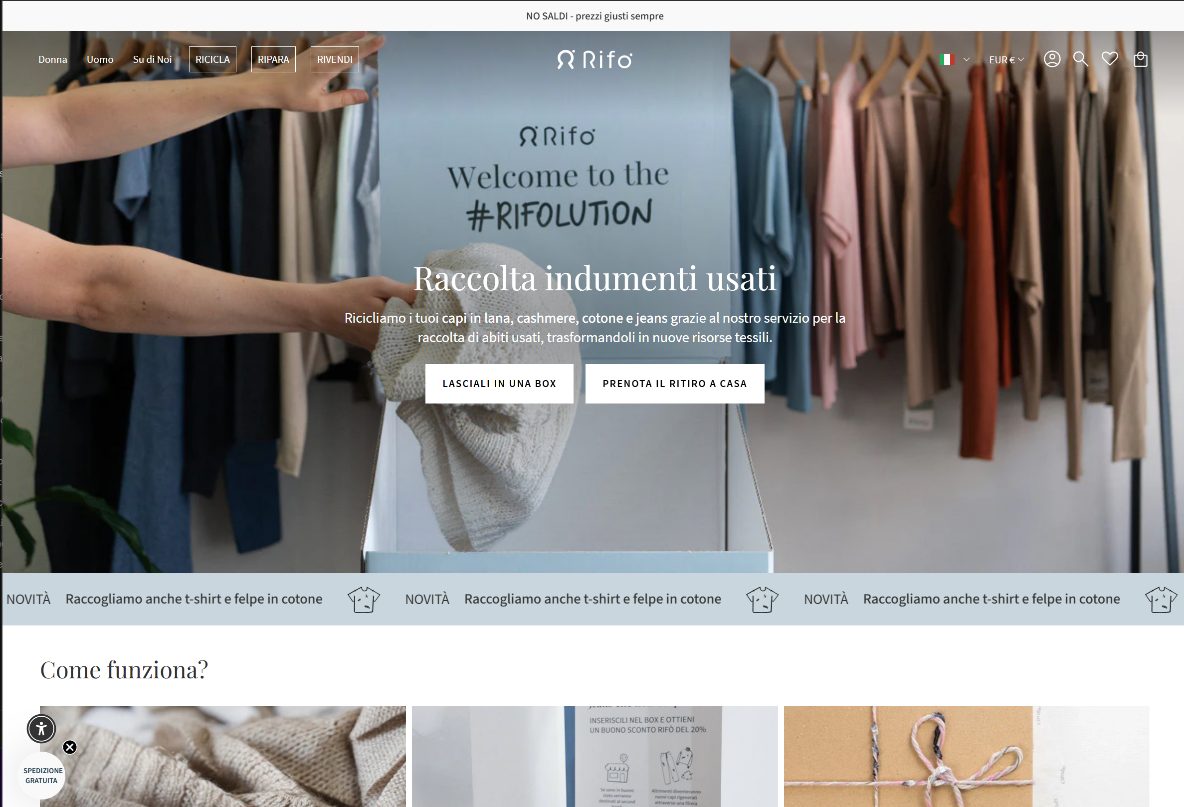
Figure 6.3, Rifò: regenerated cashmere and wool from customer take-back, produced within the Prato textile district. (Source: rifo-lab.com)
Recognized as a good practice on the EU Circular Economy Stakeholder Platform, Rifò is a working demonstration of decades-old Italian industrial circularity, the same tradition that today's sorting sensors and Digital Product Passport data will extend to fibers far harder to regenerate than wool.
6.3.3 Case example: Precious Plastic, open-source recycling machinery
Precious Plastic began as Dave Hakkens's graduation project at Design Academy Eindhoven and became a Dutch non-profit distributing the designs for a complete small-scale plastics recycling workshop: a shredder that reduces waste to flakes, extrusion and injection machines, and a sheetpress that compresses flakes into panels for furniture, tiles, and cladding. Every blueprint, tutorial, and business plan is published free, and the community platform and marketplace connect the people who build the machines with those who buy what comes out of them. The reported network stands at roughly 1,100 workspaces across 56 countries, processing on the order of 1,400 tonnes of plastic a year.
The relevance to this chapter is not the fiber but the architecture. Everything else in section 6.3 describes capital-intensive centralized infrastructure, a sorting plant that needs 24,000 tonnes a year to pay for itself, a depolymerization line that needs clean mono-material feedstock delivered at industrial volumes. Precious Plastic demonstrates the opposite topology: a recycling capability whose unit is a room, whose intellectual property is a free file, and whose economics work at the scale of a neighborhood. Distributed recycling does not compete with the industrial routes, it addresses what those routes will never collect, the small, contaminated, geographically scattered fraction that is uneconomic to transport. For a design engineer in the textile field the transferable questions are the same three: what can be recycled with machines a workshop can build, what output has value locally, and what has to be designed into the product for either to be possible.