
Chapter 5 — full chapter
Chapter 5 — full chapter
5.3 Data-Driven Material Choice
Material selection is the single most impactful design decision (up to 80% of the impact is locked in at design), and it is increasingly made using databases rather than intuition. This section connects fiber impact profiles, material databases, and the market data that frames them.
5.3.1 Beyond the Single Number: Data-Driven Material Choice
Every fiber family has a structured impact profile, and single-parameter comparisons mislead. Conventional cotton: renewable and biodegradable, but high water footprint and pesticide use. Polyester: fossil-based and a microplastic source, but low water footprint, high durability, and, per single use, potentially lower impact than a fragile natural-fiber garment. Man-made cellulosics (viscose, modal, lyocell): performance depends almost entirely on the production system, closed-loop lyocell (e.g. TENCEL™[25]) with solvent recovery differs radically from conventional viscose. Recycled polyester (rPET) requires 30–50% less energy than virgin polymer, but 98% of it still comes from PET bottles rather than textiles, which merely delays, not closes, the loop. The engineering discipline is to compare materials per functional unit, including the use phase: a 3 kg CO₂e T-shirt worn 10 times costs 0.30 kg CO₂e per wear; a 3.5 kg CO₂e T-shirt worn 50 times costs 0.07 kg CO₂e per wear, the "worse" material on the label is four times better in use. Digital tools industrialize this reasoning: LCA-based material indices aggregate cradle-to-gate impacts per material and process; chemical databases (e.g. ZDHC Gateway[20]) manage restricted substances; and DPP composition data will feed the same indices with product-specific rather than average values. The critical caveat inherited from section 6.1 applies with full force: material indices embed methodological choices (boundaries, allocation, data vintage), and comparing scores across methodologies is invalid.
The market frame (Textile Exchange[15], Materials Market Report 2025): global fiber production reached a record 132 million tonnes in 2024 (up from 125 Mt in 2023) and is projected to reach ~169 Mt by 2030 under business-as-usual. Polyester alone accounts for 59% of output (88% of it fossil-based); recycled fibers overall are 7.6%; recycled polyester's share of polyester slipped to 12%; and less than 1% of the global fiber market comes from pre- and post-consumer recycled textiles. Data-driven material choice therefore operates against a market still moving in the opposite direction (Textile Exchange, 2025).
5.3.2 Case example: Higg MSI / Cascale, a shared material database
The Higg Materials Sustainability Index (MSI), developed by Cascale (formerly the Sustainable Apparel Coalition) and hosted on the Worldly platform, is the industry's most widely used cradle-to-gate material scoring framework, built on peer-reviewed LCA data and used by tens of thousands of organisations. Version 3.11 (November 2025) added new cotton datasets and expanded material categories.
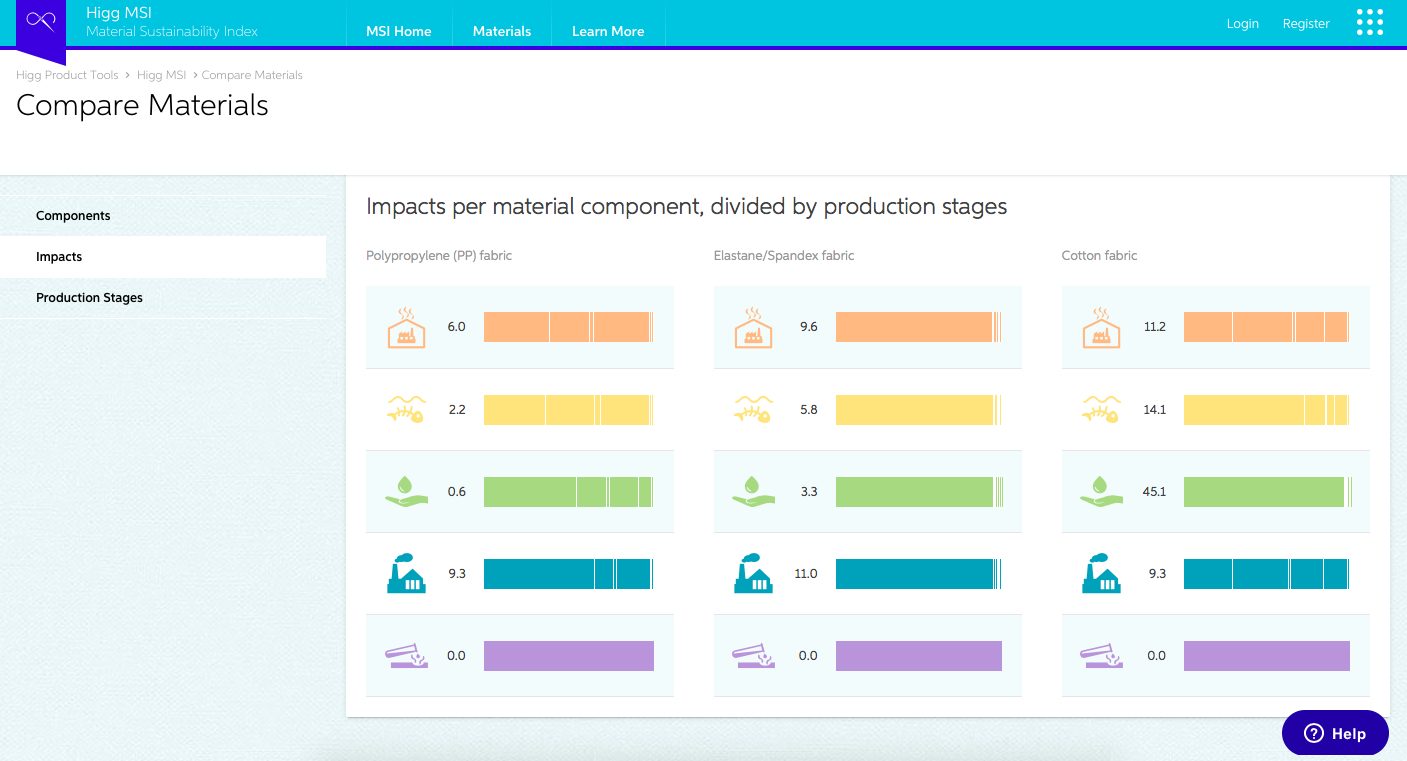
Figure 5.3, Higg MSI 'Compare Materials': environmental impact of PP, elastane and cotton, broken down by production stage. (Source: Higg MSI / Cascale)
Its history is also a methodology lesson: criticism of its data vintage and normalization choices, which led to a temporary suspension of consumer-facing use in 2022 and an independent review, demonstrates exactly the principle of section 6.1: an index is only as credible as the transparency of its method (Cascale, 2025; Worldly, 2024).