
Chapter 4 — full chapter
Chapter 4 — full chapter
4.4 AI × Manufacturing: Process Optimization, Defect Detection, Predictive Maintenance
A production line already generates the data needed to run itself better. Vibration, temperature, color readings, and images of every meter produced exist at the machine and, in most factories, are discarded within seconds. What changes with machine learning is not the sensing but the interpretation: the same signals a skilled operator reads intermittently can be read continuously, and a defect caught in the first meter costs a fraction of one caught at final inspection.
This section introduces the vocabulary in plain terms, then follows AI across the production workflow, from in-line inspection to color management and predictive maintenance, translating each application into its material effect in fabric, ink, energy, and equipment life. It also weighs the cost side, since the data infrastructure and skills these systems require are precisely what SMEs are least likely to have.
Try it now
Draw an order-to-delivery flowchart for a made-to-order T-shirt printed digitally: order → file → print → finish → ship.
Note where inventory and waste disappear compared with a batch-produced equivalent.
4.4.1 Teaching Machines to See Defects: AI on the Production Line
A plain-language toolbox: Artificial Intelligence (systems performing tasks requiring human-like judgment), Machine Learning (models that learn patterns from data to predict), Deep Learning (multi-layer neural networks, strongest on image-based tasks), Automation (rule-based task control, often combined with AI for adaptive decisions). In digital printing, a representative case for the industry, AI supports automated color matching, image upscaling, in-line defect detection through computer vision, and predictive maintenance that anticipates equipment failures from sensor data; beyond the printer, robotic automation handles feeding, fixation, cutting, folding, sorting, and packaging. Every application has a sustainability translation: fewer reprints means less ink, fabric, water, and energy; predictive maintenance means longer equipment life; automated color management means right-first-time production. The same AI/IoT stack extends to quality control and sustainability tracking across TCLF production, feeding the reporting systems of Chapter 5. The critical view: AI adoption requires investment, data infrastructure, and skills that can strain SMEs, and Industry 5.0 thinking insists AI should support human decisions with transparent reasoning, not replace them.
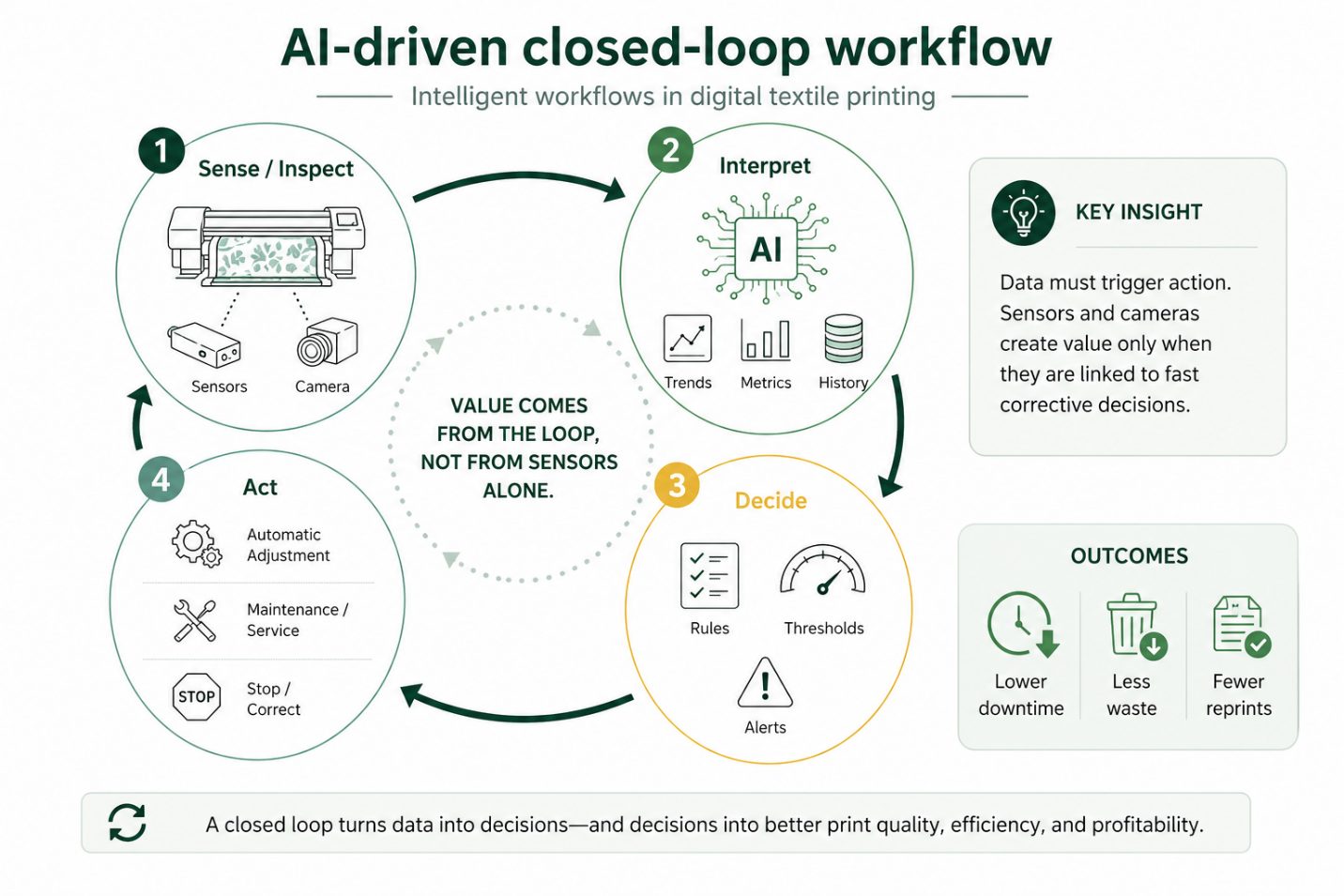
Figure 4.9, AI-driven closed-loop workflow in digital textile printing: sensor data feeds interpretation, decision, and automated action.
4.4.2 Case example: Predictive maintenance in digital printing
A 2025 predictive-maintenance study on digital printing equipment (Mithun Kumar et al., ShodhKosh 6(3s)) shows the full closed-loop architecture this section describes. A multi-sensor testbed, vibration, temperature, acoustic, and optical signals, feeds a hybrid CNN–LSTM model that predicts faults and Remaining Useful Life, combined with digital twin simulation to test maintenance decisions before applying them.
The reported results quantify the sustainability translation: predictive performance of R² ≈ 0.94 and F1 ≈ 0.93, unplanned downtime reduced by ~32%, maintenance costs by ~24%, and material waste by ~18%. Data becomes value only when converted into actions, alert, intervention, avoided scrap. The complementary industrial example is Durst's Hawk AI in-line inspection: camera vision detects defects such as missing nozzles and corrects them during production (https://www.durst-group.com/de/landing-page/durst-hawk-ai), closing the inspect–decide–act loop at production speed.
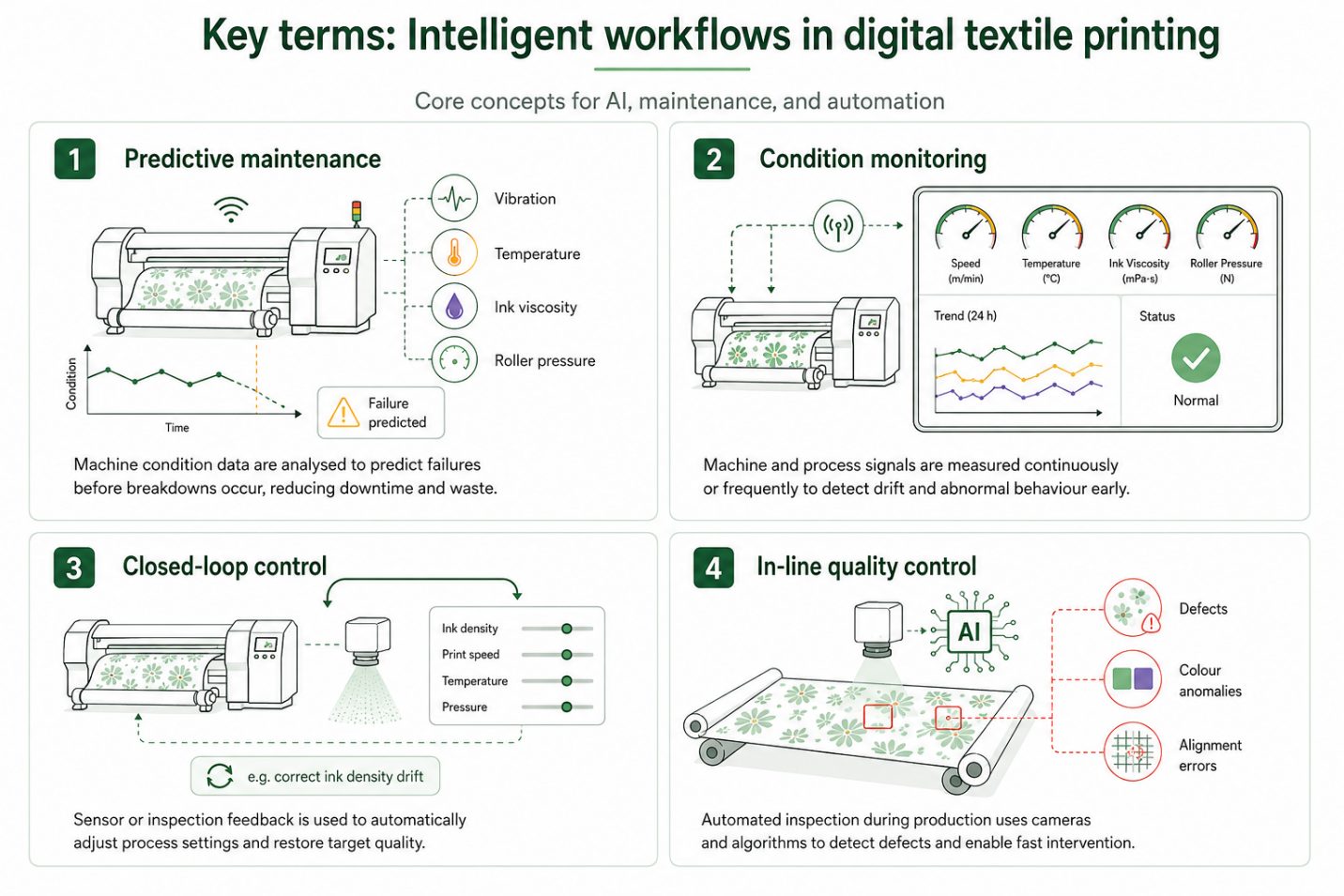
Figure 4.10, Core concepts of intelligent printing workflows: predictive maintenance, condition monitoring, closed-loop control, in-line quality control.
4.4.3 Case example: Smartex, seeing the defect before the dye bath
Smartex builds fabric quality control for circular knitting: a camera and edge computing unit mounted on the machine inspects the tube of fabric as it is produced, classifies defects in real time, and stops the machine when a periodic fault appears. The defect classes are the ones that matter industrially, holes, needle lines, oil spots, contamination, and above all elastane faults, which are close to invisible in greige fabric and typically surface only at the dyeing stage, when the roll has already absorbed water, chemistry, and energy. The system logs every meter produced, so quality data becomes a traceable production record rather than an operator's note.
The economics follow from where in the chain the error is caught. A knitting fault found in the first meters costs the yarn already knitted; the same fault found after dyeing costs the whole roll plus the entire wet processing footprint. The company reports defective production reduced to near zero, and in a documented deployment at Tintex Textiles, an average of seven rolls saved per machine per month. Founded in Porto and now operating across Europe, the United States, and China, it is the clearest industrial instance of this section's argument: inspection is worth automating not because machines see better than people, but because they see continuously.
4.4.4 Case example: sewts, teaching robots to handle cloth
Automation stopped at the sewing room for a physical reason. Industrial robots are built for rigid parts whose position is known once they are gripped, and a piece of fabric is the opposite: it deforms as it is picked up, so its geometry after the grasp cannot be read from its geometry before. This is why garment assembly remained manual while almost every other manufacturing sector automated, and why production followed low labor costs rather than machines.
sewts, a Munich deep-tech company, attacks that specific problem by combining computer vision with simulation, giving robots what it calls human-like perception of soft materials: the system predicts how a deformable textile will behave when grasped, and adjusts the motion accordingly. Its first deployments target industrial laundries with sewts.VELUM, where limp, wet-handled textiles must be fed into folding machines, with garment production as the longer-term horizon. The strategic significance for Europe is direct. If the labor intensity of textile handling falls, the calculation that moved assembly offshore weakens, and localized production of the kind described in 4.3 becomes a question of engineering rather than of wage arbitrage.