Chapter 6 — full chapter
| Site: | FashionKIC Learning Platform |
| Course: | Circular Design Strategies |
| Book: | Chapter 6 — full chapter |
| Printed by: | Guest user |
| Date: | Sunday, 1 November 2026, 3:20 AM |
Table of contents
- Chapter 6 — Midstream Strategies: Manufacturing Implementation
- 6.1.1 Overall Environmental Performance
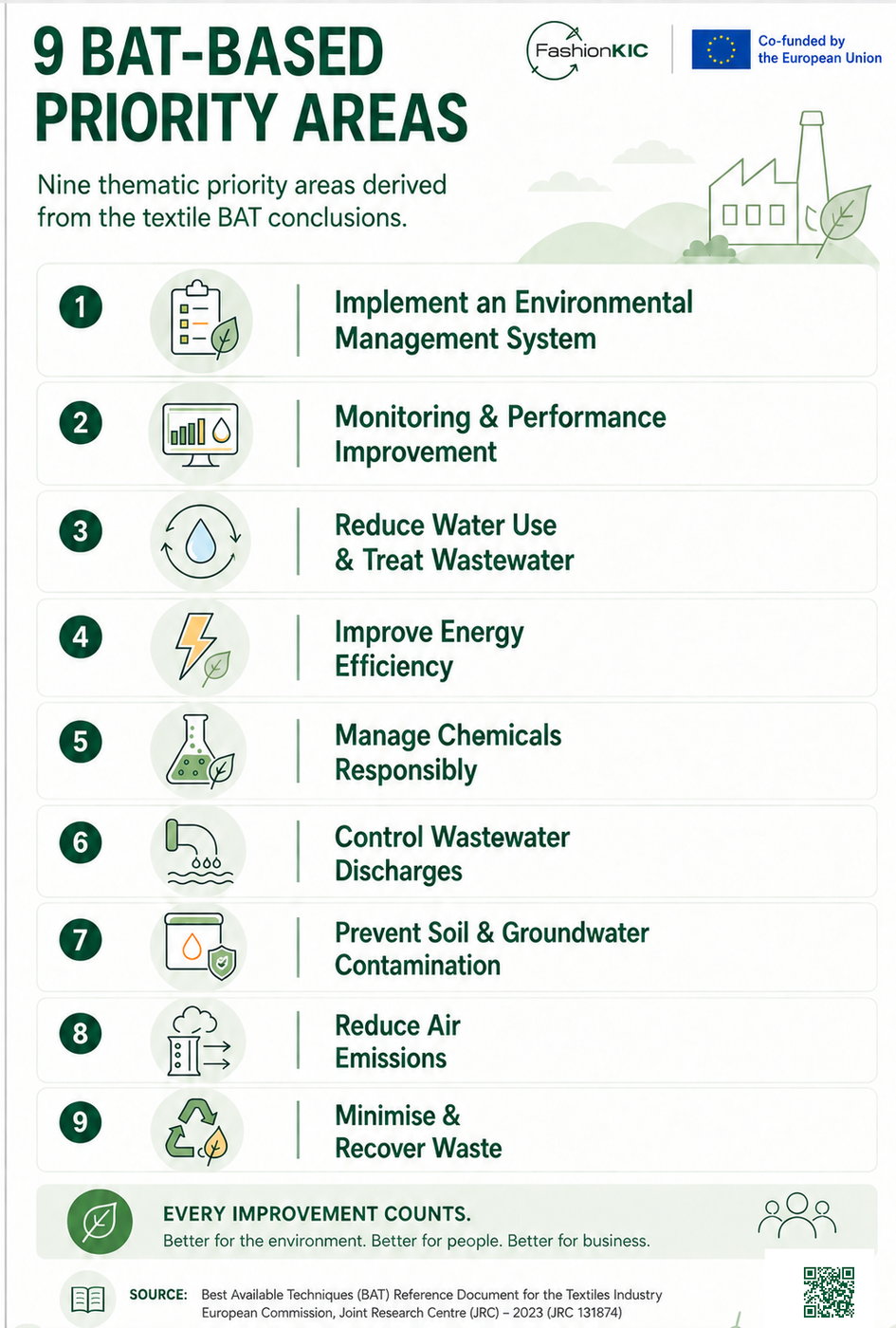
- 6.1.2 Monitoring
- 6.1.3 Water Consumption and Wastewater
- 6.1.4 Energy Efficiency
- 6.1.5 Chemicals Management, Consumption and Substitution
- 6.1.6 Emissions to Water
- 6.1.7 Emissions to Soil and Groundwater
- 6.1.8 Emissions to Air
- 6.1.9 Waste Management
- 6.1.10 Your printable BAT Poster
- 6.2.1 Jeanologia’s new technologies
- 6.2.2 Artistic Milliners Case Study
- 6.2.3 Tintex: Dyeing and Finishing
- 6.3 Smart Manufacturing
Chapter 6 — Midstream Strategies: Manufacturing Implementation
Midstream strategies address the manufacturing and processing stages of the textile value chain. This chapter explains Best Available Techniques from the EU BREF for textiles, midstream case studies (Jeanologia, Artistic Milliners), smart manufacturing (IoT, AI, digital twins) and industrial symbiosis (Orange Fiber, Sabant, Spinnova). The chapter addresses two positions in the value chain: those who operate manufacturing processes, and those brands, designers and SMEs without their own factories, who influence them by specifying requirements, asking suppliers the right questions, comparing evidence and monitoring performance. For the second group, each BAT area below is paired with the question to put to a supplier.
Midstream strategies address the manufacturing and processing stages of the textile value chain, focusing on how materials, water, energy, and chemicals are used within production systems. Their objective is to improve resource efficiency while minimizing pollution, waste, and greenhouse gas emissions. Key approaches include process optimization, closed-loop production systems, sustainable chemical management, water and energy efficiency measures, waste reduction, and optimized factory operations. These strategies are commonly implemented through environmental management systems such as ISO 14001 and EMAS. A management-system certificate confirms that an organisation’s system meets the requirements of the standard; it is not a verification of a particular level of environmental performance, which has to be demonstrated separately through measured data. This chapter unpacks the midstream strategies from the European Commission’s Best Available Techniques (BAT) Reference Document (BREF) for the Textiles Industry, published under the Industrial Emissions Directive (IED), into nine overarching topics: Overall Environmental Performance, Monitoring, Water Consumption & Wastewater, Energy Efficiency, Chemicals Management, Emissions to Water, Emissions to Soil & Groundwater, Emissions to Air, and Waste. BAT conclusions under the (Industrial Emissions Directive (IED) apply mainly to larger textile processing plants. Brands and SMEs outside that scope are not legally bound by them, but can use BAT as a supplier-engagement and benchmarking reference when specifying requirements and interpreting supplier data.
In this chapter:
- 6.1 Best Available Techniques for Textile Manufacturing
- 6.2 Midstream Case Studies
- 6.3 Smart Manufacturing
- 6.4 Industrial Symbiosis
6.1.1 Overall Environmental Performance
Best Available Techniques are technical reference points for the processes within the scope of the Industrial Emissions Directive: they describe techniques and associated consumption or emission levels that regulators and installations use when defining permits and good practice. An Environmental Management System such as ISO 14001 is a different instrument: it is the organisational framework a company uses to set targets, assign responsibilities, train employees, audit and improve performance across water, energy, chemicals and waste. BAT indicates what good practice in a process looks like; an EMS is how a company manages and documents its own performance against such references. The two are complementary and should not be treated as interchangeable.
Ask your supplier: Which environmental management system do you operate, what is its scope, and can you share the current objectives, audit findings and improvement actions?
6.1.2 Monitoring
Monitoring environmental performance helps manufacturers understand resource use and identify improvement opportunities. Manufacturers continuously measure material inputs, water and energy consumption, chemical use, wastewater quality, and waste generation. Digital sensors, meters, and production dashboards help identify inefficiencies, detect leaks, and monitor environmental KPIs. Companies such as Lenzing use real-time monitoring systems to optimize production and improve resource efficiency.
Ask your supplier: Which parameters are metered continuously, at what frequency, and can you share twelve months of water, energy and chemical consumption data for the processes you run for us?
6.1.3 Water Consumption and Wastewater
Water is extensively used during textile processing. Factories reduce water consumption by installing low-liquor-ratio dyeing machines, reusing rinse water and recycling treated wastewater. Digital printing, new finishing technologies, efficient washing processes and closed-loop water systems significantly reduce freshwater demand while lowering wastewater volumes and treatment costs.
Ask your supplier: what is your water use per kilogram of fabric, what share is recycled or closed-loop water, and how does the measured wastewater load compare with the permit or ZDHC limits?
6.1.4 Energy Efficiency
Textile manufacturing requires significant amounts of energy for heating, drying and finishing. Manufacturers improve energy performance by installing heat recovery systems, insulating steam pipes, replacing inefficient motors and using variable-speed drives. Many factories also switch to renewable electricity and continuously monitor energy use to reduce greenhouse gas emissions and operating costs.
Ask your supplier: what is your energy intensity per kilogram of fabric, what share is renewable, and which heat-recovery or efficiency measures are already installed?
6.1.5 Chemicals Management, Consumption and Substitution
Responsible chemical management reduces environmental and health impacts. Factories maintain a complete inventory of chemicals, replace hazardous substances with safer alternatives and use automatic dosing systems to minimise waste. Companies increasingly follow ZDHC Manufacturing Restricted Substances Lists (MRSL) and use bluesign®-approved chemicals to reduce risks for workers and the environment.
Ask your supplier: do you work to the ZDHC Manufacturing Restricted Substances List, how are incoming chemical formulations verified, and can you provide the chemical inventory for the processes used on our products?
6.1.6 Emissions to Water
Textile wastewater contains dyes, chemicals and organic pollutants that require effective treatment. Textile manufacturers install physical, chemical and biological wastewater treatment systems to remove dyes, organic matter and hazardous substances before discharge. Many facilities continuously monitor wastewater quality and increasingly reuse treated water within production processes.
Ask your supplier: which treatment stages does the effluent pass through, who tests it, how often, and can you provide the test reports rather than a summary statement?
6.1.7 Emissions to Soil and Groundwater
Factories prevent contamination by storing chemicals in bunded (secondary containment) areas, inspecting tanks and pipelines regularly and implementing spill response procedures. Proper storage, labelling, safety data sheets, worker training and wastewater testing prevent hazardous substances from reaching soil and groundwater.
Ask your supplier: how are chemicals stored and contained, and is there a documented inspection and spill-response routine?
6.1.8 Emissions to Air
Textile processes can release volatile organic compounds, dust and combustion gases. Manufacturers reduce air emissions by replacing solvent-based chemicals, installing VOC abatement systems, filters and scrubbers, and improving ventilation in coating, printing and finishing operations. These measures improve both environmental performance and workplace air quality.
Ask your supplier: which processes emit volatile organic compounds or dust, and which abatement or ventilation measures are installed and monitored?
6.1.9 Waste Management
Factories minimize waste by segregating textile scraps, recovering chemicals, recycling packaging, and reusing production residues wherever possible. Many manufacturers analyze waste streams to identify opportunities for reduction and increase the recovery of valuable materials before disposal.
Ask your supplier: how are production waste streams segregated, what share is reused or recycled, and which companies receive them?
6.2.1 Jeanologia’s new technologies
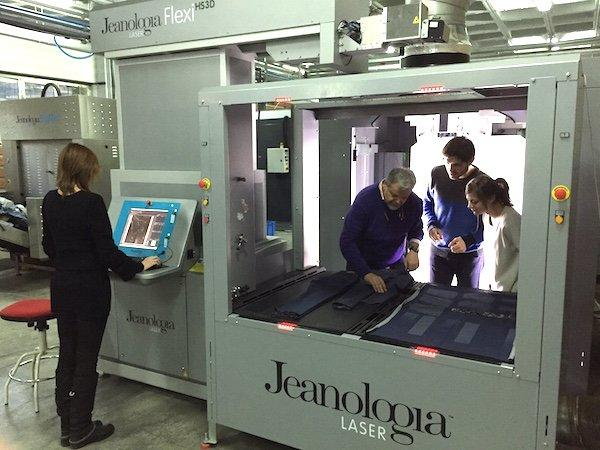
New technologies can improve and charge radically manufacturing processes, making old models obsolete. Founded in Spain in 1994, Jeanologia has revolutionized denim manufacturing by replacing conventional finishing techniques with cleaner production technologies. Traditional denim finishing relies on large amounts of water, hazardous chemicals, and labor-intensive processes such as sandblasting. Jeanologia developed laser, ozone, and water-efficient finishing systems that dramatically reduce environmental impacts while improving worker safety. Its technologies can lower water consumption by up to 95%, reduce chemical use by up to 90%, and decrease energy demand, enabling manufacturers to produce denim with a significantly smaller environmental footprint. Today, Jeanologia's technologies are used by hundreds of factories worldwide, demonstrating how process innovation can make textile manufacturing cleaner, safer, and more resource efficient.
6.2.2 Artistic Milliners Case Study
Artistic Milliners in Pakistan who manufactures for BESTSELLER, operates a Zero Liquid Discharge (ZLD) system that recovers and recirculates nearly all process water. This demonstrates how advanced water recycling technologies can substantially reduce freshwater demand while supporting more sustainable textile manufacturing. https://artisticmilliners.com/
6.2.3 Tintex: Dyeing and Finishing
Tintex is a Portuguese textile manufacturer specialising in knitting, dyeing and finishing. It belongs in the midstream chapter because the case concerns the operation and improvement of manufacturing processes. Learners should examine facility-specific evidence for water, energy, chemistry, emissions, waste, quality and production yield, then compare it with the requirements defined in Section 5.4. Source: https://tintextextiles.com/
CASE STUDY: TMG Textiles — Portugal.
Topic: Industrial Sustainability.
TMG Textiles is one of Portugal's largest vertically integrated textile groups, with longstanding commitments to sustainable manufacturing, circularity and product innovation. Its industrial-scale operations offer a real-world midstream case: energy and water efficiency, chemical management and responsible production.
6.3 Smart Manufacturing
The Textile Industry is undergoing a digital transformation in which manufacturing processes are increasingly supported by connected machines, real-time data, and intelligent decision-making. Smart Manufacturing is an enabling tool that can support sustainability, competitiveness and resilience by combining digital technologies with production systems. Digital technologies can improve efficiency, quality and resource use, but only when they use reliable, compatible data, are implemented by skilled operators, do not require disproportionate energy or equipment, and lead to concrete changes in production practices. The continuous collection and analysis of production data can help manufacturers optimise resource use, reduce waste, prevent defects, and respond more quickly to changing market demands. Digitalisation can also improve transparency across the value chain, supporting traceability, compliance, and the transition towards more circular production systems.
Resource Insight: Industry 5.0: Towards a sustainable, human-centric and resilient European industry: https://research-and-innovation.ec.europa.eu/knowledge-publications-tools-and-data/publications/all-publications/industry-50-towards-sustainable-human-centric-and-resilient-european-industry_en
6.3.1 Smart Factories
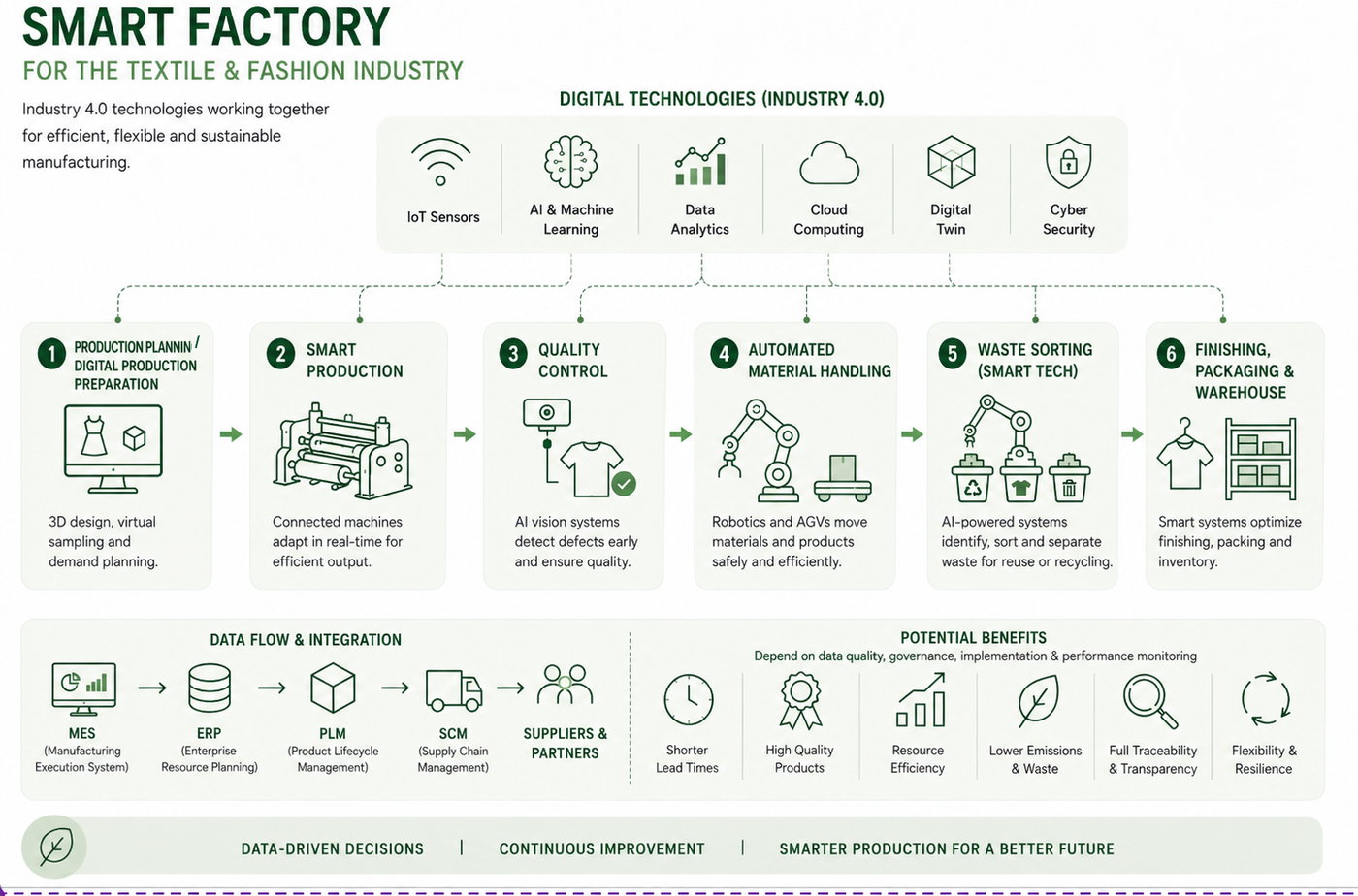
A smart factory is the manufacturing model of Industry 4.0, where machines, systems, and people work together and are connected through digital tools like the Internet of Things (IoT), Artificial Intelligence (AI), automation, and data analysis. By integrating physical production systems with digital technologies, Industry 4.0 enables manufacturers to make informed decisions based on real-time data, supporting continuous improvement and more efficient use of resources across the entire manufacturing process. Smart factories can quickly adapt to changing production requirements, enabling shorter lead times, greater product customization, and improved quality control. They also generate reliable production data that support traceability, transparency, and informed decision-making.
6.3.2 Internet of Things
Smart factories rely on the Internet of Things (IoT), where interconnected sensors embedded in machines and equipment continuously collect operational data throughout the production process. This enables real-time monitoring of manufacturing activities, while digital dashboards and production analytics transform the data into actionable insights. By monitoring equipment performance, product quality and resource consumption, manufacturers can make faster decisions, optimise energy, water and material use, and continuously improve production efficiency.
6.3.3 Artificial Intelligence
Artificial Intelligence (AI) and Machine Learning (ML) transform production data into intelligent decision-making tools that optimize manufacturing performance. By analyzing information collected from sensors, machines and production systems, AI can identify patterns, forecast demand, optimise production schedules and support more efficient resource use. Computer vision systems automatically inspect fabrics and garments to detect defects, improving quality control while reducing material waste. Predictive maintenance algorithms anticipate equipment failures before they occur, minimising downtime and extending machine life. In addition, Digital Twins create virtual replicas of products, machines or production lines that enable process simulation, performance analysis and continuous optimisation before changes are implemented in the physical factory.
6.3.4 Digital Traceability and Transparency
Digitalisation also improves the ability to trace materials, products and manufacturing processes throughout the supply chain. Digital records can capture information about raw materials, production stages, environmental performance and product specifications, making manufacturing more transparent and accountable. These systems support compliance with emerging European legislation, facilitate sustainability reporting and provide the foundation for Digital Product Passports. Improved traceability also strengthens collaboration between brands, manufacturers and recyclers by making reliable product information available throughout the product life cycle.
RESOURCE INSIGHT: iTechStyle Green Agenda — CITEVE, Portugal. CITEVE's iTechStyle universe is an innovation and business platform for the textile and clothing sector: an international conference, a showcase of circular-economy solutions, the iTechStyle Green Circle initiative promoting excellence in sustainable products, and innovation awards. It is a practical radar for professionals tracking manufacturing innovation and circular solutions in the Portuguese textile ecosystem. Source: https://www.citeve.pt/produtos-e-servicos/itechstyle.
6.4.1 From Waste to Feedstock
Industrial symbiosis is a collaborative approach in which companies from different industries exchange materials, energy, water, infrastructure or by-products so that the waste generated by one process becomes a valuable resource for another. By creating interconnected industrial ecosystems, organisations reduce waste, decrease their dependence on virgin resources and improve both environmental and economic performance. In the textile and fashion industry, industrial symbiosis complements circular design and recycling strategies by closing material and resource loops during manufacturing through cross-sector collaboration.
Industrial symbiosis can take many forms. Textile manufacturers may recover waste heat to supply neighboring facilities, share wastewater treatment infrastructure, or exchange water and energy between plants. Pre-consumer textile waste can be redirected to upcycling companies or recycled into new fibres, while agricultural and food industry by-products can become feedstocks for innovative textile materials. Emerging textile refinery technologies recover cellulose, polymers and chemicals from textile waste for use in new products across the textile, plastics and chemical industries. Exchanges must still follow the waste hierarchy and comply with waste, chemicals, product-safety and animal-welfare requirements. A by-product is not impact-free: for example, leather uses a slaughter-industry co-product but tanning can create significant chemical, water and effluent burdens. Claims should therefore disclose allocation assumptions, processing impacts, traceability and the feasible higher-value alternative for each stream.
These collaborative systems create more resilient regional value chains, reduce landfill disposal, stabilise material flows and generate new business opportunities through resource sharing.
RESOURCE Insight: Scaling Circularity, Global Fashion Agenda and McKinsey & Company, 2021. Scaling Circularity was published in 2021 by Global Fashion Agenda (GFA) with McKinsey & Company, and it draws lessons from the Circular Fashion Partnership (CFP) in Bangladesh. It is a cross-sector/pre-competitive collaboration involving fashion brands, textile and garment manufacturers, and recyclers, intended to capture and recycle post-industrial textile waste. The initiative used Reverse Resources’ digital platform to register and trace waste materials, including information on collection, quality, description, and delivery to recyclers. The report identifies investor confidence in reliable feedstock supply and demand for recycled outputs as central to scaling recycling capacity. It also discusses the need for systems and infrastructure around collection, sorting, tracing, and recycling. Registration and transparent tracking of waste flows can help create trust in material availability and quality, which is relevant to manufacturers and SMEs participating in such systems. Source: https://globalfashionagenda.org/resource/scaling-circularity-report/
6.4.2 From Agricultural By-products to Textile Fibres
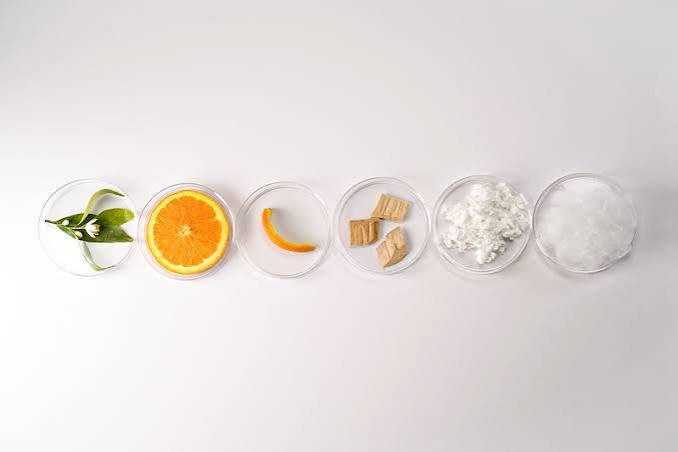
Orange Fiber is an Italian company that has developed a patented process to transform by-products from the citrus juice industry into regenerated cellulose fibres for fashion. The company uses chemical processing to extract cellulose from the collected orange peels, which is then dissolved, regenerated and spun into textile fibres. The resulting yarn can be woven or knitted into soft, silk-like fabrics that are biodegradable and suitable for high-quality fashion applications. By converting agricultural waste into a valuable textile raw material, Orange Fiber demonstrates how industrial by-products can be reintegrated into the value chain, reducing waste while creating new renewable feedstocks for the textile industry. In partnership with Lenzing, the company has also developed TENCEL™ Lyocell fibres containing cellulose derived from orange waste, further scaling this circular innovation.
5.4.3 From Brewing By-products to Material Alternatives
Similarly, Sabant (Croatia) collaborates with breweries and distilleries to collect spent barley malt and botanical residues from beer and gin production. Using a proprietary process, these by-products are transformed into durable plant-based leather alternatives suitable for footwear, bags, apparel and interior applications. By creating local partnerships with the beverage industry, Sabant demonstrates how industrial symbiosis can reduce waste while replacing fossil-based and animal-derived materials with renewable alternatives.