Chapter 4 — full chapter
| Site: | FashionKIC Learning Platform |
| Course: | Circular Design Strategies |
| Book: | Chapter 4 — full chapter |
| Printed by: | Guest user |
| Date: | Sunday, 1 November 2026, 3:19 AM |
Table of contents
- Chapter 4 — Regulation, Standards and Certification
- 4.1 Regulation as a Design Input
- 4.2 The EU Circular Textiles Framework
- 4.3 Product Information, Claims and Traceability
- 4.4 Voluntary Standards, Certifications and Other Assurance Tools
- 4.4.1 Technical Standards: Creating Comparable Evidence
- 4.4.2 Certifications, Labels and Assurance Schemes
- 4.4.3 Understanding the object of assurance
- 4.4.4 Chain of custody and product claims
- 4.4.5 Choosing an appropriate scheme
- 4.4.6 Case Example: G-Star RAW - Using a Product Standard as a Design Framework
- 4.5 Compliance Across Global Value Chains
Chapter 4 — Regulation, Standards and Certification

This chapter explains how regulation, technical standards, certification schemes, and other assurance tools influence circular fashion product development. The aim is not to turn learners into legal experts. It is to help them recognise which external requirements matter, distinguish between different types of instruments and translate them into practical decisions about materials, construction, sourcing, product information, environmental claims, market access and after-use responsibility.
The chapter focuses primarily on the European Union. It covers the EU Strategy for Sustainable and Circular Textiles, the Ecodesign for Sustainable Products Regulation (ESPR), Digital Product Passports (DPPs), the prohibition on destroying unsold apparel and footwear, textile Extended Producer Responsibility (EPR), consumer protection against greenwashing, fibre-composition labelling and chemical management. It also shows how voluntary standards and certifications can support evidence without replacing circular design or legal compliance.
Digital Product Passports are introduced only at readiness level. Learners who need detailed technical and implementation guidance should continue to FashionKIC's dedicated Digital Product Passport course.
Circularity is no longer only a voluntary ambition or a positioning choice. It is increasingly connected to product performance, product information, environmental claims, waste responsibility, chemical safety, supply-chain evidence, and access to markets. This changes the role of compliance in design. Instead of checking a finished product at the end, teams need to consider requirements while the product brief, bill of materials, supplier specifications, construction and evidence plan can still be changed.
For an SME, this does not mean memorising every legal act. It means building a reliable method: know the product, know where it will be sold, identify the applicable obligations, ask suppliers for the right evidence, control what is communicated, and keep records connected to the correct product version. This method also supports circularity. The same information that helps demonstrate compliance can enable care, repair, resale, sorting, and material recovery.
Regulation sets minimum obligations. Standards describe agreed methods or requirements. Certification or other independent assurance can verify a defined scope. None of these alone guarantees that a product is circular. Their value depends on what they cover, how evidence moves through the value chain and whether the underlying design and business model preserve product and material value.
In this chapter:
- 4.1 Regulation as a Design Input
- 4.2 The EU Circular Textiles Framework
- 4.3 Product Information, Claims and Traceability
- 4.4 Voluntary Standards, Certifications and Other Assurance Tools
- 4.5 Compliance Across Global Value Chains
4.1 Regulation as a Design Input
Regulation increasingly shapes what circular design means in practice. Requirements concerning durability, repairability, restricted substances, fibre composition, product information, claims and producer responsibility can all change the design brief. Treating them early can reduce redesign, testing delays, unsupported claims, blocked market access, and products that cannot enter viable recovery pathways.
The useful question is not simply “What does the law say?” but “What must the product team do differently?” A policy signal becomes operational only when it is translated into a product requirement, assigned to an owner and connected to evidence. For example, a requirement for reliable material information affects the bill of materials, supplier declarations, trim identification, data governance, and any future data carrier. A requirement linked to durability affects fabric testing, seam specifications, component selection, and quality control.
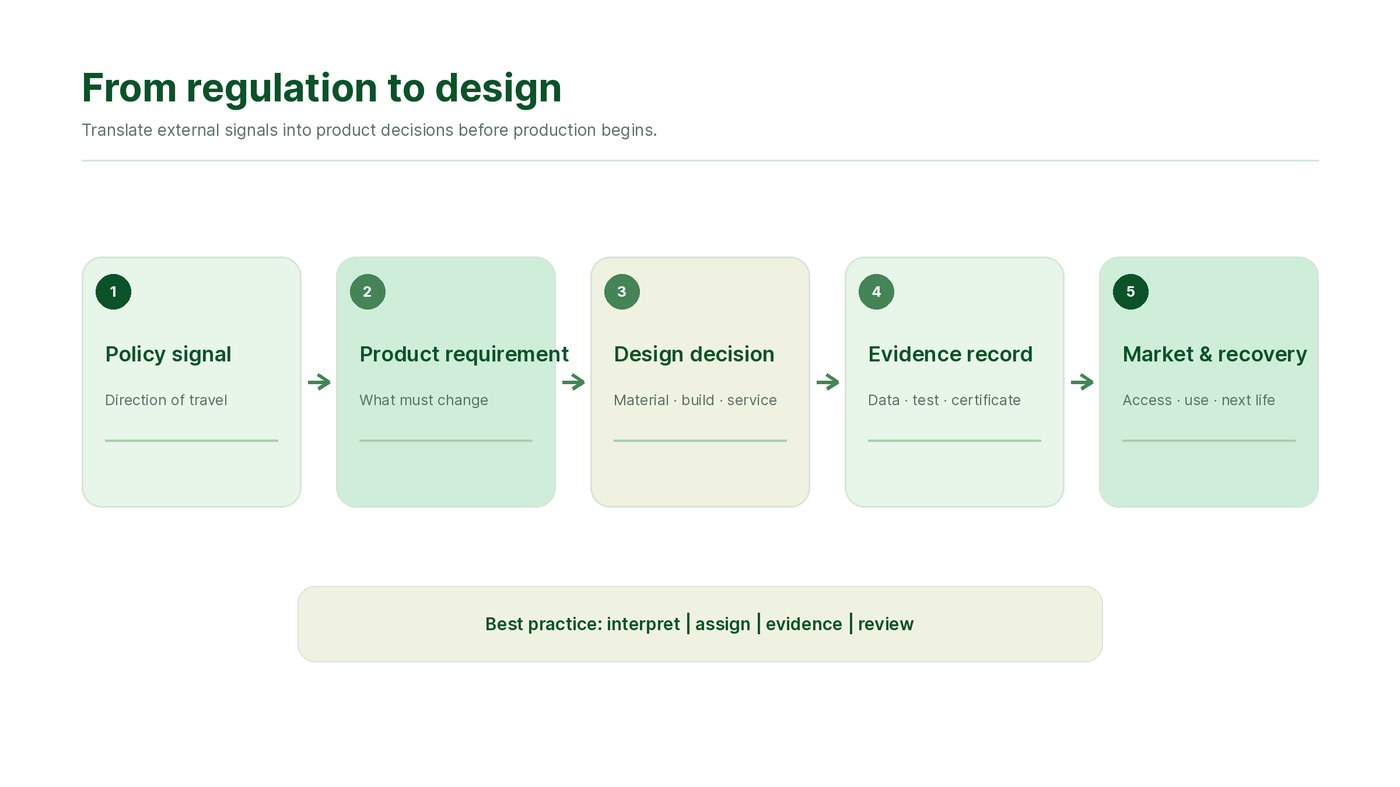
Figure X. From regulation to design. External requirements create value only when they are translated into product specifications, design decisions, evidence records and viable market or recovery outcomes.
4.1.1 Know What Kind of Instrument You Are Using
Fashion sustainability language often mixes instruments that do different jobs. Before using a requirement, logo or claim, identify what it is, who issued it, whether it is mandatory, what scope it covers, and how conformity is demonstrated.
Table 3.1. Different instruments, different functions
| Instrument | What it does | Practical question |
|---|---|---|
| Policy or strategy | Sets public direction and priorities but does not, by itself, create every product-level obligation described in the vision. | Which binding acts will implement it, and when? |
| EU regulation | Applies directly across EU Member States, although delegated or implementing acts may still be needed for specific requirements. | Does it apply to this product, company size, and date? |
| EU directive | Sets results Member States must achieve through national law, so implementation and enforcement need to be checked by market. | How has the destination country transposed it? |
| Technical standard | Provides agreed specifications, definitions, or test methods. It is usually voluntary unless legislation, a contract or a scheme makes it relevant. | Which version and test method apply? |
| Certification or verified label | Uses defined criteria and an assessment process to verify a product, material, facility, process or management system within a stated scope. | Exactly what is certified, by whom, and until when? |
| Membership, rating or improvement programme | Supports due diligence, benchmarking, tools or performance improvement but may not certify a product claim. | What evidence does participation actually provide? |
4.2 The EU Circular Textiles Framework
The EU Strategy for Sustainable and Circular Textiles establishes the direction of travel: textile products placed on the EU market should become more durable, repairable, recyclable, safer and increasingly made with recycled fibres, while producers take greater responsibility across the lifecycle. The strategy is a policy framework. Its ambitions become enforceable through separate legal instruments and product-specific measures.
The Ecodesign for Sustainable Products Regulation, in force since July 2024, creates a framework for product-specific ecodesign and information requirements. Textile apparel is a priority product group in the 2025-2030 ESPR Working Plan, but the detailed textile requirements still depend on a future delegated act. Teams should therefore prepare for likely performance and information needs without presenting draft criteria as current legal obligations.
Two parts of the ESPR are already especially visible to fashion businesses. First, from 19 July 2026 large enterprises are prohibited from destroying unsold apparel, clothing accessories and footwear, subject to defined derogations. Medium-sized enterprises enter the prohibition from July 2030; micro and small enterprises are exempt from the EU-level ban, although national rules may go further. Second, the EU Digital Product Passport Registry became operational on 20 July 2026. This provides the common indexing infrastructure, but it does not mean that final textile DPP content requirements are already mandatory.
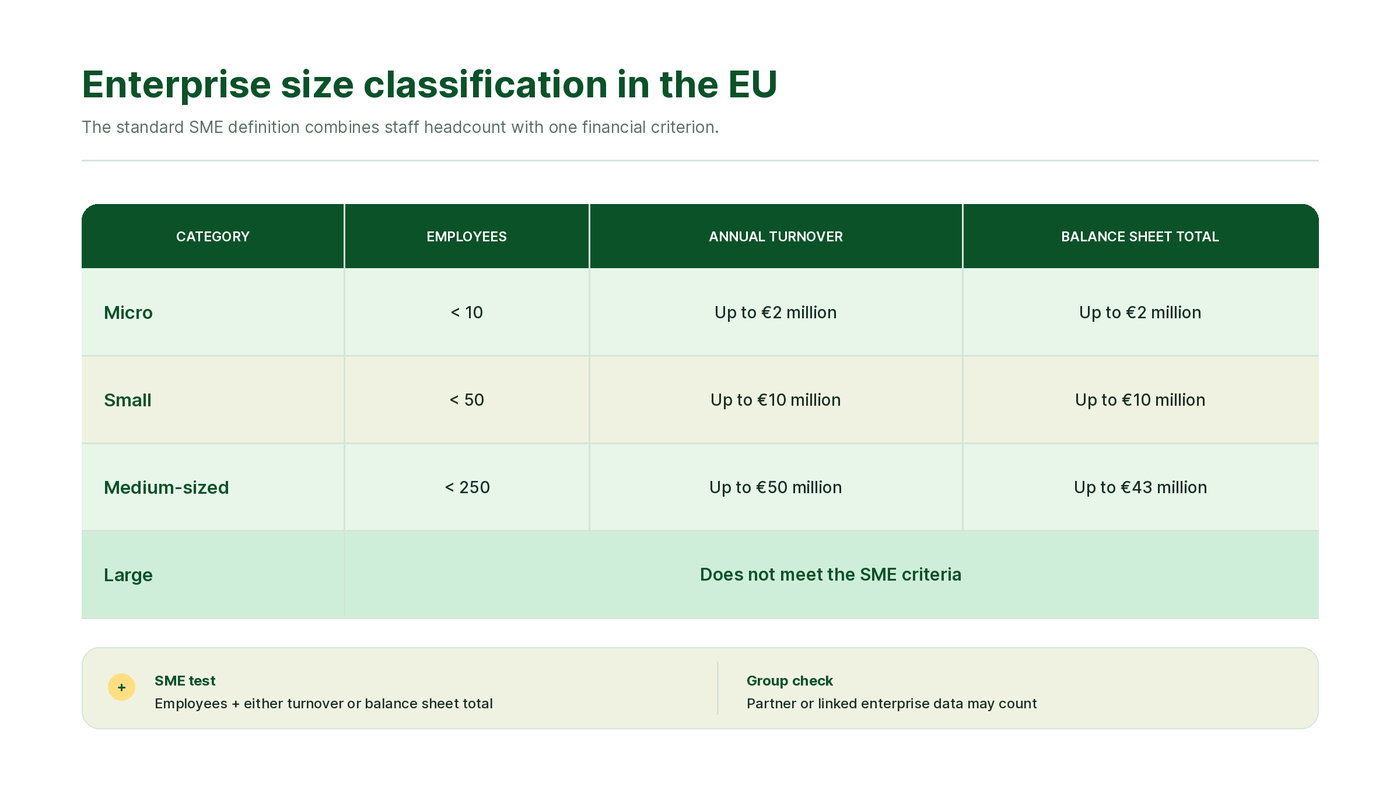
The 2025 amendment to the Waste Framework Directive requires Member States to establish EPR schemes for listed textile, textile-related and footwear products by 17 April 2028. Producers will finance defined collection and waste-management functions, and fees may be modulated using ecodesign criteria when the relevant ESPR measures exist. Separate collection of textiles has already been required in the EU since 1 January 2025. Together, these rules connect product decisions more directly to collection, sorting, reuse, and recycling costs.
Other requirements remain essential. Regulation (EU) No 1007/2011 governs textile fibre names and related composition labelling. REACH restricts hazardous substances and establishes chemical obligations relevant to materials, finishes, and articles. Directive (EU) 2024/825 strengthens consumer protection against greenwashing and early obsolescence practices; Member States must apply the transposed rules from 27 September 2026. It restricts, among other practices, unsupported generic environmental claims and sustainability labels that are not based on a certification scheme or established by public authorities.
The Omnibus package reduced the number of companies subject to mandatory corporate sustainability reporting and due-diligence requirements. However, it did not remove the product-level transition, affecting textiles. SMEs may be outside the scope of the CSRD or CSDDD while remaining subject to requirements concerning product design, chemicals, labelling, producer responsibility, environmental claims and, progressively, product data.
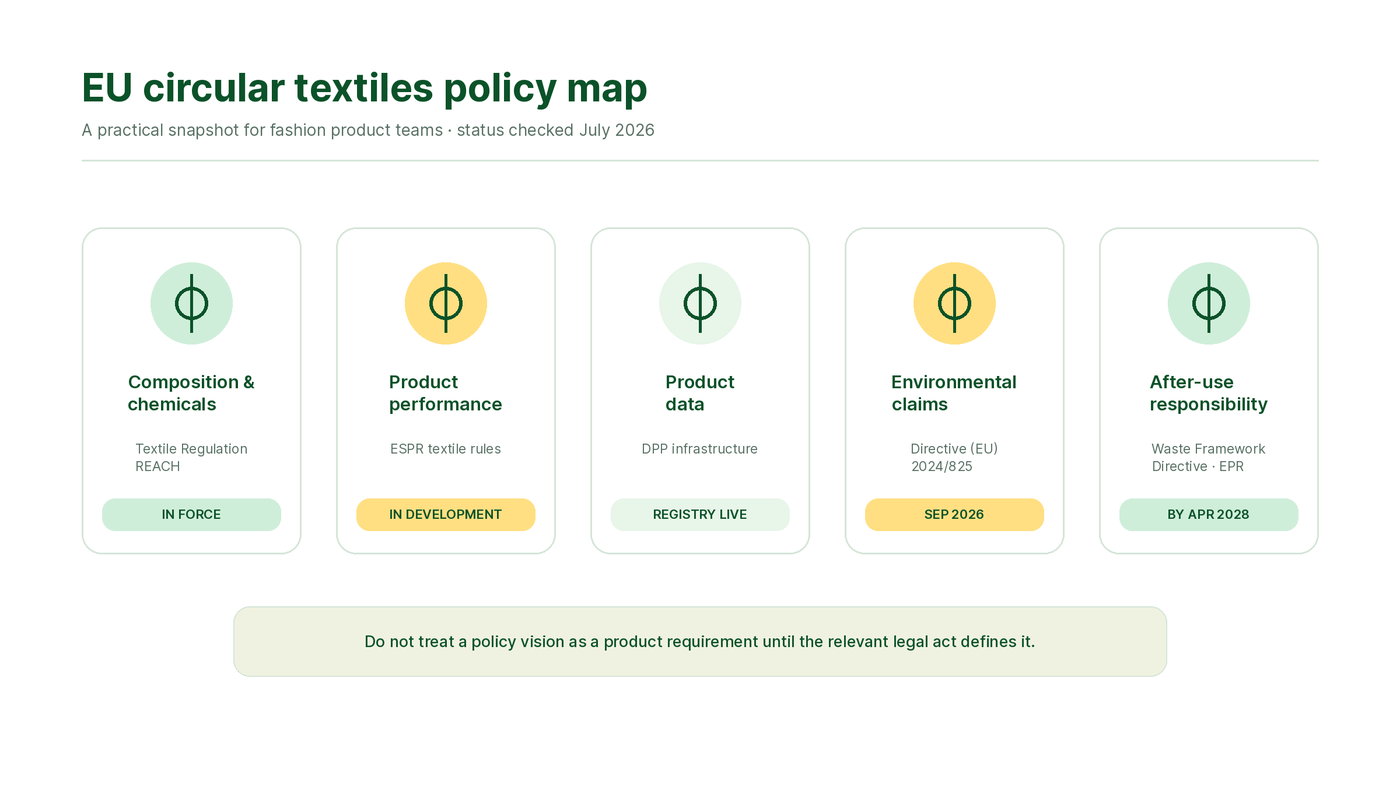
Figure X. EU circular textiles policy map. The regulatory landscape connects composition and chemical safety, emerging product-performance rules, product data, environmental claims, and after-use responsibility. Status checked July 2026.
Table 3.2. EU regulatory horizon for product teams
| Area | Current status (July 2026) | Design or business implication |
|---|---|---|
| Fibre composition and chemicals | Existing textile labeling and REACH obligations apply. | Maintain an accurate bill of materials; verify fibres, trims, finishes and restricted-substance evidence. |
| ESPR textile product rules | Framework is in force; textile-specific requirements are under development. | Build durability, repairability, material identification and data readiness into briefs now. |
| Unsold products | EU prohibition applies to large enterprises from 19 July 2026; medium enterprises from 2030. | Improve demand planning and prioritise resale, donation, reuse or other permitted value-retention routes. |
| Digital Product Passports | EU Registry is operational; textile content and application dates are not yet final. | Create structured, version-controlled product data and define data ownership before choosing technology. |
| Environmental claims | Directive (EU) 2024/825 applies through national law from 27 September 2026. | Replace vague claims with specific, evidenced, and clearly scoped statements. |
| Textile EPR | Member States must establish schemes by 17 April 2028. | Track markets, product volumes and design features that may affect fees and end-of-use routes. |
GFA RESOURCE: Policy Matrix: EU 2026 and Mapping of Global EPR for Textiles — Global Fashion Agenda, updated February 2026. GFA’s mapping tracks textile EPR schemes worldwide: in the EU, separate textile collection has been mandatory since 1 January 2025, and the revised Waste Framework Directive — in force since 16 October 2025 — requires EPR schemes in all Member States by 17 April 2028, with fees to be eco-modulated on ESPR design parameters. SMEs placing products on the EU market should plan now for EPR registration, reporting and eco-modulated fees that reward durable, recyclable, recycled-content design. Source: https://globalfashionagenda.org/wp-content/uploads/2023/06/GFA-Policy-Matrix-EU-2026.pdf.
RESOURCE INSIGHT: EU Ecodesign for Sustainable Products Regulation (ESPR) — European Commission, 2024. In force since 18 July 2024, the ESPR is the cornerstone of the EU's approach to sustainable and circular products. It introduces a Digital Product Passport, bans the destruction of unsold textiles and footwear, and will set delegated ecodesign requirements - durability, reparability, recyclability - for textiles and other priority product groups. Source: https://commission.europa.eu/energy-climate-change-environment/standards-tools-and-labels/products-labelling-rules-and-requirements/ecodesign-sustainable-products-regulation_en.
4.3 Product Information, Claims and Traceability
Circular systems depend on information that remains connected to the correct product. A product that cannot be reliably identified is harder to care for, repair, authenticate, resell, sort or recycle. Product data should therefore be treated as part of the product architecture rather than as marketing content added at launch.
A Digital Product Passport is not simply a QR code or a brand webpage. Under the ESPR architecture, it combines a persistent product identifier, a data carrier, structured information, defined access rights and registration in the EU Registry where required by the applicable legislation. Detailed data can remain decentralised under the responsibility of the economic operator. The exact textile data set and compliance timetable will be established through future product-specific rules.
SMEs do not need to wait for the final delegated act to improve readiness. A useful minimum product record can already connect the product identifier and version to the bill of materials, supplier and facility information, fibre composition, certificates and transaction documents, chemical or test evidence, care and repair guidance, recycled-content calculations, claims approval and intended recovery route. The record should distinguish verified facts from estimates and be updated when the specification changes.
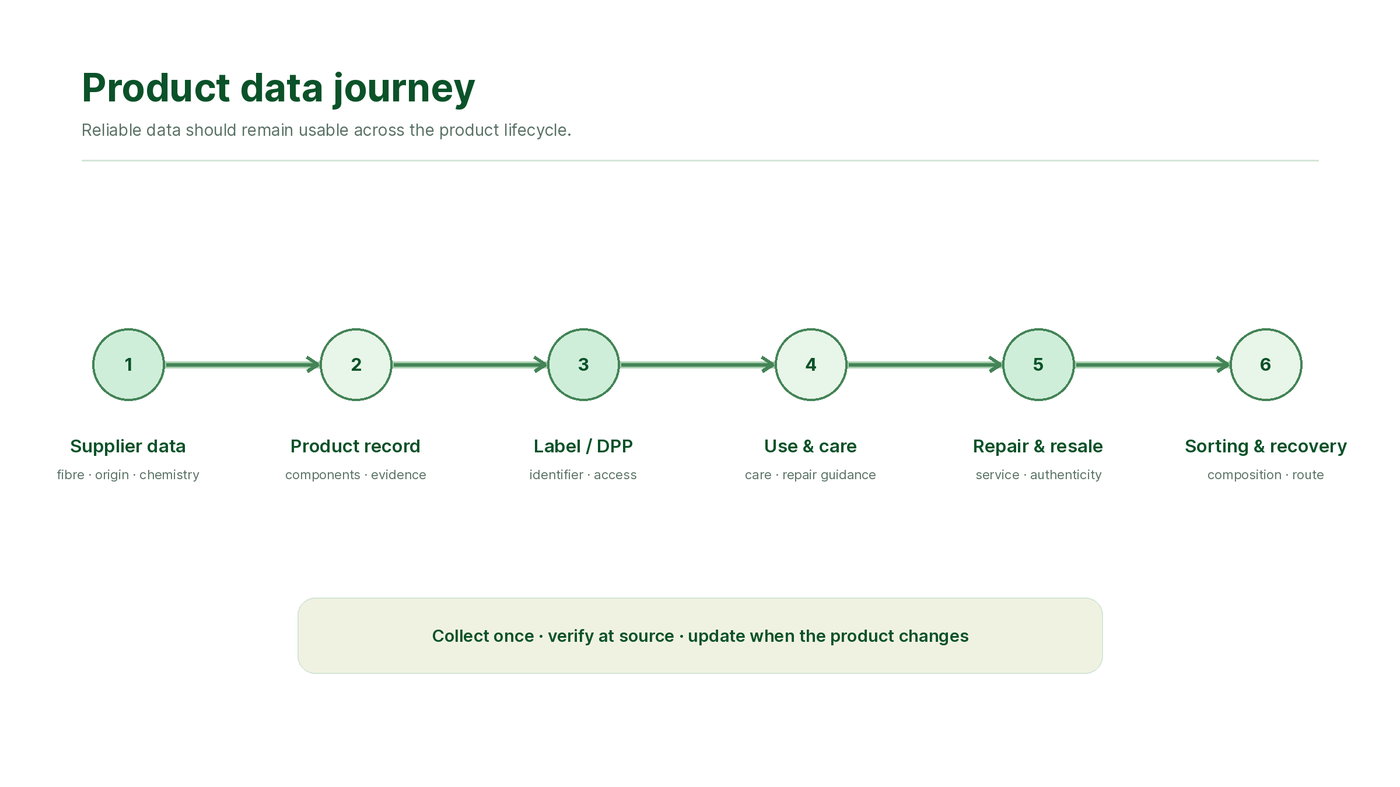
Figure X. Product data journey. Supplier evidence becomes more valuable when it is structured in a product record and remains accessible for use, repair, resale, sorting, and recovery.
RESOURCE INSIGHT: Navigating the Circular Economy Reporting Landscape — Ellen MacArthur Foundation, 2024. Measurement and reporting are essential to the circular transition: without data, businesses cannot prove the value of circular practices or direct policymakers to effective interventions. This paper maps the fast-evolving corporate reporting landscape - from EU disclosure rules to voluntary frameworks - to help companies choose indicators and stay ahead of regulatory developments.
Source:
Source: https://www.ellenmacarthurfoundation.org/navigating-the-circular-economy-reporting-landscape.
4.3.1 Case Example: Chloé Vertical - Digital Identity Linked to Resale
For its Spring/Summer 2023 Chloé Vertical initiative, Chloé introduced Digital IDs powered by EON on selected products. Customers could scan an item to access information tracing materials from source to finished product, together with care and repair information. Eligible products were also connected to an instant resale pathway through Vestiaire Collective.
The example is useful because the Digital ID was designed to support more than disclosure. It connected provenance, product identity, and a circular service. That made the data operational: the same identity that supported transparency could reduce friction in authentication and resale. It also required supplier collaboration before the product reached the customer.
However, a voluntary Digital ID pilot is not the same as regulatory compliance with a future textile DPP. The relevant lesson is readiness: define product identity, collect evidence at source, structure data, maintain it and connect it to services that preserve value.
| REFLECTION PROMPT Which information in your current product file could already support care, repair, resale or recovery - and which critical data is still held only by a supplier? |
|---|


Figure X. From sourcing strategy to product-level transparency at Chloé. After its 2021 environmental impact assessment identified raw materials as the Maison’s greatest impact area, Chloé developed annual sourcing guidelines to steer material selection and supplier practices. Its Digital ID carries traceability information forward, supporting authenticity, care, repair and facilitated resale. Sources: Chloé, Sustainability Strategy Guidelines for Sourcing 2025; Chloé Digital Passport & Circularity.
4.3.2 Claims Need an Evidence Chain
Claims should be specific enough to verify and narrow enough to remain true. “Contains 60% GRS-certified recycled polyester in the shell” identifies the material, percentage, scheme and component. “Circular jacket” does not explain which circular pathway exists, what part of the product is covered or what evidence supports the statement. A strong evidence chain connects the claim to the calculation or criterion, the supplier or assessor record, the product version and the approval owner.
- Specify the object of the claim: product, component, material, facility, service, or company.
- State the relevant threshold, percentage, geography, timeframe, or lifecycle boundary.
- Keep the evidence that supports the exact wording and product version.
- Check whether a logo or label may be used and whether the certificate is current.
- Explain limitations or conditions that could change the outcome, especially for recyclability and circularity claims.
4.4 Voluntary Standards, Certifications and Other Assurance Tools
Voluntary schemes can help companies verify organic or recycled content, chemical safety, process controls, environmental management, social performance, or chain of custody. Their usefulness depends on fit. A product-level harmful-substance test does not verify factory labour conditions. A certified environmental management system does not prove that every product has a low impact. A membership programme does not automatically certify a consumer claim.
Start with the evidence need, not with the most familiar logo. Then check scope, criteria, assurance model, chain-of-custody requirements, certificate holder, validity, transaction documentation and permitted claim wording. This avoids “certificate collecting” and helps SMEs focus resources on the risks and claims that matter most.
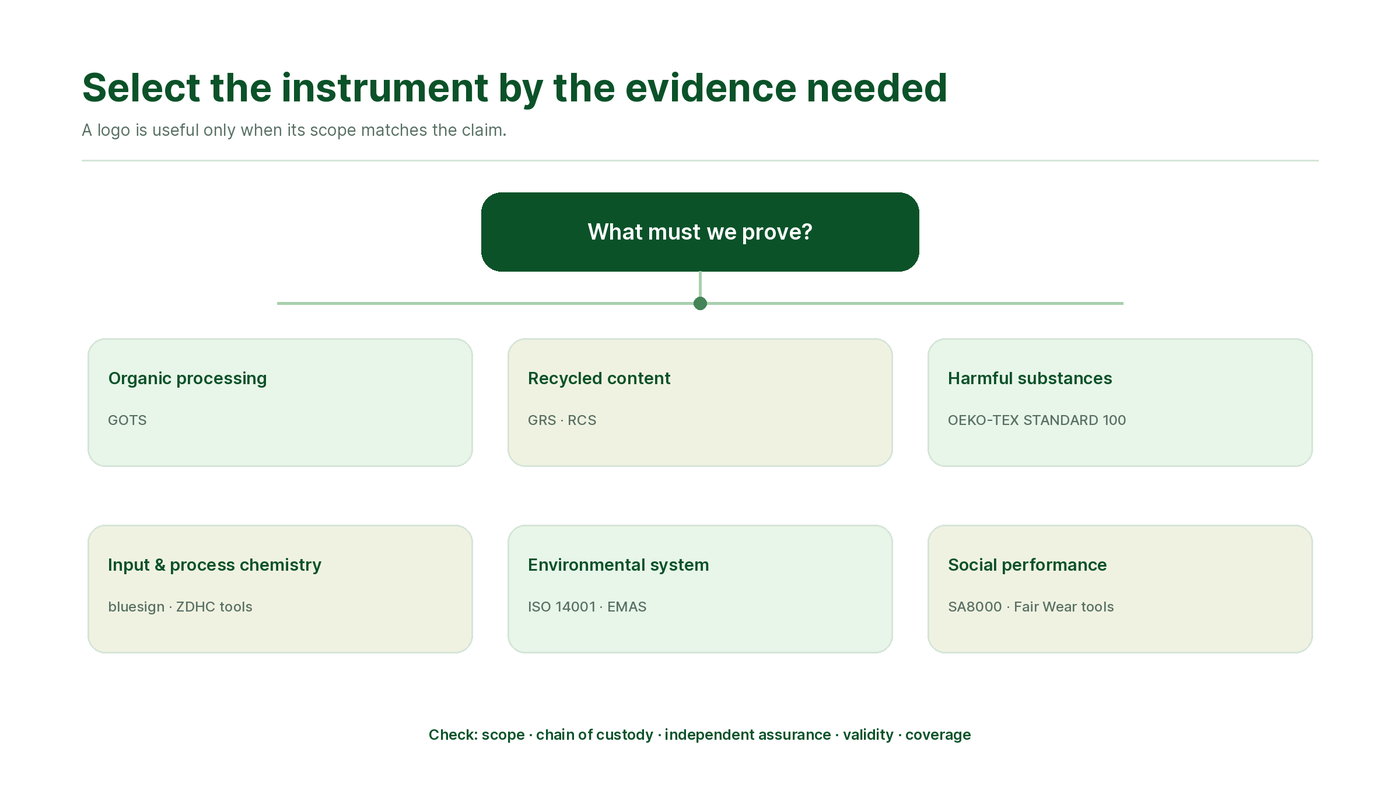
Figure X. Standards and assurance selection map. Select the instrument according to the question that needs evidence, then verify its scope, chain of custody, assurance process, validity, and coverage.
CASE STUDY: Vathos Apparel — Greece. Topic: Traceability & Certifications. Vathos Apparel is a Greek apparel producer certified under GOTS and OEKO-TEX, showing how voluntary standards and certifications translate into verifiable, lower-impact production. Its certification stack is a practical example of the assurance tools in this section — evidence an SME can use to substantiate sustainability claims.
4.4.1 Technical Standards: Creating Comparable Evidence
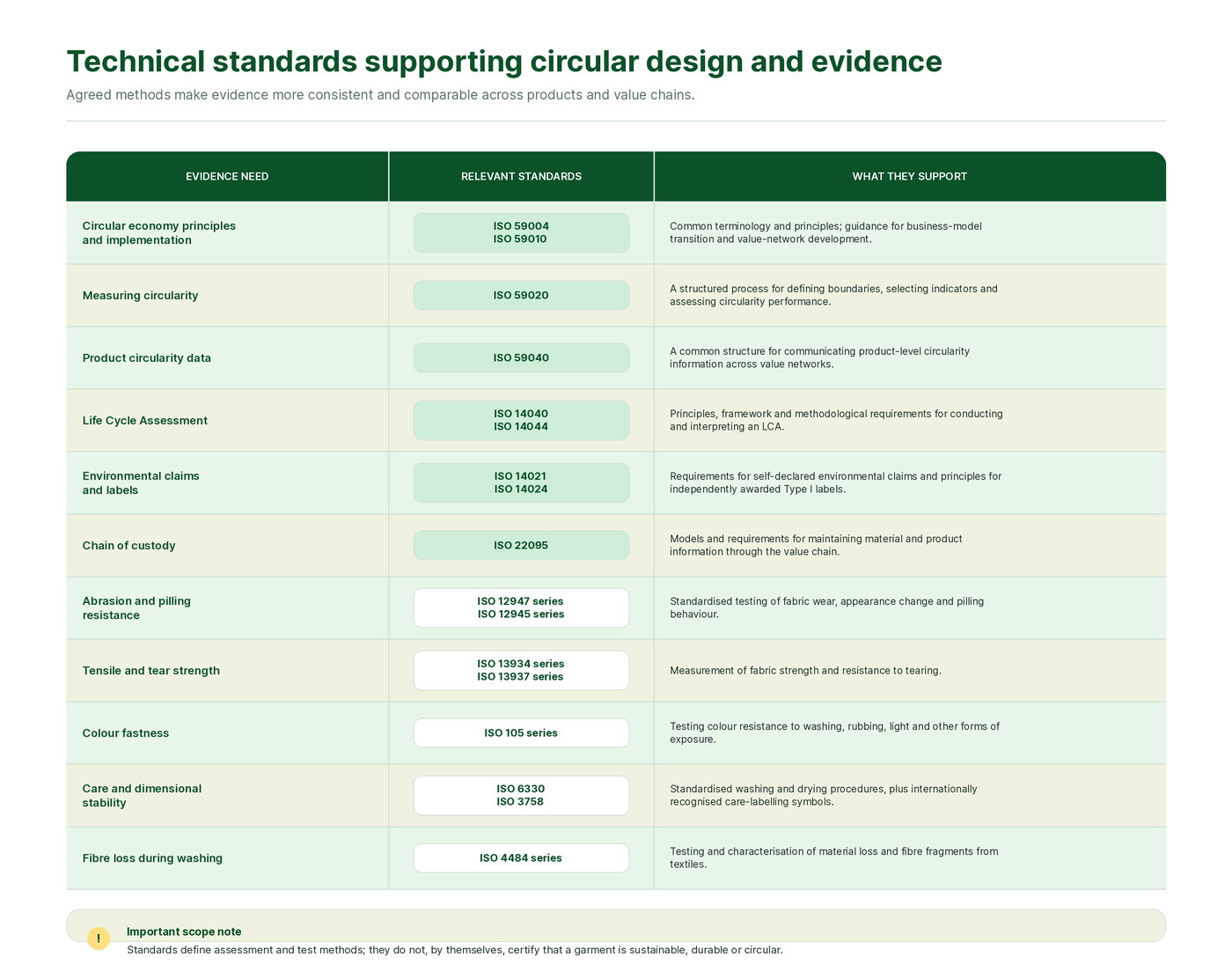
Technical standards provide agreed terminology, methods, test conditions, and measurement principles. Unlike certification schemes, they do not necessarily result in a consumer-facing label. Their role is to make evidence more consistent and comparable across designers, suppliers, laboratories, brands, and markets.
In circular fashion, standards can support different levels of decision-making. Some provide organisation-level guidance for implementing and measuring circularity. Others establish methods for Life Cycle Assessment, environmental claims and chain of custody. Textile-specific test standards can assess characteristics such as abrasion resistance, pilling, tensile and tear strength, colour fastness, dimensional stability, and fibre loss during washing.
These methods are particularly important because terms such as “durable”, “low-impact”, “recyclable” or “reduced fibre shedding” require more than an intention or material description. They require a defined test or assessment method, appropriate performance criteria, and evidence connected to the correct product.
A standard provides the method; it does not automatically determine whether the result is good enough. Companies must still define performance requirements appropriate to the product, intended use, and market. Standards are generally voluntary, but they may become contractually required or support compliance with legislation and future product-specific ecodesign requirements.
Table 3.3. Examples of standards and assurance tools
4.4.2 Certifications, Labels and Assurance Schemes
Certifications, labels, and other assurance schemes can help companies demonstrate that a defined material, product, facility, process, or management system meets specified criteria. They may support sourcing decisions, supplier requirements, business-to-business evidence, and consumer communication.
However, these terms should not be used interchangeably:
- Certification is formal assurance that a defined object meets the requirements of a standard or scheme. Certification is usually conducted by an independent certification body.
- A label is a communication tool displayed on a product, packaging, or digital interface. It may communicate a certified result, but the presence of a label does not mean that every aspect of the product has been assessed.
- An assurance scheme is a broader system that may combine criteria, audits, testing, chain of custody, documentation, reporting, and verification.
- A membership or improvement programme supports organisations in managing risks and improving practices but does not necessarily certify a product or company.
- A rating or performance assessment evaluates performance against defined indicators. It should not automatically be described as certification.
This distinction matters because schemes answer different questions. A recycled-content certification does not demonstrate safe chemistry. A harmful-substance test does not verify labour conditions. A factory audit does not prove that every product made at that facility is sustainable. Similarly, company membership in an improvement programme cannot be transferred into a product-level claim.
4.4.3 Understanding the object of assurance
Before selecting or interpreting a scheme, companies should identify exactly what is being assessed:
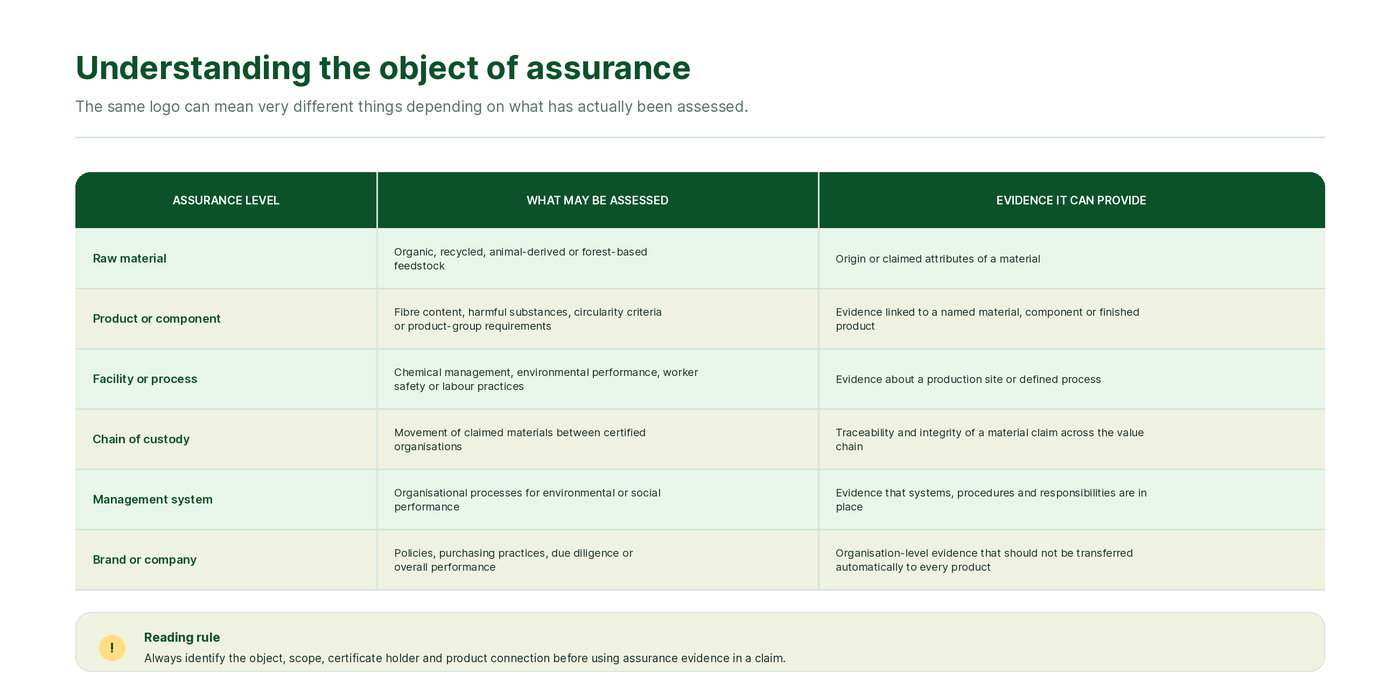
Figure X. Understanding the object of assurance: what different assurance levels assess and the evidence they can provide.
4.4.4 Chain of custody and product claims
Material certifications often depend on a chain-of-custody system. This records how a claimed material moves through processing, manufacturing, and trade. If an uncertified operator enters the chain, or if the required documentation is missing, the final product may no longer be eligible for the certification claim.
A scope certificate normally demonstrates that an organisation is approved to handle specified materials, processes or product categories. It does not necessarily prove that every product or shipment sold by that organisation is certified. Depending on the scheme, transaction certificates, traceability records or other product-specific documentation may also be required.
Brands should therefore verify:
- the certificate holder and certification body;
- certificate number, validity and current status;
- activities, materials and product categories included in the scope;
- chain-of-custody coverage;
- documentation connecting the evidence to the actual order or product;
- minimum content thresholds;
- permitted claim wording and logo use;
- the proportion of the collection or assortment covered.
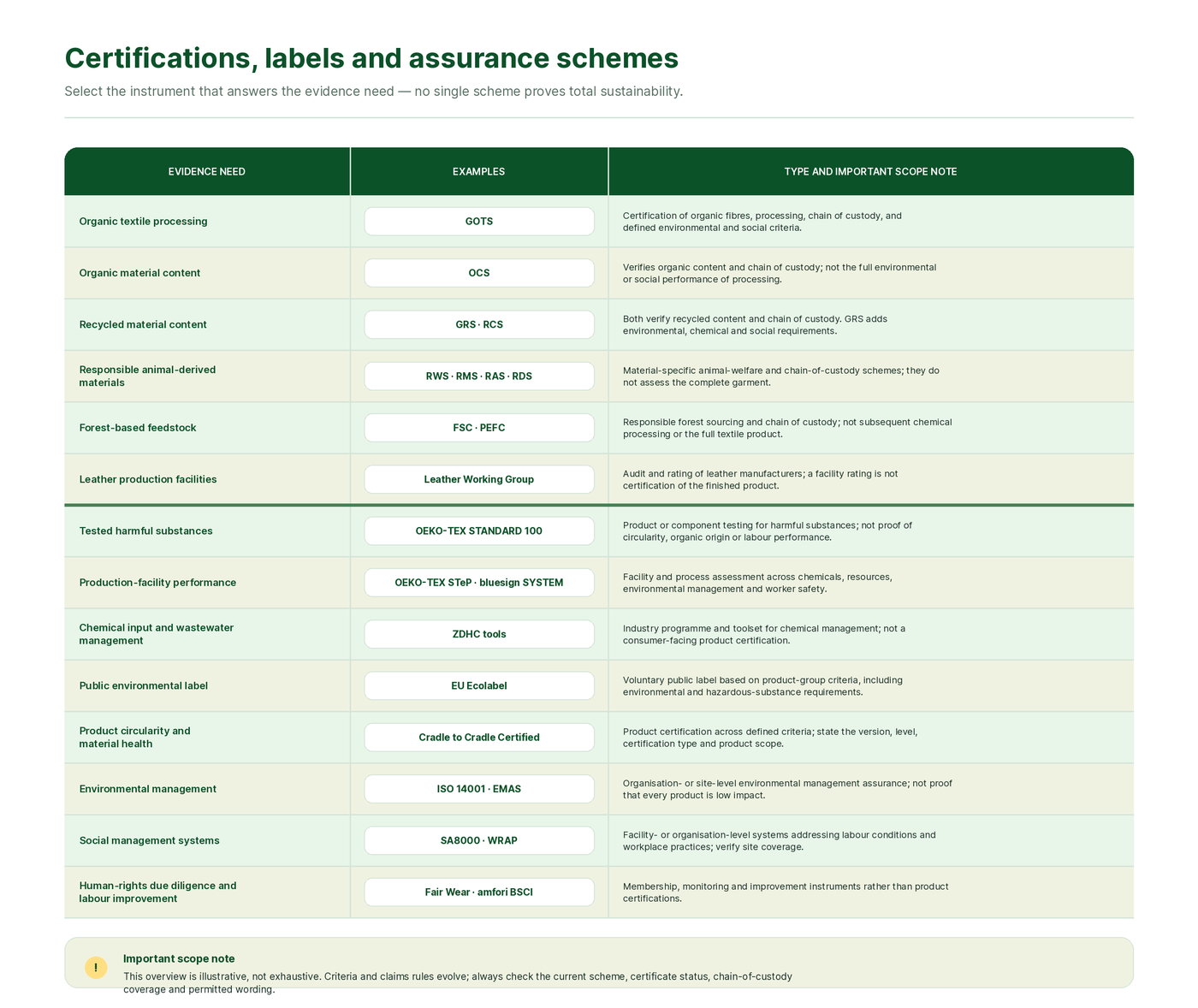
Figure X. Certifications, labels and assurance schemes mapped to different evidence needs and scope of assessment.
4.4.5 Choosing an appropriate scheme
The most recognised logo is not necessarily the most relevant instrument. Selection should begin with the risk, decision, or claim that requires evidence.
A company should ask:
- What needs to be demonstrated? Organic origin, recycled content, safe chemistry, durability, labour conditions, facility management or product circularity?
- What is the object of assurance? A fibre, component, product, facility, supply chain, management system or company?
- How much of the value chain is covered? Does the scheme include physical chain of custody, transaction verification or only an assessment at one stage?
- Who performs the verification? Is assurance independent, accredited and based on defined evidence?
- What claim is permitted? Certification does not automatically authorise any wording or logo placement chosen by the brand.
- How much of the assortment is covered? A certified capsule, supplier, or material should not be presented as evidence for the entire business.
For SMEs, certification costs and supplier access can be significant constraints. It may be more effective to prioritise the schemes linked to the company’s most material risks, customer requirements and product claims rather than attempting to collect multiple certificates without a clear evidence strategy.
Key principle: certification can strengthen evidence, but it does not replace legal compliance, supplier due diligence, product testing or transparent communication about limitations.
The distinction is supported by the current guidance from GOTS, Textile Exchange, OEKO-TEX, ZDHC, EU Ecolabel, Fair Wear and Cradle to Cradle Certified
Try it now
open EUR-Lex and locate Regulation (EU) No 1007/2011 (fibre names and composition labelling) and the ESPR (EU) 2024/1781. For each, note the entry-into-force date and whether it applies to your product and company size. Then pick one certificate you currently use (GOTS, GRS, RCS, OEKO-TEX, Cradle to Cradle) and write down exactly what it proves — object, scope, certificate holder, validity — using the checklist in section 4.4.4.
RESOURCE INSIGHT: Circular Design Standard (CDS) — circular.fashion, version 6.0. An industry-developed framework built over five years, the CDS turns circularity into product- and material-specific criteria across four pillars: circular inputs, design for recyclability, design for longevity, and enabling circulation. It offers certification for apparel and positions itself as a pathway beyond compliance, aligned with ESPR and EPR eco-modulation requirements. Source: https://circular.fashion/en/circular_standard/index.html.
4.4.6 Case Example: G-Star RAW - Using a Product Standard as a Design Framework
G-Star RAW worked with denim mill Artistic Milliners, dye producer DyStar, manufacturer Saitex and an accredited assessor to develop Cradle to Cradle Certified Gold denim. The collaboration began at material and chemistry level and expanded to finished denim garments. According to the Cradle-to-Cradle Products Innovation Institute, the work achieved Gold certification with particularly strong performance in material health and water stewardship.
The value of the case is not the badge alone. The certification criteria created a shared development framework across brand, mill, chemistry provider, manufacturer, and assessor. This helped translate high-level circularity intentions into material formulations, process controls, supplier evidence, and product-level verification. It also shows why ambitious certification work often requires value-chain collaboration that an individual design team cannot provide alone.
The critical reading remains important: certification applies to the named products, criteria, version, and level. It should not be expanded into a claim that every G-Star product, impact area, or business practice is circular.

Figure X. G-Star RAW’s Cradle to Cradle denim. Campaign imagery illustrating how the brand uses the Cradle-to-Cradle Certified® standard as a framework for developing denim fabrics across material health, product circularity, clean chemistry, water stewardship and social fairness. Source: G-Star RAW, 2024.
4.5 Compliance Across Global Value Chains
Fashion products often combine design in one country, materials from several others, assembly elsewhere and sales across multiple markets. Compliance therefore has three interacting layers: the law where production occurs, the requirements of each destination market, and contractual or voluntary requirements imposed by customers, retailers or certification schemes.
SMEs frequently depend on suppliers for declarations, certificates, test reports, transaction documents, and facility information. That dependence makes supplier collaboration essential, but it does not remove the brand or importer's responsibilities. Requirements should be written into specifications and purchase agreements, evidence should be checked before claims are approved, and records should be linked to the correct style, colour, batch or production period.
A practical compliance chain starts with the product-market brief. It converts legal and voluntary requirements into supplier instructions, identifies acceptable evidence, and assigns internal owners. Production evidence then enters a controlled product record that supports labelling, market access, and claims. Information from returns, complaints, repairs, and recovery should feed back into the next design brief.
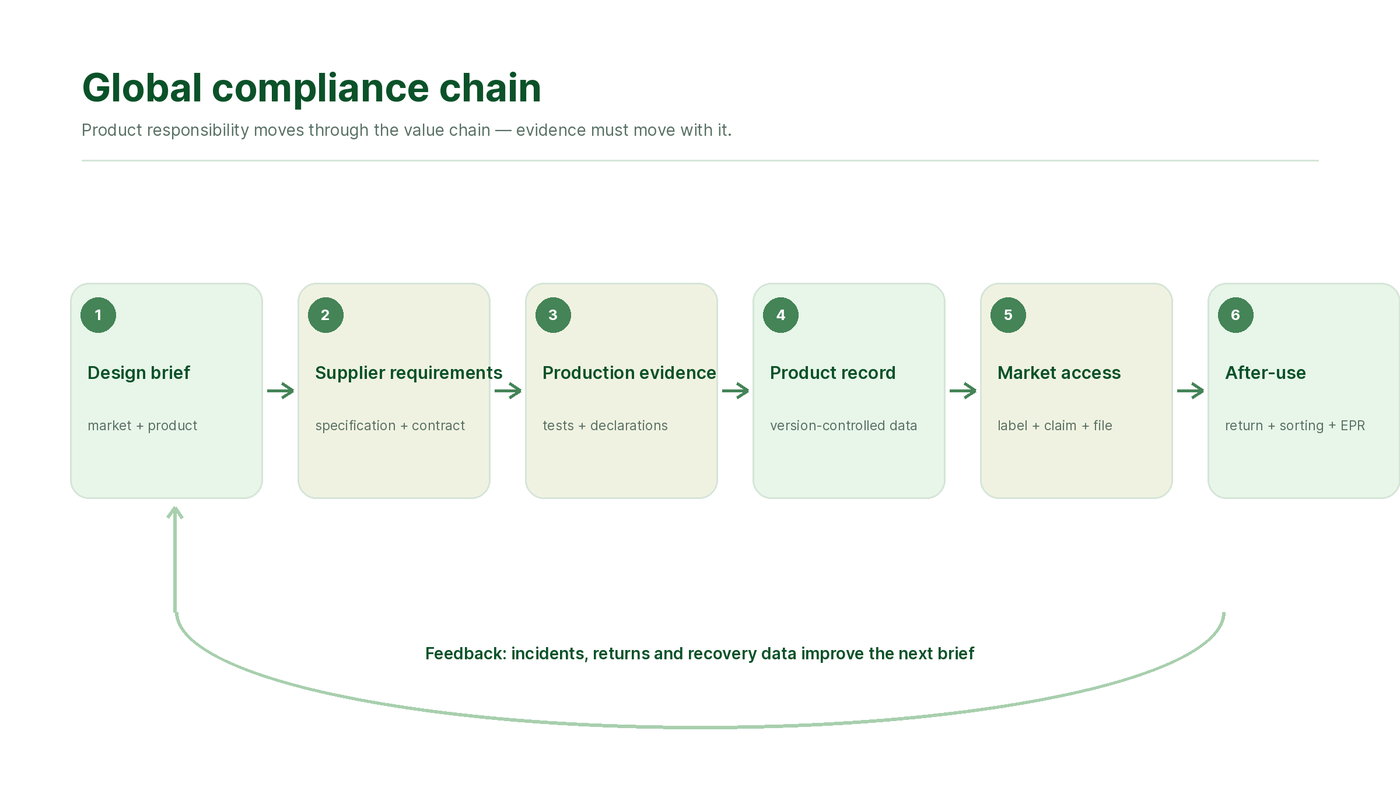
Figure X. Global compliance chain. Requirements and evidence must remain connected from the design brief and supplier specification to production, market access and after-use responsibility, with feedback informing the next product.
Table 3.4. Minimum supplier evidence controls
| Evidence item | Ask the supplier | Internal control |
|---|---|---|
| Bill of materials | Full fibre and component composition, including trims, coatings and finishes. | Approve one controlled version and record every specification change. |
| Chemical compliance | Current declarations, test reports and applicable restricted-substance evidence. | Check market, product and date scope; escalate gaps before production. |
| Certification | Certificate number, holder, scope, site, validity and transaction documents where required. | Verify the certificate with the scheme or certification body and control logo use. |
| Social or facility evidence | Site identity, subcontractors, audit or programme records and corrective actions. | Assess risk and remediation, not only the presence of an audit. |
| Claims evidence | Source records and calculation method for content, origin, or impact data. | Match evidence to exact wording, product version and approval owner. |
| DPP-ready data | Structured identifiers and data that can be maintained, shared, and updated. | Define data owner, access rights, retention and change process. Define data owner, access rights, retention and change process. FOR YOUR SME / BUSINESS CASE (added): build the minimum product record for one hero product in about 2 hours: product ID + version, bill of materials, fibre composition, supplier and facility, certificates with validity dates, test reports, care/repair information and the intended recovery route. Cost example: a missing supplier declaration can block an environmental claim and force re-testing at €300–1,500 per test; a complete version-controlled record avoids repeat audits and prepares you for DPP and EPR data requests. |
4.5.1 Case example: ARMEDANGELS - Building an Evidence Stack
ARMEDANGELS provides a useful European example of why one certification is rarely enough. The company uses different schemes for different material questions and combines them with supplier management, chain-of-custody systems, and social due diligence. Its 2025 Impact Report identifies a portfolio including GOTS, GRS, RCS, OCS and animal-fibre standards, with annual certification work conducted through Control Union. It also reports membership of Fair Wear and the use of TextileGenesis to support material traceability.
The standards are selected according to the claim and material. GOTS supports organic textile processing and defined environmental and social criteria. GRS and RCS support recycled-content verification and chain of custody, with different criteria and thresholds. Fair Wear supports the company's approach to labour-risk management and remediation but is not presented as a product certificate. TextileGenesis supports traceability infrastructure rather than replacing independent certification.
A particularly strong feature is disclosure of coverage rather than an undefined statement that all products are certified. For 2025, ARMEDANGELS reported that 51.3% of products were GOTS certified, 13% were GRS certified, and 1.72% were RCS Blended certified. Coverage figures make the scope visible and reduce the risk that evidence from one product group is generalised to the entire assortment.
The case also shows the limits of a standards portfolio. Certificates can verify defined inputs, processes or systems, but they do not decide whether the brand produces too much, whether a garment remains desirable, whether repair is accessible or whether a viable recovery pathway exists. Those questions still require circular design, business-model choices, due diligence, and transparent performance management.
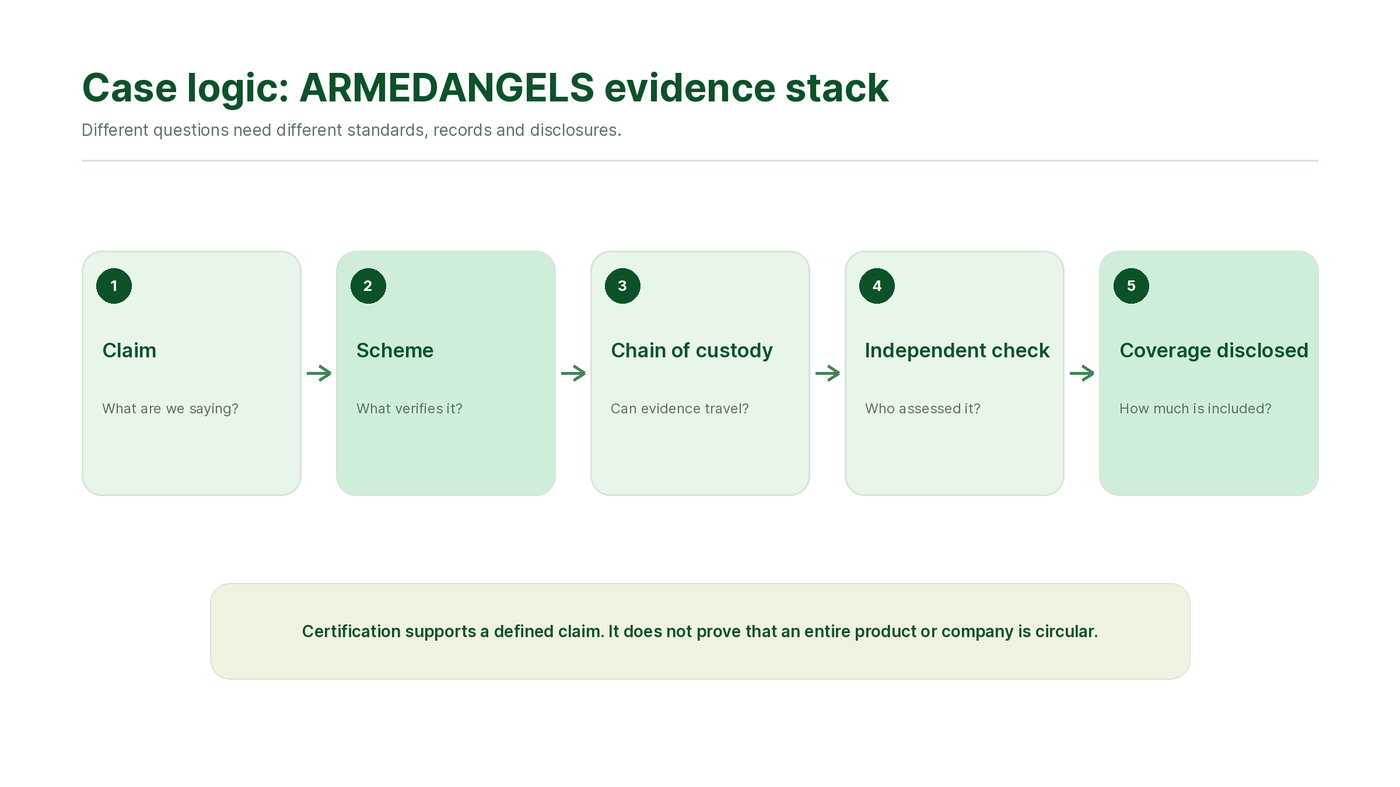
Figure X. ARMEDANGELS evidence stack. Credible communication connects a defined claim to an appropriate scheme, chain-of-custody records, independent assessment, and transparent disclosure of coverage.
Case Study Lessons
- Use different schemes for different evidence needs; do not expect one logo to verify every impact area.
- Maintain chain-of-custody and transaction evidence, so material claims remain connected to the final product.
- Distinguish certification, membership, traceability technology and due-diligence processes.
- Disclose the share of the assortment covered instead of implying universal certification.
- Treat standards as an evidence layer within circular strategy, not as the circular strategy itself.
| CRITICAL REFLECTION Would a customer understand exactly which ARMEDANGELS products, materials and impact areas are covered by each scheme? How could the same scope discipline improve claims made by another brand? |
|---|
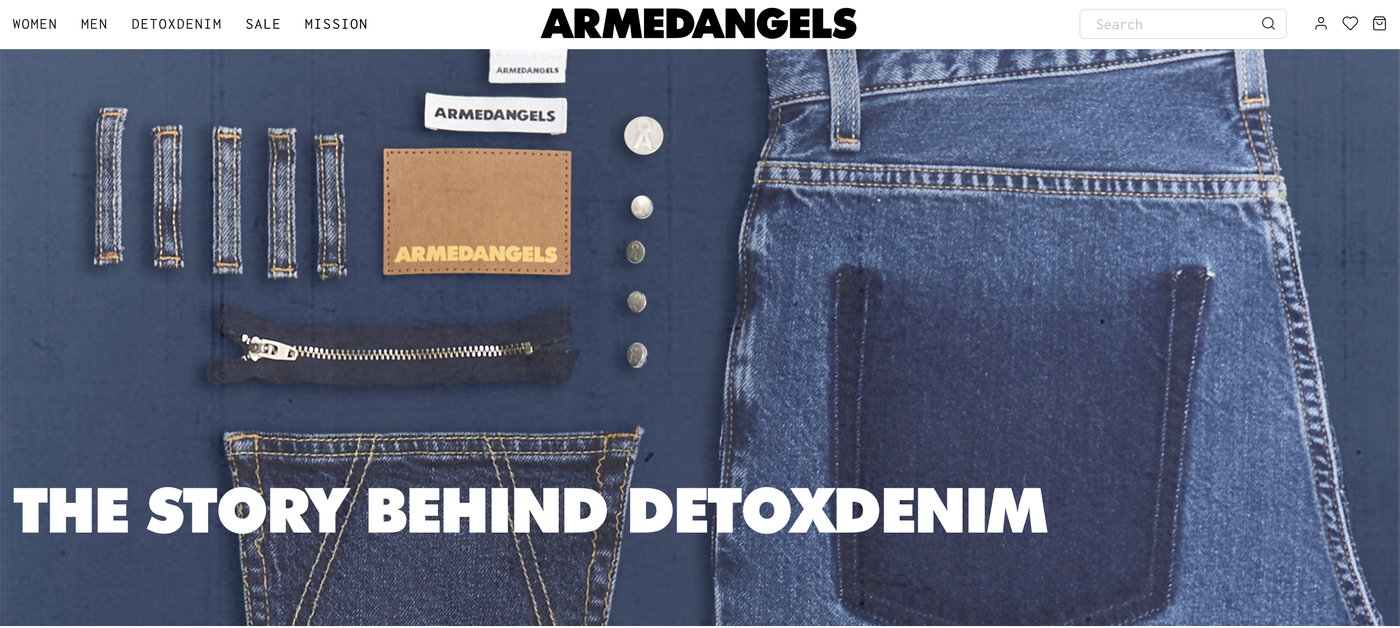
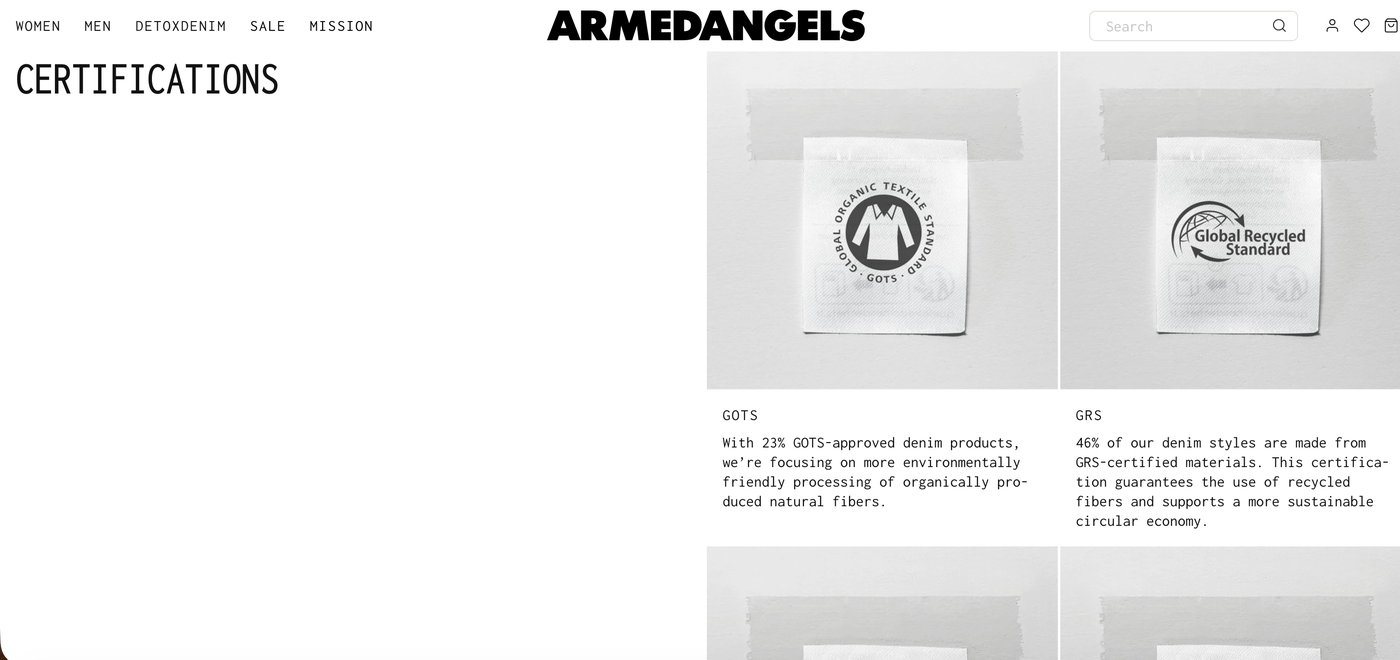
Image X. ARMEDANGELS’ DetoxDenim approach and certification framework, highlighting the use of standards such as GOTS and GRS to support lower-impact denim production and recycled material claims.