Chapter 5 — full chapter
| Site: | FashionKIC Learning Platform |
| Course: | Digital Product Passports |
| Book: | Chapter 5 — full chapter |
| Printed by: | Guest user |
| Date: | Sunday, 1 November 2026, 3:20 AM |
Table of contents
- Chapter 5 — Technologies and Standards
- 5.1 GS1
- 5.1.1 GS1 identification standards (GTIN) as the common language for unique product identifiers
- 5.1.2 GS1 Digital Link: connecting a physical item to online data
- 5.1.3 How a shared, global identifier system supports interoperability across brands, retailers and recyclers
- 5.1.4 Practical adoption path for SMEs
Chapter 5 — Technologies and Standards
Guiding question : Which building blocks — QR, RFID, GS1 Digital Link, interoperable formats — turn a passport from a label into a working product language?
This chapter introduces the technologies and standards that turn a Digital Product Passport from a data requirement into a working system: identification standards such as GS1, data carriers such as QR codes and RFID, the interoperability needed to connect them across the value chain, and the digital infrastructure that hosts and serves DPP data. It also equips learners to distinguish standards that are already established from technologies still under development.
Learning objective
Learners will be able to understand and evaluate the role of technologies and standards, such as GS1, QR codes, RFID, and interoperability frameworks, in supporting Digital Product Passport implementation.
In this chapter:
- 5.1 GS1
5.1 GS1
Chapter 3 treated a data requirement as incomplete until it was linked to the physical carrier that would deliver it (section 3.1.2). GS1 is where that link is made concrete: it is the identification system that underpins the vast majority of product barcodes already in circulation, and it is the foundation on which the QR codes, RFID tags and resolvers discussed later in this chapter are all built. Understanding GS1 first makes the rest of the chapter easier to follow, because QR and RFID are best understood as two different physical ways of carrying the same underlying GS1 identifier.
5.1.1 GS1 identification standards (GTIN) as the common language for unique product identifiers
The Global Trade Item Number (GTIN) is GS1’s core identifier: a unique number assigned to a specific product that is recognised, read and understood consistently across brands, retailers, logistics providers and, increasingly, recyclers. GS1 standards already underpin the vast majority of product barcodes in circulation in Europe, which means that for most SMEs already selling into retail, the identification infrastructure a DPP needs is not something to build from scratch. It very likely already exists on the product in the form of an existing barcode. The GTIN itself conforms to the international identification standard ISO/IEC 15459, and GS1 Digital Link to ISO/IEC 18975, which is part of why regulators keep converging on GS1 as the practical foundation for the DPP rather than inventing a parallel system; GS1’s own members are migrating toward 2D barcodes as the default by 2027, an industry initiative known as “Sunrise 2027” that lines up closely with the ESPR’s own textile timeline.
5.1.2 GS1 Digital Link: connecting a physical item to online data
GS1 Digital Link extends a GTIN from a number that identifies a product to a web address that resolves to information about it. In practice, a 2D barcode, typically a QR code or a data matrix, is encoded with a GS1 Digital Link: a structured web URL with the product’s GTIN embedded in it, and optionally additional identifiers such as a batch, lot, or serial number appended for finer granularity. Scanning the code does not just identify the product; it opens a live web resource, which is what allows a single GS1 Digital Link to serve care instructions to a consumer, compliance documentation to a regulator, and material specifications to a recycler, all from the same physical code.
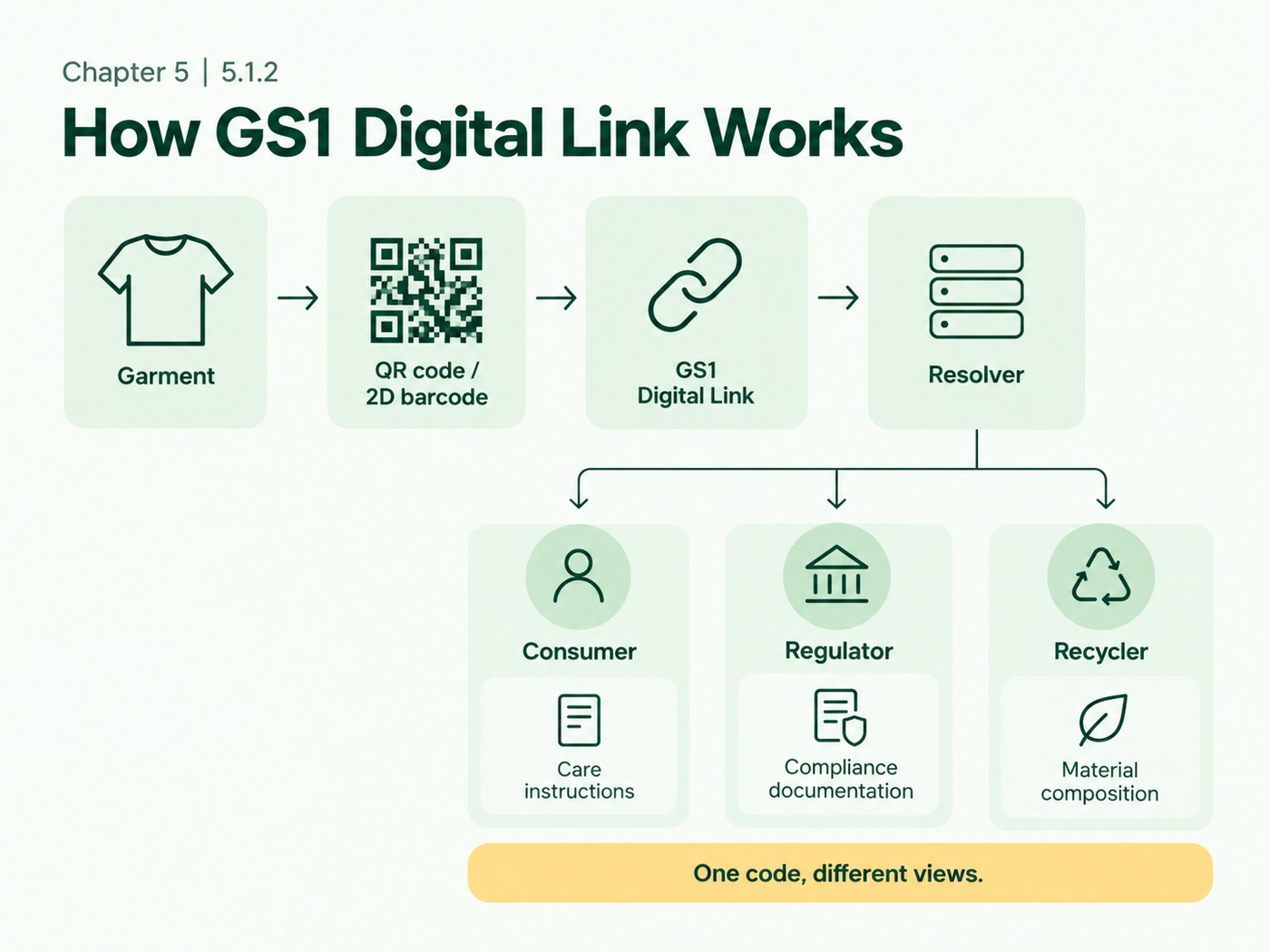
The mechanism that makes this possible is the resolver, introduced briefly in Chapter 3. A resolver does not store product information itself; it is a routing layer that redirects a scan to the correct source, based on who is asking and what they are asking for. This is what allows a brand to update or add information sources over time (a new sustainability report, a seasonal promotion, a revised care guide) without reprinting a single label, since the code encodes the identifier, not a fixed destination.
5.1.3 How a shared, global identifier system supports interoperability across brands, retailers and recyclers
A proprietary, brand-specific identifier only ever means something to the brand that created it. A GTIN, by contrast, is designed to be read the same way by any GS1-connected system anywhere in the world, which is precisely the interoperability problem raised in the context of data governance (section 3.4.3): actors across a value chain cannot share data meaningfully unless they are identifying the same product the same way. GS1’s global reach is what allows a Portuguese manufacturer, a German retailer and a Dutch recycler to all resolve the same identifier to the same underlying record, without a bespoke integration between each pair of parties.
5.1.4 Practical adoption path for SMEs
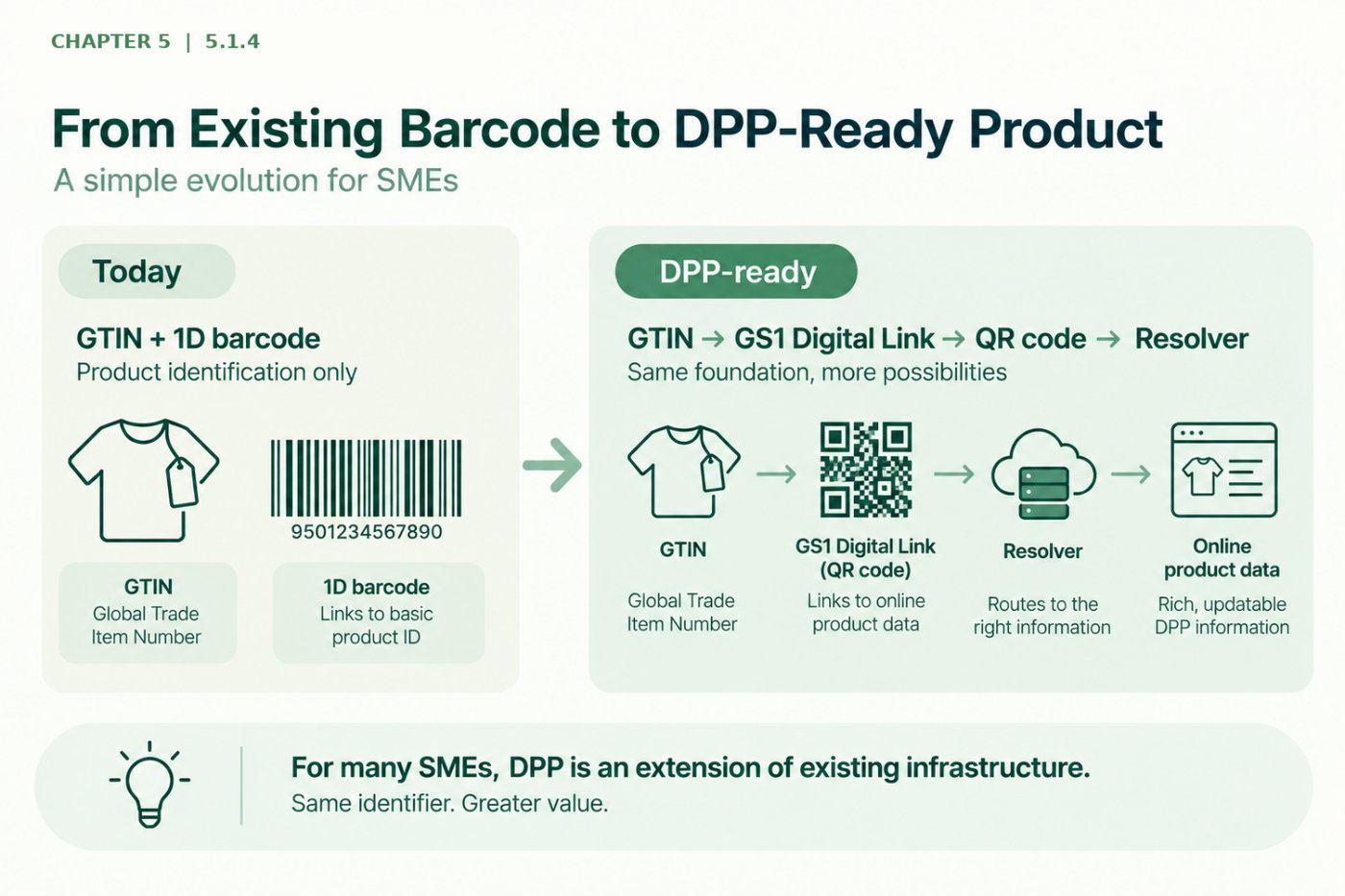
For an SME, the practical starting point is rarely a blank page. Because GS1 identification standards are already used by the great majority of brands and retailers in Europe, most SMEs selling into retail already hold GTINs for their products. The DPP-specific step is not acquiring new identifiers but extending existing ones through GS1 Digital Link — encoding the GTIN into a 2D barcode connected to a resolver, rather than a conventional 1D barcode that only identifies the product without connecting to any online record. This makes GS1 adoption for DPP purposes an extension of infrastructure most SMEs already have, not a parallel system to build.