Chapter 4 — full chapter
| Site: | FashionKIC Learning Platform |
| Course: | Digital Product Passports |
| Book: | Chapter 4 — full chapter |
| Printed by: | Guest user |
| Date: | Sunday, 1 November 2026, 3:20 AM |
Chapter 4 — Getting Business Ready for the Digital Product Passport (DPP)
Guiding question: If the detailed textile rules are still being finalised through delegated acts, how can a fashion brand start organising its product data today — rather than waiting for a compliance deadline to force the issue?
Chapter Overview
This chapter moves from why the DPP matters to the first steps a fashion brand can take to prepare for it. It opens by reframing DPP data as a shared resource: the same dataset collected once for the DPP can also support several other regulatory obligations, rather than being collected separately for each obligation. It then provides a practical readiness guide: mapping the information a business already holds and assigning ownership; opening a structured conversation with suppliers and turning data collection into an ongoing habit built around update triggers and routine review. Throughout, the chapter draws on real, documented examples alongside fictional case studies illustrating common pitfalls.
Objective
This chapter shows participants how DPP data can support multiple regulatory obligations rather than being treated as a standalone compliance burden. It introduces the idea of collecting and using the same data across different textile-specific requirements, while helping participants think through how to organise, manage and maintain that data.
Outcome
By the end of this chapter, participants will understand how DPP data can support multiple regulatory requirements and have a practical starting point for organising their data, identifying existing sources and responsibilities, engaging suppliers, and keeping information up to date.
In this chapter:
- 4.1. One Data Set, Many Obligations
- 4.2 Where Your Business Stands Today
- 4.3 Opening the Conversation with Suppliers
- 4.4 Making Data Collection a Habit
4.1. One Data Set, Many Obligations
This subchapter introduces the core idea that the same product data collected for the DPP can also support Textile Labelling requirements, Extended Producer Responsibility reporting, and claims made under the Empowering Consumers Directive. This reframes the Digital Product Passport as a shared resource rather than an isolated task.
Collecting product data for the DPP does more than satisfy the Ecodesign for Sustainable Products Regulation (ESPR). The ESPR establishes an EU DPP registry, but this registry does not store the complete DPP itself — the passport data is held by the responsible economic operator or a DPP service provider, with the registry storing the information specified by the relevant legal framework. Structured well, the same underlying data can also support:
- Textile Labelling Regulation (TLR): fibre composition data you've already gathered for the DPP can carry over to labelling requirements, and the ongoing TLR revision may extend this further to cover origin, care, and size information.
- Empowering Consumers Directive: the substantiated data behind your product backs up any environmental claims you make, protecting you against greenwashing accusations.
- Waste Framework Directive (Extended Producer Responsibility): the revised Waste Framework Directive requires all EU Member States to introduce mandatory textile EPR schemes, with fees eco-modulated according to sustainability criteria such as durability and recyclability. Durability, repairability and recyclability data collected for the DPP may therefore become relevant to future EPR reporting, though the EU's own criteria for how fees should be modulated have not yet been finalised.
- Note: Member States have until June 2027 to transpose the Directive into national law, and until April 2028 to have EPR schemes operational.
- REACH and General Product Safety Regulation (GPSR): chemical composition and producer/traceability details support both chemical safety compliance and broader product safety obligations.
The DPP itself remains the legal requirement under ESPR, but the data collection effort behind it doesn't stop there. Structured well, it becomes reusable across your entire compliance landscape.
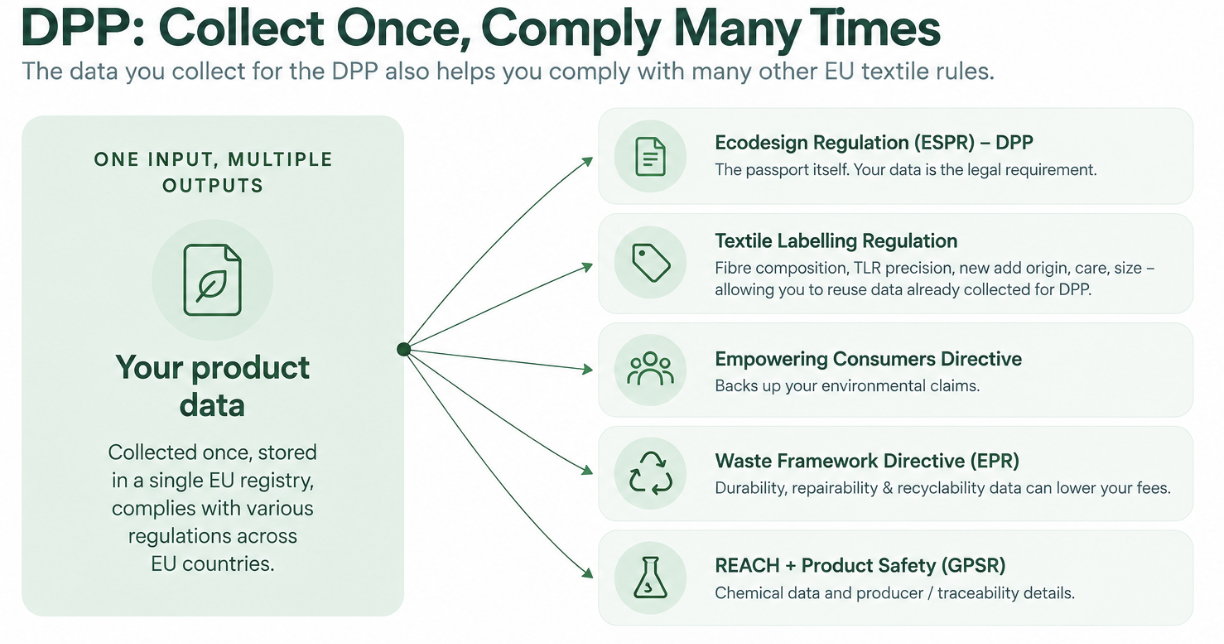
Figure 4.1. One Input, Multiple OutputsDPP data collected once can be reused across multiple EU regulatory requirements, supporting more efficient compliance and reducing duplication.
Why This Reframing Matters. Many organizations treat each regulation as a separate project, with separate teams collecting overlapping data multiple times. This is inefficient and increases the risk of inconsistency between what's reported where.
Reframing the DPP as a shared resource rather than an isolated task changes the operating model:
- Collect once — build your product data collection process around a single, well-structured source.
- Store centrally — the EU registry (or your internal system feeding it) becomes the single source of truth.
- Reuse across obligations — the same dataset flows out to labelling, consumer claims, EPR reporting, and safety documentation.
This is the "collect once, comply many times" principle: effort invested in getting DPP data right pays dividends across the rest of your regulatory obligations.
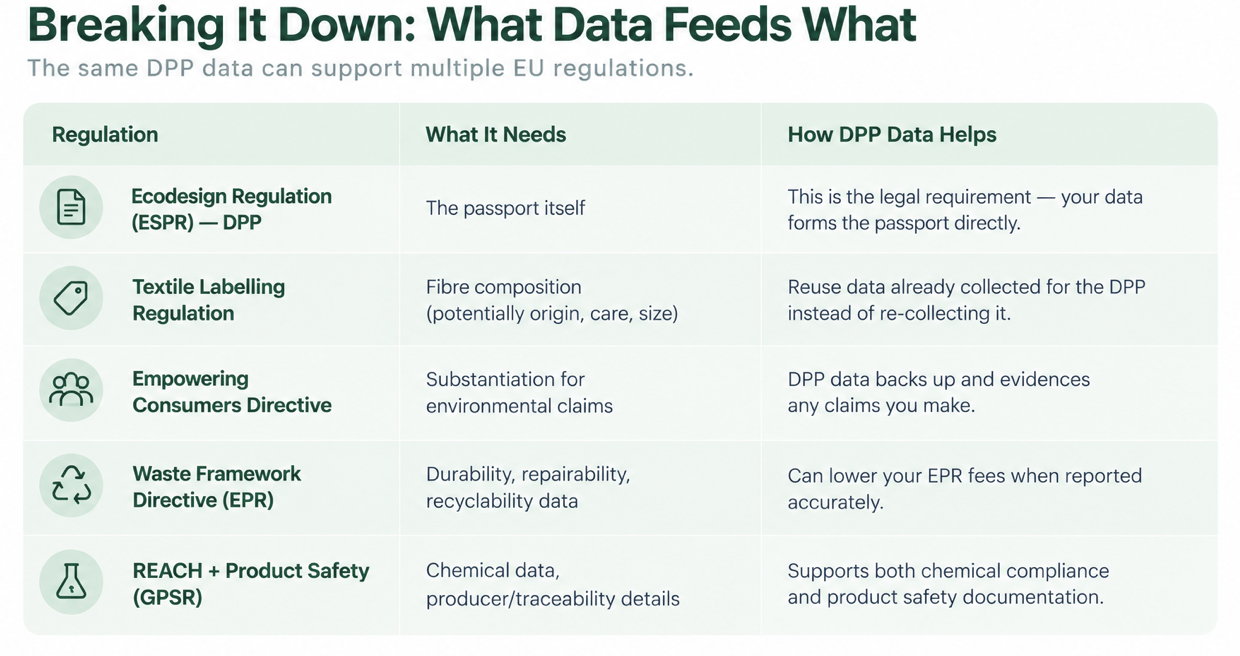
Figure 4.2. How DPP Data Supports Multiple EU RequirementsThe figure illustrates how data collected for the DPP can also support related EU regulatory requirements, reducing duplication and enabling more efficient compliance.
4.2 Where Your Business Stands Today
Before a fashion brand can create its first DPP, it needs to understand the following:
What product information already exists, where is it stored, who owns it, and what information are we still missing?
For many fashion brands, the challenge is not that product information does not exist. The challenge is that it is spread across the business.
Fibre composition might sit with the product developer, a fabric certificate with sourcing, a factory address in the ERP system, chemical data in a supplier declaration, photographs with marketing, and repair information with customer service.
DPP readiness starts with understanding the information a business already has — where it lives, who holds it, and how complete it is. That groundwork makes every later step, including choosing a system to manage the data, far more straightforward.
4.2.1. The starting point: Mapping the information you already have
A useful starting point is to map the information associated with one product from design through to sale. For example, imagine a fashion brand launching a cotton T-shirt. The company may already have the below listed information.
While the information may exist, it might not necessarily be in a form that can easily be connected to a DPP. It also isn't all equally easy to compile: industry pilot projects have found that data splits broadly into two kinds — straightforward facts such as country of manufacture or material composition, and data that depends on a calculation method not yet agreed industry-wide, such as a product's carbon footprint. The second kind will typically take longer to become "ready," regardless of how well-organised a company's records are.
4.2.2 A practical DPP data inventory and readiness check
The table below combines an inventory of where product information tends to live with a quick readiness status: READY (exists, owned, evidenced), NEEDS WORK (exists but incomplete or hard to find), or MISSING.
Important: This table is an example of a business-readiness tool, not a definitive list of future textile DPP fields. The final mandatory data requirements depend on the applicable EU product rules and delegated acts.
This exercise usually reveals that the biggest problem is not data collection, but data organisation and ownership: the information already exists somewhere in the business, but no one has connected it, verified it or taken responsibility for it.
A fictional case study: Fragmented information
Situation: A fictional 25-person fashion brand believes it already has most of the information it needs for its first DPP.
· fibre composition is in an Excel file;
· supplier addresses are in an ERP system;
· factory information is in a sourcing manager's spreadsheet;
· certifications are stored in individual supplier folders;
· chemical test reports are in the compliance team's email;
· sustainability claims were developed by marketing; and
· care instructions are stored in product-development files.
No single person has a complete view.
The real problem is not a data shortage; it is fragmentation.
4.2.3 From 'Where is the data?' to 'Who owns the data?'
One of the most useful decisions a brand can make is to assign clear data ownership — not necessarily a new role. In a smaller company, one person may hold several responsibilities; in a larger one, they tend to sit with dedicated teams.
The key is that someone should be responsible for knowing: 'Is this information correct, and where is the evidence?'
Ownership is not only about who is responsible internally — it is also worth considering who eventually needs to see each piece of information. Some data stays internal to the brand, some needs to be shared with or verified by suppliers, and some will ultimately need to reach downstream actors such as repairers, resellers or recyclers. Mapping ownership alongside this kind of access need makes it easier to decide what to priorities first.
A parallel worth watching: Battery manufacturers are already going through this exact exercise. Under the Battery Regulation (EU 2023/1542), a mandatory digital battery passport applies from 18 February 2027 — and the European Commission's own guidance for it lists 71 separate data points across categories like carbon footprint, recycled content, performance and safety. Getting ready has meant the same things this chapter recommends: assigning named ownership for each data category, coordinating with suppliers who hold information the manufacturer doesn't, and building the data-collection habit well before the deadline rather than after it. Textile brands are roughly two to three years behind this timeline, which gives a real preview of what's coming.
European Commission (n.d.) Batteries. Available at: https://single-market-economy.ec.europa.eu/batteries_en (Accessed: 23 July 2026).
4.2.4 Case Studies
Example 1: The Trace4Value Pilot (Kappahl and Marimekko)
Between 2023 and 2024, GS1 Sweden coordinated a live Digital Product Passport pilot called Trace4Value, working with Swedish and Finnish fashion retailers Kappahl and Marimekko, technology partner TrusTrace, and organisations including the Swedish Institute for Standards and Aalto University.
- Over 3,000 garments from Kappahl's and Marimekko's collections were tagged with a QR code linked to a GS1 Global Trade Item Number (GTIN).
- The passport needed to bring together materials information, supplier data, environmental labelling and circularity information — data that sat with different partners, in different systems, using different formats.
- No single existing system held all of this in one place. Each scan retrieved the relevant data from multiple sources via APIs and assembled it on the spot.
- The first products carrying a working passport launched in January 2024.
The core challenge was not a shortage of information; the retailers, suppliers and technical partners between them already held most of what was needed. The difficulty was data standardisation and system interoperability — getting data that lived in different partners' systems, in different formats, to connect reliably to a single product record a consumer could scan and trust.
Lesson: Even a well-resourced pilot with a dedicated technology partner and a national standards body found that the hard part of a DPP was not collecting new data, but agreeing a shared structure for data that already existed across the value chain.
Source: GS1 Sweden (2024) From production to sales – digital product passport in textiles. Available at: https://gs1.se/en/case/digital-product-passport-pilot-within-textiles/ (Accessed: 23 July 2026); Trace4Value (2025) Pioneering Digital Product Passports: transforming textile industry standards. Available at: https://trace4value.se/content/uploads/2025/04/Report-Trace4Value-Pioneering-Digital-Product-Passports.pdf (Accessed: 23 July 2026).
Example 2: The Swedish School of Textiles Pilot (ETON and Gina Tricot)
Alongside Trace4Value, a separate pilot coordinated through the Swedish School of Textiles brought together several Swedish fashion companies, including tailoring brand ETON and fast-fashion retailer Gina Tricot, to test DPP readiness ahead of the EU's textile delegated act.
- ETON's Global Head of Sustainability, Lina Ödeén, has described the first step as a gap analysis: comparing the data ETON already held in its existing systems against the data a DPP would eventually require, rather than starting to collect new information from scratch.
- Gina Tricot, which has long-standing relationships with many of its suppliers, found this an advantage — established relationships made early data requests easier to act on than they would have been with newer, less familiar partners.
- Both companies tested the process on a real product line rather than attempting to map their entire catalogue at once.
Lesson: A gap analysis against existing systems, not a blank-page data collection exercise, is consistently how real organisations begin. Long-standing supplier relationships also appear to meaningfully shorten the time needed to get usable data — reinforcing why starting with the strongest, best-documented part of the business tends to work better than starting everywhere at once.
Source: TrusTrace (2026) How fashion brands can prepare for the EU Digital Product Passport: a practical guide. Available at: https://trustrace.com/knowledge-hub/how-fashion-brands-can-prepare-for-the-eu-digital-product-passport-a-practical-guide-1 (Accessed: 23 July 2026).
Example 3: The CIRPASS-2 Textile Lighthouse Pilot (Avery Dennison and circular.fashion)
CIRPASS-2 is an EU-funded initiative (Digital Europe Programme, May 2024–April 2027) bringing together roughly 50 partners to test Digital Product Passports across four value chains — textiles, electronics, tyres and construction — through 13 "lighthouse" pilots. Six of these pilots focus specifically on textiles. One of them pairs Avery Dennison, a labelling and packaging materials company, with circular.fashion, a circular design platform, to track garments designed against circular.fashion's Circular Design Criteria as they move into repair, resale, sorting and recycling services.
The pilot follows garments across multiple stakeholders — from retail through collection, repair and upcycling — rather than stopping at the point of sale.
Its purpose is explicitly to test interoperability: whether DPP data created by one actor (a brand or manufacturer) can be picked up and used by a completely different actor (a recycler or resale platform) later in the product's life.
Unlike the Trace4Value and Swedish School of Textiles pilots, which are brand-led, this pilot is run by a materials/technology partner and a circularity-standards organisation — testing the DPP from the infrastructure side rather than the retailer side.
Lesson: Readiness isn't only about a brand's own data. It also depends on whether that data can be understood and used by parties the brand never directly works with — repairers, resellers, recyclers — which is exactly why interoperability, not just data collection, is one of CIRPASS-2's central research questions.
Documented in: Fraunhofer IZM (n.d.) CIRPASS-2. Available at: https://www.izm.fraunhofer.de/en/institut/projects/cirpass-2.html (Accessed: 23 July 2026); Avery Dennison (2024) A.D. & circular fashion bring Digital Product Passports. Available at: https://apparelsolutions.averydennison.com/en/perspectives/avery-dennison-and-circular-fashion-bring-digital (Accessed: 23 July 2026).
4.3 Opening the Conversation with Suppliers
For most fashion brands, a large share of the information needed to understand a product sits outside the company. The brand knows what it designed; the supplier knows what actually went into it. This makes suppliers a critical part of DPP readiness. However, collecting information from suppliers is rarely as simple as sending an email saying: 'Please send us your DPP data.' Suppliers often have their own tiers of suppliers: a garment factory may know its fabric source but not where the fibre originated, and a fabric mill may know the yarn composition but not every chemical used further upstream. Suppliers may also use different systems, terminology and formats from the brand. The objective is therefore to begin the conversation early and systematically.
4.3.1 Define what to ask for
Start with what you actually need. A long, all-purpose questionnaire tends to overwhelm suppliers and produce incomplete answers. Instead, start with what is required for the products and obligations relevant to your business.
Potential Supplier Data Starting Points. The below lists information companies may consider requesting from suppliers, which should be adapted to the specific product, supply chain and applicable requirements.
Basic supplier information
- Legal company name
- Address
- Manufacturing site
- Contact person
- Role in the supply chain
Material information
- Fiber composition
- Material specifications
- Recycled content, where relevant
- Material certifications
- Country/origin information where required
- Relevant processing information
Chemical information
- Relevant substances and treatments
- Evidence of compliance with applicable restrictions
- Relevant declarations or test results
Production information
- Manufacturing location
- Production process
- Relevant subcontractors, where required
- Product/component traceability
A supplier statement is not the same as evidence. Imagine a supplier tells a brand: 'This fabric is 100% recycled polyester.' The brand now has a statement. But what supports it?
- a certification;
- a transaction certificate;
- a material specification;
- a test report;
- a supplier declaration; or
- another recognised form of evidence.
The appropriate evidence depends on the specific claim and regulatory requirement. The practical lesson is to not collecting claims separately from the evidence supporting those claims.
4.3.2 Structuring the relationship
Starting the supplier conversation upstream. A brand’s sourcing team usually has a direct relationship with its Tier 1 supplier, the garment manufacturer. But the information a DPP needs, such as where a fibre originated or what chemicals were used in processing, often sits two or three tiers further up a supply chain the brand has never directly contacted.
4.3.2 Putting it into practice
Reflection Prompts: Draft your supplier request
- What information do I need, and why?
- What evidence should the supplier provide, and who should send it?
- What would trigger an update, and how will I store the response?
- What happens if the supplier cannot provide it?
4.4 Making Data Collection a Habit
The biggest risk for any fashion brand is treating DPP preparation as a one-off project. A company might spend six months building its first passport — then, six months later, a supplier changes, a certificate expires, or a product is redesigned. The passport still exists, but the information behind it may no longer be reliable. ESPR requires DPP data to stay accurate, complete and up to date, with controls over who can modify it.
Make data maintenance part of normal product management. The simplest way to do this is to use update triggers. Rather than checking everything constantly, identify the events that should trigger a review. See the examples of potential triggers below.
The principle is simple: no change, no unnecessary work; change, review the relevant data.
When developing a new product
- Has the product information record been created?
- Have material and supplier data been captured?
- Has the evidence been stored?
When approving a new supplier
- Has the supplier provided the required data?
- Has the information been verified?
- Who is responsible for future updates?
When changing a material
- Does this change affect product information?
- Does it affect labelling?
- Does it affect environmental claims?
- Does it affect chemical compliance?
- Does the DPP data need updating?