Chapter 2 — full chapter
| Site: | FashionKIC Learning Platform |
| Course: | Digital Product Passports |
| Book: | Chapter 2 — full chapter |
| Printed by: | Guest user |
| Date: | Sunday, 1 November 2026, 3:20 AM |
Chapter 2 — Legislative Framework
Guiding question : Why will a Digital Product Passport soon be mandatory for garments sold in the EU — and is regulation the fastest route to transparency, or only the start?
Objective:
This chapter gives participants their first proper introduction to the Ecodesign for Sustainable Products Regulation. It explains what the regulation is, why it exists, and how it creates the legal basis for the Digital Product Passport (DPP). It also presents how this general framework is being translated into practical rules for textiles and gives participants a first structured look at the data requirements that may be included in the textile DPP.
Outcome:
By the end of this chapter, participants will understand the foundations of the ESPR and the DPP, and how these obligations are being translated into concrete rules for textiles. They will also be able to identify the categories of product data they already have and the data they may need to start collecting.
Time: ≈ 3–5 h · reading & timeline activity (2.5 h) · assignment worksheet (1–2 h) · quiz (10 min).
In this chapter:
- 2.1 ESPR explained
- 2.2. From ESPR to Textile Specific Rules
- 2.3 Data Points Under Consideration Part I (Product and producer identification and information).
- 2.4 Data Points Under Consideration Part II.
- 2.5 Data Points Under Consideration Part III.
2.1 ESPR explained
This subchapter introduces ESPR from the ground up, explaining what the regulation covers, why the EU introduced it and how it establishes the DPP as a key tool for implementing sustainability requirements.
The Ecodesign for Sustainable Products Regulation (ESPR) is a landmark European Union framework policy designed to make products sold in the EU more durable, repairable, recyclable, and transparent. By replacing the older 2009 Ecodesign Directive, it expands the EU's environmental design standards from just energy-related appliances to virtually all physical goods placed on the market
The regulation introduces several sweeping changes to how products are designed, tracked, and managed across their lifecycles:
- Expanded Product Scope: Unlike the old directive which focused solely on energy use (e.g., washing machines and refrigerators), the ESPR covers almost all physical goods. Priority categories include textiles, furniture, steel, aluminum, tires, and electronics. Food, feed, and medicinal products are exempt.
- The Digital Product Passport (DPP): Products will require a mandatory digital passport (accessed via QR code or barcode). The DPP acts as a digital ID card, providing consumers, recyclers, and authorities with transparent data regarding a product's material composition, environmental footprint, and end-of-life recycling options.
- Ban on Destroying Unsold Goods: To curb waste, large and medium-sized corporations are banned from destroying unsold consumer goods, starting with clothing and footwear. Companies must also publicly disclose the volume of unsold products they discard each year.
- Circularity Criteria: New rules focus on specific sustainability factors, including a product's lifespan, the ease of disassembly, the restriction of "substances of concern," and the incorporation of higher recycled content.
For the Commission's own explanation of ESPR in its own words, watch the recording of its 22 May 2024 information session, or review the accompanying slide deck, both available on the Commission's ESPR page.
European Commission (n.d.) Ecodesign for Sustainable Products Regulation. Available at: https://commission.europa.eu/energy-climate-change-environment/standards-tools-and-labels/products-labelling-rules-and-requirements/ecodesign-sustainable-products-regulation_en (Accessed: 23 July 2026).
Why ESPR exists
- Replaces the old 2009 Ecodesign Directive, which only covered energy-related products (fridges, lightbulbs, boilers)
- Central to the European Green Deal and 2020 Circular Economy Action Plan
- Shift in logic: from "make products more energy-efficient" to "make almost all physical products durable, repairable, recyclable, and transparent"
- Entered into force 18 July 2024
What ESPR covers
- Scope: nearly all physical goods placed on the EU market
- Key exclusions: food, feed, medicinal products (human and veterinary), living plants/animals/microorganisms, products of human origin (blood, tissue, organs), and products already regulated by dedicated EU laws with equivalent ambition
- The Ecodesign for Sustainable Products and Energy Labelling Working Plan 2025-2030, adopted in April 2025, names the priority sectors: iron & steel, aluminium, textiles/apparel, tyres, furniture, and mattresses
- Critical teaching point: ESPR itself sets almost no product-specific requirements. The regulation establishes that a passport is mandatory and defines how the system works - what a DPP is, how it's carried, where it lives, who can inspect it - but deliberately leave the content undefined. Which data fields, which carrier, which thresholds: those come later through delegated acts, sector by sector, because a t-shirt and a piece of furniture don't share the same durability or material-composition data.
How ESPR builds the Digital Product Passport
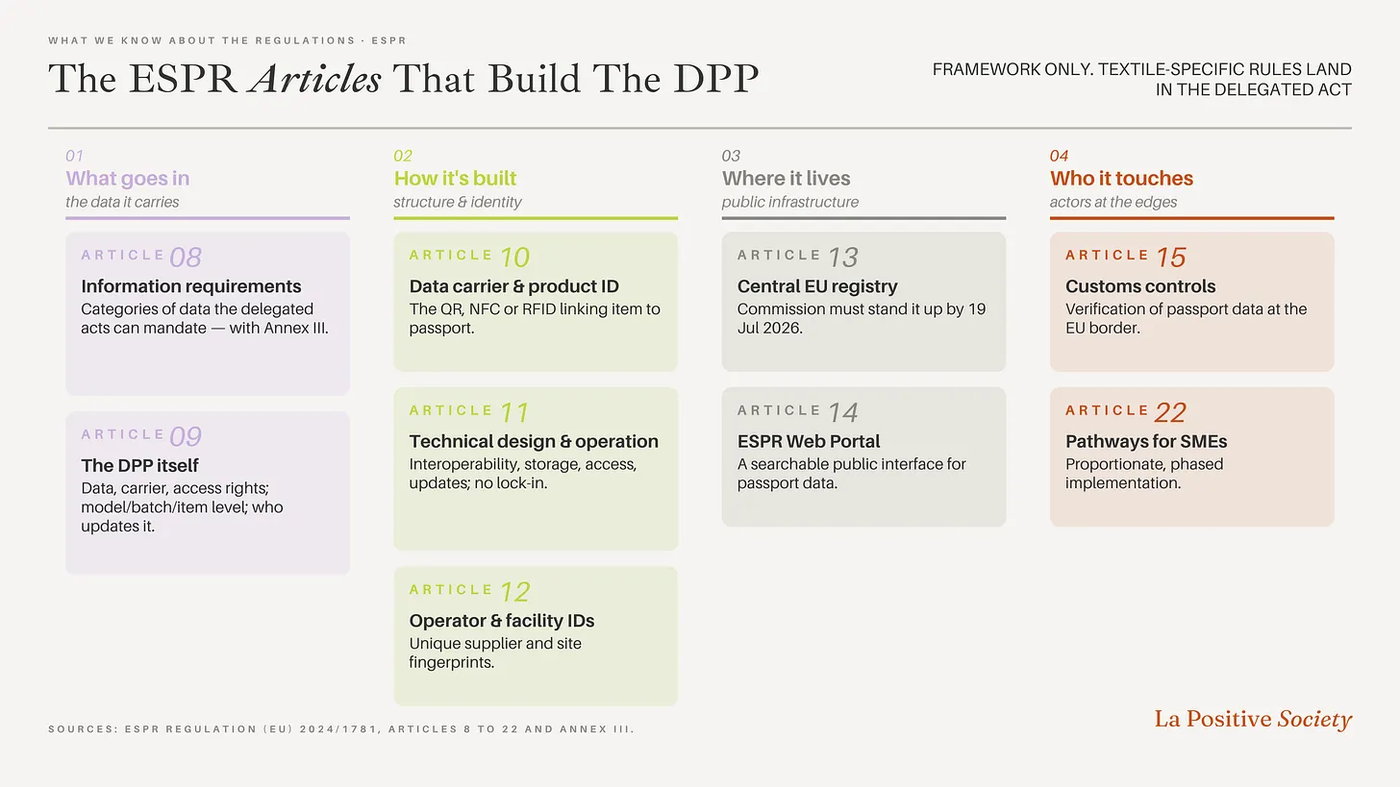
Timeline Reality Check
ESPR became law in 2024. That does not establish obligations for any given product today. Eco-design and DPP requirements in those sectors remain downstream, pending the delegated acts that will set them sector by sector.
A working example already exists. The Battery Regulation (EU 2023/1542) makes a digital "battery passport" mandatory from 18 February 2027 — for electric vehicle, light-transport and industrial batteries above 2 kWh. It's widely treated as the first real-world test case for how the textile DPP will function, since it's built on the same ESPR-style logic (unique identifier + structured data + access rights), just for a different product category. [Source: European Commission (n.d.) Batteries. Available at: https://single-market-economy.ec.europa.eu/batteries_en (Accessed: 23 July 2026)]
2.2. From ESPR to Textile Specific Rules
This subchapter moves from ESPR's general framework to where textile requirements actually stand. ESPR sets the overall direction, while the detailed requirements are still being developed through the upcoming Textile Delegated Act. It introduces the JRC (Joint Research Centre) study - the European Commission's own technical research feeding those rules - and gives participants a realistic sense of when textile-specific requirements are likely to land.
The DPP Timeline for Textiles
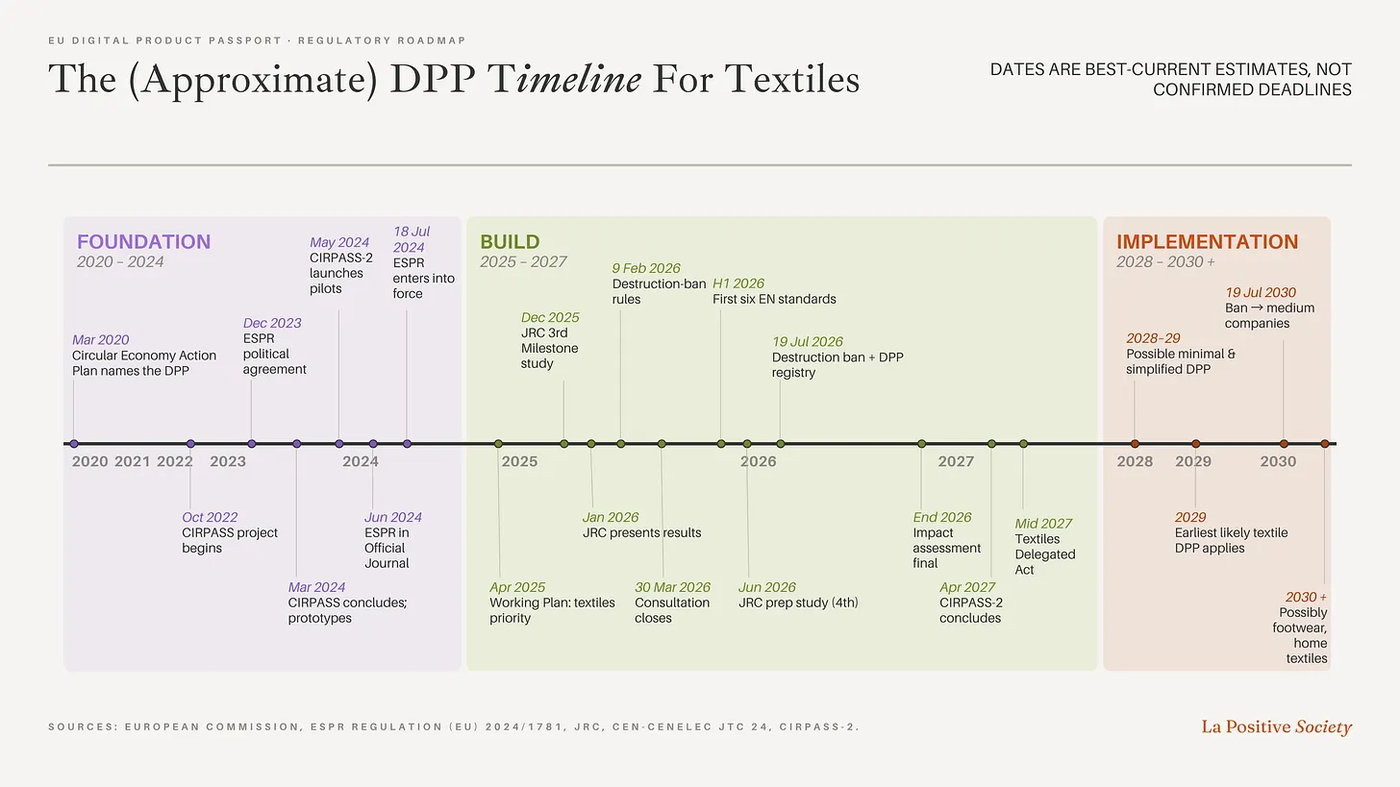
Phase 1 - Foundation (2020-2024): the idea becomes law
Textile passport prototypes were already being tested before ESPR existed - the EU was exploring what a passport could look like at the same time it was legislating that one must exist.
Phase 2 - Build (2025-2027): the evidence-gathering phase
This is where the JRC - the Joint Research Centre, the Commission's in-house scientific service - does its work. Before writing a binding delegated act, the Commission needs an evidence base, and the JRC's preparatory study on textiles is that evidence: it's building the case for what should go in the passport and how it should be tested. The study itself is not law - it's the research the law will be built from.
Phase 3 - Implementation (2029+): rules apply
Two dates matter and they're not the same: when the delegated act is adopted (currently estimated 2027), and when compliance is required (currently estimated no earlier than 2029). Everything before that - the JRC study, the consultations - is preparation, not obligation, and every date here can still move. Treat 2029 as the current direction of travel, not a locked deadline.
2.3 Data Points Under Consideration Part I (Product and producer identification and information).
This subchapter introduces the first layer of data expected in a textile DPP: identifying the product and its producer, then describing them - covered in two parts, A (identification) and B (information).
A. Product and producer identification
This category is about making sure every product, and every actor connected to it, can be uniquely identified in the DPP system. Product identification is the foundation the whole passport is built on - it's what lets information be reliably linked, accessed, and reused digitally.
ESPR defines three types of unique IDs, each pointing to a different thing:
- Unique Product Identifier (UPI) - identifies the product itself and links it to its DPP. This is the main reference point everything else hangs off.
- Unique Operator Identifier (UOI) - identifies an economic operator involved in the product's value chain, so the product information can be traced to the right actor.
- Unique Facility Identifier (UFI) - identifies a specific location or facility involved in the product’s value chain, when that level of detail is required.
B. Product and producer information
This category covers the descriptive information about the product and who's responsible for it - filling in the "what is it, and who's accountable" that the identifiers alone don't capture. It may include:
- Product name, model designation, and version - enough to tell product variants apart.
- Manufacturer or other responsible economic operator’s identity and contact details - who's responsible for placing it on the EU market.
- Manufacturing site or other relevant facilities info - when needed for compliance or enforcement checks.
- Other descriptive details - anything else needed to distinguish between configurations, batches, or versions of a product.
Level of granularity: Model, Batch, or Item? Granularity means: at what level is the DPP actually tracking the product - a single item, a batch, or a whole model? The ESPR leaves this to the product-specific delegated acts, which will set the right level for each sector - balancing market surveillance, circularity, and traceability needs against the administrative burden of tracking at too fine a level.
The JRC preparatory study establishes three working definitions:
- Model: a version of a product where every unit shares the same technical traits and the same model identifier.
- Batch: a subset of one model, made at one factory, at one point in time.
- Item: a single unit.
2.4 Data Points Under Consideration Part II.
(Product-specific information). This subchapter introduces the second layer of data categories expected in a textile DPP covering material composition, environmental performance, durability, etc.
This is the layer that tells a customer, a recycler, or a regulator something meaningful: what is this garment made of, how well is it made, and what's its environmental footprint? It's also the most contested layer - several of these metrics were narrowed or dropped as the JRC study progressed.
The product information that may be required for textiles in the DPP includes:
- Material information: fiber composition (in line with the Textile Labelling Regulation), and components specification (using GTIN-13 or equivalent)
- Mechanical properties: robustness score (the methodology will be proposed in detail in the Textiles Delegated Act)
- Substances of concern (SoC): name and numerical code of the SoC present in the product, location of the SoC within the product, concentration, instructions for safe use, information relevant for disassembly, preparation for reuse, recycling, etc.
- Recyclability: recyclability score (the methodology will be proposed in detail in the Textiles Delegated Act)
- Recycled content (value expressed in % in relation to the product’s weight. The methodology will be proposed in detail in the Textiles Delegated Act) and origin of the recycled content (post-industrial, pre- and post- consumer waste)
- Organic content (value expressed in % in relation to the product’s weight. The methodology will be proposed in detail in the Textiles Delegated Act) and EU ecolabel
- Product carbon footprint and environmental footprint (the methodology for both footprints will be proposed in the Textiles Delegated Act based on the PEFCR)
- Manual and Instructions: care instructions (in line with the Textile Labelling Regulation), repair instructions, contact of repair services offered by brand, warranty duration/commercial guarantee duration above the 2-year legal minimum (in line with ISO 22059:2020 and the Consumers Rights Directive).
2.5 Data Points Under Consideration Part III.
(Compliance documentation). This subchapter introduces the final layer of DPP data: the paperwork that proves a product meets its eco-design requirements before it’s placed on the market.
Three types of documents fall under this:
- EU Declaration of Conformity - the manufacturer's own signed statement that the product complies with ESPR and any other applicable rules.
- Technical documentation - the underlying evidence supporting compliance with the eco-design requirements: drawings, test results, measurements, design calculations.
- Certificates - formal sign-off from notified bodies confirming compliance.
Together, these turn the DPP into something regulators and market surveillance authorities can check against - not just a marketing claim, but a paper trail. Delegated acts can add more compliance documents on top of these for specific product groups.