Chapter 6 — full chapter
| Site: | FashionKIC Learning Platform |
| Course: | Sustainable Materials and Processes |
| Book: | Chapter 6 — full chapter |
| Printed by: | Guest user |
| Date: | Sunday, 1 November 2026, 3:19 AM |
Table of contents
- Chapter 6. After Use & Material Recovery
- 6.1.1 Why textiles are lost from the system
- 6.1.2 Current recovery challenges
- 6.1.3 Product and material recovery pathways
- 6.2 Circular Recovery Systems
- 6.2.1 Collection systems
- 6.2.2 Reverse logistics
- 6.2.3 Case study: Reverse Resources Platform
- 6.2.4 Sorting technologies and grading
- Case Example - HUMANA Spain & Lipor Portugal
- 6.2.5 Preparation for reuse and recycling
- Tool — material composition checklist
- 6.2.6 Textile waste logistics
- 6.2.7 Digital Product Passport support
- 6.3 Product Value-Retention Pathways
- 6.4 Fibre and Material Recovery Pathways
Chapter 6. After Use & Material Recovery
This chapter examines what happens when textiles are no longer wanted or usable in their current form. Recovery options are shaped earlier by fibre composition, construction, trims, finishes, durability, repairability, traceability and the collection and sorting infrastructure available (Huygens et al., 2023; Jia et al., 2020).
This chapter focuses on the operational conditions that determine whether after-use textiles can enter a viable route: collection, storage, logistics, sorting, grading, product data and partner capacity. It assumes the circular strategies introduced in Chapter 1 and concentrates on how SMEs can plan and verify real recovery outcomes.
6.1.1 Why Textiles Are Lost from the System
Textiles are lost when one or more links in the recovery chain fail. Products may enter mixed waste because separate collection is unavailable or inconvenient; after collection, contamination, poor condition or inadequate sorting can prevent reuse. Missing composition data, fibre blends, elastane, coatings, finishes and hard-to-remove trims can also restrict recycling.
Technical recyclability is therefore only one condition. A viable route also needs sufficient volumes of consistent material, safe storage, transport, market demand and suitable local repair, resale or recycling capacity. EU separate collection (European Environment Agency, 2025a) can increase captured textiles, but it does not guarantee recovery. SMEs can reduce losses by designing simpler products, providing accurate material information, keeping production waste separated and agreeing acceptance criteria and destinations with partners before launching take-back schemes.
6.1.2 Current Recovery Challenges
After collection, recovery systems must turn varied used products into streams with consistent composition, quality and volume. Fibre blends, elastane, coatings, colours, contamination and missing product data determine which processes are possible and the quality of their outputs. Most recycling technologies perform best with clean, well-sorted and relatively homogeneous feedstock (Huygens et al., 2023; Loo et al., 2023).
Scaling recovery also requires sorting capacity, dependable logistics, stable demand for recovered materials and economics that cover inspection and processing. Digital product information and automated identification may improve decisions, but they do not replace physical testing or market infrastructure. SMEs should define specifications with recovery partners, separate known production waste from uncertain post-consumer inputs, track contamination and yields, and report verified destinations. Designing for fewer materials and removable components makes later recovery more realistic.
Product and material recovery pathways
After collection and assessment, textiles may enter product-level or material-level pathways. Product-level pathways, including reuse, repair, refurbishment and remanufacturing, retain the product or some of its components in use. Material-level pathways process textiles into fibres, polymers or other secondary raw materials. The appropriate route depends on product condition, material composition, contamination, available infrastructure and the quality requirements of the receiving process. These pathways are examined in Sections 6.3 and 6.4.
Recovery performance indicators
The tool focuses on measurable recovery-system performance:
-
- quantity collected;
- proportion successfully sorted;
- proportion directed to product-level pathways;
- proportion directed to material recovery;
- rejected or contaminated fraction;
- recycling-process yield;
- destination traceability;
- quality of the recovered output.
6.2 Circular Recovery Systems
Material recovery depends on more than the garment itself. It also depends on the systems around it: collection, logistics, sorting, grading, repair services, resale channels and recycling partners.
A product can only follow a circular route if the right system exists to collect it, identify it, sort it and send it to the most suitable next step.
6.2.1 Collection systems
Collection brings used products and production waste back into circulation through brand take-back schemes, retailers, municipalities, donation points and business-to-business channels. Keeping items clean, dry and separate from contaminated waste preserves their value and improves the prospects for reuse, sorting and recycling. EU separate-collection requirements increase available volumes, but collection alone does not guarantee recovery (European Environment Agency, 2025a; Huygens et al., 2023).
A workable system defines which streams are accepted, where they are stored, who transports and sorts them, and which destinations can process each grade. Production offcuts, retail returns and post-consumer textiles have different levels of information and contamination, so they should be recorded separately. SMEs should measure both quantities collected and verified outcomes, including reuse, recycling and residual disposal.
Reference: Refashion, Activity Report 2025.
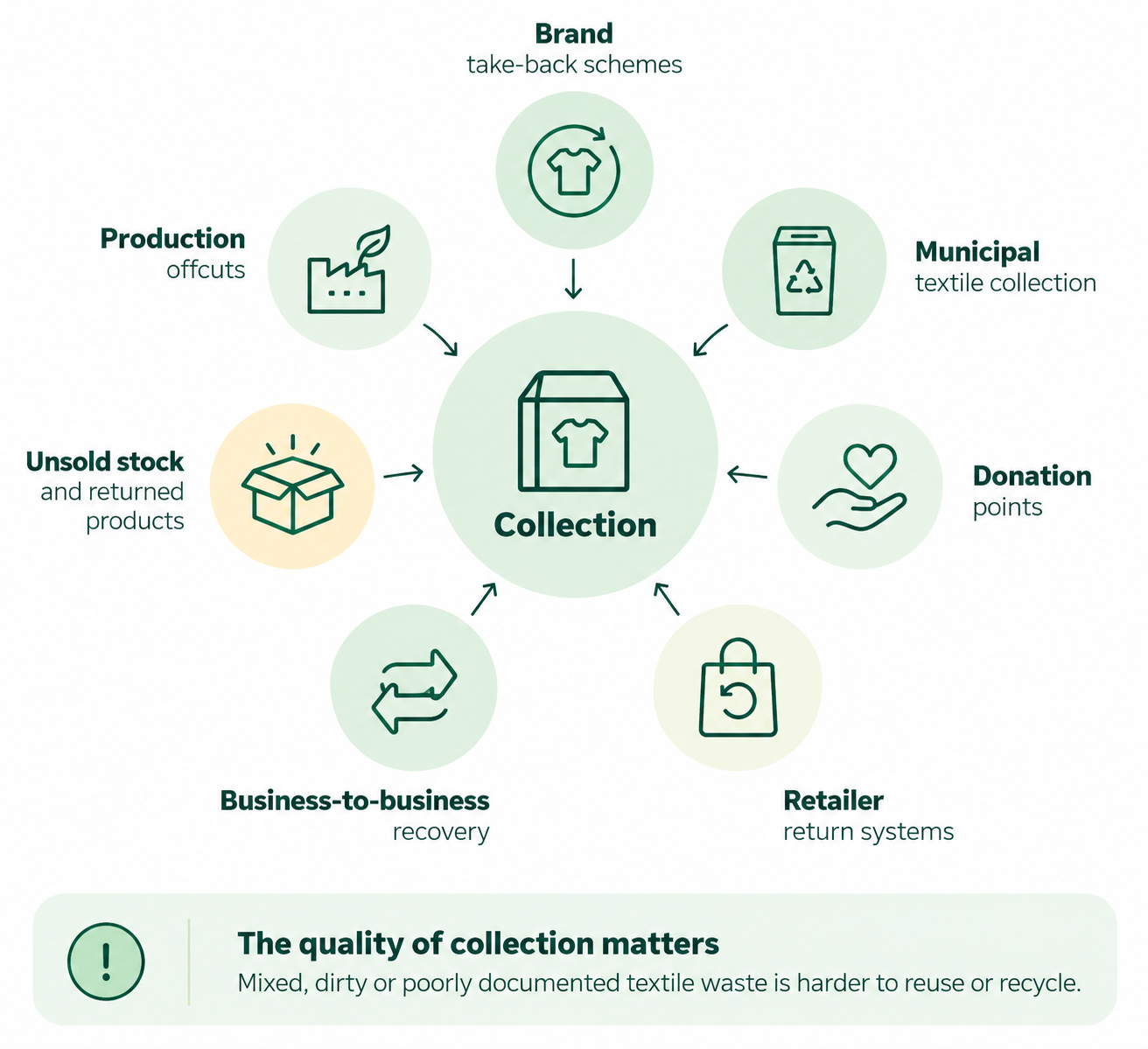
Figure 6.2.1 Textile collection can take place through different channels, including take-back schemes, municipal systems, retailers, donation points and production waste streams. Credit: FashionKIC, Textile Collection Systems Diagram, 2026.
6.2.2 Reverse logistics
Reverse logistics manages the movement of products and materials back through the fashion value chain after they leave a manufacturer, retailer or user. It includes customer returns, unsold stock, production surplus and textiles collected after use. Collection captures these streams; reverse logistics determines how they are transported, consolidated, assessed and directed towards resale, repair, reuse, recycling or other treatment.
These routes depend on the item’s condition and origin. An unworn customer return may be restocked, a damaged garment may be repaired, and used clothing may need sorting before a suitable destination can be identified. Keeping information about where items came from, what they contain and how they were handled helps preserve their value. It also allows organisations to plan transport and sorting around the volumes collected. The number of items taken back is therefore a measure of collection, not evidence that those items have been recovered (Colombo et al., 2025).
Reverse logistics can be challenging because it requires organisation, storage, transport and clear responsibilities. Before launching a take-back scheme, companies need to understand what will happen to the collected products.
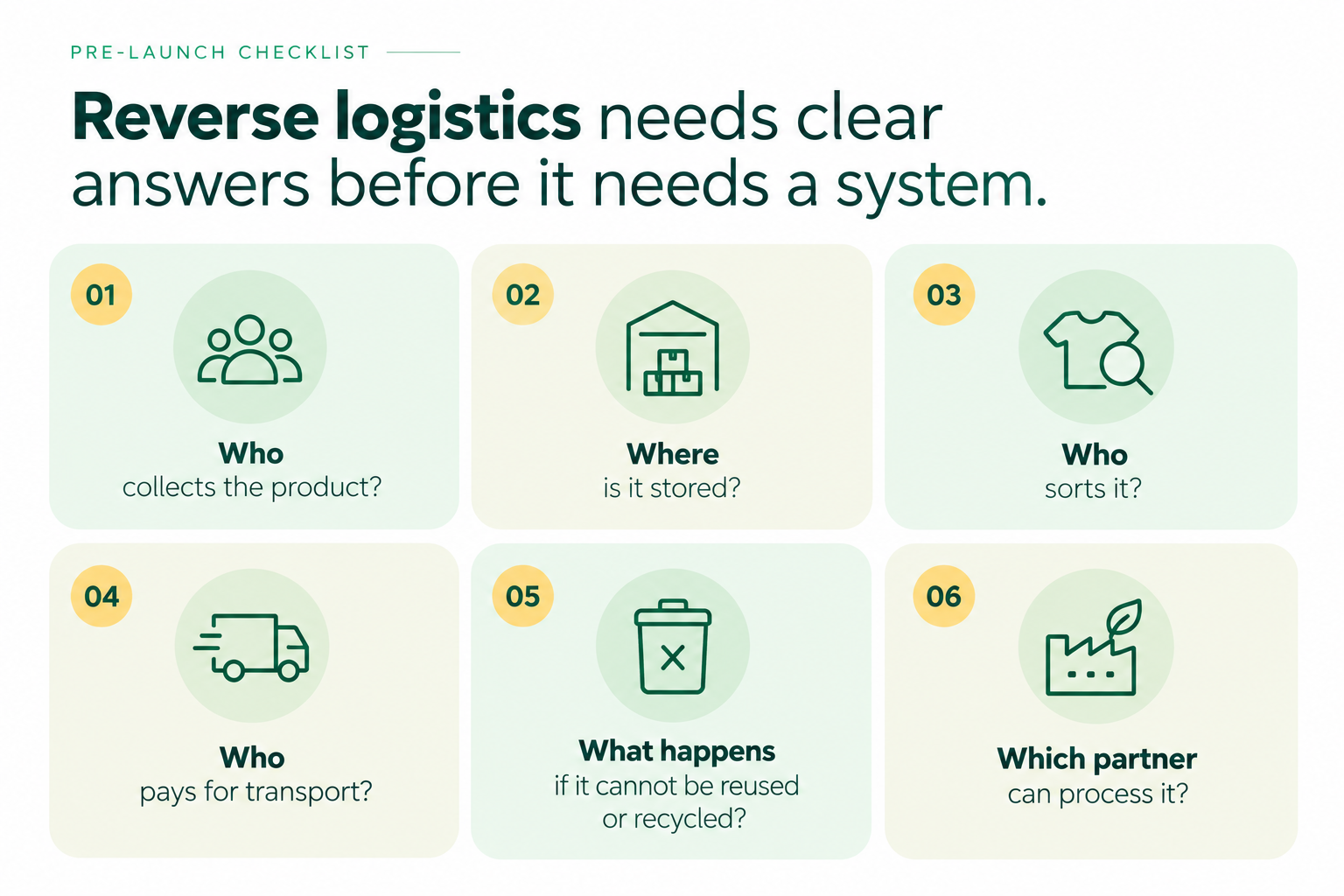
Figure 6.3. Reverse logistics checklist for planning textile take-back and recovery systems, covering collection, storage, sorting, transport and processing responsibilities. Credit: FashionKIC, Reverse Logistics Checklist, 2026
Useful questions include:
- Who collects the product?
- Where is it stored?
- Who sorts it?
- Who pays for transport?
- What happens if the product cannot be reused or recycled?
- Which partner can process it?
Before launch, assign responsibility for every answer and test the route with a small batch. Record transit time, handling cost, rejection reasons and verified destinations so the system can be improved before volumes increase.
← PreviousNext: 6.2.3 Case study: Reverse Resources Platform →
6.2.3 Case study: Reverse Resources Platform
Reverse Resources provides a digital platform that helps brands, manufacturers, waste handlers and recyclers track textile waste streams and connect them to suitable recycling partners.
Reverse Resources provides a digital platform for the production stage of reverse logistics. Garment factories record textile waste by quantity, fibre composition, colour and quality, while waste handlers record its movement through collection and sorting. The platform connects these documented streams with recyclers whose processes require particular types of feedstock. This helps brands and manufacturers see where production offcuts go and supports decisions about which materials can enter textile-to-textile recycling. Reverse Resources coordinates information and connections between the organisations handling the waste; it does not carry out the recycling itself. Its main focus is pre-consumer manufacturing waste, making it a useful counterpart to the collection systems for used clothing described earlier.
6.2.4 Sorting technologies and grading
After collection, textiles must be assessed before they can be directed towards reuse, repair or material recovery. Across Europe, sorting for reuse still relies heavily on people assessing individual garments. Trained workers examine garments, considering their condition, type, quality and suitability for different second-hand markets. Manual sorting is mostly important for garments that remain in use as a product.
Textiles that cannot be reused require a different level of identification: recycling processes often need feedstock with a known fibre composition, colour and degree of material purity. Automated systems, including near-infrared scanning, can help identify and separate these materials at greater volumes than visual inspection alone.
The two approaches can therefore work in sequence: manual sorting identifies reusable garments and removes unsuitable items, while technology-assisted sorting prepares the remaining textiles for specific recycling processes. In either case, sorting only creates a potential route; the outcome also depends on the availability of buyers, repair services and recyclers able to use each fraction (Huygens et al., 2023).
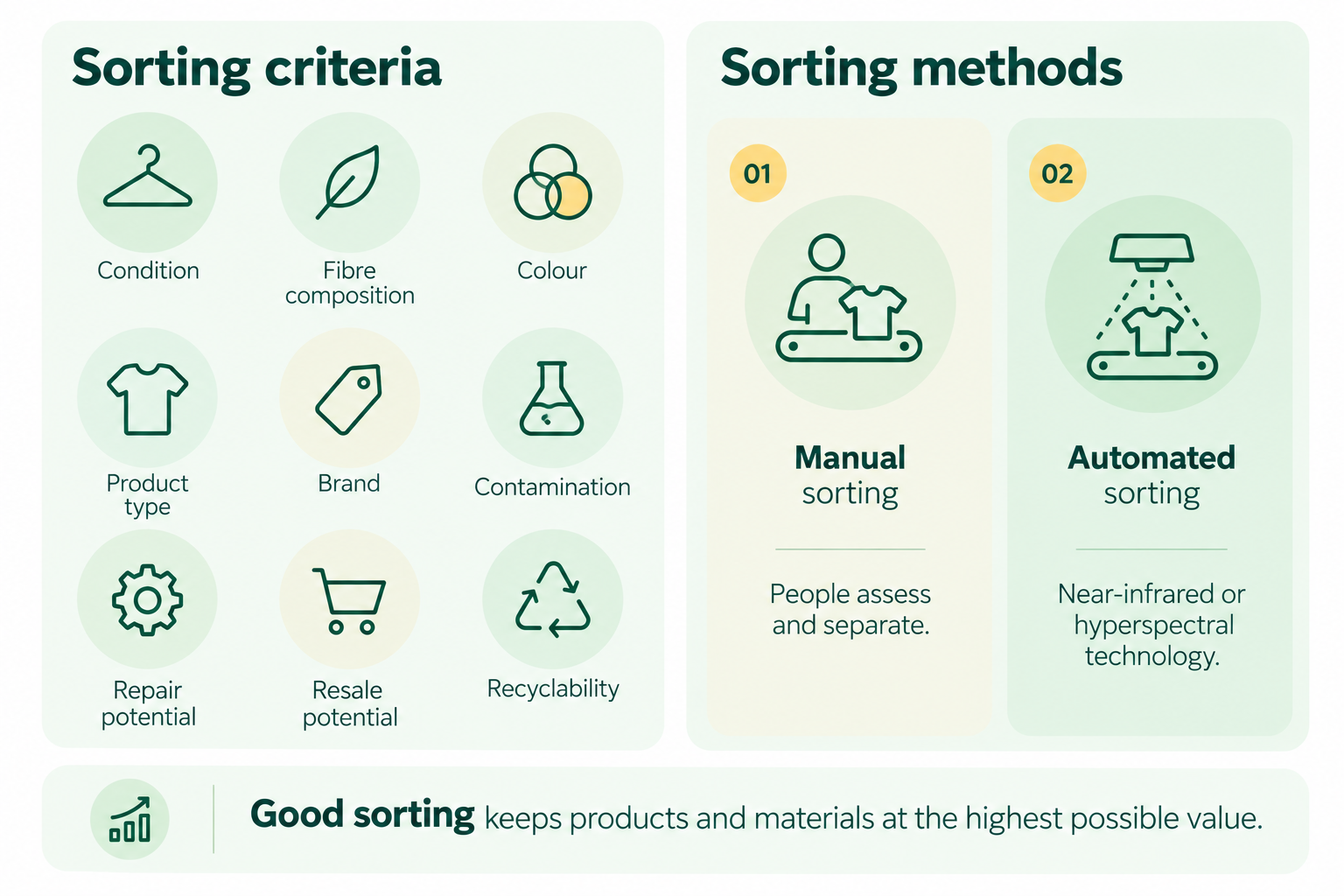
Figure 6.2.2 Textile sorting combines product criteria such as condition, fibre composition and reuse potential with manual and automated identification methods. Credit: FashionKIC, Textile Sorting Criteria and Methods Diagram, 2026.
Resource insight: Huygens, D., Foschi, J., Caro, D., Caldeira, C., Faraca, G., Foster, G., Solis, M., Marschinski, R., Napolano, L., Fruergaard Astrup, T., & Tonini, D. (2023). Techno-scientific assessment of the management options for used and waste textiles in the European Union. Publications Office of the European Union. https://doi.org/10.2760/6292 https://publications.jrc.ec.europa.eu/repository/handle/JRC134586
HUMANA Spain
At Humana’s Leganés plant in Spain, workers inspect donated textiles item by item and assign them to more than 85 categories according to condition, product type and destination. Good-quality garments may enter Spanish shops or international second-hand markets; other fractions go to recycling or disposal. Humana reports that 62% of the textiles it sorts are suitable for reuse, illustrating that collection is not the same as recycling.
LIPOR’s Portuguese pilot similarly separates items with reuse potential before classifying the remaining textiles for recovery. Together, the cases show why skilled manual assessment, consistent grading, market knowledge and reliable data are essential. A recovery system needs destinations for every output stream, not only a collection point, and its performance should be reported by verified route and quality.
Sources: Humana reporting; PICVISA.
6.2.5 Preparation for reuse and recycling
Before a product can be reused or recycled, it often needs preparation. For reuse, this may include cleaning, repair, quality control, relabelling, photography, pricing and redistribution. For recycling, it may include removing trims, separating material types, cutting, shredding, fibre opening, chemical pre-treatment and removing contaminants (Textile Exchange, 2025; Refashion, n.d.).
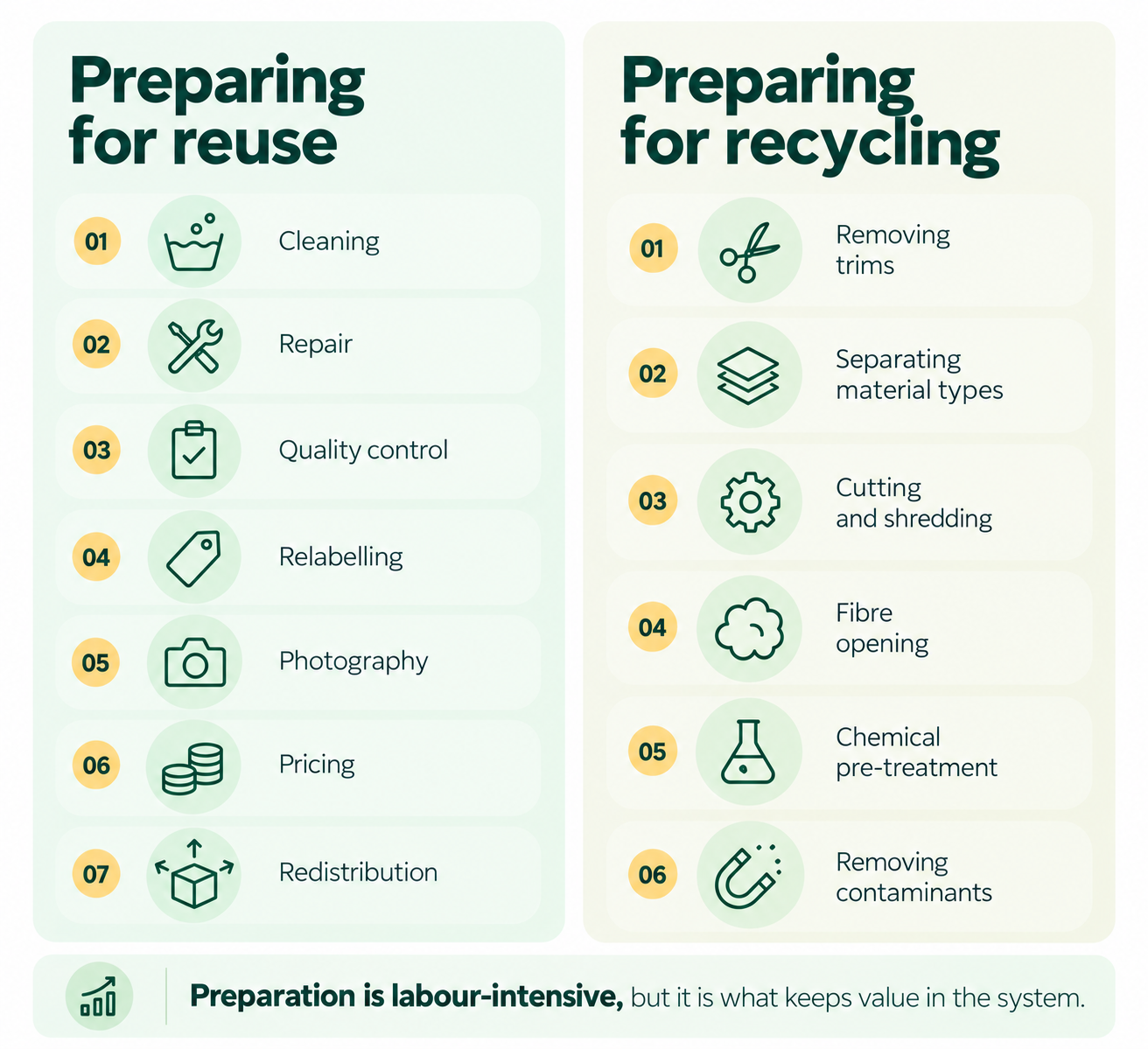
Preparation is often labour-intensive, but it is essential for keeping value in the system. A garment cannot move into the right recovery route only because it has been collected. It needs to be assessed, prepared and matched with a realistic destination.
Tool — material composition checklist
A material composition checklist identifies the main recovery barriers:
- fibre composition
- blends
- elastane
- trims
- coatings
- finishes
- sewing thread
- labels
- colour
- contamination
This tool helps learners understand why product information is so important for circular recovery.
6.2.6 Textile waste logistics
Textile waste logistics refers to how textile waste is stored, transported, grouped, and delivered to the right partner. This is especially important for SMEs, because small volumes can be difficult to process economically.
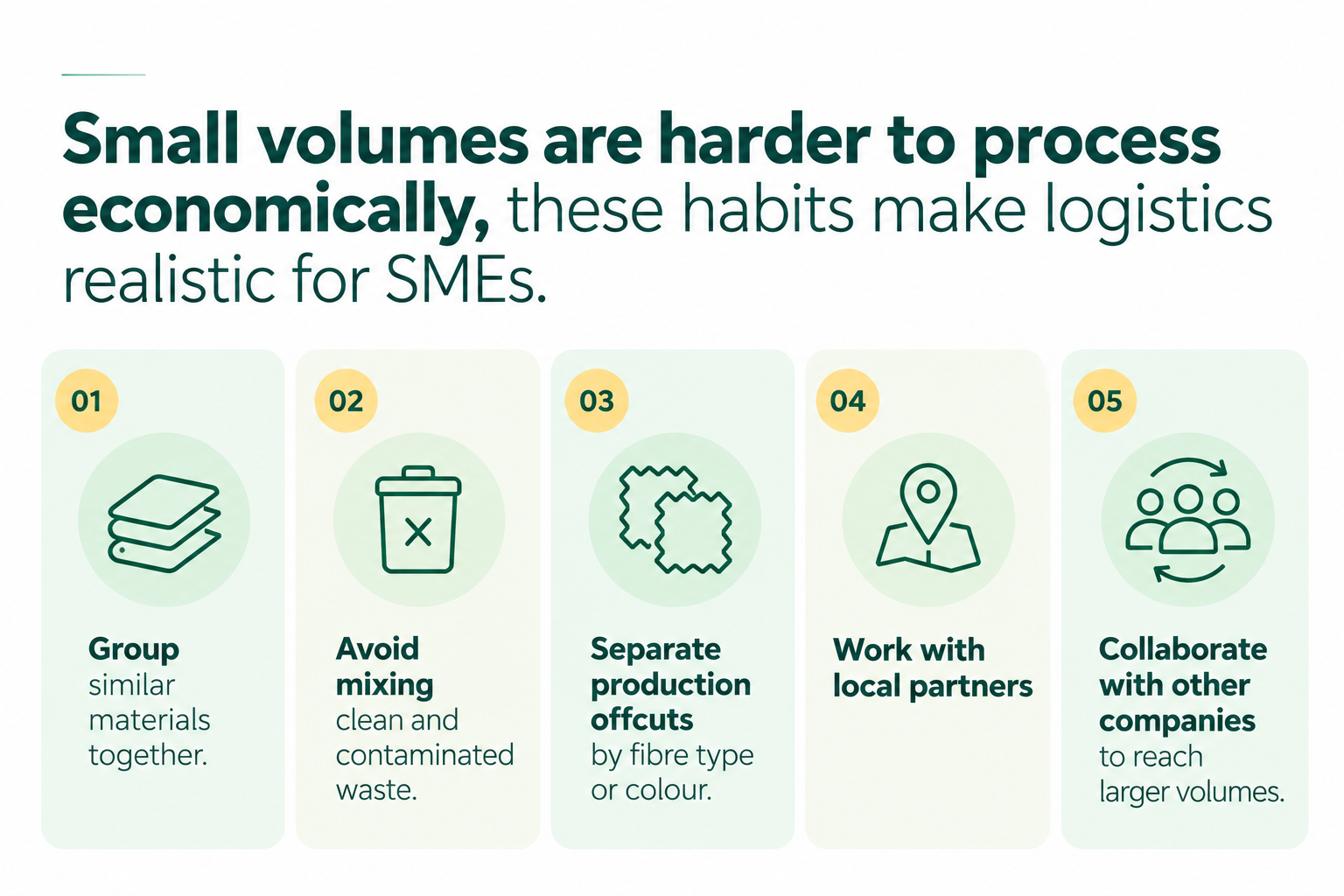
To make logistics more realistic, SMEs may need to:
- group similar materials together
- avoid mixing clean and contaminated waste
- separate production offcuts by fibre type or colour
- work with local partners
- collaborate with other companies to reach larger volumes
6.2.7 Digital Product Passport support
Product information can support better recovery. Digital Product Passports can help future users, repairers, sorters and recyclers understand what a product is made of and how it should be handled.
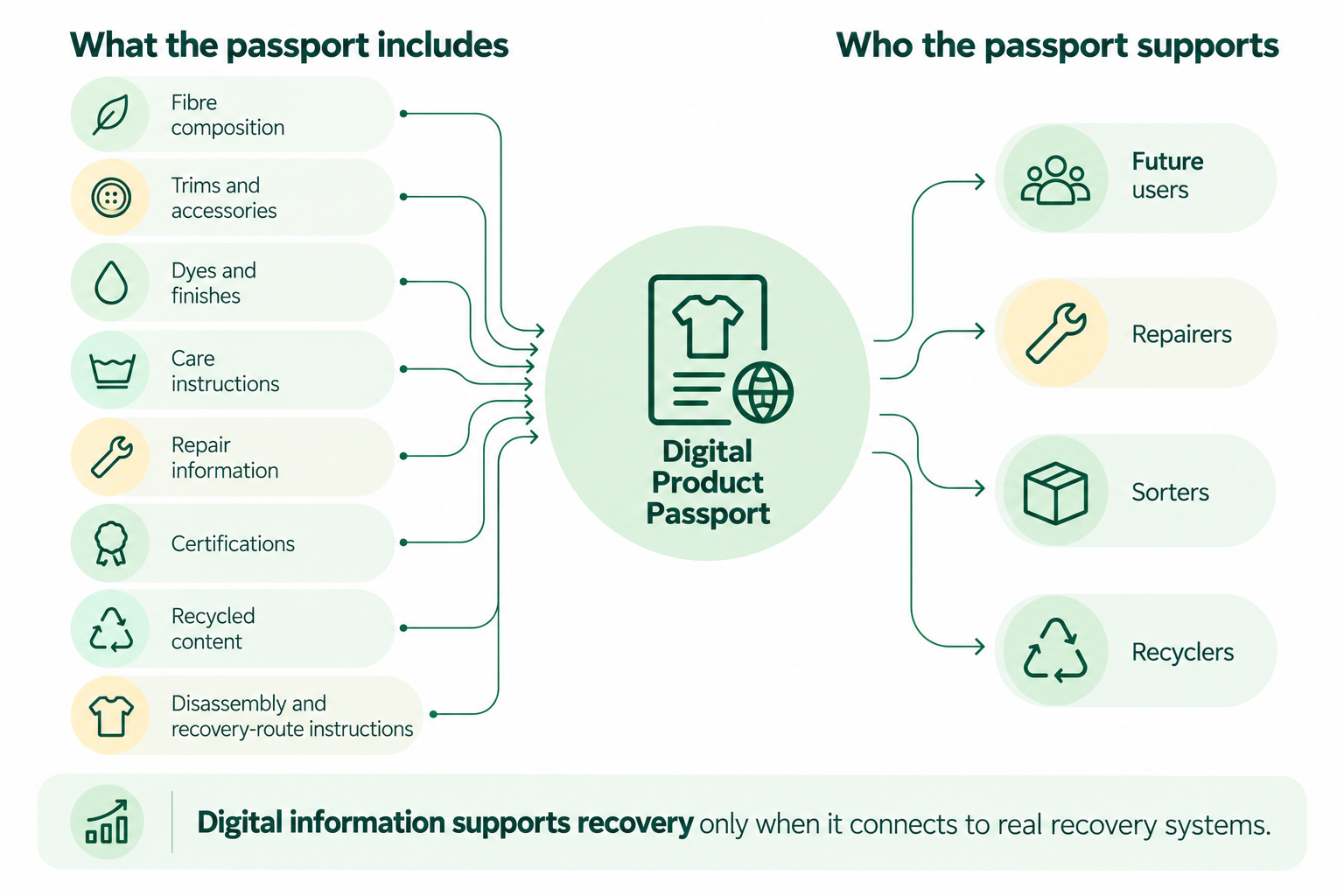
Useful information may include:
- fibre composition,
- trims and accessories,
- dyes and finishes,
- care instructions,
- repair information,
- certifications,
- recycled content,
- disassembly instructions, recommended recovery route.
Digital information does not solve recovery by itself, but it can make sorting and decision-making easier when connected to real recovery systems.
Case studies: PICVISA, Reverse Resources, Refashion France, Reflaunt
6.3 Product Value-Retention Pathways
Building on the Butterfly Diagram and the 10R Framework introduced in Chapter 1, this section does not redefine the value-retention strategies. Instead, it applies them to after-use decision-making by asking which route is realistic for a specific product, given its condition, composition, construction, available infrastructure, market demand and verifiable destination (Potting et al., 2017; Sandin & Peters, 2018).
The following tool helps teams compare these factors, select the highest-value feasible route and document the evidence behind that decision.
Tool — Recovery Route Map
Use this map as an application tool for the strategies introduced in Chapter 1. Select one textile product and record six assessment factors: condition, fibre composition, construction, trims, dyes and finishes, and available recovery infrastructure. Then compare the feasible routes, starting with the highest-value option that the available evidence and partners can support.
The objective is to turn circular principles into a justified operational decision. Record why each option was accepted or rejected, the partner and preparation required, expected output quality, destination and any information gaps. A route is credible only when technical suitability, logistics, economics and market demand align (Boorsma et al., 2022; Huygens et al., 2023).
For an SME pilot, record the volume and frequency of returns, storage needs, transport distance, preparation steps, partner capacity, rejection rate, process yield and verified destination of each output. Review the results after every batch so that design requirements, customer information and partner agreements can be improved using evidence rather than collection totals.
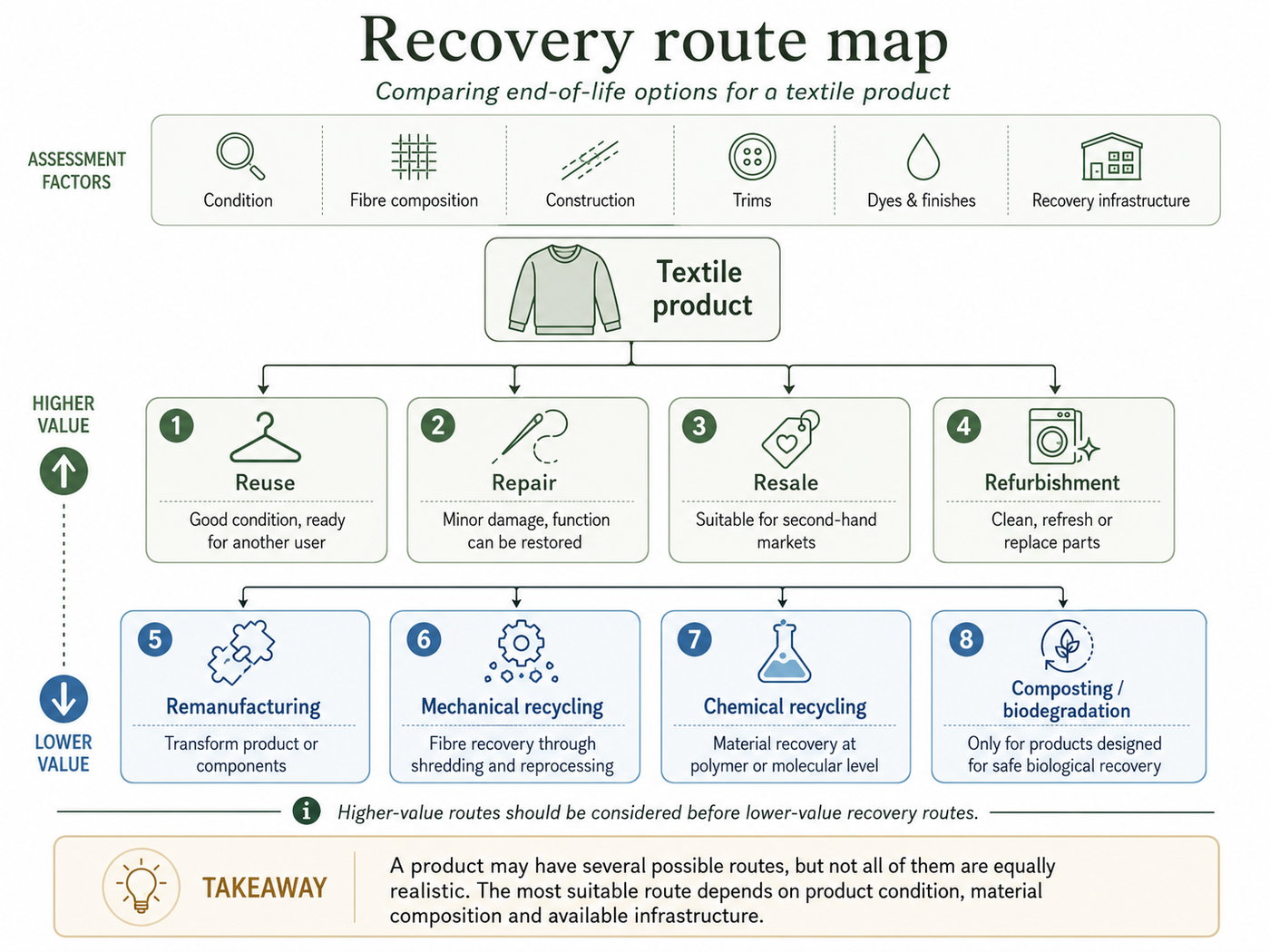
Figure 6.3. Recovery route map — comparing end-of-life options for one product by condition, composition and available infrastructure. Credit: FashionKIC, Recovery Route Map, 2026.
6.3.1 Reuse
Confirm that the product meets the agreed condition, cleanliness and safety criteria, and that a verified user or market exists. Record the receiving channel, expected preparation, ownership transfer and final destination so that the outcome can be distinguished from collection alone (Sandin & Peters, 2018).
Evidence should include quantity, grading result, date, receiving organisation and confirmation that the item entered another use cycle.
6.3.2 Repair
Identify the most common product failures and confirm access to suitable skills, spare parts, construction information and service capacity (Ruiz-Pastor & Mesa, 2023; Rahee & Sarker, 2024). Compare the repair cost and turnaround time with the product’s remaining value, then record whether the restored item returned to active use.
Monitor recurring failure points, completion rate, customer uptake and warranty outcomes so that repair evidence feeds back into product design.
6.3.3 Resale
Verify demand, grading criteria, cleaning and presentation requirements, pricing, traceability and the process for unsold or returned items. For SMEs, a resale route is credible when the product can be authenticated, prepared efficiently and connected to a defined second-hand market (Coscieme et al., 2022).
Track time to sale, markdowns, unsold stock and returns to test whether the route genuinely extends use and retains value.
6.3.4 Refurbishment
Specify the interventions and quality threshold required before the product can return to use. Document cleaning, repairs, replacement components, safety checks, presentation, warranty or disclosure requirements, and the destination for any removed parts or materials (Potting et al., 2017; Rahee & Sarker, 2024).
Track intervention time, component use, pass rate and resale outcome, then use recurring findings to improve the original product specification.
6.3.5 Remanufacturing and upcycling
Verify that the available feedstock is sufficiently consistent in condition, colour, quantity and composition for the proposed design and process. Estimate labour, material yield, production capacity, quality requirements, output market and the recovery route for scraps that remain after transformation (Jia et al., 2020; Potting et al., 2017).
Record input mass, usable yield, rejected material and sales destination to show whether the transformation creates value without generating another unmanaged waste stream.
6.4 Fibre and Material Recovery Pathways
Mechanical recycling
Mechanical recycling usually involves sorting, shredding and opening textile waste into fibres. These fibres can then be used for new yarns, nonwovens, insulation, fillings or other applications.
Mechanical recycling works best with clean, well-sorted and relatively simple material streams. Fibre quality can decrease during the process, so mechanically recycled fibres are often blended with virgin fibres or used in lower-grade applications.
Chemical recycling
Chemical recycling breaks materials down at polymer or molecular level. It can support textile-to-textile recycling in some cases, especially for selected fibre types.
However, chemical recycling usually needs precise sorting, clean inputs and industrial infrastructure. It is not a universal solution for all textile waste.
Textile-to-textile recycling
Textile-to-textile recycling aims to turn textile waste into new textile fibres, yarns or fabrics. It is one of the main goals of circular fashion, but it remains technically and logistically challenging.
Main barriers include:
- mixed fibre compositions
- elastane
- coatings and finishes
- colour contamination
- low fibre quality
- lack of accurate product data
- limited recycling infrastructure
- difficulty collecting enough consistent material.
Designers and SMEs can support textile-to-textile recycling by simplifying material composition, reducing unnecessary trims, avoiding problematic finishes and keeping better product information.
Composting and biodegradation
Composting and biodegradation are only suitable when the product has been designed for biological recovery. A natural fibre is not automatically compostable.
For biological recovery to be realistic, the full product must be considered: fibre, dye, finish, coating, sewing thread, labels, trims and possible contamination during use.
Products with synthetic blends, elastane, plastic trims, harmful dyes, coatings or finishes are usually not suitable for this route.
Case studies: Nudie Jeans, Worn Again Technologies, Back to Eco / Infinit Denim
Case Example: Re-Fresh Global
Re-Fresh Global is a Berlin–Israel deep-tech company that converts mainly cotton, polyester and cotton–polyester textile waste into new raw materials. Mechanical shredding is followed by enzymatic treatment, filtration and material preparation to separate cellulosic and synthetic fractions instead of treating a blend as one low-quality stream.
The process produces Re-Celloop™, a regenerated cellulosic material, and Re-SanPulp™, based on recovered synthetic fibres. Outputs may be used in fibres, nonwovens, packaging, coatings, construction or automotive applications. The case combines mechanical pre-processing with biochemical recycling and shows both textile-to-textile and cross-sector routes. Its circular value depends on input quality, yield, energy and chemical use, output performance and whether recovered material displaces virgin resources.
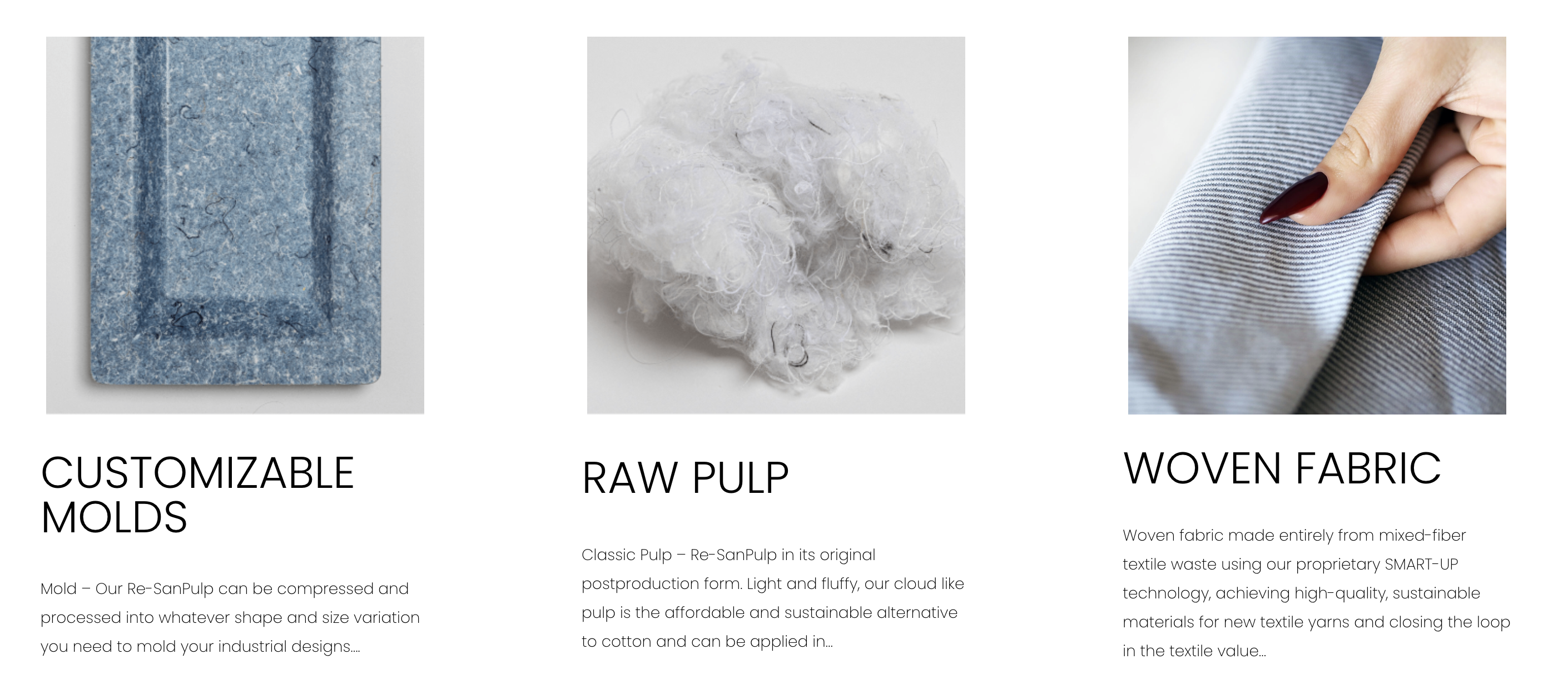
Figure 6.4 Re-Fresh Global recycled textile material produced from mixed-fibre textile waste.
Source: https://re-fresh.global/