Chapter 4 — full chapter
| Site: | FashionKIC Learning Platform |
| Course: | Sustainable Materials and Processes |
| Book: | Chapter 4 — full chapter |
| Printed by: | Guest user |
| Date: | Sunday, 1 November 2026, 3:19 AM |
Chapter 4 Circular Product Architecture
In this chapter:
- 4.2 Principles of circular product architecture
- 4.3 Pattern architecture and material efficiency
- 4.4 Component architecture
- 4.5 Architecture for longevity
- 4.6 Architecture for recovery
4.1. Chapter overview
Circular product architecture considers how the structure of a textile product influences material use, product lifetime and what can happen to its components and materials after use. Decisions about pattern geometry, seams, components, fastenings and material combinations affect not only how a garment is manufactured, but also how easily it can be repaired, adapted, disassembled or recycled.
This chapter explores circular product architecture through four connected areas. Pattern architecture and material efficiency considers how pattern development and digital tools can reduce fabric waste. Component architecture examines how trims, fasteners and modular elements can support repair, adaptability and recovery. Architecture for longevity focuses on durability and repairability, while architecture for recovery looks at disassembly, recyclability and future material cycles.
Circular product design therefore requires designers and product developers to consider more than the initial appearance and function of a garment. Product characteristics such as durability, repairability, standardisation, remanufacturing potential and recyclability are strongly influenced by decisions made during design and product development (Rahee & Sarker, 2024).
For fashion SMEs, these strategies can be introduced progressively. Improving a pattern layout, reducing unnecessary components, making a frequently failing part replaceable or simplifying material combinations can all create measurable improvements without requiring a complete redesign of the production system.
Learning objective: Learners will be able to translate circular design principles into product architecture decisions that improve material efficiency, longevity, repairability and recovery.
Rahee & Sarker identify reliability, durability, reuse, repairability, standardisation, remanufacturing and recyclability as key circular product-design strategies in apparel.
4.2 Principles of circular product architecture
Product architecture describes how the different parts of a product are organised and connected. In garments, this includes the relationship between fabric panels, seams, linings, trims, fasteners, labels and other components.
In circular design, these decisions are considered across the product life cycle. The same construction choice can influence material efficiency during manufacturing, durability during use, repairability when something fails and the ability to separate materials at the end of use.
Four principles are particularly relevant:
- Use materials efficiently: reduce unnecessary material use and cutting waste.
- Keep products useful: design for durability, maintenance, repair and adaptation.
- Reduce unnecessary complexity: simplify material combinations and components where possible.
- Enable future recovery: consider disassembly, component separation and available recycling routes.
These principles can sometimes create trade-offs. A modular garment, for example, may be easier to repair or adapt but require additional fasteners. A highly durable coating may extend product life but make material recycling more difficult. Circular product architecture therefore requires life-cycle thinking rather than optimising one characteristic in isolation.
Design decisions establish many of the characteristics that later influence durability, repairability, remanufacturing and recyclability. Integrating these considerations early in product development can make circular strategies easier to implement later (Rahee & Sarker, 2024).
The following sections apply these principles to pattern architecture, component systems, longevity and recovery.
4.3 Pattern architecture and material efficiency
Low-waste pattern cutting reduces the gaps between pattern pieces; zero-waste design develops garment form, pattern geometry and fabric width together so the full textile is used (Rissanen & McQuillan, 2023). Strategies include tessellating panels, sharing edges, integrating small components into gaps and testing coordinated layouts for several pieces or sizes.
For SMEs, the practical starting point is to measure marker efficiency, identify recurring offcuts and test one style at a time. Digital nesting can improve a conventional marker, but larger gains may require changing seams, silhouettes or construction. Material efficiency should therefore be treated as a design requirement, while offcuts that remain need a defined reuse or recovery route.
RESOURCE INSIGHT:
Source: Rissanen, T., & McQuillan, H. (2023). Zero Waste Fashion Design (2nd ed.). Bloomsbury Visual Arts https://research.tudelft.nl/en/publications/zero-waste-fashion-design-2/
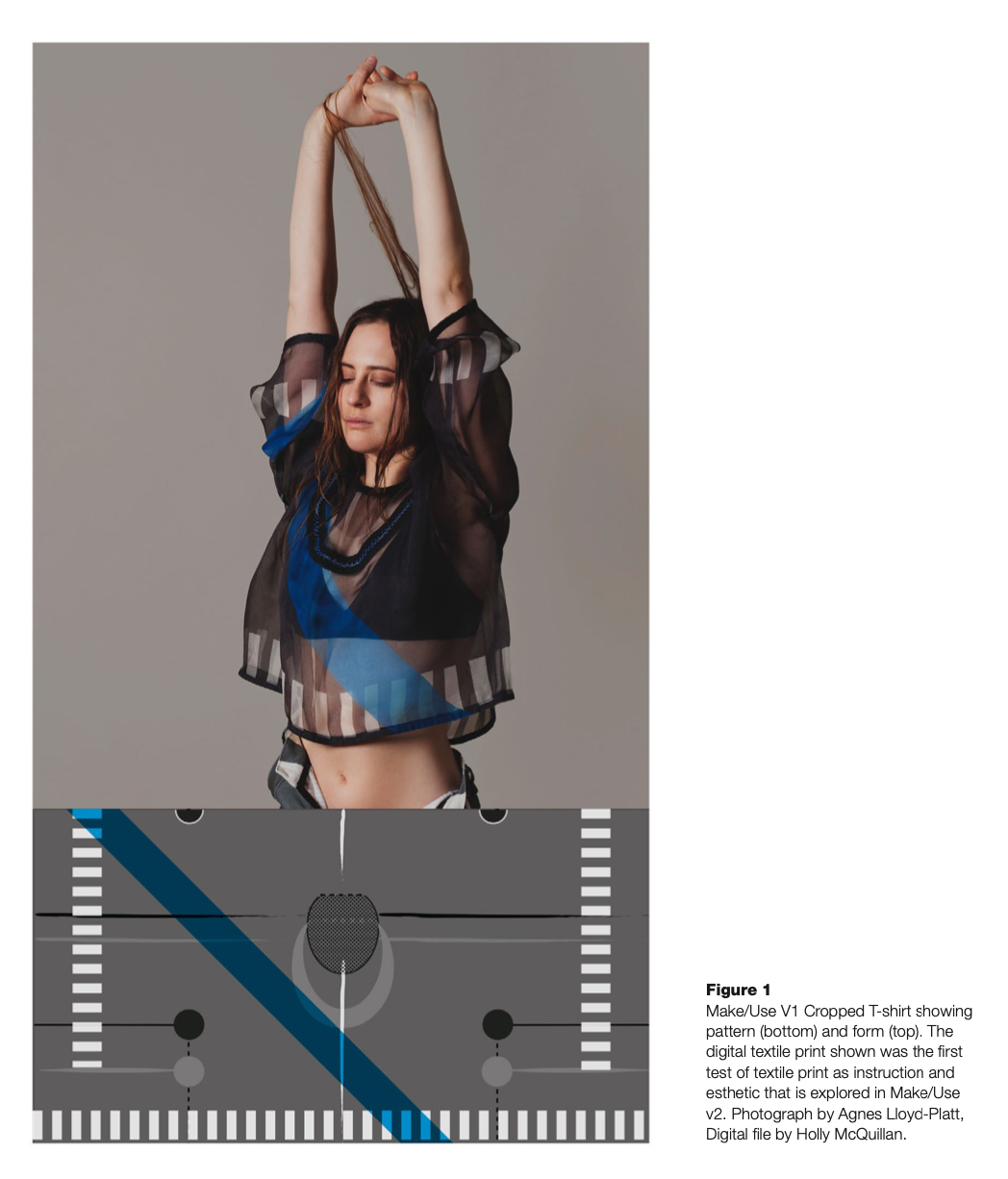
Figure 4.1. Make/Use Crop T-shirt showing the relationship between the zero-waste printed pattern and the resulting garment. Digital file: Holly McQuillan. Photograph: Bonny Beattie. Source: McQuillan et al. (2018).
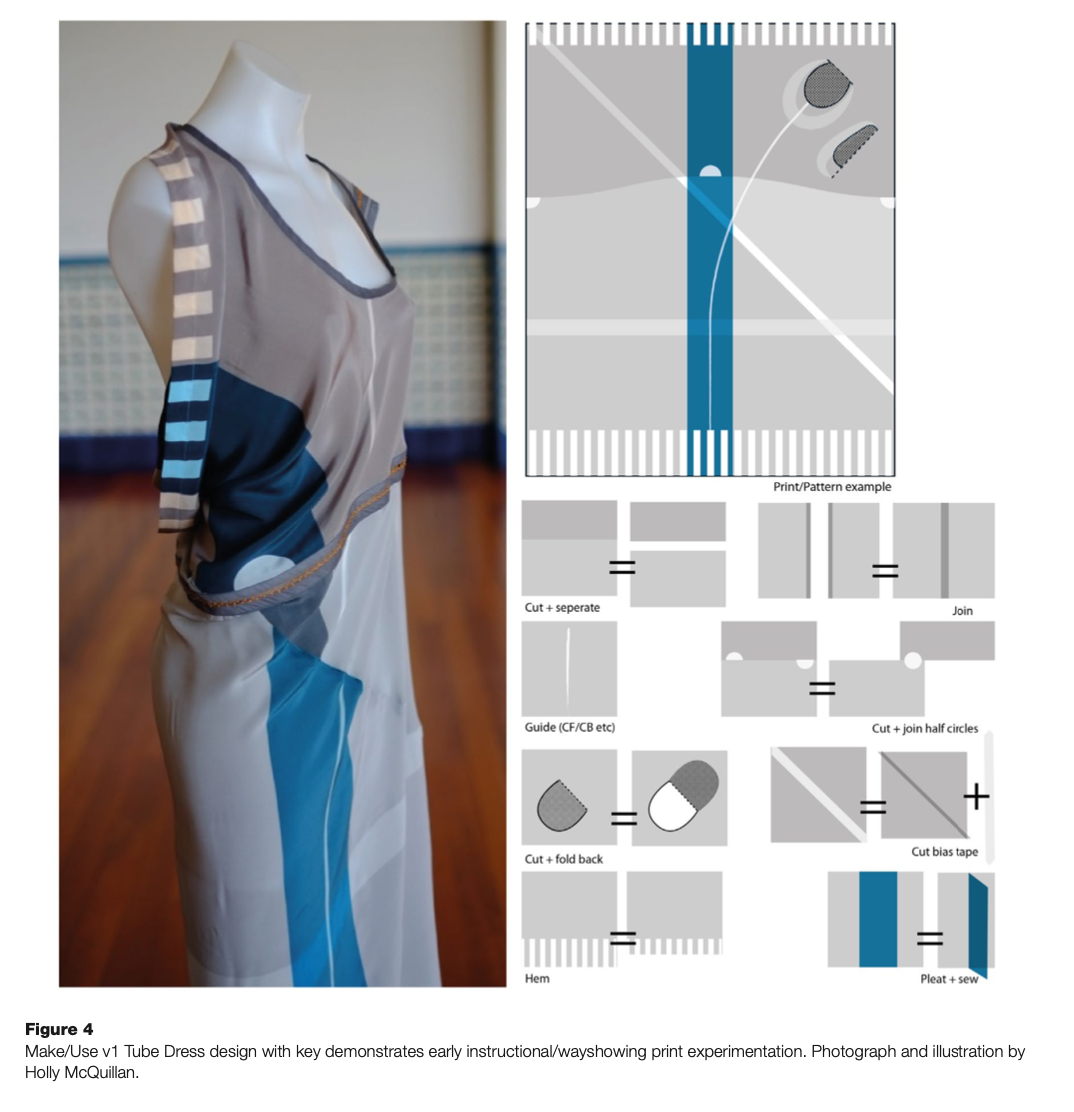
Figure 4.2. Make/Use v1 Tube Dress showing the embedded instructional system used to guide garment construction and modification. Photograph and illustration: Holly McQuillan. Source: McQuillan et al. (2018).
Source: McQuillan, H., Archer-Martin, J., Menzies, G., Bailey, J., Kane, K., & Fox Derwin, E. (2018). Make/Use: A system for open source, user-modifiable, zero waste fashion practice. Fashion Practice, 10(1), 7–33. https://doi.org/10.1080/17569370.2017.1400320
4.3.2 Digital pattern optimisation
Digital pattern tools allow designers to test fit, construction, grading and material use before physical production. CAD, automated nesting and 3D garment simulation can reduce sampling, reveal problems earlier and improve marker efficiency. They are most effective when combined with good pattern architecture: software can optimise the placement of existing pieces, but deeper reductions may require changing garment geometry itself (McQuillan, 2019; McQuillan et al., 2018).
SMEs can begin with one repeat style, compare physical samples and fabric utilisation before and after digital development, and record any effect on lead time, fit and waste. Virtual results must still be validated against real fabric behaviour, production skills and final quality.
RESOURCE INSIGHT: Katty Fashion
Source: Katty Fashion Panel, Circular Society Summit, Berlin 2026; https://katty-fashion.com/
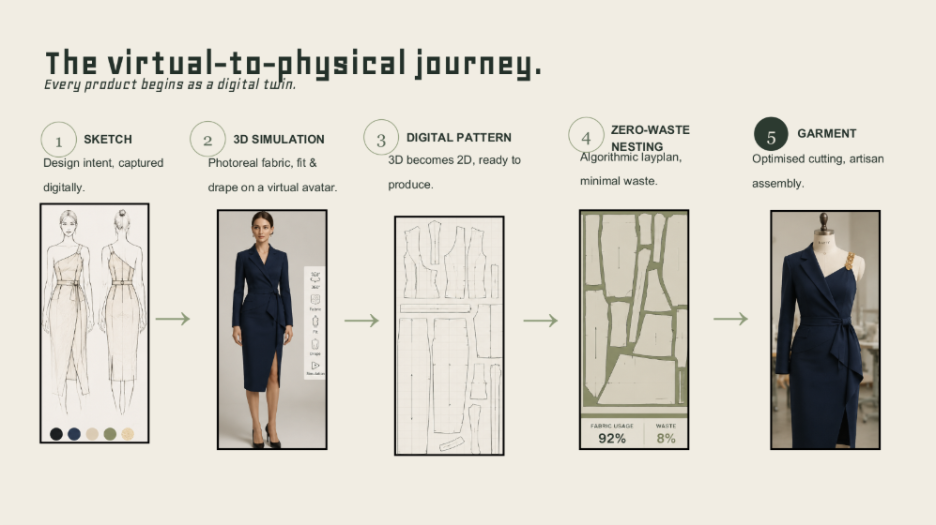
Source: Katty Fashion Panel, Circular Society Summit, Berlin 2026 https://katty-fashion.com/
For evaluation, compare fabric utilisation, number of physical samples, development time and fit corrections before and after digital optimisation. The result should show whether digital tools reduced total material and iteration, rather than merely shifting work between design and production.
4.4 Component architecture
Building on the garment anatomy introduced in Chapter 3, component architecture considers how the different parts of a garment are organised, connected and replaced.
Once the materials and components of a product have been identified, the next question is how they should work together as a system. A zip, lining, interlining, thread or label may perform a necessary function, but the way it is selected and attached can influence repair, replacement, disassembly and recovery.
This section examines two complementary strategies. Component standardisation and compatibility can simplify repair, replacement and material recovery, while modularity allows selected parts of a product to be removed, replaced or reconfigured during use.
4.4.1 Component Standardisation and Compatibility
Garments often combine materials and components with very different functions: main fabrics, sewing threads, linings, interlinings, zips, buttons, labels and decorative trims. These components may represent a small proportion of the total product weight but can strongly influence repairability and material recovery.
Circular product architecture aims to avoid unnecessary complexity. This may include reducing decorative components, using detachable fasteners, standardising frequently replaced parts and selecting trims or threads that are compatible with the main material or with the intended recovery process.
Standardisation can also support repair. When buttons, zips or other components can be replaced using commonly available parts, products are easier to maintain than when they depend on unique components that become unavailable after production.
However, material compatibility depends on the intended recovery route. A component that works well for one recycling technology may create problems for another. Designers should therefore consider available recovery processes rather than assuming that one construction solution is universally recyclable (Rahee & Sarker, 2024).
Reliable product information can support these decisions later in the value chain. Repairers, sorters and recyclers need to know what components are made from and how they are attached, but information cannot compensate for unnecessarily complex product architecture.
Product-level traceability and Digital Product Passports are discussed in more detail in Chapter 6, where their role in supporting sorting and recovery is examined.
RESOURCE INSIGHT Napapijri Circular Series: Napapijri is a company that designed an entire jacket, including fabric, padding, zips and trims from Nylon 6. The process involved creating entirely new components so the product can be recycled into nylon yarn in its entirety, bypassing the component compatibility challenge many companies face.
Source: Napapijri, Circular Series. https://www.napapijri.com/nl-nl/pages/veelgestelde-vragen-circular-series
4.4.2 Modularity
Modular designs treats garments as assemblies of interchangeable components rather than fixed products. Individual modules such as sleeves, collars, pockets, linings or functional inserts can be replaced, upgraded or reconfigured independently, extending product lifetime without requiring complete garment replacement.
This approach supports product adaptability, repairability and personalisation while reducing resource consumption associated with manufacturing entirely new garments. Modular product architecture also facilitates maintenance, refurbishment and remanufacturing, allowing products to evolve according to changing user needs or functional requirements.
To implement modular manufacturing successfully, designers should use compatible materials, standardized interfaces, and fastening systems that enable repeated assembly and disassembly without compromising product quality.
Modularity also changes how garments are produced. Instead of long runs of identical products, production becomes configurable: a factory makes a range of standard modules that can be combined into different end products. This requires flexible production lines that can switch quickly between modules and styles, and adaptable tooling, such as cutting templates, sewing jigs and machine settings, that can be adjusted rather than rebuilt for every new design.
In return, companies can offer customization, assembling garments to each customer's choice from existing modules instead of developing new products from scratch. The main challenge is balancing flexibility with efficiency, since every extra option adds changeovers, planning, and complexity. Companies therefore need to decide how much variety is worth offering and keep the number of modules and interfaces limited enough to stay productive.
RESOURCE INSIGHT:
Flavia La Rocca is an Italian fashion label that designs modular tops and bottoms joined by hidden zips, so the same pieces can be worn as a dress, an overall, a skirt or as separates. Instead of buying a new outfit, customers can recombine the pieces they already own or add a single new module, and everything is made to order to avoid overproduction.
Source: https://wwd.com/fashion-news/fashion-scoops/flavia-la-rocca-launches-e-commerce-made-to-order-sustainable-1235397337/
4.5 Architecture for longevity
Architecture for longevity focuses on the characteristics that help textile products remain useful for longer. Extending product life can reduce the need for replacement products, but longevity depends on more than physical durability alone.
Research on clothing lifespans shows that factors such as product quality, fit, frequency of use, maintenance, repair and continued user acceptance all influence how long a garment remains in active use (Laitala & Klepp, 2020; Vanacker et al., 2022).
Two complementary strategies are particularly important. Design for durability aims to ensure that materials, seams and components can withstand expected conditions of wear and care. Design for repair considers how a product can be restored when damage occurs.
These strategies need to work together. A physically durable garment may still leave use early if it no longer fits, is difficult to maintain or is no longer valued. Conversely, a damaged garment may remain in use when repair is technically possible and accessible (Cooper & Claxton, 2022; Ruiz-Pastor & Mesa, 2023).
For SMEs, architecture for longevity means designing products that can both withstand use and recover from failure.
4.5.1 Design for durability
Design for durability extends product life by matching materials, construction and components to the intended use. Teams should specify abrasion resistance, dimensional stability, colour fastness and mechanical strength, then ensure seams, threads, fasteners and high-wear areas can withstand repeated use and care. Timeless styling, adaptable functions and clear maintenance instructions can also reduce premature replacement.
Durability must be verified rather than assumed. Prototype testing, supplier evidence, wear trials, repair records and customer feedback help identify the failures that matter most. A longer-lasting product only delivers value when people continue to use it, so physical robustness, comfort, appearance and emotional relevance should be considered together (Laitala & Klepp, 2020; Vanacker et al., 2022). Results can inform minimum specifications and continuous improvement across later collections.
RESOURCE INSIGHT:
4.5.2 Design for Repair
Design for repair keeps garments serviceable through accessible seams, replaceable fasteners, durable thread and components that can be removed without damaging the product. Standardised parts, spare buttons or zips, repair instructions and clear material information reduce the time, skills and cost needed for maintenance.
Repair also depends on services and infrastructure. Brands can work with local repairers, offer in-house or mail-in services, provide spare parts and use recurring failures to improve future designs. Repair cafés and partner workshops build practical skills and show where products are difficult to open, diagnose or restore. For SMEs, piloting repair on one product category can test demand, pricing and logistics before a wider programme (Cooper & Claxton, 2022; Ruiz-Pastor & Mesa, 2023).
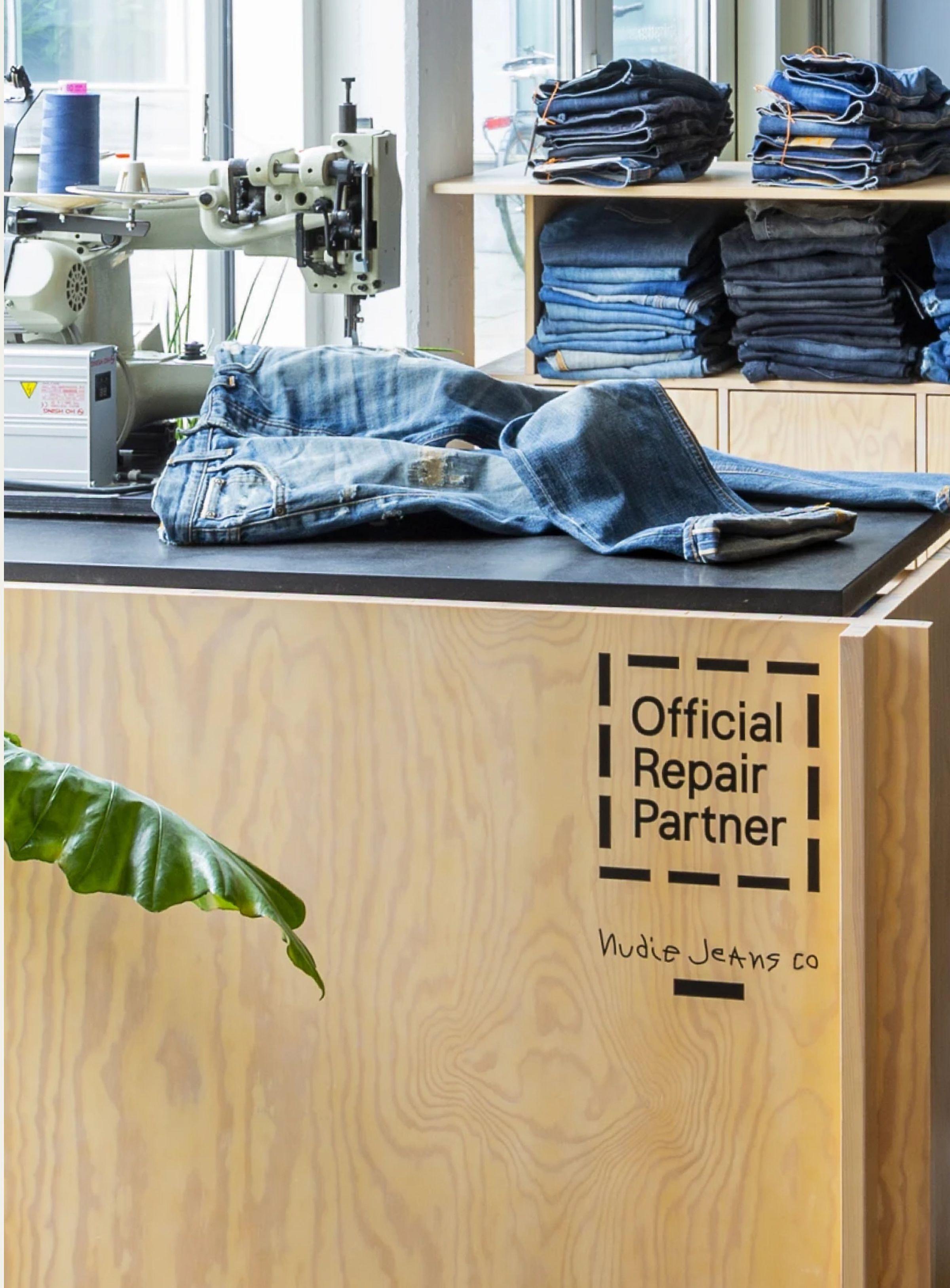
Figure 4.1. Repair in practice at a Nudie Jeans Repair Partner, where damaged jeans are restored using specialist sewing equipment rather than replaced. The case shows how repair services can extend product life when product design, spare materials and service infrastructure work together. Credit: Nudie Jeans. Source: Nudie Jeans, Repair Service.
Source: Nudie Jeans, Repair Service.
4.6 Architecture for recovery
Chapter 3 showed how material combinations, trims and finishes influence the recovery potential of a textile product. Architecture for recovery takes the next step: designing the product so that useful components and materials can actually be separated and recovered later.
Two questions guide this section:
Can the product be taken apart?
Design for disassembly considers whether useful components and materials can be separated without unnecessary damage.
Can those materials enter a realistic recovery process?
Design for recyclability and cyclability considers whether material composition and construction are compatible with available recovery technologies.
These decisions need to be made during product development rather than when the garment becomes waste. Circular apparel research similarly identifies disassembly, standardisation, repairability, remanufacturing and recyclability as interrelated product-design strategies (Rahee & Sarker, 2024).
4.6.1 Design for disassembly
Design for disassembly ensures that garments can be easily taken apart at the end of their useful life without damaging their components or materials. It is a fundamental principle of circular product design because effective repair, remanufacturing and fibre-to-fibre recycling all depend on the ability to separate garment components efficiently.
Designers therefore consider seam construction, fastening systems, trims, interlinings and material compatibility from the earliest stages of product development. Permanent bonding of incompatible materials should be minimised, while detachable fasteners and standardised components facilitate easier dismantling and material recovery.
In addition, disassembly procedures should be clearly documented through technical documentation, product specifications and Digital Product Passports, enabling manufacturers, repair centres and recyclers to identify appropriate disassembly methods and recover valuable materials more efficiently.
Disassembly information should be documented clearly so that future repairers, remanufacturers or recyclers can understand how relevant components are connected. Chapter 6 examines how this information can later support sorting and recovery systems.
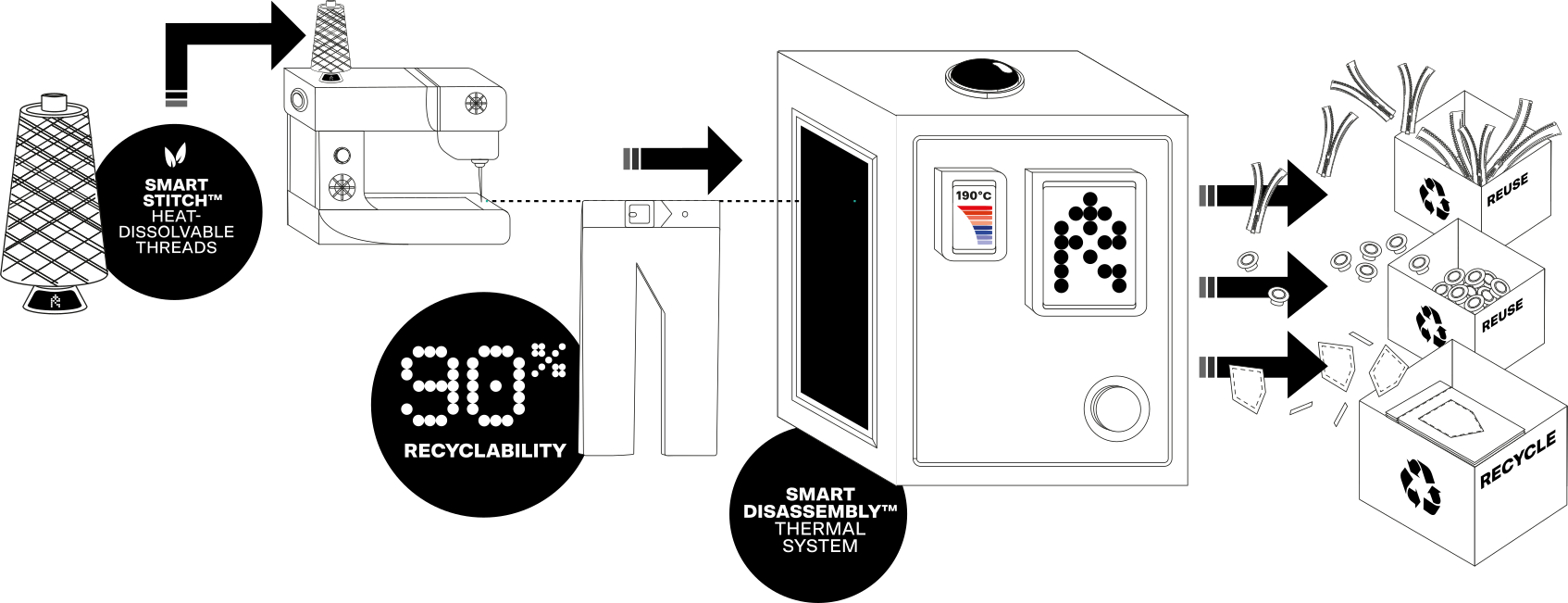
RESOURCE INSIGHT: Resortecs. Resortecs, a Belgian start-up developed sewing threads which dissolve at temperatures between 150 and 190°C, depending on the fabric. Garments sewn with these threads re heated in an industrial oven until the seams open at the end of their life . Zips, buttons and labels can then be removed without cutting or slow manual work. Brands such as Bershka and Decathlon have already used the threads in denim and ski jacket collections.
Source: https://www.eib.org/en/stories/recycling-clothes-resortecs
4.6.2 Design for cyclability
Design for cyclability ensures textile products and materials can re-enter the value chain after use. While durability extends product life, cyclability guarantees that when a product is no longer usable, its components can be effectively recovered, reused, remanufactured, or recycled. Together, these strategies maximize material value and minimize waste throughout the product’s lifecycle.
Cyclability begins at the design stage. One of the most effective strategies to improve cyclability is mono-material design, where a garment's main components are made from a single fiber type or fibers from the same family. Compared to complex blends, mono-material products are easier to sort, separate, and recycle with existing mechanical, chemical, or fiber-to-fiber technologies. When complete mono-material construction isn't feasible, designers should minimize complexity by selecting compatible fibers and components that are easy to disassemble.
Product architecture impacts cyclability by enabling easier disassembly. Standardized parts, detachable fasteners, and modular design allow garments to be repaired, upgraded, reused, or recovered without damaging the rest. Designers should reduce material complexity, avoid permanent bonds between incompatible layers, and choose sewing threads, interlinings, and accessories that facilitate material recovery.
Digital traceability further supports cyclability. Product labels, QR codes and Digital Product Passports (DPPs) provide essential information on material composition, construction methods and recommended recovery pathways. This enables manufacturers, repair services, remanufacturers and recyclers to identify the most appropriate circular strategy for each product.
Key Design Strategies for Cyclability
- Prioritise mono-material or compatible material combinations.
- Minimise permanent bonding and complex composite structures.
- Reduce unnecessary accessories and decorative elements.
- Use detachable and standardised components.
- Select compatible sewing threads, interlinings and trims.
- Design garments for easy disassembly.
- Clearly identify material composition through Digital Product Passports and product labelling.
- Consider available recycling technologies during product development.
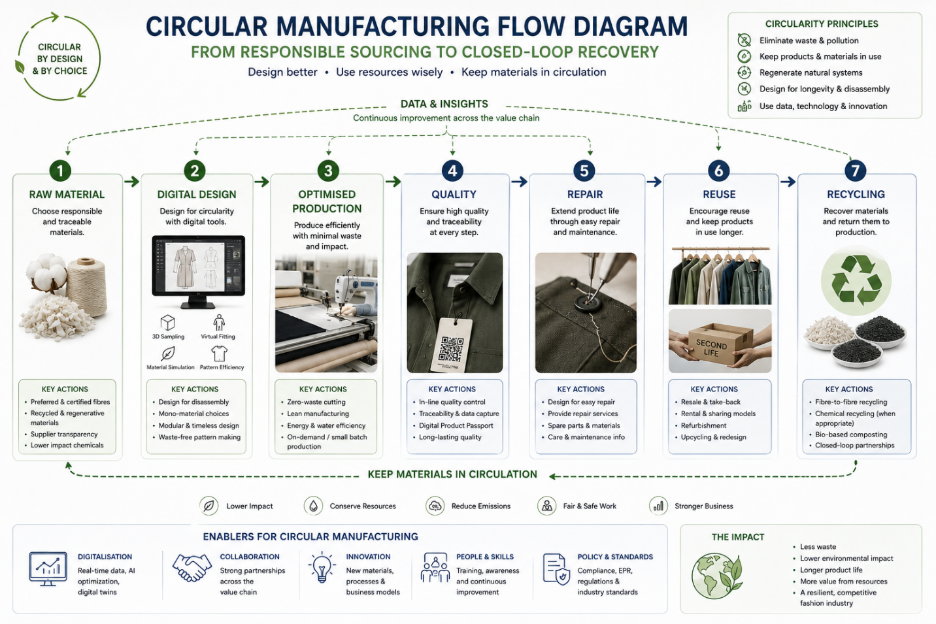
Figure 4.3 Circular Manufaturing Flow Diagram. Source FashionKIC, 2026
Tool - WRAP Textiles Design for Cyclability Toolkit
The toolkit is a practical resource designed to help businesses integrate recyclability into product development. It includes Clear design strategies to embed recyclability principles, Printable worksheets to guide action, and Future-focused insights, considering both current and emerging recycling technologies. WRAP Textiles Design for Cyclability Toolkit (six steps: materials, soft trims, construction, dyes/prints/finishes, hard trims, enable). Copyright WRAP. Source: https://www.wrap.ngo/resources/tool/design-recyclability-toolkit-fashion-and-textiles
It introduces six steps:
1 – Materials
2 – Soft trims
3 – Construction techniques
4 – Dyes, prints and finishes
5 – Hard trims and fastenings
6 – Enable
- Prioritise mono-material or compatible material combinations.
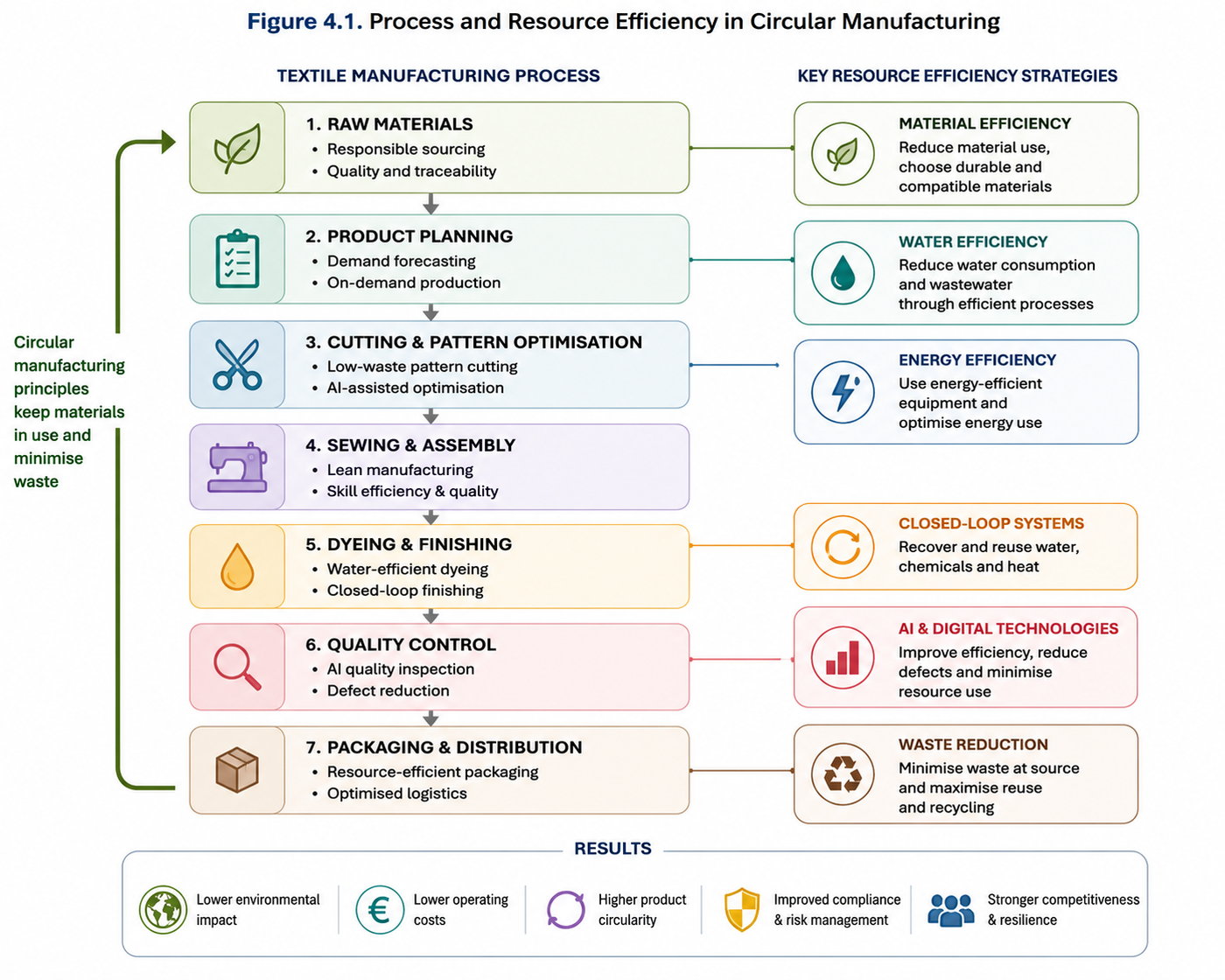
Figure 4.3. Design for cyclability — key design strategies that keep products and materials able to re-enter the value chain. Credit: FashionKIC, Design for Cyclability Diagram, 2026.
WRAP Textiles Design for Cyclability Toolkit (six steps: materials, soft trims, construction, dyes/prints/finishes, hard trims, enable). Copyright WRAP. Source: https://www.wrap.ngo/resources/tool/design-recyclability-toolkit-fashion-and-textiles