Chapter 7 — full chapter
Chapter 7 — Downstream Strategies: Value Retention and Recovery
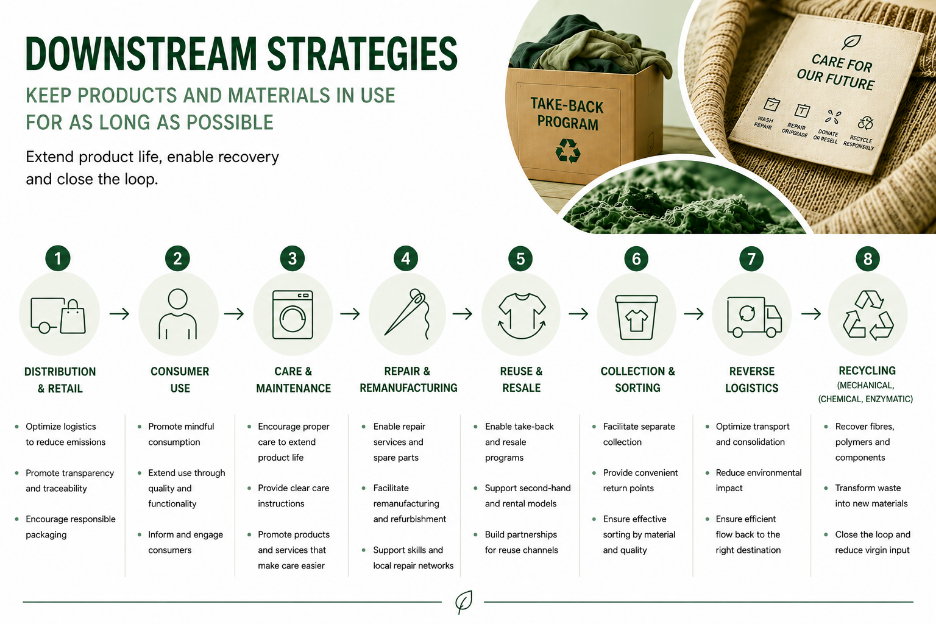
Downstream strategies address how products are distributed, used, maintained, recovered and transformed after production — from distribution and retail to consumer use and care, repair and remanufacturing, reuse and resale, collection and sorting, reverse logistics and recycling. Regulation (separate collection, EPR, the ESPR and the ban on destroying unsold textiles) is accelerating these practices, while economic, logistical and infrastructure challenges remain.
Chapter 6 ends where the product leaves production. Chapter 7 asks what has to exist after that point for the value created earlier to be preserved: how repair, resale, collection, sorting, reverse logistics and recycling services are designed, operated, measured and paid for, and how they connect back to product decisions. The conceptual pathways — multi-life design, inner and outer loops, the recovery hierarchy — are introduced in Chapter 1, and the instruments that shape them in Chapter 4; here the focus is implementation: service and route design, the actors and partnerships involved, the product information each route depends on, and the economics that decide whether a route is viable at all. Regulation is increasing responsibility for product design, information, unsold products and textile waste, which changes the conditions in which these services operate — separate collection, EPR, the ESPR and the prohibition on destroying unsold apparel do not make repair, resale or remanufacturing mandatory. Implementation remains uneven across Europe.
Reverse logistics is the management of the recovery operations that moves used or returned garments from consumers back to retailers, manufacturers or specialised recovery facilities. Reverse logistics supports take-back schemes, repair services, resale, remanufacturing and recycling by transporting products to the appropriate facilities. Reverse logistics is best understood as cross-cutting infrastructure rather than a late step in a sequence: it links take-back, repair, resale, remanufacturing, sorting and recycling, and its cost, speed and reliability often decide whether a service is viable at all.
Effective reverse logistics relies on integrated transport, handling and information systems that connect collection points, warehouses, service centres and recycling facilities. By optimising these return flows, companies can reduce transport costs, recover more products and materials, and support circular business models.
Guiding questions
- Which circular business models (rental, leasing, subscription, repair services) make most sense for our SME?
- How must product design change when we move from one-off sales to product–service systems over multiple life cycles?
- What organisational capabilities and partnerships do we need to support maintenance, upgrade, and take-back services?
- How can we design experiences and offers that encourage customers to participate in circular services?
In this chapter:
- 7.1 Distribution and Retail
- 7.2 Consumer Use, Care and Maintenance
- 7.3 Repair and Remanufacture
- 7.4 Reuse and Resale
- 7.5 Collection and Sorting
- 7.6 Recycling and Upcycling