Chapter 5 — full chapter
Chapter 5 — Upstream Strategies: Integrating the Brief before Production

Chapter 5 is the integration layer for the upstream stages. It shows when, by whom and with which evidence the principles introduced in Chapters 1–4: lifecycle thinking, circular design criteria, regulation and standards, claims and traceability, are translated into a design brief, a material decision, sourcing requirements and a production plan. Upstream decisions are made before manufacturing begins and many of them are high-leverage, although their relative weight depends on the product, the impact category and the system boundaries used in the evidence behind them.
Upstream decisions begin with the business model and market positioning: the value proposition, price point, quality level, expected volumes, collection rhythm, target customer and intended product lifespan. These choices shape the design brief, and the brief in turn constrains or enables the material, sourcing and production decisions that follow. This is where many high-leverage choices are made, since the relative weight of upstream, manufacturing, use and end-of-life stages varies by product type and impact category. Upstream activities run from raw material cultivation, extraction and fibre production to the decisions taken by brands during product development, material selection, sourcing and production planning.
Upstream strategies aim to minimize the environmental and social impacts embedded in products by improving material selection, product design, sourcing practices, and production planning before manufacturing begins. Key approaches include selecting materials against stated criteria (recycled or regenerative feedstock, verified chemistry, traceability), often labelled 'preferred fibres' in industry benchmarks such as Textile Exchange, a criteria-based sourcing label rather than a universal ranking, applying circular design principles, engaging responsible suppliers, integrating traceability and transparency, using environmental assessment tools during product development, and adopting sustainable procurement and production planning practices.
Different upstream strategies apply to raw material producers, fiber and textile manufacturers, and designers and brands. As this course focuses on strategies for brand owners, designers and SMEs, we summarize these upstream strategies into five main categories. These five areas are not equivalent sequential steps: business strategy and market positioning set the brief first, product design responds to it, and sourcing and production planning implement it. Evidence, measurement and collaboration cut across all five.
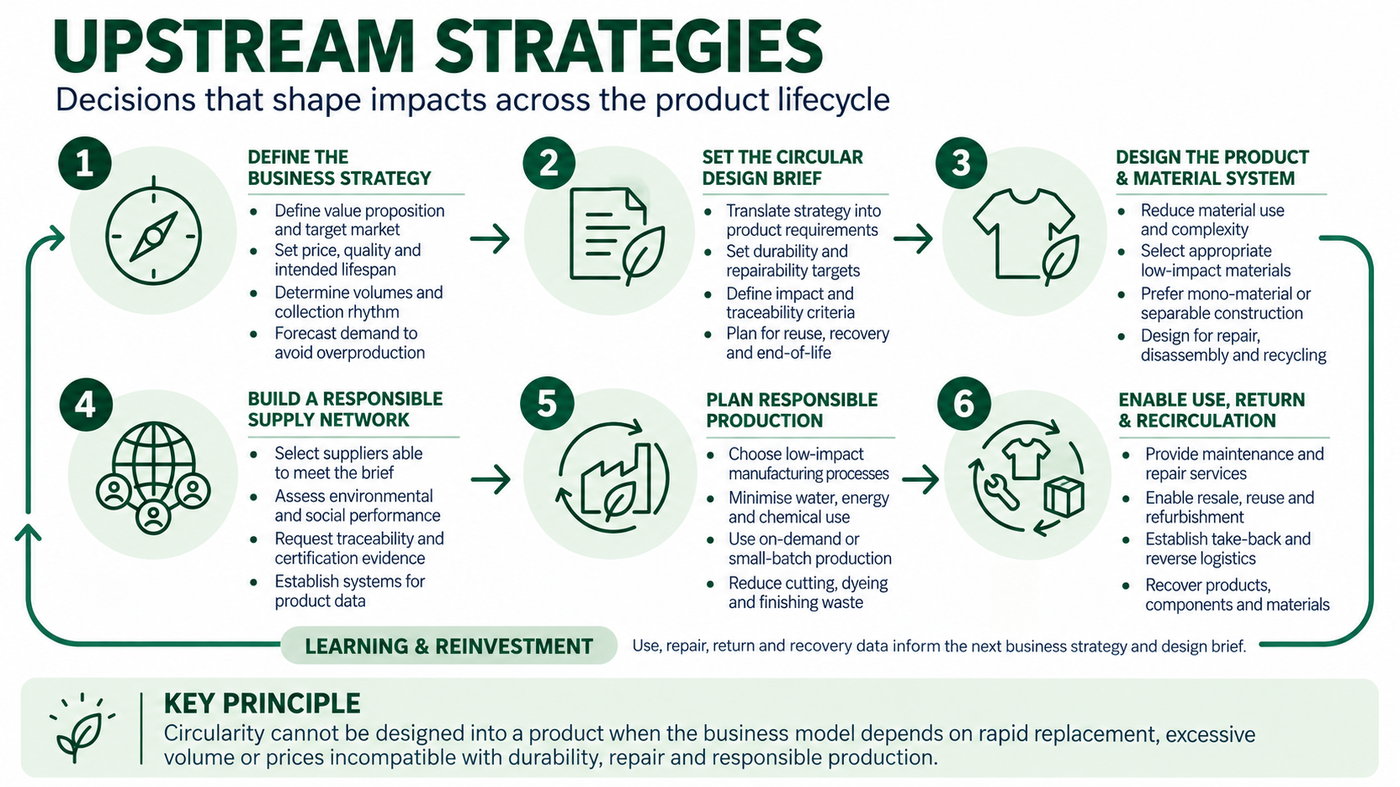
In this chapter:
- 5.1 Select Materials for the Intended Lifecycle and Impact Priorities
- 5.2 Design for Circularity
- 5.3 Source Responsibly
- 5.4 Define Manufacturing Requirements and Select Production Partners
- 5.5 Plan Responsible Business Strategies