Chapter 4 — full chapter
4.5.1 Case example: ARMEDANGELS - Building an Evidence Stack
ARMEDANGELS provides a useful European example of why one certification is rarely enough. The company uses different schemes for different material questions and combines them with supplier management, chain-of-custody systems, and social due diligence. Its 2025 Impact Report identifies a portfolio including GOTS, GRS, RCS, OCS and animal-fibre standards, with annual certification work conducted through Control Union. It also reports membership of Fair Wear and the use of TextileGenesis to support material traceability.
The standards are selected according to the claim and material. GOTS supports organic textile processing and defined environmental and social criteria. GRS and RCS support recycled-content verification and chain of custody, with different criteria and thresholds. Fair Wear supports the company's approach to labour-risk management and remediation but is not presented as a product certificate. TextileGenesis supports traceability infrastructure rather than replacing independent certification.
A particularly strong feature is disclosure of coverage rather than an undefined statement that all products are certified. For 2025, ARMEDANGELS reported that 51.3% of products were GOTS certified, 13% were GRS certified, and 1.72% were RCS Blended certified. Coverage figures make the scope visible and reduce the risk that evidence from one product group is generalised to the entire assortment.
The case also shows the limits of a standards portfolio. Certificates can verify defined inputs, processes or systems, but they do not decide whether the brand produces too much, whether a garment remains desirable, whether repair is accessible or whether a viable recovery pathway exists. Those questions still require circular design, business-model choices, due diligence, and transparent performance management.
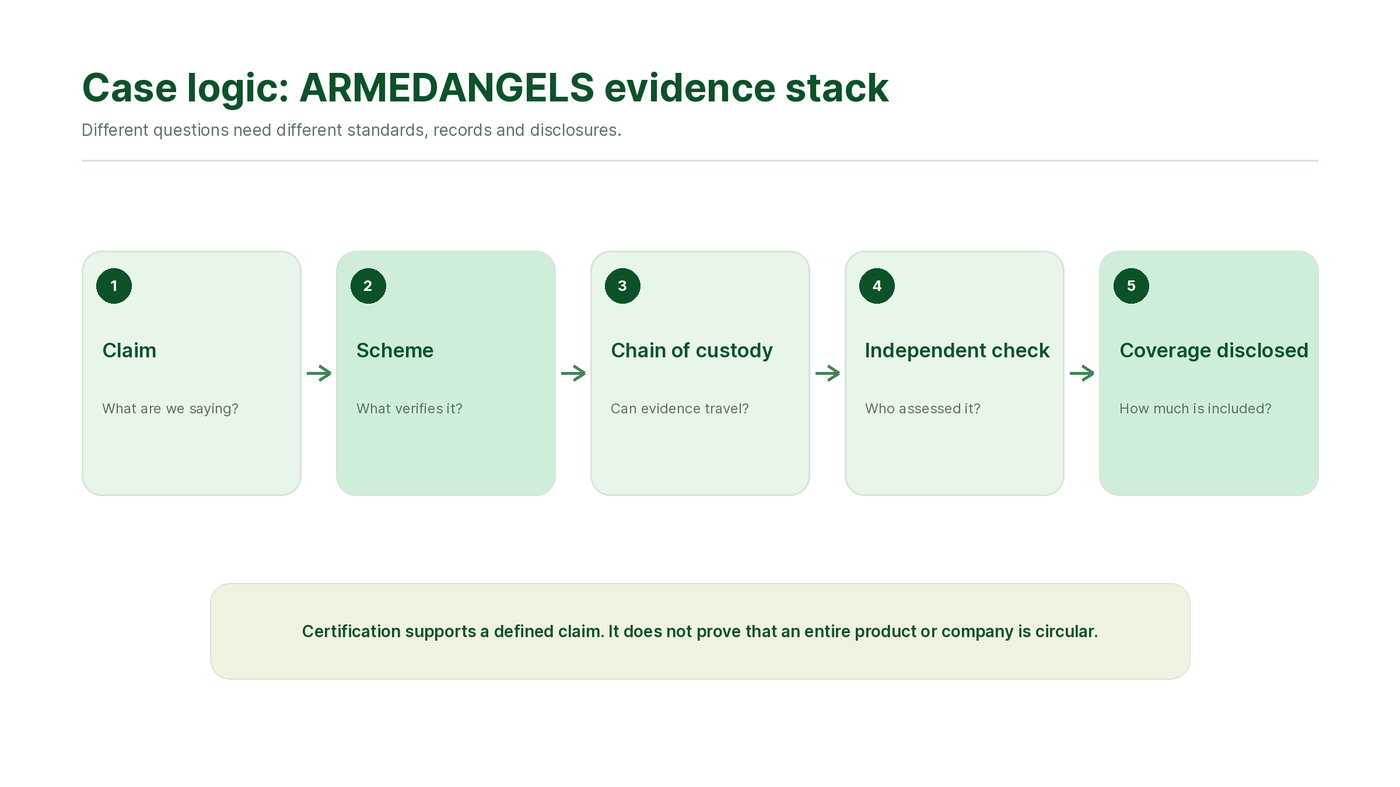
Figure X. ARMEDANGELS evidence stack. Credible communication connects a defined claim to an appropriate scheme, chain-of-custody records, independent assessment, and transparent disclosure of coverage.