Chapter 4 — full chapter
4.4.1 Technical Standards: Creating Comparable Evidence
Technical standards provide agreed terminology, methods, test conditions, and measurement principles. Unlike certification schemes, they do not necessarily result in a consumer-facing label. Their role is to make evidence more consistent and comparable across designers, suppliers, laboratories, brands, and markets.
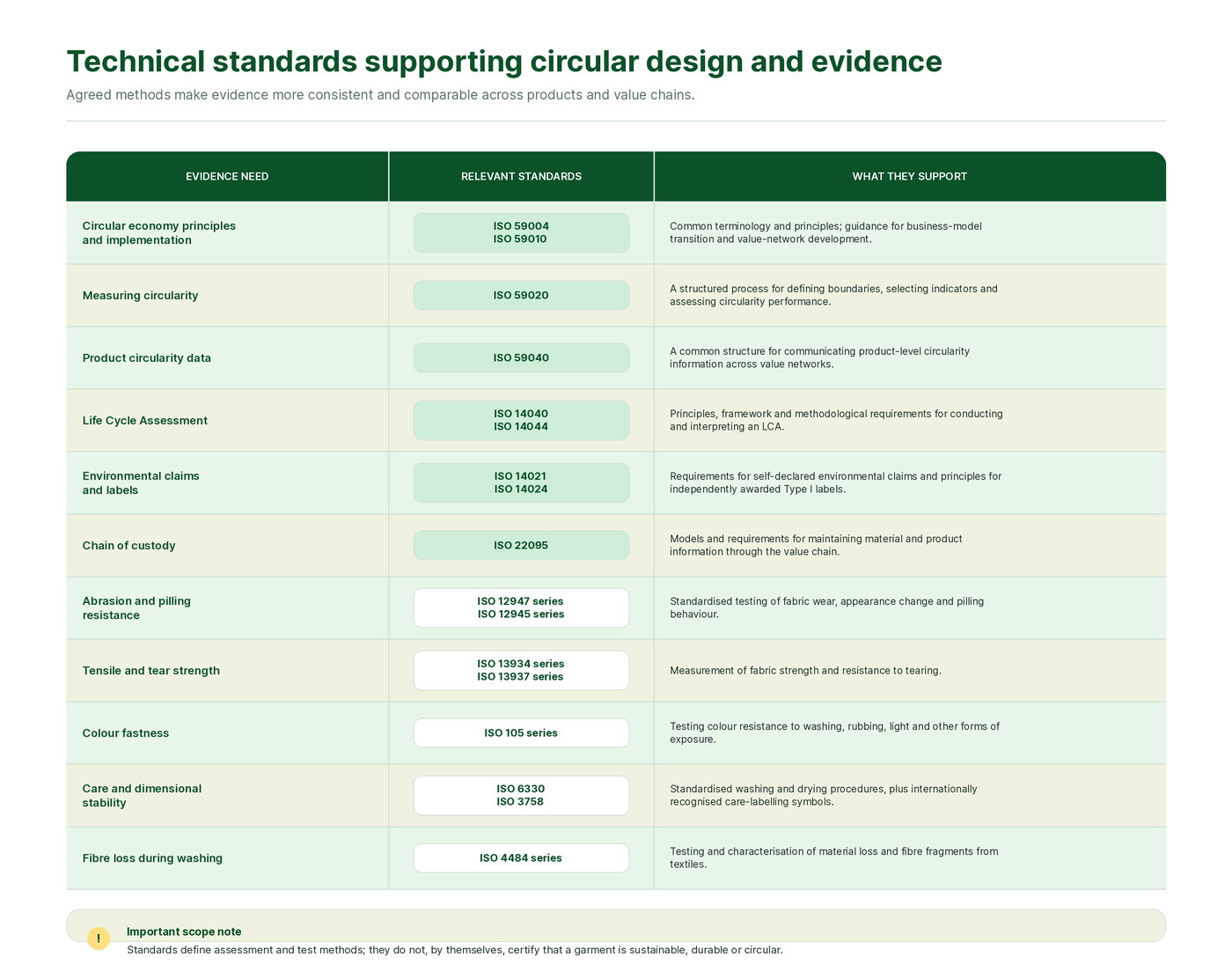
In circular fashion, standards can support different levels of decision-making. Some provide organisation-level guidance for implementing and measuring circularity. Others establish methods for Life Cycle Assessment, environmental claims and chain of custody. Textile-specific test standards can assess characteristics such as abrasion resistance, pilling, tensile and tear strength, colour fastness, dimensional stability, and fibre loss during washing.
These methods are particularly important because terms such as “durable”, “low-impact”, “recyclable” or “reduced fibre shedding” require more than an intention or material description. They require a defined test or assessment method, appropriate performance criteria, and evidence connected to the correct product.
A standard provides the method; it does not automatically determine whether the result is good enough. Companies must still define performance requirements appropriate to the product, intended use, and market. Standards are generally voluntary, but they may become contractually required or support compliance with legislation and future product-specific ecodesign requirements.
Table 3.3. Examples of standards and assurance tools