Chapter 3 — full chapter
3.6.2 Case Example — Resortecs: Enabling Design for Disassembly Through Smart Stitch™
Separating trims, fastenings and other non-textile components at end of use is often slow and expensive when done manually. Mechanical shredding can avoid manual disassembly, but may shorten fibres and mix recyclable textile content with trims, threads, and other contaminants. As a result, even garments made from potentially recyclable fabrics may not become suitable recycling feedstock.
Resortecs approaches this problem through design for disassembly. Its Smart Stitch™ system consists of heat-activated sewing threads designed to perform during normal production and use but release at specific elevated temperatures. The threads can be integrated using widely available industrial sewing machinery, allowing disassembly capability to be introduced during garment construction without fundamentally changing the appearance of the product.
At the end of use, garments can be processed through the company’s Smart Disassembly™ thermal system. In a controlled low-oxygen environment, the threads release and enable textile panels to be separated from components such as zips, buttons, labels and elastic bands. This can produce cleaner and more consistent material streams for subsequent sorting and recycling.
The case demonstrates that end-of-use outcomes can be influenced by a decision as apparently small as the choice of sewing thread. Designers and product developers must anticipate which components need to remain secure during use, which should be replaceable for repair, and which must eventually be separated for recycling.
However, design for disassembly does not create a circular system by itself. Garments still need to be collected, identified, sorted, and directed towards compatible disassembly and recycling infrastructure. The recovered textile material must also meet the requirements of a viable recycling process and be connected to demand for the resulting output.
Resortecs therefore connects product architecture with industrial infrastructure. Its value lies not only in the thread, but in the relationship between an early design decision and a defined downstream process. The case shows designers that circularity can be embedded in construction details, while also demonstrating that those details only produce value when the wider recovery system exists.
In 2026, Resortecs announced a partnership with industrial thread manufacturer AMANN Group to support the industrialisation and distribution of its design-for-disassembly approach. This development reinforces a central lesson of the chapter: circular innovation reaches scale through coordination between designers, manufacturers, technology providers, waste managers and recyclers, rather than through isolated product experiments.
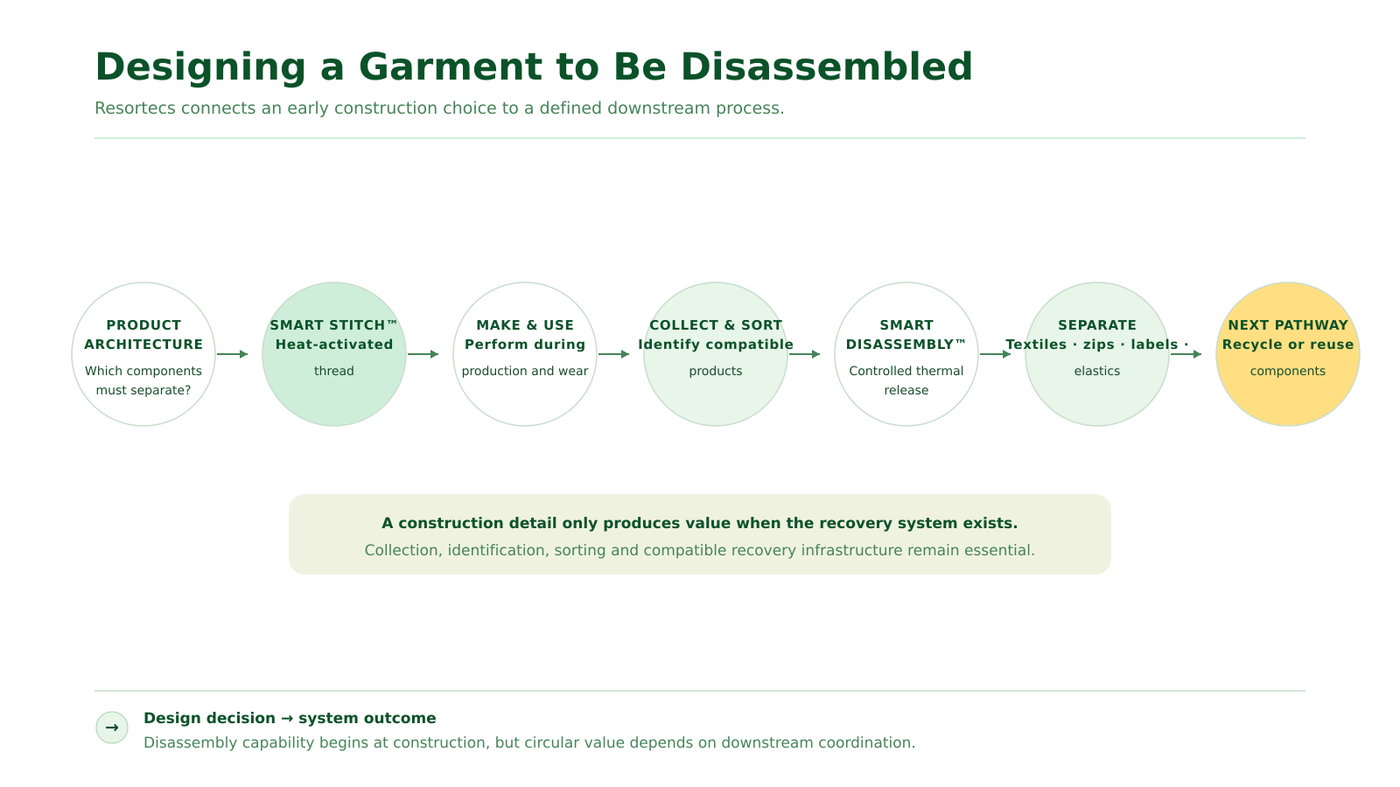
Figure X. Designing for disassembly with Resortecs. Smart Stitch™ introduces disassembly capability during product construction, while Smart Disassembly™ enables components to be separated at the end of use. The circular outcome still depends on collection, sorting, and access to compatible recovery infrastructure.
Critical Assessment
The Resortecs system responds directly to a recognised recycling bottleneck: the cost and difficulty of separating recyclable textile content from incompatible components. Nevertheless, its effectiveness should be assessed through evidence concerning:
- thread performance and durability during use;
- compatibility with different textiles and garment constructions;
- access to thermal disassembly infrastructure;
- collection and sorting volumes;
- energy requirements;
- purity and yield of recovered materials;
- compatibility with subsequent recycling processes;
- costs compared with manual or mechanical disassembly;
- demand for the recovered textile feedstock.
Reflection prompt:
At which point in the design and development process would Smart Stitch™ need to be specified? Which actors and infrastructures must remain connected for that decision to produce a circular outcome at the end of use?
Sources: Resortecs — Technology and Resortecs × AMANN Group
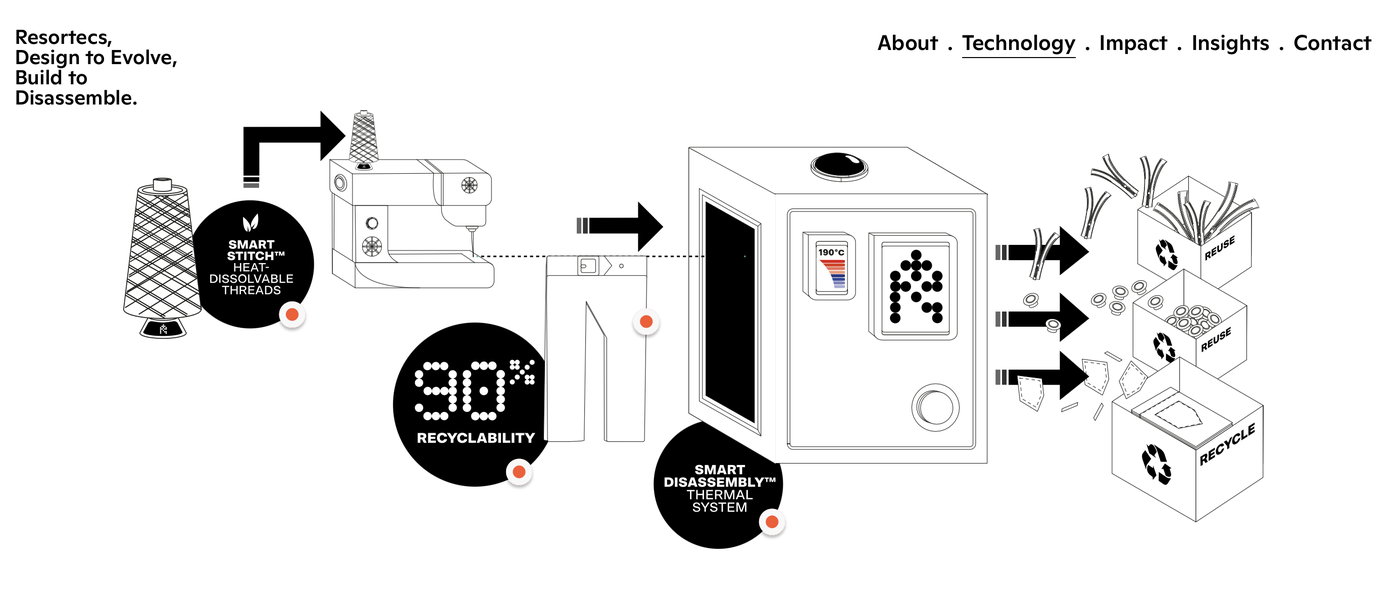
Figure X. Resortecs Smart Stitch™ and Smart Disassembly™ system. Heat-activated sewing threads allow textile panels and incompatible components to be separated through a controlled thermal process, supporting cleaner material streams for recycling. Source: Resortecs.

Video X. Resortecs design-for-disassembly process. The demonstration shows how a construction decision made during manufacturing can facilitate automated component separation when a garment reaches the recovery system. Source: Resortecs.