Chapter 3 — full chapter
3.6.1 ESG in Practice: Mapping Stakeholders and Material Priorities
ESG provides a practical lens for connecting circular design with wider organisational responsibility.
Environmental considerations may include material sourcing, water and energy use, chemical safety, waste, emissions, biodiversity, durability, and end-of-use recovery. Social considerations include working conditions, wages, worker safety, skills, accessibility, and the effects of production or waste systems on local communities. Governance concerns how decisions are made and supported through responsibilities, supplier requirements, data ownership, traceability, targets, and accountability for claims.
ESG does not replace circular design. It helps organisations understand the environmental, social, and governance conditions required to make circular strategies credible and achievable.
What is stakeholder mapping?
Stakeholder mapping identifies the people and organisations that affect, are affected by or hold knowledge relevant to a product, business model or circular pathway.
In circular fashion, stakeholders may include internal teams, fibre producers, suppliers, manufacturers, workers, customers, repairers, resale and rental platforms, logistics providers, collectors, sorters, recyclers, municipalities, regulators, industry networks, researchers and local communities.
Stakeholder mapping should not focus only on stakeholders with the greatest commercial power. Workers, communities, or other affected groups may have limited influence over company decisions but experience significant environmental or social impacts. Their perspectives may reveal risks, needs, or knowledge that an exclusively internal analysis would overlook.
For each stakeholder, learners should consider:
- How are they affected by the product or business model?
- What knowledge, capabilities, or resources do they hold?
- Which decisions can they influence?
- At what stage should they be involved?
- Could they enable or prevent the intended circular pathway?
- What form of engagement would be appropriate?
How to map stakeholders
A simplified stakeholder mapping process can follow four steps:
- Define the scope. Select the product, service, product category, or business decision being analysed.
- Map the value chain. Identify where materials, production, use, repair, collection, and recovery activities take place.
- Identify affected and influential stakeholders. Include internal decision-makers, value-chain partners, users, affected groups, and circular ecosystem actors.
- Map influence and dependency. Determine who controls relevant decisions, who holds essential information, and which external capabilities are required.
The result should identify relationships and dependencies, not merely produce a list of names. For example, a brand may want to introduce a take-back service but depend on logistics providers, sorters, resale partners and recyclers to determine what happens to the returned products.
What is materiality?
Materiality helps organisations determine which sustainability issues are significant enough to guide priorities, resources, targets, and decisions.
In a simplified circular design exercise, potential material issues might include fibre sourcing, durability, repairability, chemical safety, working conditions, traceability, water use, production waste, microfibre release, recyclability or access to circular services.
Double materiality considers two connected perspectives:
- Impact materiality: how the organisation, its products and its value chain affect people and the environment.
- Financial materiality: how environmental and social issues may create risks or opportunities for the organisation.
A sustainability issue may be material from either perspective or from both. For example, hazardous chemicals may create impacts on workers and ecosystems while also creating regulatory, reputational, operational, or financial risks for the company.
Learners can assess each issue through the following questions:
- What actual or potential impact occurs?
- Where in the value chain does it occur?
- Which people, groups or ecosystems are affected?
- How severe and likely is the impact?
- Does it create a business risk or opportunity?
- How urgent is the issue?
- Can product or business model decisions influence it?
- Is collaboration with another stakeholder required?
- What evidence is available, and what information is still missing?
From mapping to action
Stakeholder mapping and materiality assessment should lead to a decision, rather than ending with a matrix or stakeholder list.
The practical sequence is:
Map the value chain → Identify stakeholders → Assess impacts, risks and opportunities → Prioritise material issues → Define actions and indicators
The final output should connect four elements:
Material priority → Stakeholders involved → Design or business response → Evidence or indicator
For example, if repairability is identified as a material priority, the organisation may need to involve designers, manufacturers, repair partners, and users. The response could include replaceable components, accessible seams, spare parts, and a repair service. Evidence might include repair instructions, repair uptake, common failure points, and the percentage of products successfully repaired.
Stakeholder mapping identifies the people, knowledge and capabilities required to make circularity possible. Materiality helps organisations decide which issues deserve priority attention. Together, they prevent circular design from becoming a collection of isolated product features disconnected from real impacts, infrastructure, and business decisions.
Learning note: This simplified exercise introduces stakeholder mapping and materiality as strategic decision-making tools. It is not a substitute for a formal double materiality assessment conducted for regulatory reporting.
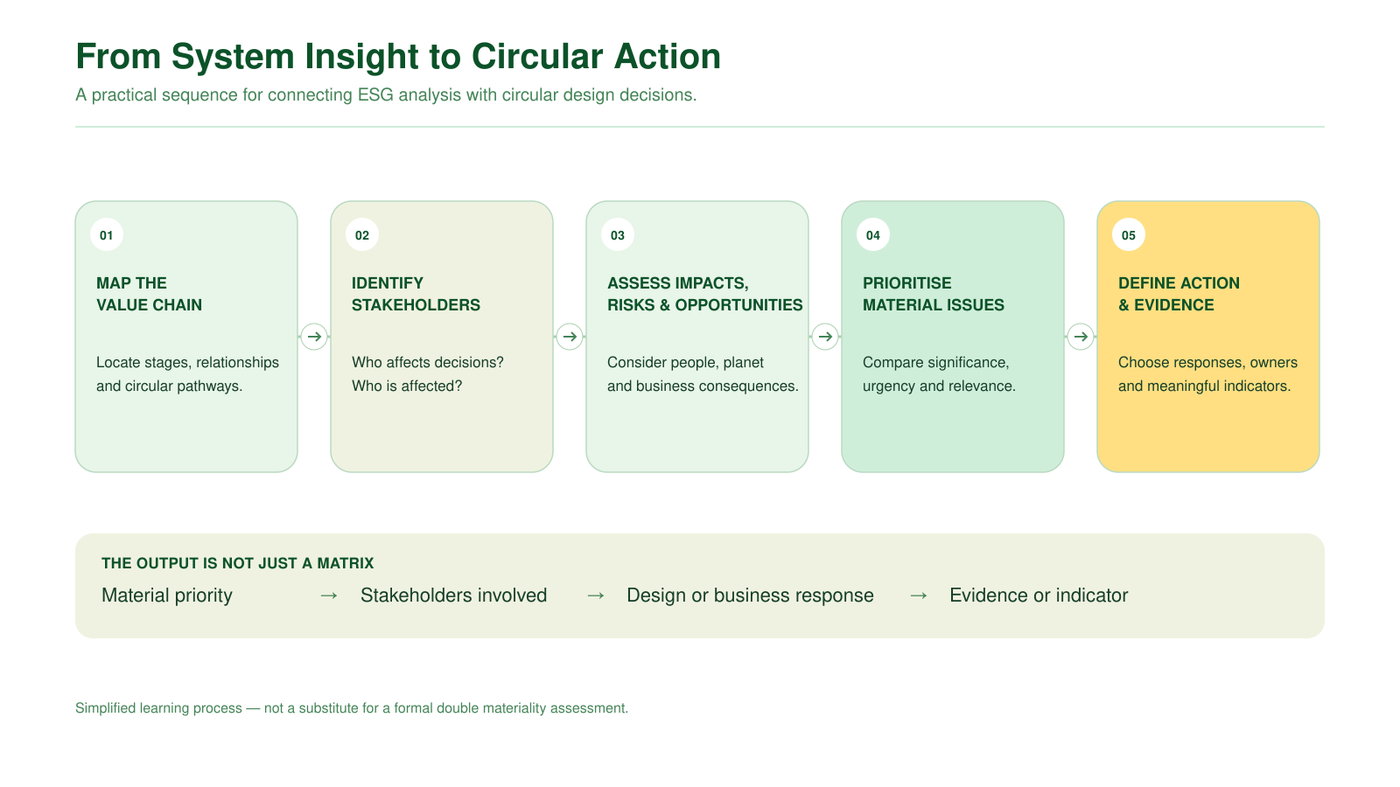
Figure X. From system insight to circular action. Stakeholder and materiality analysis connect value-chain hotspots with prioritised circular design actions, responsible actors and evidence.
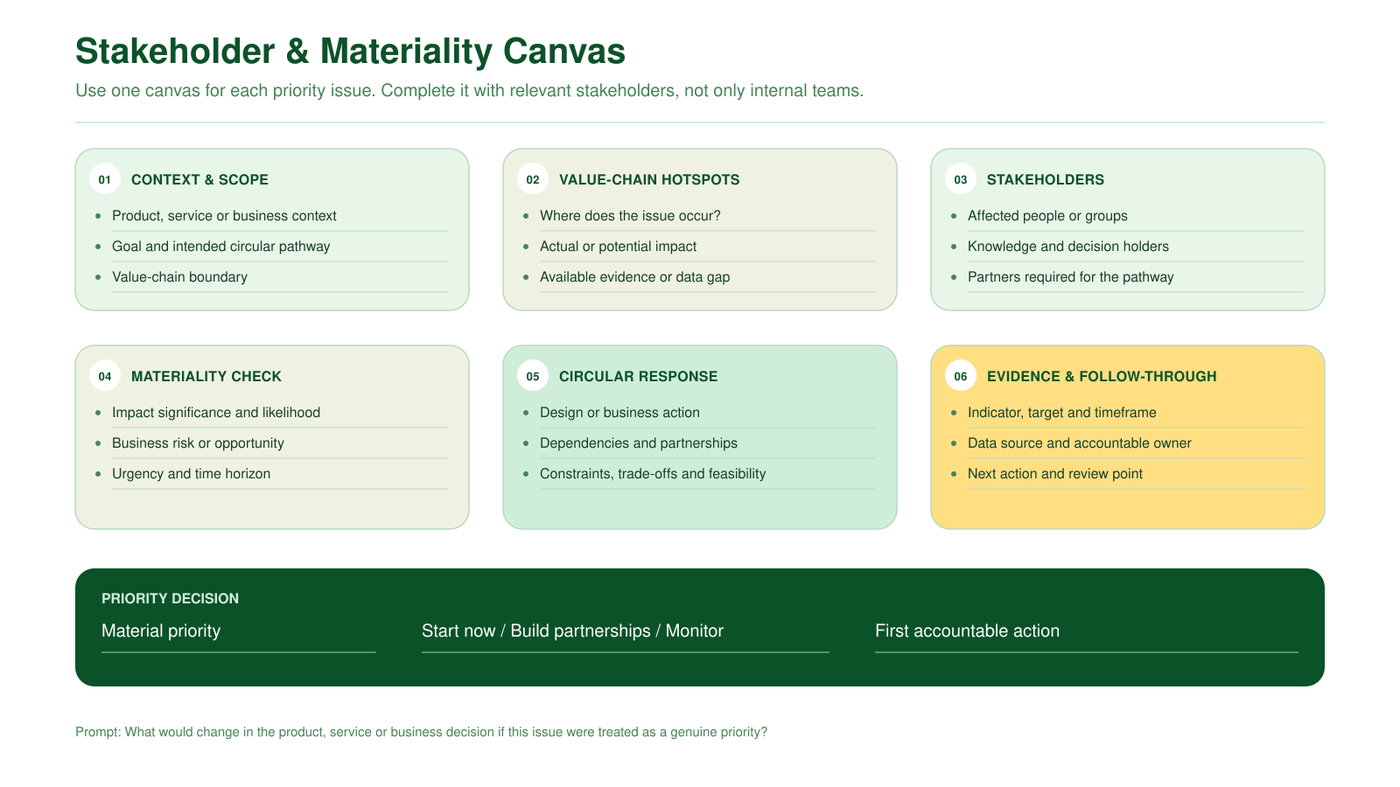
Worksheet X. Stakeholder and Materiality Canvas. A simplified tool for identifying value-chain hotspots, relevant stakeholders, material issues, feasible responses, and indicators.
Sources: EFRAG — Materiality Assessment Implementation Guidance, GRI 3 — Material Topics e OECD Due Diligence Guidance for Garment and Footwear.
Try it now
run a 20-minute stakeholder map for one of your products on paper or a free Miro board: list 8–10 stakeholders along the value chain, mark who can enable or block your chosen circular pathway (e.g., a take-back scheme), and note one engagement action per stakeholder. Then complete the free B Impact Assessment quick version (bcorporation.eu) to see which ESG areas your company scores lowest on.