Chapter 3 — full chapter
3.4 Environmental, Social and Economic Dimensions: What Can Be Material in Fashion?
Circular strategies need to be assessed across environmental, social, and economic dimensions at the same time. Improving performance in one area does not automatically improve the others. A material with lower environmental impacts may be more expensive or difficult to source at scale; a recycling process may recover valuable fibres while requiring significant energy, infrastructure and skilled labour; and a repair or resale model may extend product life but depend on logistics and service costs that are difficult for some businesses to absorb.
Social considerations are equally important. New circular activities — including sorting, repair, remanufacturing and recycling — create different forms of work and redistribute responsibilities across the value chain. Their contribution to circularity therefore depends not only on environmental outcomes, but also on safe working conditions, appropriate skills, transparency, and fair distribution of value.
For SMEs in particular, circular decision-making often involves balancing ambition with feasibility. Rather than searching for a universally “best” solution, businesses need to understand which impacts are most significant in their context, where trade-offs occur, what resources and partnerships are required, and which improvements can realistically be implemented and scaled.
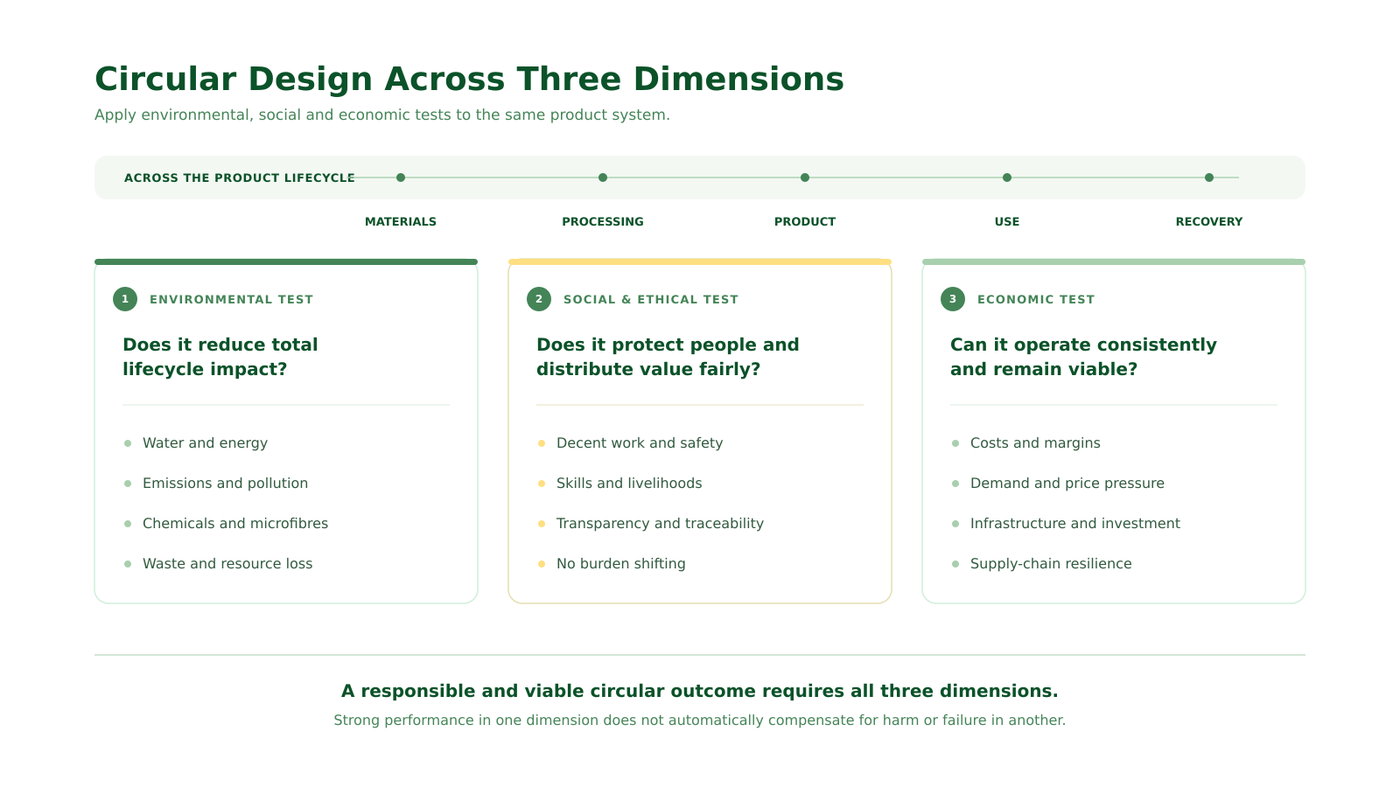
Figure X. Environmental, social, and economic challenges in circular design. Circular solutions must reduce environmental impacts, protect people, and distribute value fairly, while remaining economically viable throughout the product lifecycle. Progress in one dimension should not be achieved at the expense of another.
RESOURCE INSIGHT: Living Within Planetary Boundaries: The Circular Economy — Ellen MacArthur Foundation, 2025 (7-minute video). Six of the Earth's planetary boundaries have now been crossed, driven by the linear 'take, make, waste' system. This short film argues that because that system was designed, it can be redesigned: circular economy solutions - eliminating waste and pollution, circulating materials, regenerating nature - are already operating and can help turn things around. Source: