Chapter 3 — full chapter
3.2 Why Circular Fashion Is Difficult to Implement
Circularity is difficult to implement because it depends on interconnected decisions, actors, and systems. Circular outcomes for a product depend on the alignment of design, sourcing, production, use, collection, sorting and appropriate next-use or recovery pathways. Product-level design is essential, but it cannot enable circularity on its own.
Fashion is still shaped by systemic lock-ins, including linear supply chains, short product cycles, low-cost production, pressure on margins, fragmented data and dependence on external infrastructure for repair, collection, sorting and recycling. SMEs may also face limited budgets, restricted influence over suppliers, lack of technical information, and uncertain access to circular partners.
Product complexity does not affect every circular pathway in the same way. Multiple materials, bonded layers and complex trims generally make sorting, automated disassembly and fibre-to-fibre recycling more difficult. However, a complex or higher-value product may still be economically attractive to maintain, repair, resell, or remanufacture. This depends on its durability, desirability, construction, available product information, and access to appropriate services. Complexity should therefore be assessed in relation to the intended circular pathway rather than treated as a single measure of circularity.
Circularity must therefore be approached as both a design and coordination challenge. Learners should identify the intervention points they can realistically influence, such as product architecture, material choices, supplier requirements, care information, repairability, take-back partnerships, resale potential and data collection. They should also recognise where implementation depends on collaboration with suppliers, service providers, infrastructure operators, and other value-chain actors.
RESOURCE INSIGHT: Circular Economy Action Agenda: Textiles — Platform for Accelerating the Circular Economy (PACE), 2021. A multi-stakeholder roadmap that identifies 14 key barriers collectively slowing the textile transition and sets seven action areas, including incentivising design for longevity and recyclability, shifting to safe material inputs, and strategically planning collection, sorting and recycling operations. It frames circularity as a systemic challenge that no single company can solve alone. Source: https://environmentaldocuments.com/pace/circular-economy-action-agenda-textiles.pdf.
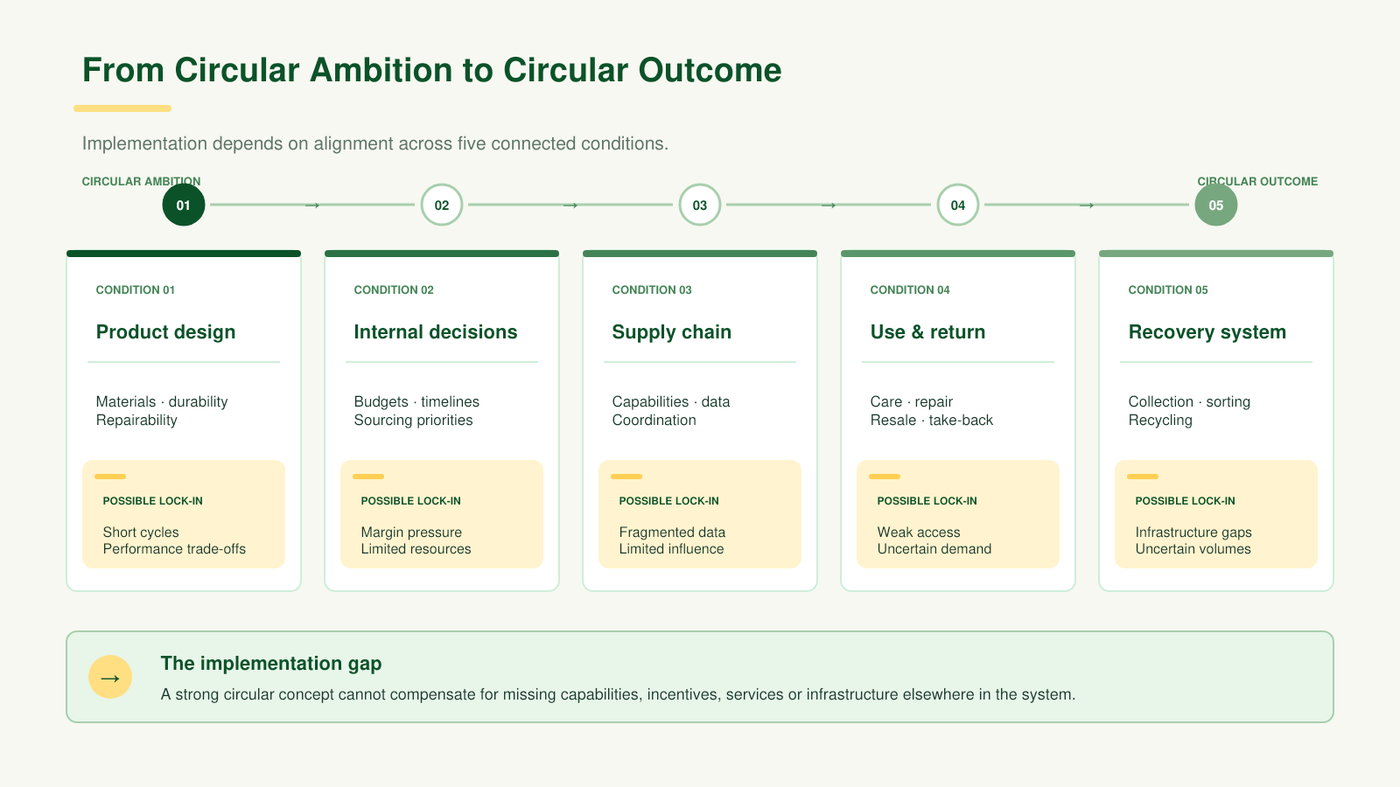
Figure X. From circular ambition to circular outcome. Circular design requires alignment between product decisions, organisational priorities, supply-chain capabilities, user-facing systems, and recovery infrastructure. Gaps in resources, incentives, data, services, or infrastructure can prevent technically viable ideas from achieving circular outcomes.