Chapter 3 — full chapter
3.1 Six Interrelated Challenges to Circular Fashion
Circular fashion is shaped by six interrelated challenge areas. These barriers appear across the textile value chain and cannot be addressed through isolated product-level changes.
The first challenge is technical and material. Fibre blends, coatings, finishes, adhesives, trims and complex product constructions can make garments difficult to identify, repair, disassemble or recycle. A material may offer durability or performance during use while limiting the product’s end-of-use options. Designers must therefore consider material compatibility, construction methods, and the intended circular pathway together.
The second challenge is systemic and organisational. Textile value chains are fragmented across fibre producers, mills, manufacturers, brands, retailers, users, repair services, collectors, sorters, and recyclers. Information and responsibilities are often distributed between organisations that use different systems or have limited visibility beyond their own operations. Brands and designers may influence product decisions but still depend on external infrastructure and collaboration to enable collection, repair, resale, or recycling.
The third challenge is environmental. Textile production and consumption are associated with resource use, emissions, water and soil pollution, hazardous substances, microfibre release, and waste. Circular responses can reduce some of these impacts, but they may also create trade-offs. Recycling, for example, requires energy, transport, and processing. Environmental improvements should therefore be assessed across the lifecycle to avoid shifting impacts from one stage to another.
The fourth challenge is social and ethical. Circularity should support safe working conditions, fair wages, appropriate skills, transparency, and fair value distribution. These concerns apply not only to conventional production but also to emerging circular activities such as collection, sorting, repair, recycling, and remanufacturing. A system should not be considered circular if environmental gains depend on unsafe work or the transfer of social burdens to lower-income regions.
The fifth challenge is cultural and behavioural. Fashion systems built around novelty, volume and short product cycles encourage underuse and disposability. Longer use may involve care, repair, reuse, resale, rental or return, but responsibility cannot be placed only on consumers. Products, services, communication, retail environments and policy conditions must make circular practices accessible, attractive, and convenient.
The sixth challenge is economic and implementation-related. Circular materials, technologies and services may involve higher initial costs, infrastructure investment, uncertain demand, limited margins, and new logistical requirements. SMEs may also have limited influence over suppliers, minimum order quantities, or downstream service providers. Implementation therefore depends on prioritisation, partnerships, organisational capacity, and viable business conditions.
These challenges interact. Technical choices influence environmental impacts and economic feasibility; infrastructure affects which design strategies are realistic; and social, cultural and organisational conditions determine whether circular solutions can operate at scale.
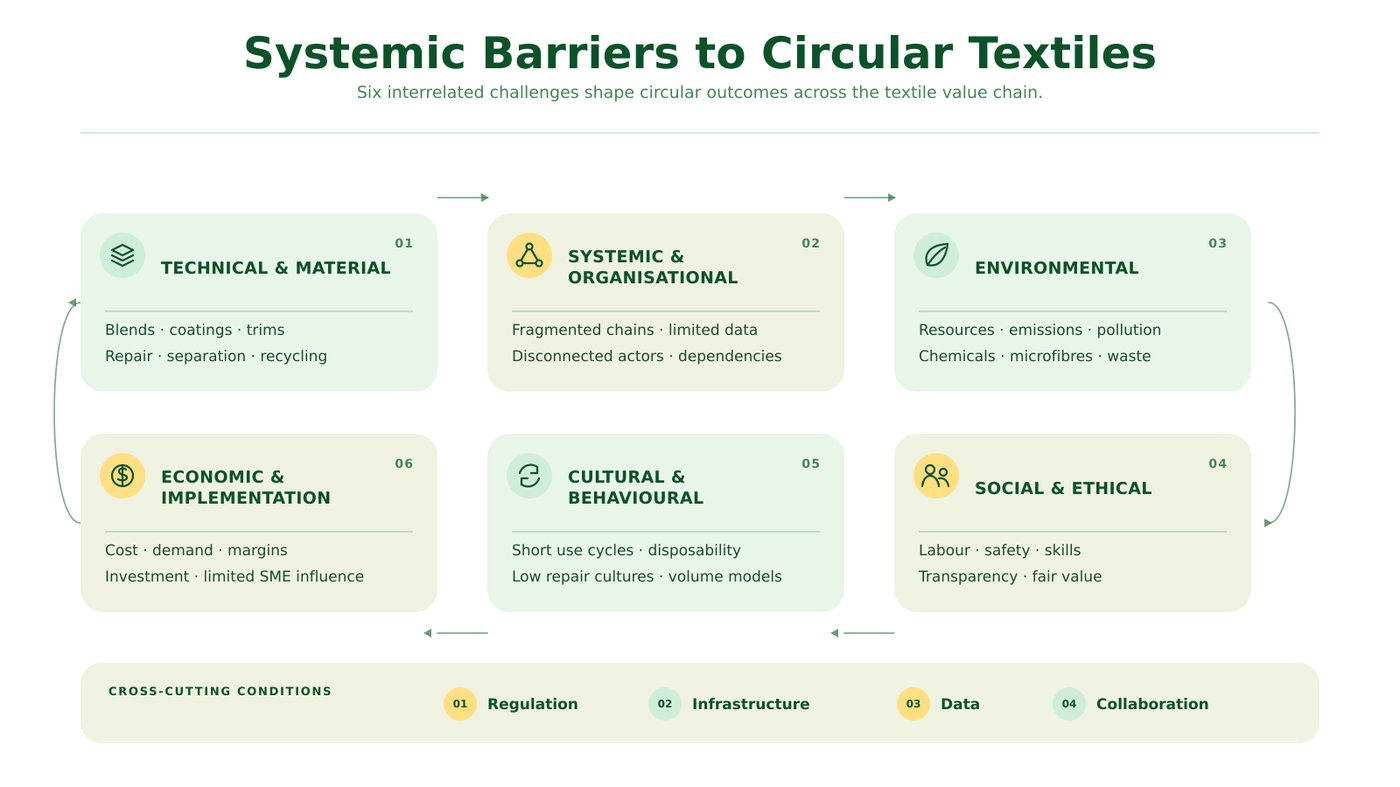
Figure 2.1. Systemic barriers to circular textiles. Six interrelated technical, systemic, environmental, social, cultural, and economic challenges shape the circular textile transition. Regulation, infrastructure, data, and collaboration act as cross-cutting implementation conditions.