Chapter 1 — full chapter
1.2 The Circular Textile Chain and Urban Textile Mines
To understand where circular value can be retained, recaptured, or lost, it is necessary to move beyond the individual product and examine the textile chain as a connected system.
The textile chain can be understood as a sequence of transformations: raw materials or polymers become fibres, fibres become yarns, yarns become fabrics, and fabrics are finished, cut and assembled into products. In a circular model, however, this is not simply a one-way chain. It becomes a system of potential loops through which products, components, and materials can circulate and retain value.
The idea of the “urban textile mine” adapts the broader concept of urban mining to textiles. Cities, households, wardrobes, resale platforms, donation systems, and post-consumer textile flows become reservoirs of embedded value. These textile stocks can feed take-back schemes, resale, rental, repair, remanufacturing, upcycling, and fibre-to-fibre recycling.
Source note: The term “urban mining” is commonly associated with the recovery of valuable materials from existing urban stocks and waste streams. It was originally used mainly in relation to metals, electronics and built-environment materials, and is here adapted to textiles as “urban textile mine”. In this module, the term refers to the value embedded in garments, home textiles, and post-consumer textile flows already circulating within cities and households.
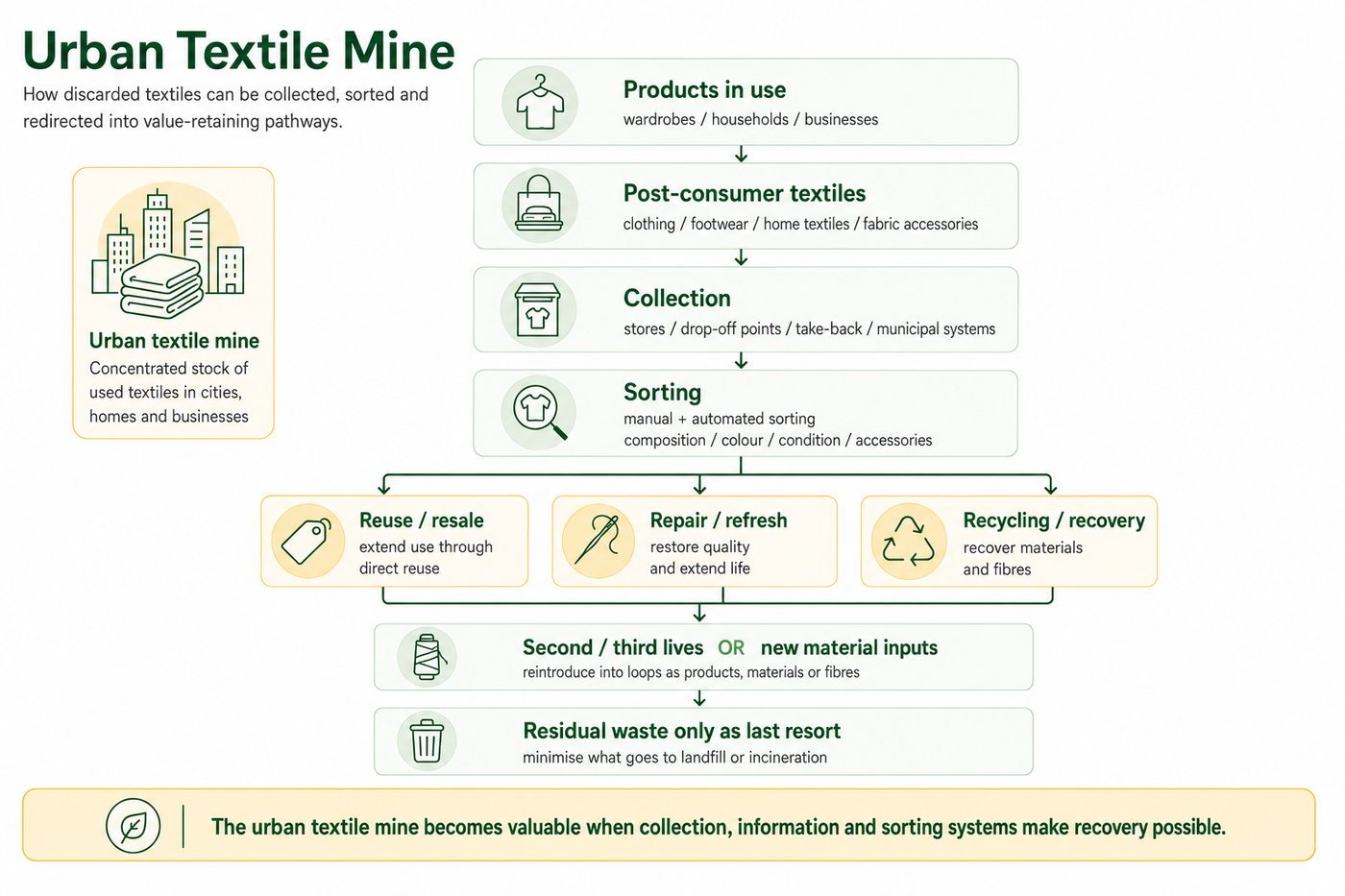
Figure 6. Urban Textile Mine — from discarded textiles to circular pathways. Urban Textile Mine: post-consumer garments, footwear, home textiles and fabric accessories as urban material stocks that can be collected, sorted and redirected towards reuse, repair, resale, recycling or recovery pathways.
RESOURCE INSIGHT: Circularity Gap Report – Textiles — Circle Economy. The global textile industry is trapped in a vicious cycle described as 'too poor, too much, too cheap': vast quantities of finite resources are turned into short-lived garments, and recycled textiles remain a drop in the ocean. Circle Economy's analysis shows that applying circular strategies could make the industry three times more circular, halve its environmental footprint and reduce textile waste. Source: https://circularity-gap.world/textiles.
RESOURCE INSIGHT: Our Vision of a Circular Economy for Fashion — Ellen MacArthur Foundation, 2023. The Foundation's vision asks the industry to design clothes that are used more, made to be made again, and made from safe recycled or renewable inputs. Getting there requires industry and government working together, significant investment, and system-wide transparency and traceability - the payoff is a resilient, thriving industry that regenerates the environment and creates distributed, inclusive growth. Source:
Source: https://www.ellenmacarthurfoundation.org/our-vision-of-a-circular-economy-for-fashion.