Chapter 1 — full chapter
1.1.1 Circular Business Models and Real-World Trade-offs
Circular design becomes commercially durable when product architecture and value capture are aligned. If a company earns only from the first sale, the financial return from repair, resale or multiple ownership cycles may accrue mainly to users or third parties, even though the company may still benefit through quality, reputation, compliance and lower material risk. Business models that include repair, resale, rental, take-back, refurbishment or product-as-a-service allow the company to participate more directly in the value retained after the first sale.
The appropriate model depends on the product and market. A brand does not need to operate every circular pathway itself, but it should identify who captures value, who carries the cost and which partners make repair, resale, return or recovery feasible. The design brief and the value-creation model therefore need to be developed together.
Circular design is also connected to business model choices. If a company depends on selling more new products every season, design decisions will often support short cycles and replacement. If the business model includes repair, resale, rental, leasing, take-back, or remanufacturing, the product must be designed differently from the start. It may require stronger construction, replaceable components, clearer material information, timeless or adaptable aesthetics, and systems that support return, sorting, and recovery.
In this sense, circular design is not only about materials or construction. It is about aligning product design, user experience, value creation, and recovery pathways. Circularity is therefore not an afterthought added at the end of a product’s life. It is a design logic that must shape decisions from the first brief.
However, circular fashion is not a frictionless transition: each strategy solves some problems while potentially creating others.
Designing for circularity requires navigating trade-offs rather than applying universal solutions.
FOR YOUR SME / BUSINESS CASE: concrete numbers first. A €60 T-shirt worn 30 times costs €2.00 per wear; worn 120 times it costs €0.50 per wear. According to WRAP, extending the active life of clothing by just 9 months reduces its carbon, waste and water footprints by roughly 4–10% each. For an SME this means: specify durability (seam strength, colour fastness) and repair information in the design brief now — it costs almost nothing at the drawing stage and shows up directly in fewer returns, fewer complaints and higher resale value later.
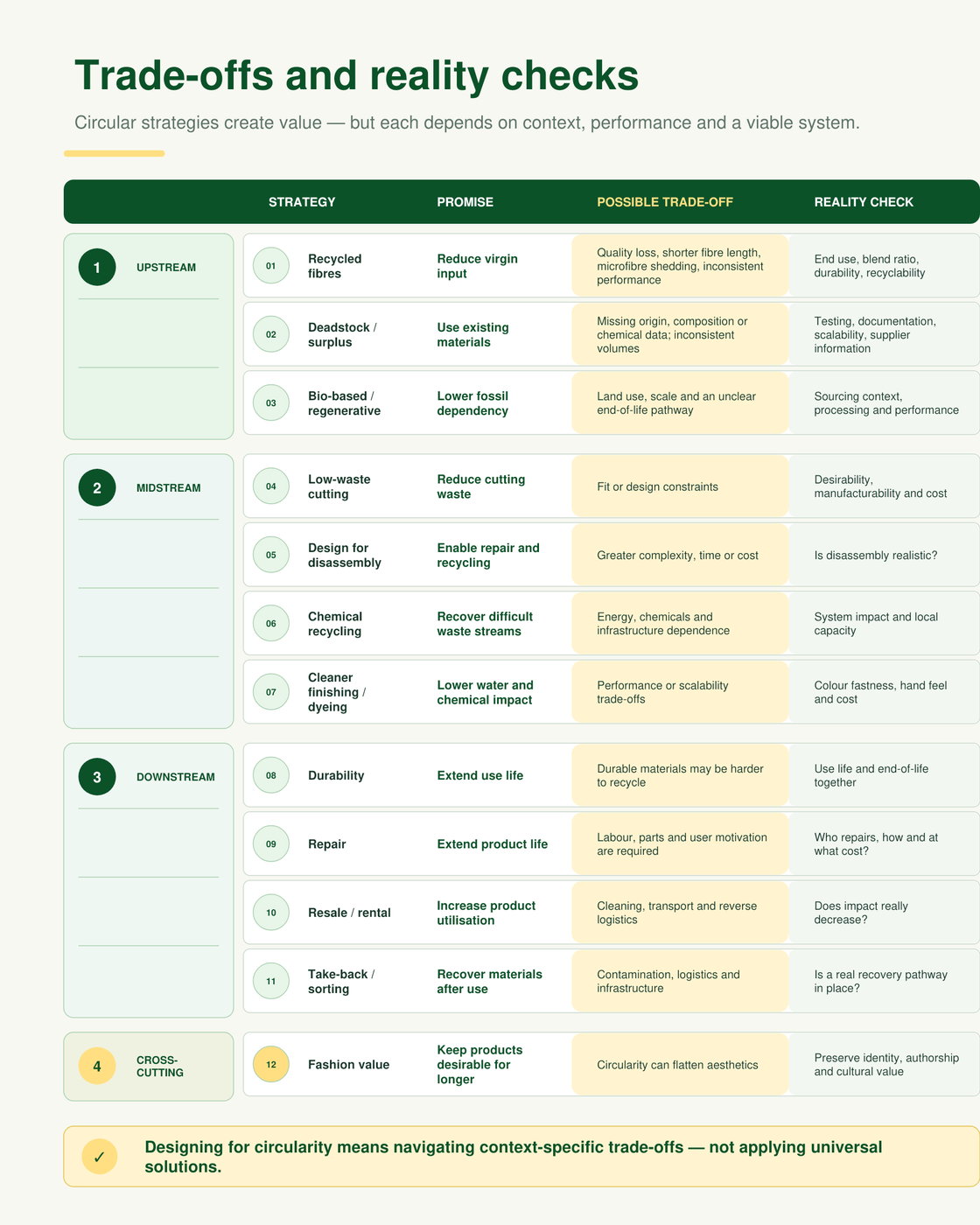
Figure 3. Trade-offs and Reality Checks in Circular Fashion. Circular design decisions rarely produce benefits across every impact area. A strategy may preserve product or material value while increasing energy use, transport, cost, or operational complexity. Trade-offs should therefore be assessed across the full lifecycle and in relation to the product’s intended use, expected lifespan, and available infrastructure.