Chapter 2 — full chapter
2.1 ESPR explained
This subchapter introduces ESPR from the ground up, explaining what the regulation covers, why the EU introduced it and how it establishes the DPP as a key tool for implementing sustainability requirements.
The Ecodesign for Sustainable Products Regulation (ESPR) is a landmark European Union framework policy designed to make products sold in the EU more durable, repairable, recyclable, and transparent. By replacing the older 2009 Ecodesign Directive, it expands the EU's environmental design standards from just energy-related appliances to virtually all physical goods placed on the market
The regulation introduces several sweeping changes to how products are designed, tracked, and managed across their lifecycles:
- Expanded Product Scope: Unlike the old directive which focused solely on energy use (e.g., washing machines and refrigerators), the ESPR covers almost all physical goods. Priority categories include textiles, furniture, steel, aluminum, tires, and electronics. Food, feed, and medicinal products are exempt.
- The Digital Product Passport (DPP): Products will require a mandatory digital passport (accessed via QR code or barcode). The DPP acts as a digital ID card, providing consumers, recyclers, and authorities with transparent data regarding a product's material composition, environmental footprint, and end-of-life recycling options.
- Ban on Destroying Unsold Goods: To curb waste, large and medium-sized corporations are banned from destroying unsold consumer goods, starting with clothing and footwear. Companies must also publicly disclose the volume of unsold products they discard each year.
- Circularity Criteria: New rules focus on specific sustainability factors, including a product's lifespan, the ease of disassembly, the restriction of "substances of concern," and the incorporation of higher recycled content.
For the Commission's own explanation of ESPR in its own words, watch the recording of its 22 May 2024 information session, or review the accompanying slide deck, both available on the Commission's ESPR page.
European Commission (n.d.) Ecodesign for Sustainable Products Regulation. Available at: https://commission.europa.eu/energy-climate-change-environment/standards-tools-and-labels/products-labelling-rules-and-requirements/ecodesign-sustainable-products-regulation_en (Accessed: 23 July 2026).
Why ESPR exists
- Replaces the old 2009 Ecodesign Directive, which only covered energy-related products (fridges, lightbulbs, boilers)
- Central to the European Green Deal and 2020 Circular Economy Action Plan
- Shift in logic: from "make products more energy-efficient" to "make almost all physical products durable, repairable, recyclable, and transparent"
- Entered into force 18 July 2024
What ESPR covers
- Scope: nearly all physical goods placed on the EU market
- Key exclusions: food, feed, medicinal products (human and veterinary), living plants/animals/microorganisms, products of human origin (blood, tissue, organs), and products already regulated by dedicated EU laws with equivalent ambition
- The Ecodesign for Sustainable Products and Energy Labelling Working Plan 2025-2030, adopted in April 2025, names the priority sectors: iron & steel, aluminium, textiles/apparel, tyres, furniture, and mattresses
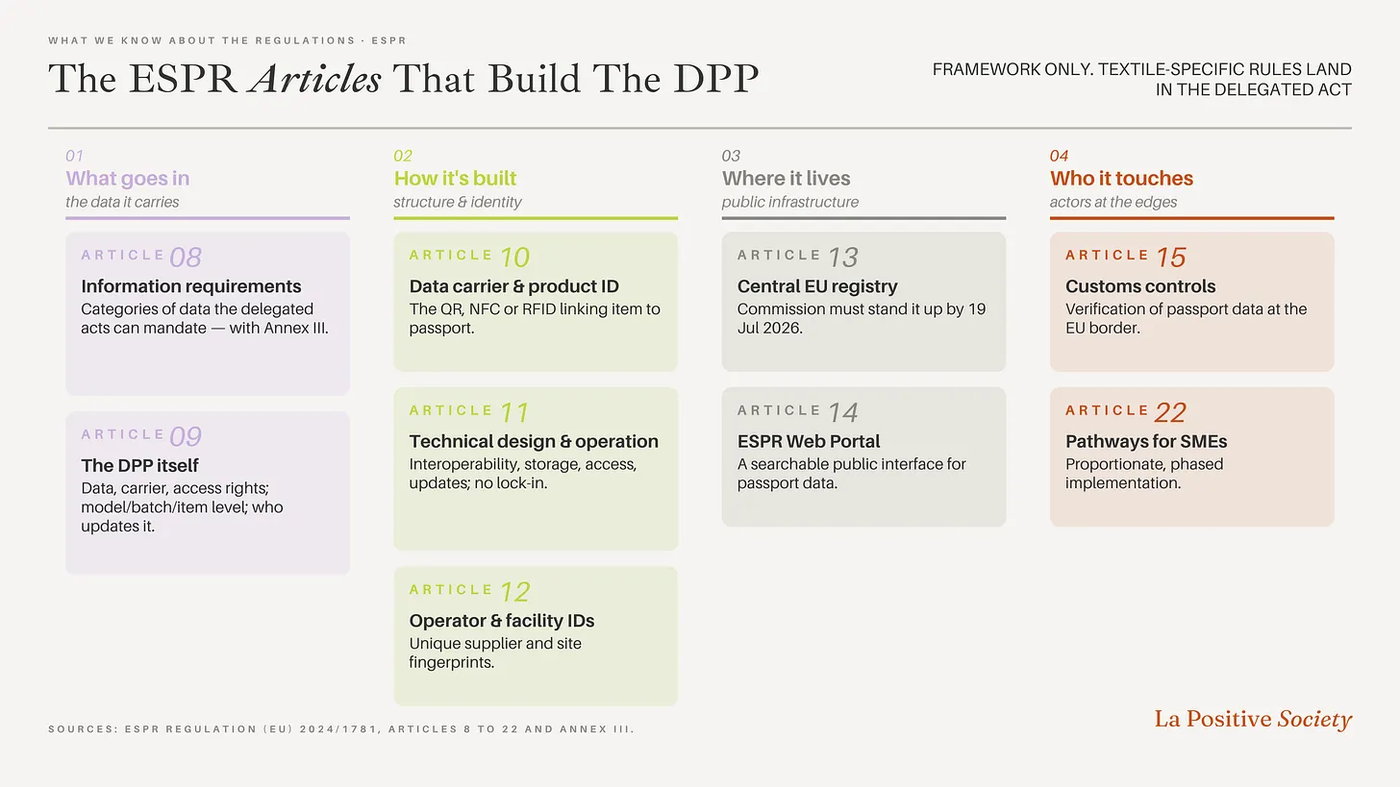
- Critical teaching point: ESPR itself sets almost no product-specific requirements. The regulation establishes that a passport is mandatory and defines how the system works - what a DPP is, how it's carried, where it lives, who can inspect it - but deliberately leave the content undefined. Which data fields, which carrier, which thresholds: those come later through delegated acts, sector by sector, because a t-shirt and a piece of furniture don't share the same durability or material-composition data.
How ESPR builds the Digital Product Passport
Timeline Reality Check
ESPR became law in 2024. That does not establish obligations for any given product today. Eco-design and DPP requirements in those sectors remain downstream, pending the delegated acts that will set them sector by sector.
A working example already exists. The Battery Regulation (EU 2023/1542) makes a digital "battery passport" mandatory from 18 February 2027 — for electric vehicle, light-transport and industrial batteries above 2 kWh. It's widely treated as the first real-world test case for how the textile DPP will function, since it's built on the same ESPR-style logic (unique identifier + structured data + access rights), just for a different product category. [Source: European Commission (n.d.) Batteries. Available at: https://single-market-economy.ec.europa.eu/batteries_en (Accessed: 23 July 2026)]