Chapter 4 — full chapter
4.1 Drivers and barriers to circular participation
Consumer behaviour is shaped by more than values. People may care about sustainability but still make choices based on price, convenience, aesthetics, identity, habit, availability, trust, or social pressure.
In fashion, this is especially important because clothing is emotional and cultural as well as functional. People use clothes to express identity, confidence, belonging, aspiration, or pleasure. Circular communication therefore needs to do more than provide information. It must make circular practices feel understandable, normal, and desirable.
This does not mean manipulating consumers or moralising behaviour. The aim is to understand what prevents people from participating in circular actions and how communication can reduce those barriers. A barrier may be practical, such as uncertainty about how a service works; perceptual, such as doubts about quality or desirability; or informational, when circular options are difficult to compare or understand. Communication can help reduce these barriers by making processes clearer, providing relevant evidence, and presenting circular choices in ways that feel credible and easy to act on.
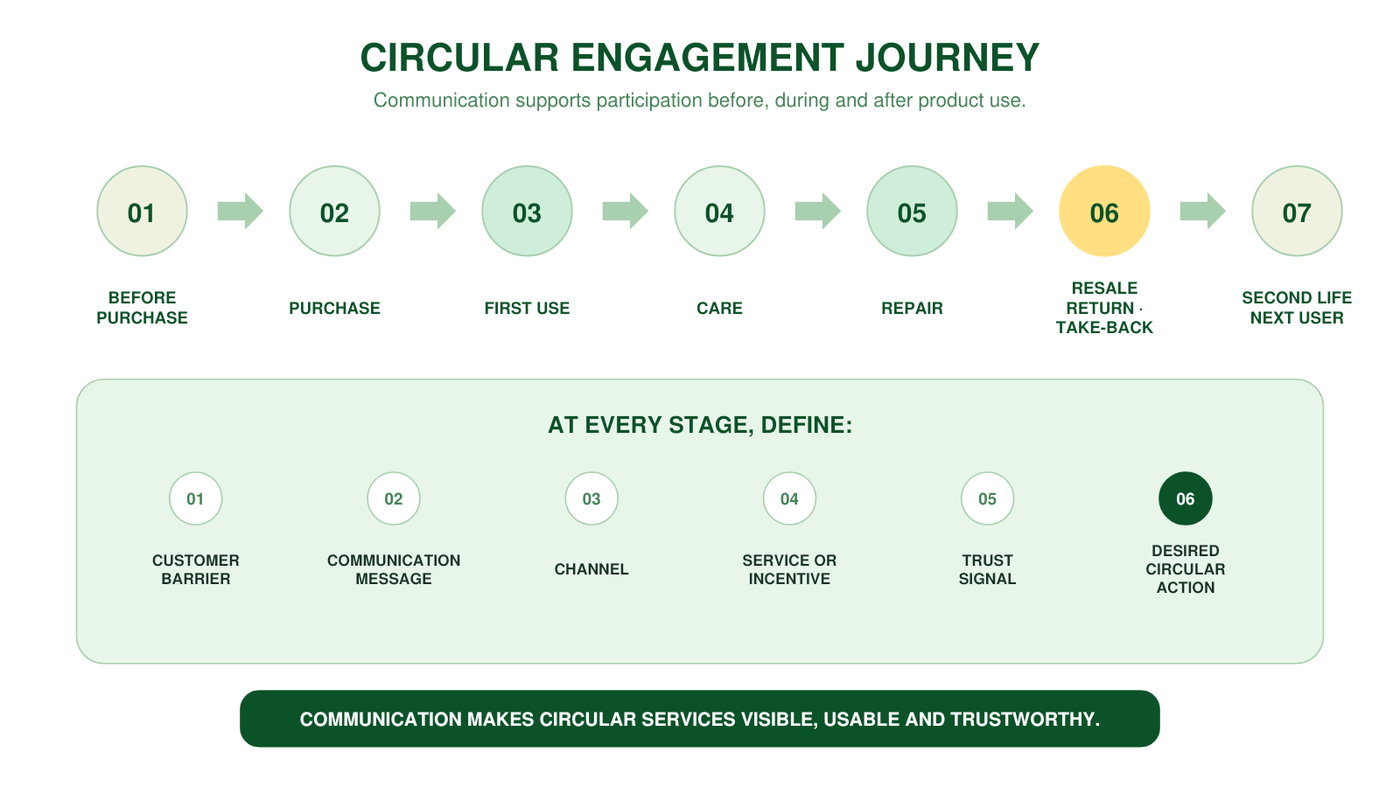
Figure 4.3. Circular Engagement Journey. Mapping barriers, messages, channels, services, incentives and trust signals across the product journey helps connect communication with the practical conditions required for circular participation.
RESOURCE INSIGHT: Keeping Customer Connections: Lessons from the Circular Economy — Ellen MacArthur Foundation (CE100). Customer relationships do not have to end at the point of sale. This CE100 collaborative project — including a 250-consumer survey across the US, UK, France and Spain — explores how repair, resale and take-back services keep products in use and customers engaged, converting one-off purchases into ongoing relationships and new revenue streams. Source: https://content.ellenmacarthurfoundation.org/m/4ce60e6f114ee252/original/Keeping-Customer-Connections.pdf.
PARTNER CASE STUDY: Exploring Sustainable Clothing Consumption in Middle-Income Countries — arXiv, Romania. Topic: Report / resource. This study of Romanian consumers, available on the open-access repository arXiv, maps what drives and what holds back sustainable clothing purchases, giving communication teams evidence on real barriers such as price, trust and convenience. It supports the drivers-and-barriers discussion by grounding it in consumer research from a middle-income EU market. Source: