Chapter 4 — full chapter
Chapter 4 — Consumer Engagement, Trust and Co-Creation
Chapter purpose
This chapter explores how communication can support participation in circular fashion practices such as care, repair, reuse, resale, rental, take-back, sharing, and co-creation.
The primary responsibility for the transition to circular fashion does not lie with consumers. Consumers cannot repair products that were not designed to be repaired, access services that do not exist, verify claims unsupported by evidence, or overcome barriers created by price, convenience and inadequate infrastructure. Companies are responsible for designing durable and repairable products, developing accessible circular services, providing reliable information, and reducing the practical barriers to participation. Policymakers are responsible for establishing and enforcing the rules, incentives and infrastructure needed to make circularity viable at scale.
Communication can help people understand, trust and use the circular options available to them, but it cannot replace better products, services, business models or regulation. Nor should it be used to transfer accountability from organisations to individuals by simply asking consumers to “make better choices”.
The chapter therefore examines how brands and organisations can use clear information, accessible services, credible evidence, appropriate incentives, and meaningful participation to make circular practices easier, more desirable and more trustworthy. Consumer engagement is treated as an enabled response to well-designed systems, rather than the starting point or primary driver of the transition.
Supporting sources: The EU policy framework places primary responsibility on producers and public authorities through product-design requirements, Extended Producer Responsibility schemes, and support for repair, reuse and circular infrastructure. Behavioural research also shows that environmental concern alone is insufficient when sustainable options are unavailable, unaffordable, or inconvenient.
- European Commission — EU Strategy for Sustainable and Circular Textiles. The strategy establishes that textile producers should take responsibility for their products throughout the value chain and foresees requirements for durability, repairability and recyclability, as well as widely available repair and reuse services.
- European Commission — Revised Waste Framework Directive enters into force (2025). The Directive introduces mandatory Extended Producer Responsibility schemes for textiles and footwear. Producers must finance collection, sorting, reuse, recycling and waste management, with fees linked to criteria including durability and recyclability.
- European Environment Agency — Scaling Circular Business Models in Europe (2026). The EEA identifies regulation and policy, finance, technology, behavioural change and ecosystem collaboration as essential conditions for scaling circular business models beyond niche markets.
- OECD — How Green Is Household Behaviour? Sustainable Choices in a Time of Interlocking Crises (2023). Based on a survey of more than 17,000 households, the OECD concludes that availability, affordability and convenience are decisive for sustainable choices and that environmental concern alone is often insufficient to change behaviour.
Central message: communication can encourage care, repair, resale, take-back and co-creation when the product, service and infrastructure support them.
Chapter overview
In circular fashion, consumers are not only buyers. They are users, carers, repairers, resellers, returners, community members, and sometimes co-creators. Communication can help them understand how to participate in circular systems, but only when those systems are accessible and trustworthy.
This chapter introduces consumer engagement as a design challenge. Learners will explore the attitude-action gap, circular loyalty, peer-to-peer models, trust-based communication, and co-creation. They will learn how communication can support circular behaviours across the product lifecycle, from purchase and use to care, repair, return, resale and second life.
The chapter also shows that consumer engagement should not be confused with shifting responsibility onto consumers. Brands and organisations must create the conditions that make circular participation possible.
Time: ≈ 2.5–4 h · reading & activities (2 h) · assignment (1–3 h) · quiz (10 min).
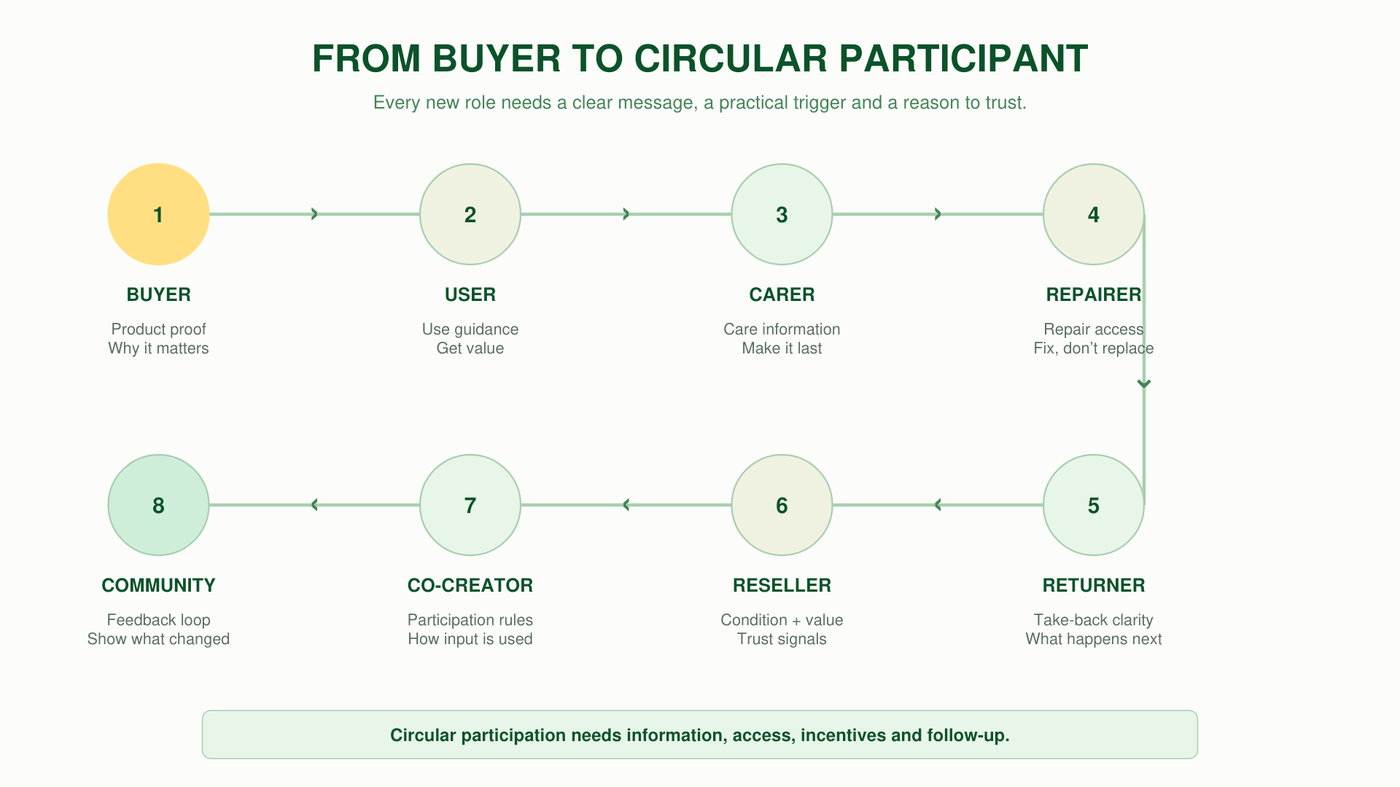
Figure 4.1. From buyer to circular participant. Circular engagement depends on more than awareness: each role requires specific information, access to services, incentives and trust signals to make participation possible.
Introduction — From passive audience to active participant
Linear fashion communication often focuses on encouraging people to buy new products. Circular fashion communication has a broader role: it can help people use products for longer, care for them better, repair them, return them, resell them, share them or pass them on.
This changes the role of the consumer. The consumer becomes part of the product lifecycle. However, this does not mean the consumer should carry the burden of sustainability alone. If repair is expensive, take-back is confusing, resale is inconvenient, product information is unclear or circular options are unattractive, communication alone will not change behaviour.
Circular engagement depends on both message and system. A brand can communicate a repair service effectively only if the service is easy to access. It can promote resale only if customers trust the process. It can invite take-back only if people understand what happens after return.
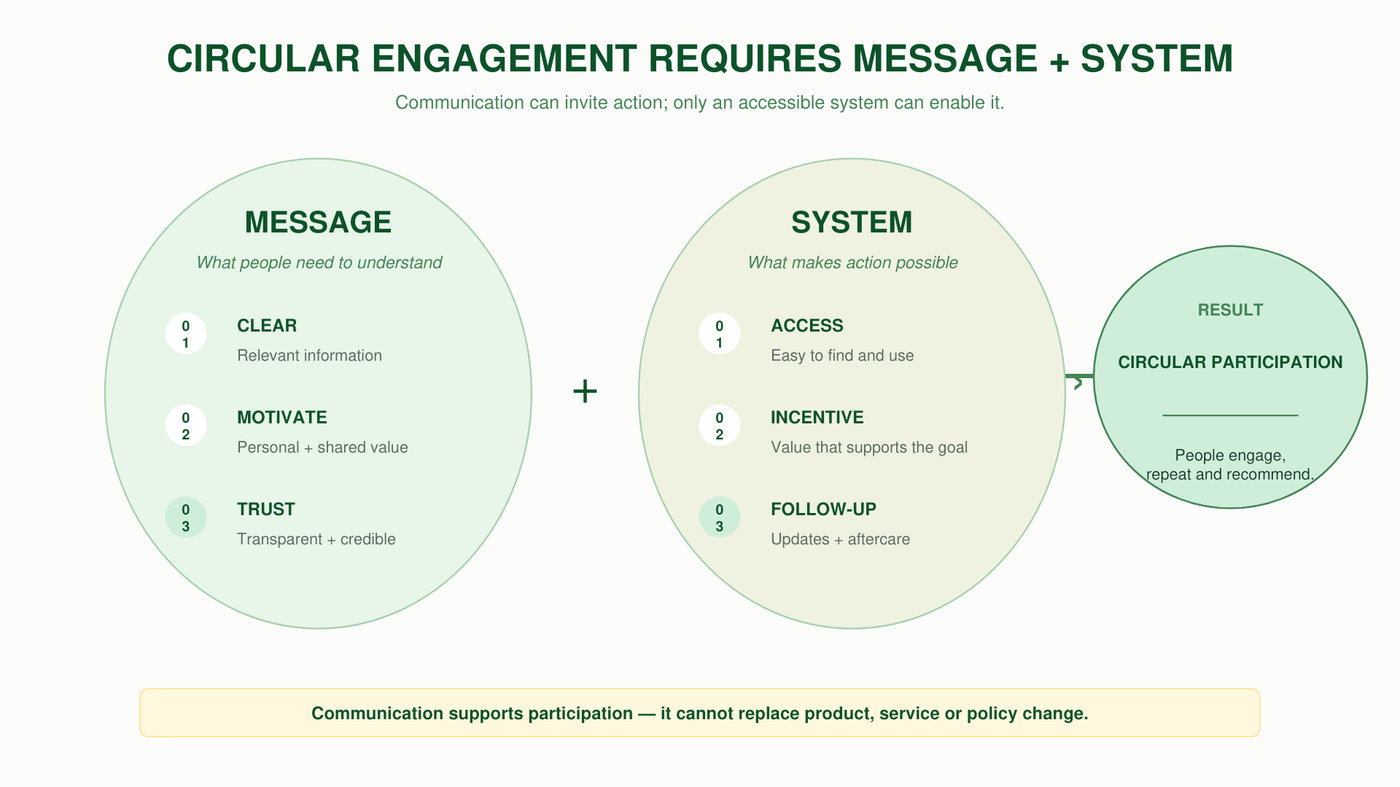
Figure 4.2. Circular engagement requires message + system. Circular participation depends on both clear communication and accessible infrastructure: people need to understand the action, trust the process, and find it easy enough to participate.
In this chapter:
- 4.1 Drivers and barriers to circular participation
- 4.2 From the attitude-action gap to participation design
- 4.3 Circular loyalty loops
- 4.4 P2P models, resale and trust-based marketing
- 4.5 Co-creation and community participation
- 4.6 Closing the participation loop
- 4.7 Engagement in practice — brand examples