Chapter 3 — Full chapter
3.5 Common risks in stakeholder communication
Adapting communication to different stakeholders creates several risks. One is oversimplification: reducing technical information so much that important context, scope or qualifications are lost. The opposite can also happen. Providing excessive detail without considering the stakeholder’s role may make the information difficult to understand or use.
Another risk is inconsistency. Although audiences may require different formats and levels of detail, the underlying meaning must remain the same. Suppliers, customers, retailers, employees, and policymakers should not receive conflicting accounts of the same product, service, or initiative.
Communication may also focus on visibility rather than usefulness. A message can reach a large audience but still fail if it does not provide the information needed to make a decision or take an action. Publishing a repair initiative, for example, is not enough if customers cannot understand where the service is available, what it costs, or which products are eligible.
Channel selection can create further barriers. Important information may be placed in reports or webpages that the intended stakeholder is unlikely to consult. Language, accessibility, digital access, and technical literacy should also be considered.
Finally, one-way communication limits learning and accountability. Stakeholders need appropriate ways to ask questions, report problems, and provide feedback. Effective stakeholder communication therefore requires consistency, relevance, accessibility, and dialogue — not simply the distribution of information.
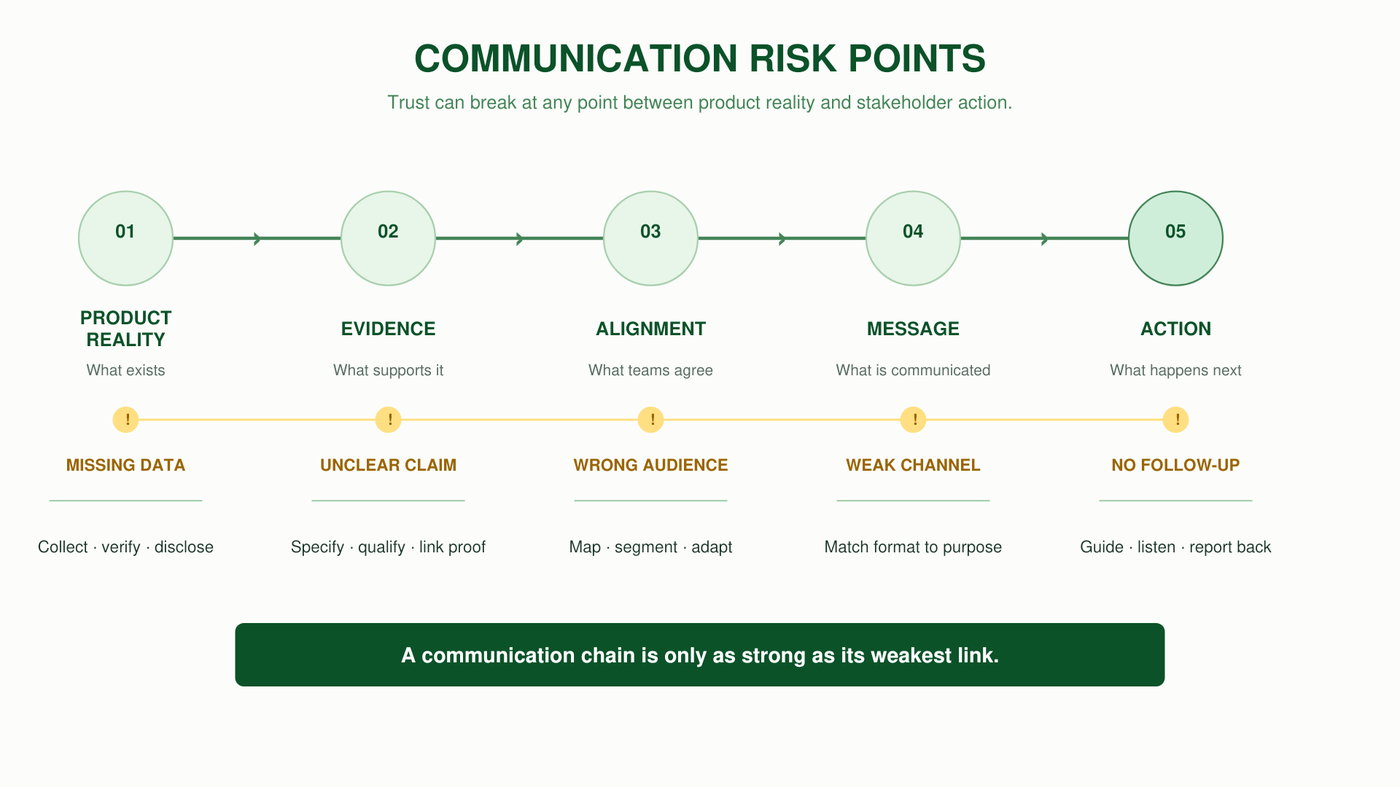
Figure 3.5. Communication Risk Points. Communication risks can emerge at every stage between product reality and stakeholder action. Missing data, unclear claims, internal misalignment, unsuitable channels, and weak follow-up can undermine accuracy, understanding, and trust.
FOR YOUR SME / BUSINESS CASE: inconsistency between channels is a legal and commercial risk, so the same claim should carry the same scope everywhere. Retailers and marketplaces increasingly ask for the evidence behind sustainability claims, such as certificates or LCA summaries, before listing products. Preparing a one-page substantiation pack per claim (claim wording, evidence, scope, owner and review date) takes a few hours and supports consistency across every channel. Indicative — adapt to your product range.