Chapter 6 — full chapter
6.2.4 Sorting technologies and grading
After collection, textiles must be assessed before they can be directed towards reuse, repair or material recovery. Across Europe, sorting for reuse still relies heavily on people assessing individual garments. Trained workers examine garments, considering their condition, type, quality and suitability for different second-hand markets. Manual sorting is mostly important for garments that remain in use as a product.
Textiles that cannot be reused require a different level of identification: recycling processes often need feedstock with a known fibre composition, colour and degree of material purity. Automated systems, including near-infrared scanning, can help identify and separate these materials at greater volumes than visual inspection alone.
The two approaches can therefore work in sequence: manual sorting identifies reusable garments and removes unsuitable items, while technology-assisted sorting prepares the remaining textiles for specific recycling processes. In either case, sorting only creates a potential route; the outcome also depends on the availability of buyers, repair services and recyclers able to use each fraction (Huygens et al., 2023).
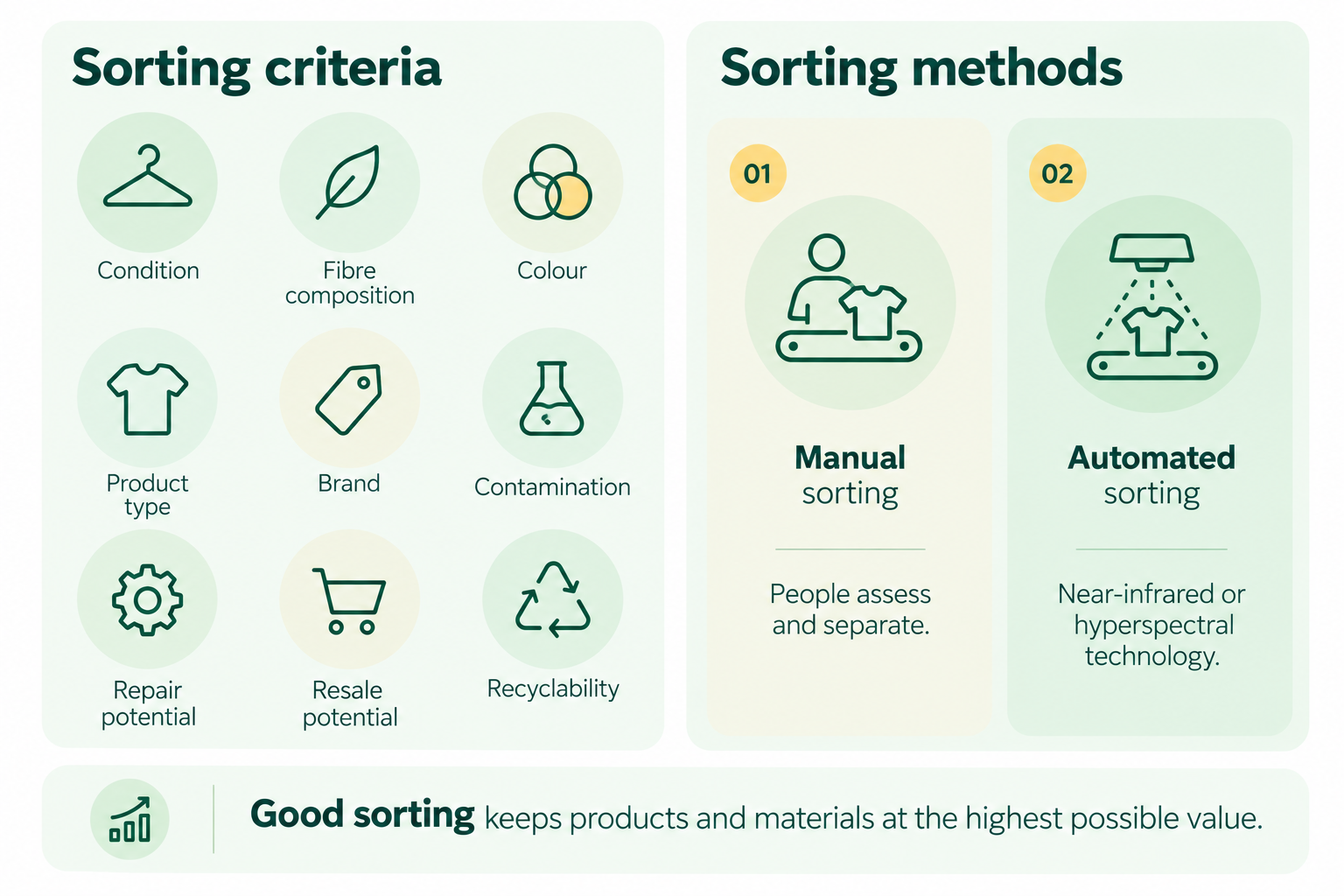
Figure 6.2.2 Textile sorting combines product criteria such as condition, fibre composition and reuse potential with manual and automated identification methods. Credit: FashionKIC, Textile Sorting Criteria and Methods Diagram, 2026.
Resource insight: Huygens, D., Foschi, J., Caro, D., Caldeira, C., Faraca, G., Foster, G., Solis, M., Marschinski, R., Napolano, L., Fruergaard Astrup, T., & Tonini, D. (2023). Techno-scientific assessment of the management options for used and waste textiles in the European Union. Publications Office of the European Union. https://doi.org/10.2760/6292 https://publications.jrc.ec.europa.eu/repository/handle/JRC134586