Chapter 4 — full chapter
4.6.1 Design for disassembly
Design for disassembly ensures that garments can be easily taken apart at the end of their useful life without damaging their components or materials. It is a fundamental principle of circular product design because effective repair, remanufacturing and fibre-to-fibre recycling all depend on the ability to separate garment components efficiently.
Designers therefore consider seam construction, fastening systems, trims, interlinings and material compatibility from the earliest stages of product development. Permanent bonding of incompatible materials should be minimised, while detachable fasteners and standardised components facilitate easier dismantling and material recovery.
In addition, disassembly procedures should be clearly documented through technical documentation, product specifications and Digital Product Passports, enabling manufacturers, repair centres and recyclers to identify appropriate disassembly methods and recover valuable materials more efficiently.
Disassembly information should be documented clearly so that future repairers, remanufacturers or recyclers can understand how relevant components are connected. Chapter 6 examines how this information can later support sorting and recovery systems.
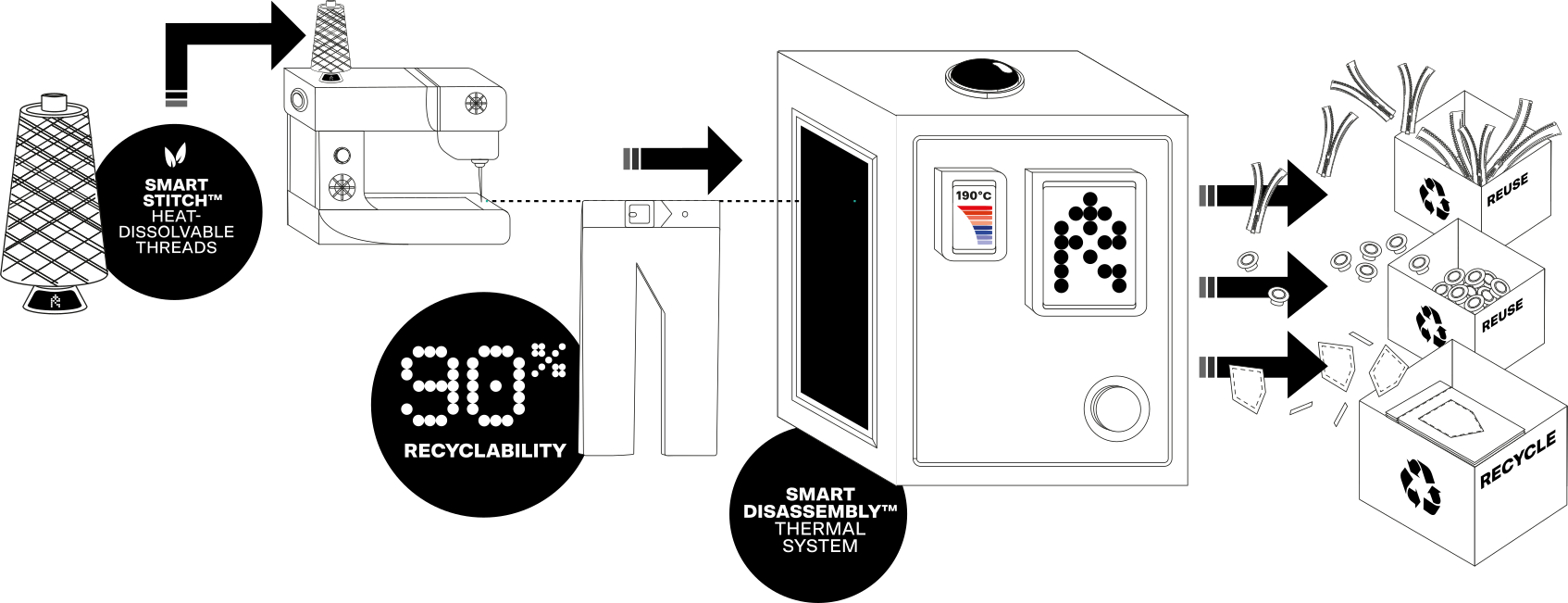
RESOURCE INSIGHT: Resortecs. Resortecs, a Belgian start-up developed sewing threads which dissolve at temperatures between 150 and 190°C, depending on the fabric. Garments sewn with these threads re heated in an industrial oven until the seams open at the end of their life . Zips, buttons and labels can then be removed without cutting or slow manual work. Brands such as Bershka and Decathlon have already used the threads in denim and ski jacket collections.
Source: https://www.eib.org/en/stories/recycling-clothes-resortecs