Chapter 4 — full chapter
4.3.2 Digital pattern optimisation
Digital pattern tools allow designers to test fit, construction, grading and material use before physical production. CAD, automated nesting and 3D garment simulation can reduce sampling, reveal problems earlier and improve marker efficiency. They are most effective when combined with good pattern architecture: software can optimise the placement of existing pieces, but deeper reductions may require changing garment geometry itself (McQuillan, 2019; McQuillan et al., 2018).
SMEs can begin with one repeat style, compare physical samples and fabric utilisation before and after digital development, and record any effect on lead time, fit and waste. Virtual results must still be validated against real fabric behaviour, production skills and final quality.
RESOURCE INSIGHT: Katty Fashion
Source: Katty Fashion Panel, Circular Society Summit, Berlin 2026; https://katty-fashion.com/
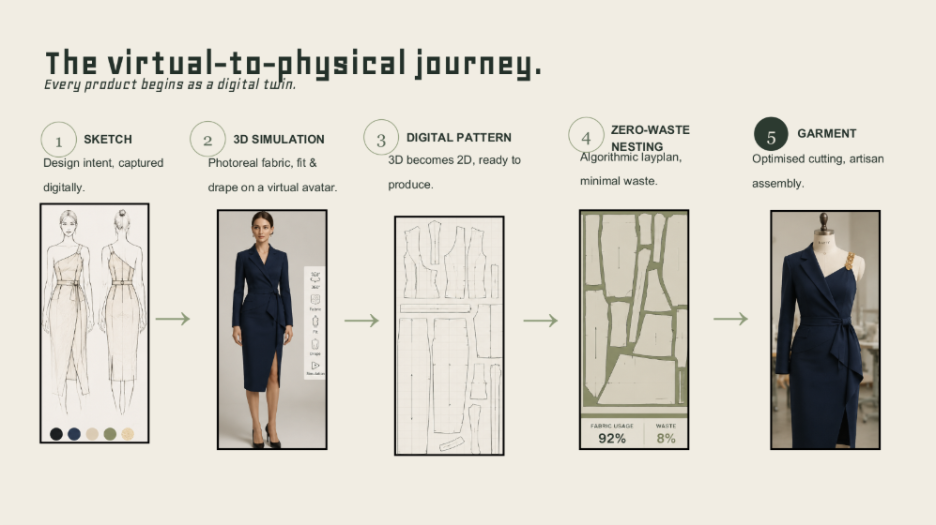
Source: Katty Fashion Panel, Circular Society Summit, Berlin 2026 https://katty-fashion.com/
For evaluation, compare fabric utilisation, number of physical samples, development time and fit corrections before and after digital optimisation. The result should show whether digital tools reduced total material and iteration, rather than merely shifting work between design and production.